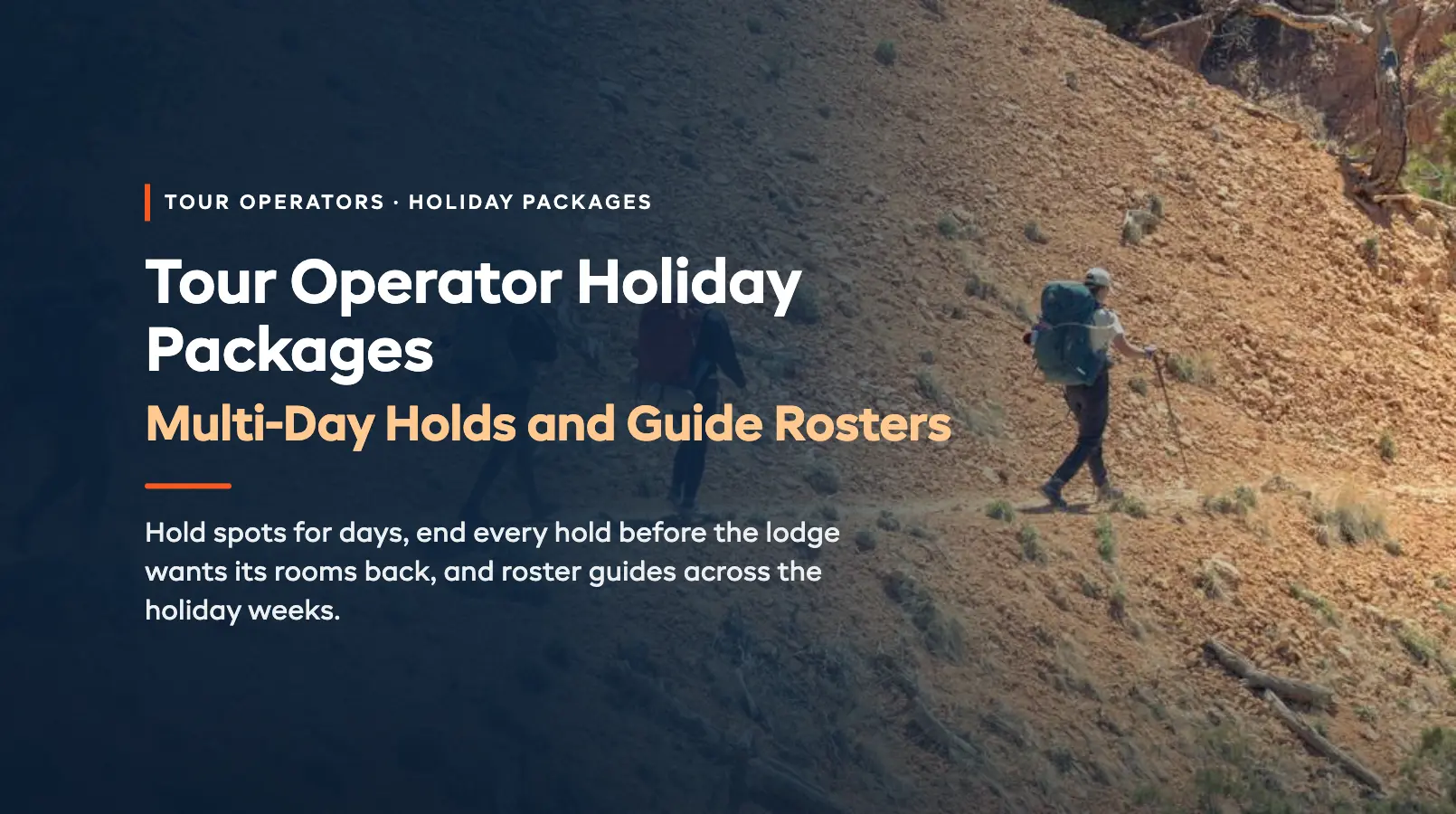
Tour Operator Holiday Packages: Multi-Day Holds and Guide Rosters
A family of six emails on November 30 asking for your 3-day trip over December 27 to 29. They want an answer today and they'll pay next week, once the grandparents confirm. Tour operator holiday packages are mostly about that gap, because the seats, the lodge rooms and two guides are tied up for days while you wait.
This guide covers the parts of a holiday package that a day tour never asks of you: how long to hold a spot, how to line holds up with your lodge, when to call a short departure, and how to roster guides across Christmas and New Year.
Christmas Day falls on Friday, December 25, 2026, and New Year's Day on Friday, January 1, 2027, per the federal holiday calendar from OPM. That puts two clean 3-day departures in the week between them.
What a holiday package needs that a day tour doesn't
A day tour sells a seat and gives it back by dinner. A 3-day trip takes the seat, a bed, a share of the van and a guide's whole week, so every unpaid hold costs you more. A 2-day kayak or bike trip with one night out works the same way, because the guide is gone for both days.
Package or multi-day experience
In EquipDash you can sell a holiday trip two ways, and they suit different trips. A Package runs on dates only. You set a Package duration once (3 shows as "3 Days / 2 Nights"), and the traveler's price is built from the choices they pick, such as a Standard room or a Deluxe room.
A package departure belongs to one party. You control it with Max people per group and Groups per day, which makes it a good fit for a private family trip. For the family of six, that could be 6 and 1.
A multi-day experience is the shared kind. Turn on Runs over multiple days, and each departure gets a start date and time, an end date and time, one capacity for the whole trip (say 8) and the guides leading it. The calendar shows the trip on every day it covers, marked Day 2/3, Day 3/3 and so on.
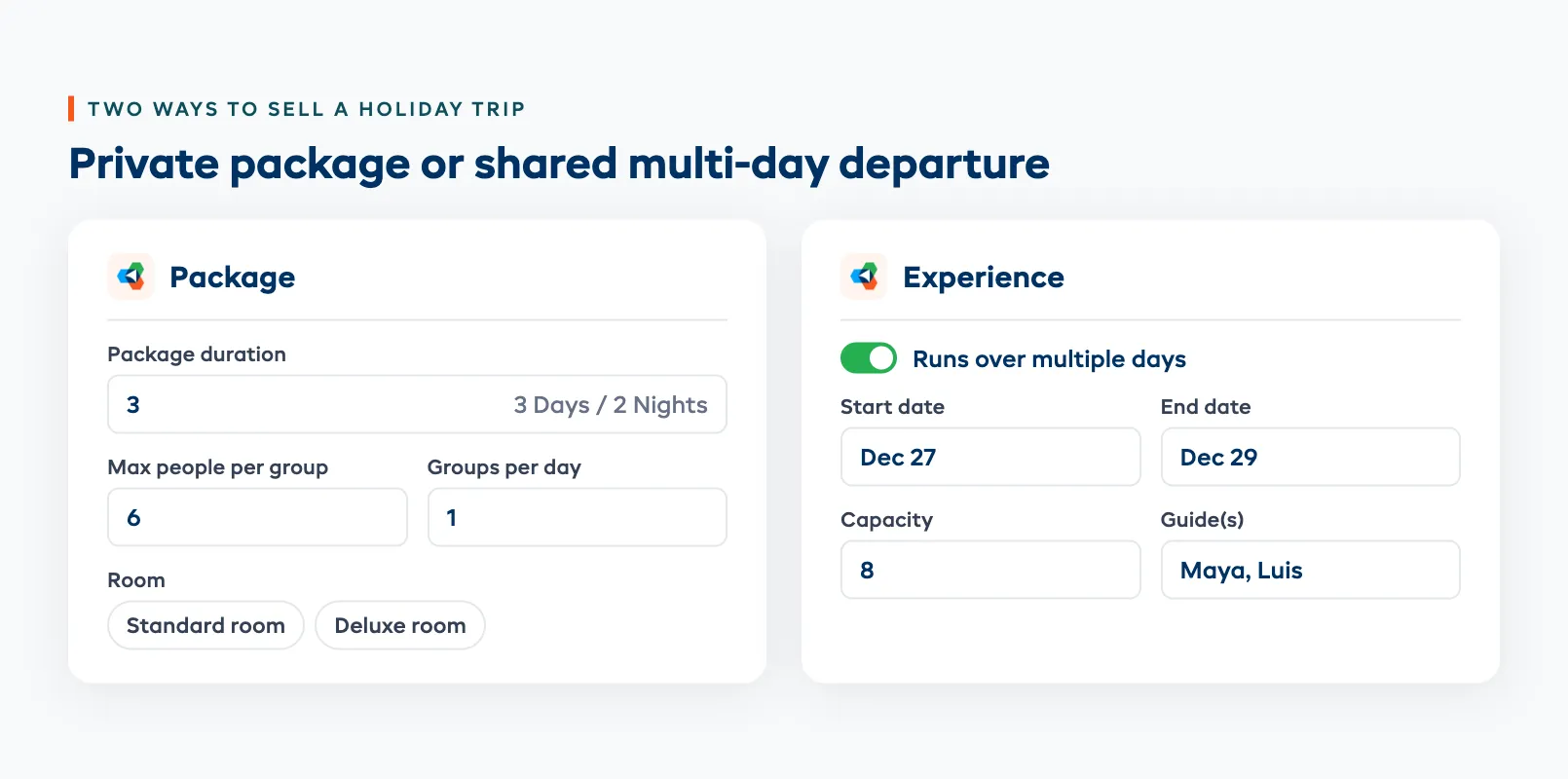
Know the limits before you build. A multi-day experience treats the trip as one whole, so there's no separate check-in for each day, no swapping guides part-way through and no room management. A Room choice on a package sets the price, so size Groups per day to the rooms your lodge is holding.
How long to hold a holiday spot
Pick the hold window before the first inquiry lands, and give everyone the same one. We'd hold a holiday week spot for two or three days. A two-week hold in late November keeps a seat off sale through the busiest booking weeks you'll get.
Save it as a draft and hold the dates
When the family of six calls, build the booking in POS, open the arrow next to Create booking and choose Save as draft. Turn on Hold these dates, then set Hold until to December 3.
Those places now come off sale the same way a confirmed booking takes them. Nothing is sent to the customer, and your team isn't alerted.
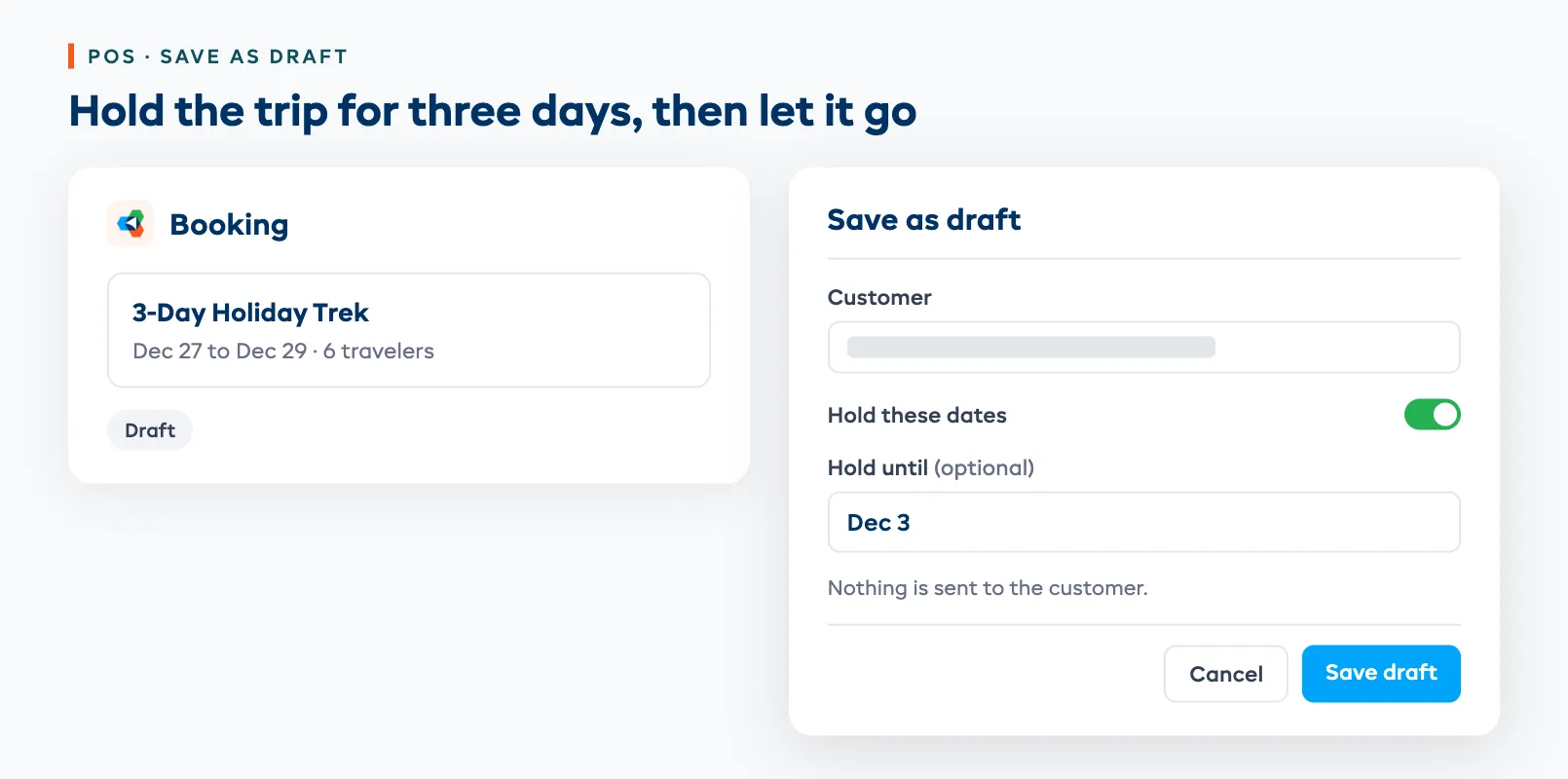
After December 3 the hold ends on its own and the places go back on sale. The draft stays, so if the family comes back on December 4 you can still Confirm booking. EquipDash checks the places are free first and tells you what's gone if they aren't.
Use Request to book for private groups
For a private holiday trip you'd rather vet first, set the experience to Request to book. The guest asks for a scheduled time or their own date, nothing is charged, and the time is held while you check the guides and the lodge.
Approve it and the booking follows your normal payment rules. Decline it and the hold is released.
Either way, answer the same day. A family group may be talking to other operators too, and a same-day reply with a clear hold window has a head start.
Line every hold up with your lodge
Your lodge or hut has its own clock. Many room blocks come with a release date, after which unsold rooms go back to the lodge. Say yours wants names or the rooms back 14 days before arrival, which is December 13 for a December 27 start.
A customer hold should always end before that date. If a draft is still waiting on December 12, you're deciding whether to pay for rooms nobody has paid you for. If you don't use a lodge, pick the last day you can still fill a short departure or move a guide, and end every hold before that.
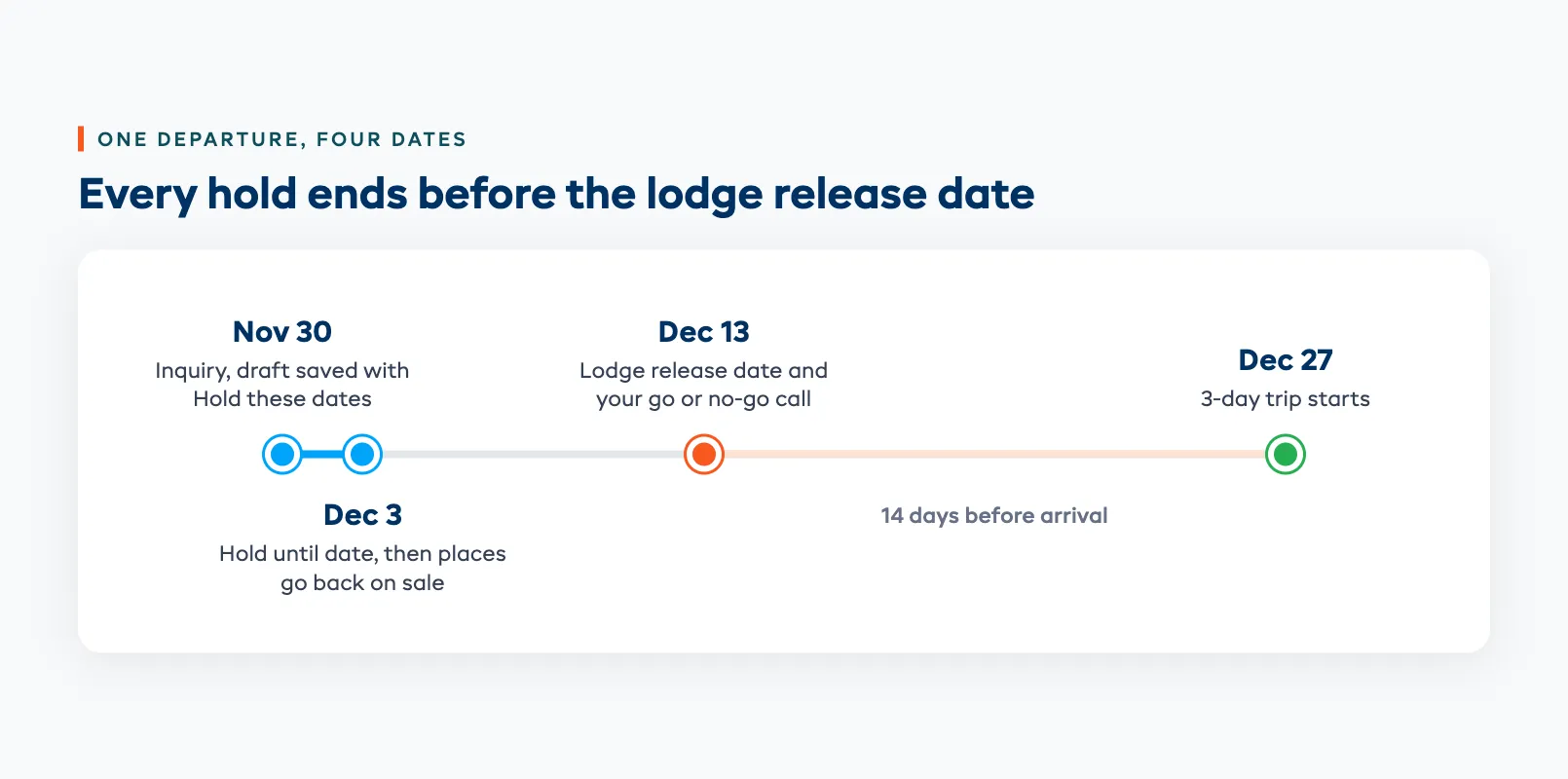
Write your own three dates down for each departure: the last day you take new holds, the lodge release date and the trip start. When the family is ready, turn the hold into a confirmed booking with a deposit. Our tour group pricing guide covers how to size that deposit.
Pick a go or no-go date for short departures
A shared holiday departure can stall at three guests. In EquipDash, set Runs with at least on the experience, say 4, and a short departure shows "Needs 2 more to run" on Today, the calendar and the manifests until it fills.
EquipDash emails anyone on your team who has that alert switched on 24 hours before a short session starts. That's fine for a 2-hour tour and far too late for a 3-day trip with a lodge block and two guides, so make the real call on your lodge release date.
If it's still short then, use Cancel session. Every booking on it is canceled and refunded in full, whatever your cancellation policy says, and each guest is told not enough people booked. Our guide to tour no-shows and cancellations covers how to word that policy before you need it.
Build the holiday guide roster
Ask guides for their holiday time off before the first package sells, and if you haven't yet, ask this week. Then record it in Staff on each guide's Schedule tab with Record Time Off and the Vacation type.
Approved time off counts. A guide on time off isn't treated as free to lead a departure that day, so the roster and the booking page stay honest with each other.
Assign the whole trip, not day one
On a multi-day experience, add the guides when you add the departure. A guide on December 27 to 29 then shows as unavailable for any other departure that overlaps those days.
Turn on Need a guide to run? on every experience the same guides lead, and set Guides per departure to 2 if your trips go out with a lead and a sweep. From then on a time only sells while a guide is free, so a day tour can't quietly take your trip leader on December 28.
Here's how 4 guides can cover both trips. Maya and Luis take December 27 to 29, and Priya and Sam take December 30 to January 1, which covers New Year's Eve on December 31.
Priya's vacation on December 26 ends before her trip starts. No guide works both trips, so nobody is out for six days straight.
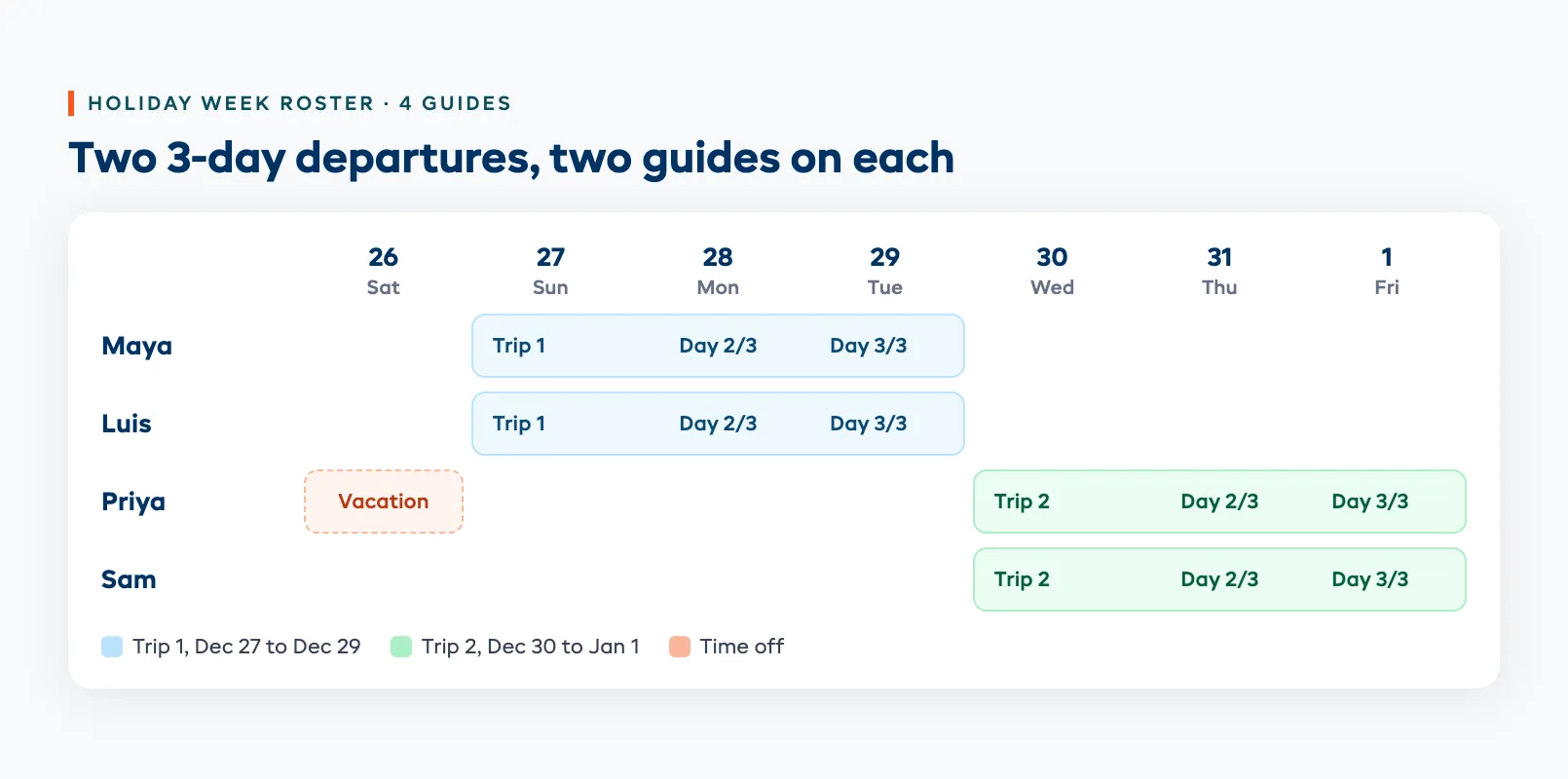
If a departure needs 2 guides and only has 1, the availability list warns you before a customer finds the time unavailable. More on everyday shifts is in our multi-guide operations guide.
Name a backup for every departure
The software won't swap guides part-way through a multi-day trip, so plan the swap yourself. Put a named backup on standby for each departure and agree how they'd reach the group on day 2.
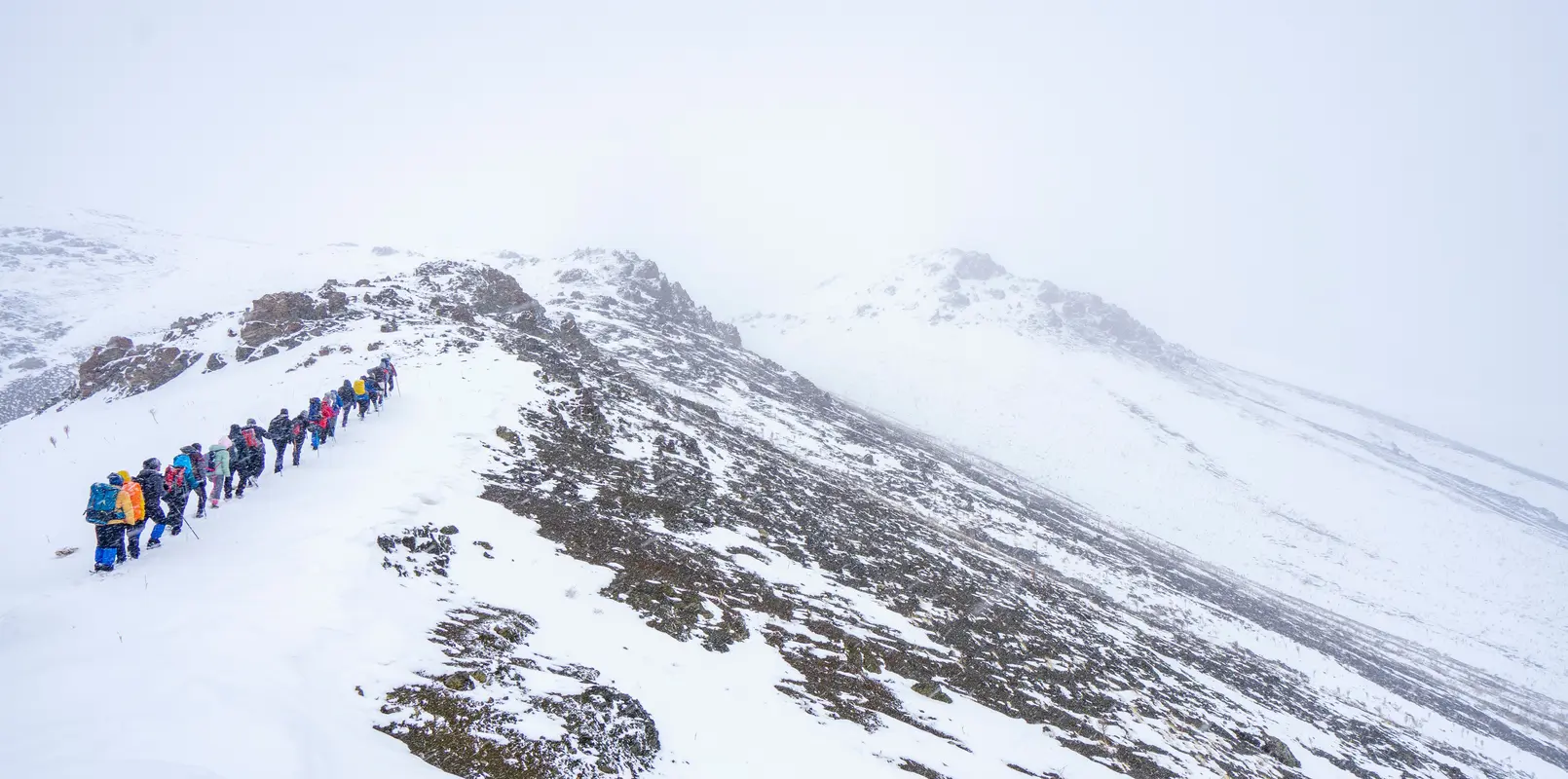
A long group also needs a guide at the back. On a snowy ridge, the gap between the first and last walker can stretch fast.
Pay guides correctly for overnight trips
A 3-day trip blurs work time and sleep, so check the rules before you set a trip rate. Under the US Department of Labor's hours worked guidance, a guide on duty for less than 24 hours is working even while allowed to sleep.
On duty for 24 hours or more, you and the guide may agree to leave out a regular sleep period of up to 8 hours. That only works if you provide adequate sleeping facilities and they can usually sleep through, and no time comes off at all unless they get at least 5 hours.
Federal law doesn't require extra pay for working a holiday. The DOL's holiday pay page treats it as a matter of agreement between you and your staff, so put any holiday rate in writing before the season. Hours past 40 in a workweek still owe federal overtime for nonexempt guides.
In Australia and New Zealand this is peak summer, and the rules differ. The Fair Work Ombudsman's public holidays page covers the right not to work on a public holiday, public holiday rates, and the rule that staff get the holidays where they're based, even on a trip in another state.
In New Zealand, a guide who works a public holiday that would otherwise have been a working day is owed at least time and a half and an alternative holiday. In Canada, check your province's employment standards for holiday pay.
Check what guests and guides see before you open dates
Before the first holiday booking, open one test departure and read it the way a guest would. The booking page shows a multi-day trip on its start day only, with the dates and times written out, so nobody books the middle day.
The manifest shows the full date range, and the pre-trip reminder goes out once before the trip starts. For a package, each choice gets its own column on the manifest, which is the sheet your lodge and transfer company want.
For the permits, base camp and safety side of longer trips, see our multi-day adventure operations guide. If your holiday trips are single-day winter tours, the Thanksgiving winter capacity caps guide is the closer fit.
Holiday package checklist
- Pick package or multi-day experience for each trip.
- Set one hold window, two or three days, and use it for everyone.
- Write down the lodge release date and end every hold before it.
- Set Runs with at least and make the go or no-go call on the release date.
- Record guide time off, assign guides to each whole departure and name a backup.
- Agree sleep time and holiday pay in writing before the first trip.
Everything above lives in the EquipDash tour packages feature and guide management pages. The EquipDash page for tour and activity operators shows how the rest fits together.
FAQ
How long should a tour operator hold a holiday package spot?
Two or three days is enough for most families to decide, and it keeps the spot from sitting off sale through the busiest booking weeks. Whatever you pick, use the same window for everyone and end every hold before your lodge's release date.
Should a holiday trip be a package or a multi-day experience?
Use a package for a private trip priced from choices such as room type, because each departure belongs to one party. Use a multi-day experience for a shared departure with one capacity, a start and end time, and a guide team.
When should you cancel a multi-day departure that hasn't filled?
Decide on the date your lodge wants unsold rooms back, not the day before the trip. If it's still short then, cancel it and refund everyone in full so they have time to book something else.
Do guides get paid for sleeping on an overnight trip?
In the US, a guide on duty for less than 24 hours is working even while asleep. On duty for 24 hours or more, you may agree to leave out up to 8 hours of sleep if you provide proper sleeping facilities and they get at least 5 hours.
Do you have to pay guides extra for working Christmas?
US federal law doesn't require holiday pay, so any holiday rate comes from your agreement with staff and any state rules. In Australia, the Fair Work rules cover public holiday rates and the right not to work on a public holiday. In New Zealand, a guide who works a public holiday that would otherwise have been a working day is owed at least time and a half and an alternative holiday.
in one place