Pricing Conference and Project IT Hire: Day, Week and Project Rates That Hold Up

A conference organizer asks for 40 laptops, six displays and two projectors for a three-day event. Quote three day rates and you get paid for three days, while the kit is out of your warehouse for five and in the imaging queue for two more.
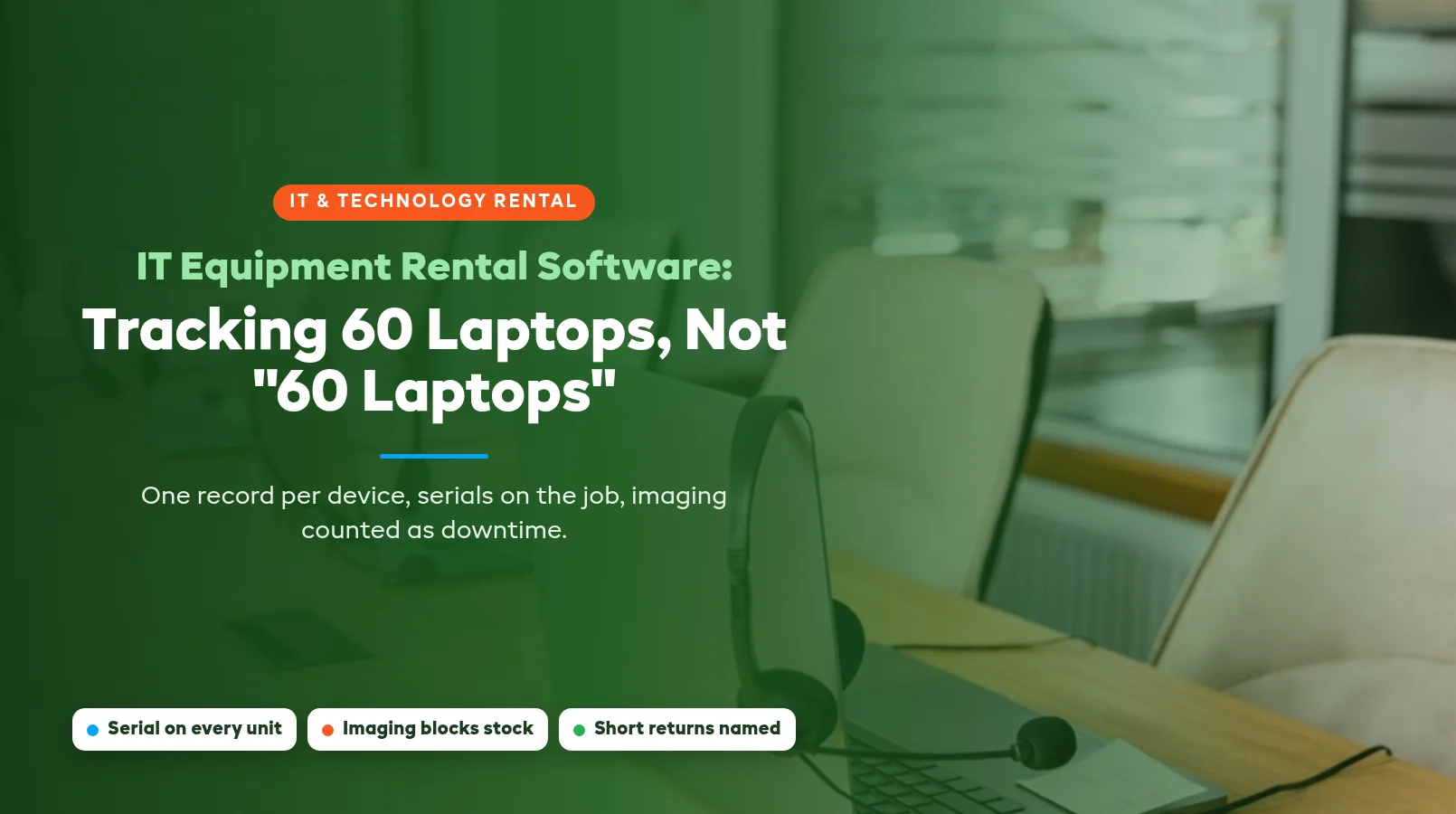
That gap is where a lot of IT hire margin leaks. Corporate clients think in event days. Your fleet lives in days away, delivery runs, setup hours and wipe-and-reimage time. The pricing questions worth getting right are what you bill as a day, when a project rate beats a daily ladder, which work goes on its own line, and how big the deposit should be on a deployment worth more than a car. This guide works through each one. For what to look for in the system that runs it all, see our IT equipment rental software guide, and for the general basics, the equipment rental software guide.
Bill the days the kit is gone, not the show days
The event runs Tuesday to Thursday. Your van drops the gear Monday afternoon so the venue team can test it, and collects Friday morning because the hall is locked Thursday night. Then the laptops need wiping, reimaging and charging before anyone else can have them.
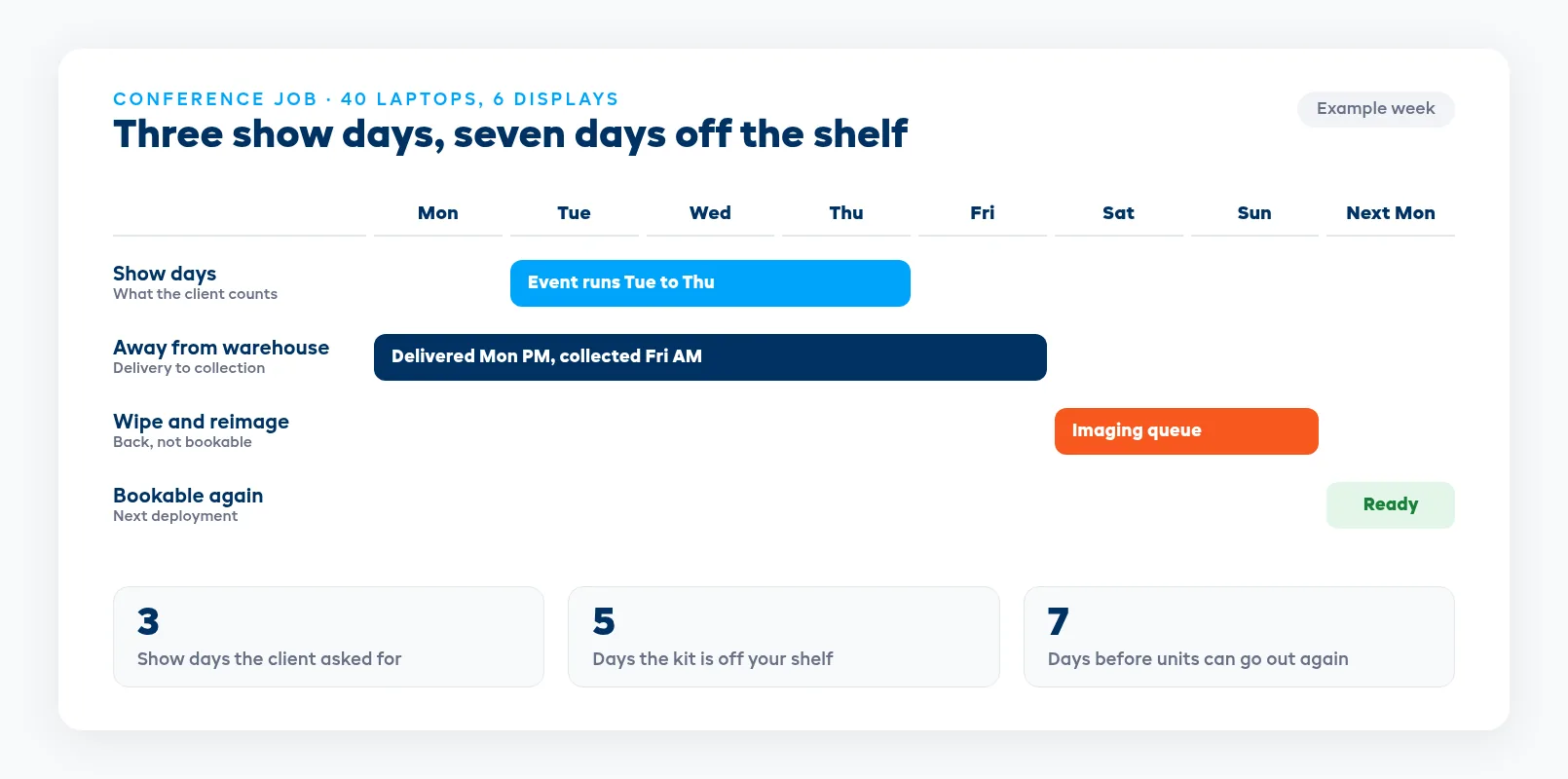
That's three show days, five days away and seven days before the units are bookable again. You don't have to charge for all seven, but you do have to decide on purpose. Three common ways to handle it:
- Charge from delivery to collection. The hire period is the time the kit is off your shelf. Monday to Friday is five days, priced off your rate ladder. This is the cleanest rule and the easiest one to explain to a client.
- Charge show days, with a set-in and set-out fee. Some clients push back on paying for days nobody is using the gear. A flat set-in and set-out charge covers the extra days without arguing over each one.
- Price imaging into the rate. Turnaround time is a cost of every job, so it belongs in the per-day price, not as a surprise line. If your laptops spend a day in imaging for every three days out, your day rate has to carry that.
Whichever you pick, put the boundary in writing. "Day" can mean 24 hours from delivery or the calendar date, and on a job that crosses a weekend those give different totals. If you deliver early in the morning and collect late in the afternoon, charging by calendar date means the time of day never changes the price.
Day, multi-day and weekly rates
A single day rate underprices a one-day product launch and overprices a two-week training course. IT hire needs a ladder, where the per-day price falls as the hire gets longer, because a longer job means one delivery, one setup and one imaging cycle spread over more paid days.
A working ladder for a standard business laptop might look like this. The numbers are illustrative; yours depend on the spec, your market and what you paid for the fleet:
| Hire length | Example price | Per-day equivalent |
|---|---|---|
| 1 day | $45 | $45 |
| 2-3 days | $35 per day | $35 |
| 1 week | $150 | $21 |
| 2-4 weeks | $14 per day | $14 |
| Monthly (project) | $280 per month | about $9 |
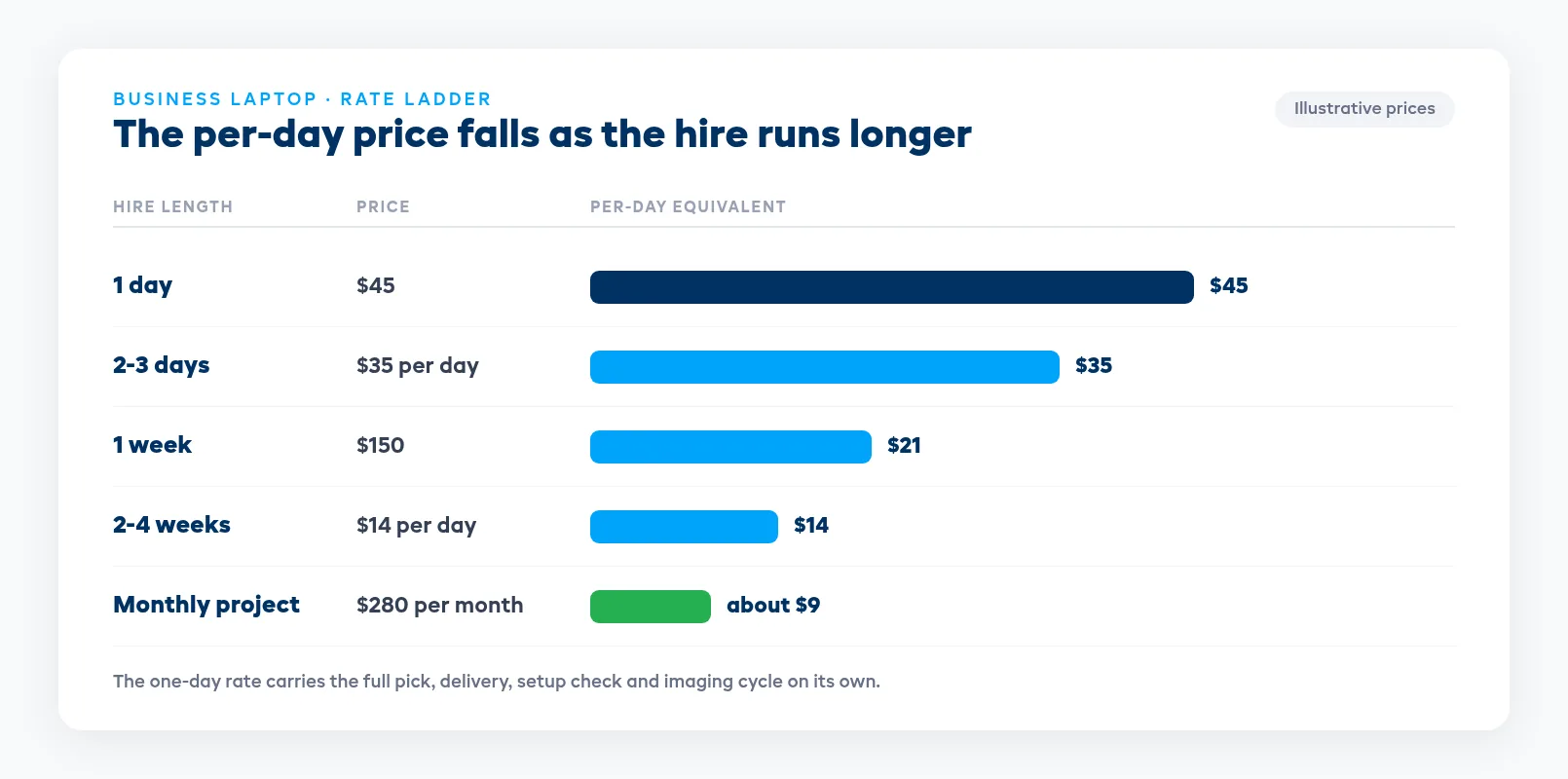
Three things about the shape:
- Keep the one-day rate high. A one-day job costs you the same pick, delivery, setup check and imaging cycle as a week. The day rate has to pay for all of that on its own.
- Don't let the weekly rate fall too far. A week out is cheaper to handle per day, but it also blocks the unit from every short, high-rate event that week. A weekly rate somewhere around three to four day rates is a common starting point.
- Price the spec, not just the category. A high-spec design laptop, a 75-inch display and a laser projector each need their own ladder. One "laptop" rate across three spec levels means the cheap units subsidize the expensive ones.
The ladder belongs in your booking system, not on a PDF, so every quote and online booking uses the same tiers. In EquipDash you set duration tiers once on a pricing template, such as "from 2 days, $35 per day", and apply it to every laptop in that spec, so a 40-unit quote prices itself the same way whoever builds it.
When a project rate beats the ladder
Project hire is a different product from conference hire. An office refit that needs 120 laptops for three months, a school that needs exam-season devices, or a software rollout that needs a training room for six weeks will not pay a daily ladder, and you don't want them to try.
A project rate is usually a monthly price per unit with a minimum term. A few terms make it work:
- Set a minimum term. If the project rate assumes three months, a client who returns everything after five weeks should pay the five weeks at the shorter-hire rate, or pay out the minimum. Write which one in the agreement.
- Price extensions in advance. Projects run late. Agree what month four costs before month three ends, so an extension doesn't turn into a negotiation.
- Include swaps. On a long project, units fail. Say up front how fast you replace a dead laptop and whether the swap run is included. It's often the thing that wins the job.
- Bill on a schedule. A three-month hire billed monthly is easier for the client's finance team to approve than one large invoice, and it keeps your cash moving.
Project rates are an easy place to give away margin to win a big order. Before you sign, check what the units would have earned on short hires over the same period. If 120 laptops would have gone out on conference jobs most weeks, the project rate needs to be close to what those weeks would have paid.
Put delivery, setup and imaging on their own lines
The rental price pays for the kit. The work around the kit is a separate cost, and it should show up as separate lines on the quote.
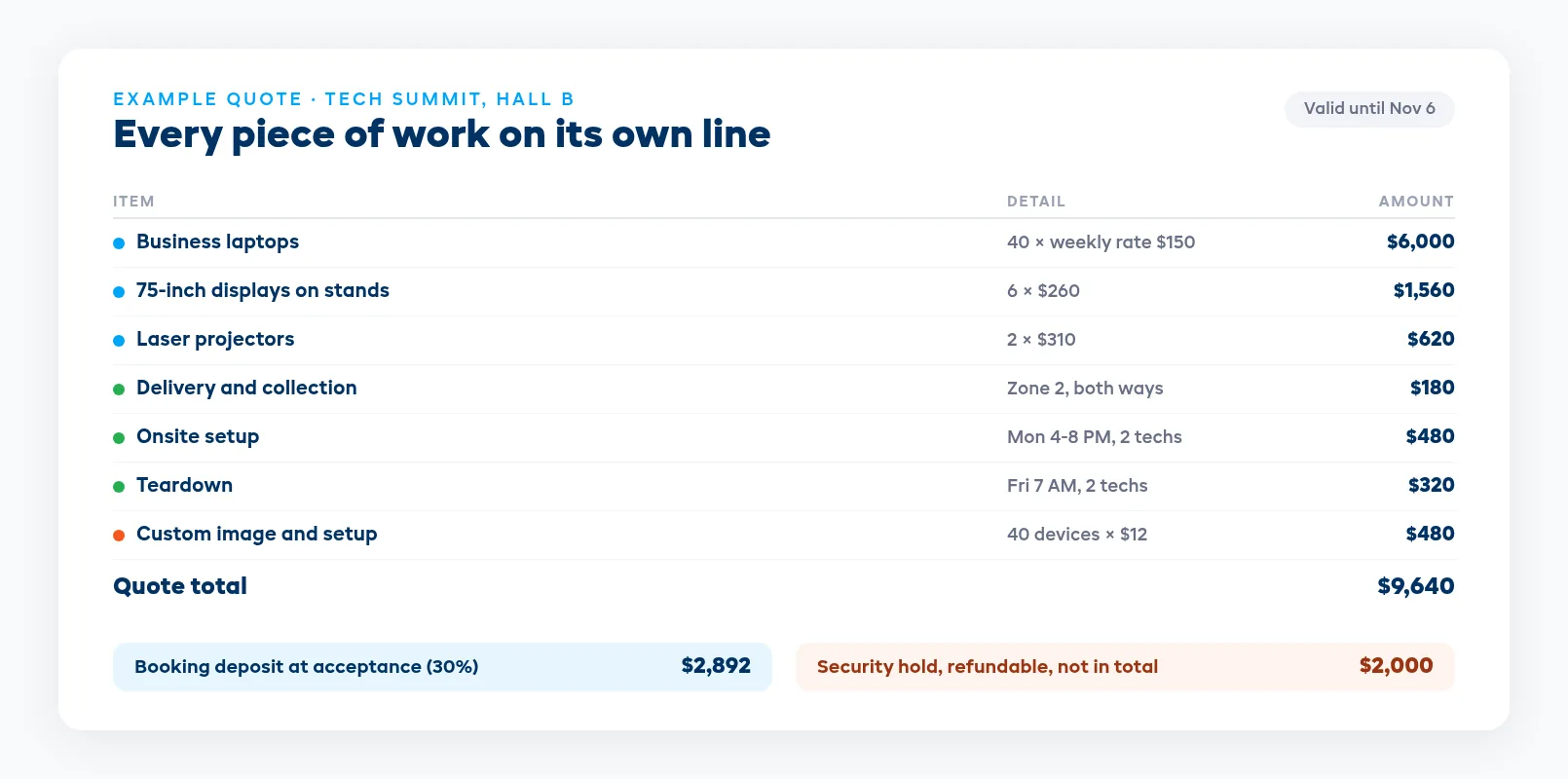
Delivery and collection. A van run into a city venue at 6 AM costs you a driver, fuel and parking. Charge it by distance or by zone, with a minimum charge so a short run still pays, and decide whether the price covers both directions or each way. A free-delivery threshold on large orders is fine, as long as the threshold sits above what a delivery actually costs you.
Setup and teardown. Unboxing 40 laptops, connecting displays, testing the projector and labeling the charging trolleys is skilled work, often done at night or on a weekend. Price it per hour or per job, with a higher rate outside business hours. Teardown is a separate line, because it happens on a different day and sometimes with a different crew.
Imaging and configuration. Your standard image is part of the rental. A client's custom image, their software installed on every device, or devices joined to their network is extra work. Charge a per-device configuration fee, and add the extra turnaround time to the job so the units aren't promised to anyone else while you build it.
Clients rarely argue with lines they can see. They argue with a single total that seems higher than the last company's day rate. Breaking the quote down also makes it easy to drop setup when a client says their own IT team will handle it, without cutting your rental price.
Deposits and damage on high-value deployments
A 40-laptop deployment can be worth more than a small car. A flat deposit doesn't fit that, so size it to the value of what goes out and how long it's away.
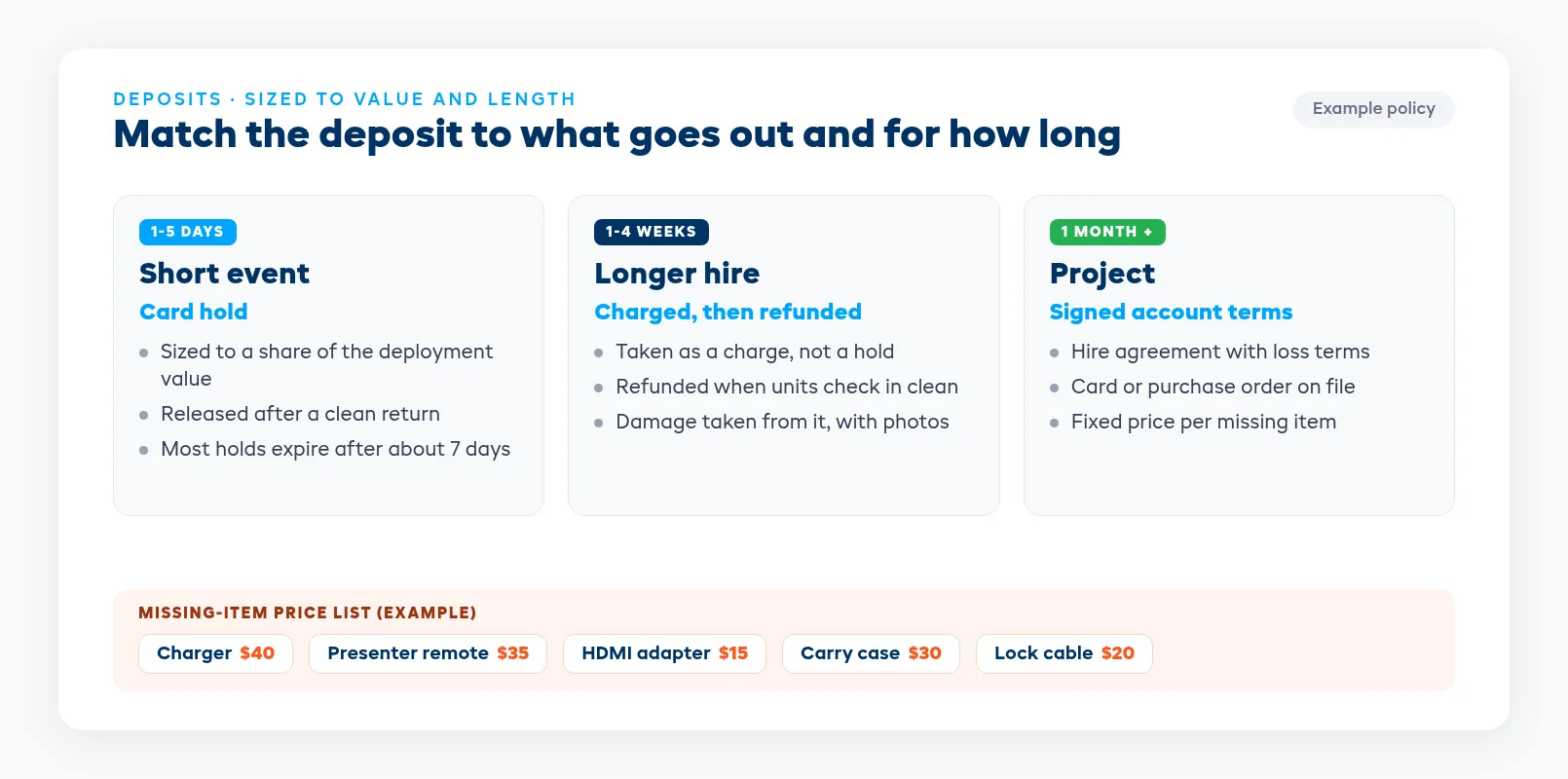
Keep two things apart. A booking deposit is part of the price paid up front, often a percentage to confirm the dates. A security deposit is a refundable amount held against damage or loss and given back after a clean return. Conference clients mix the two up all the time, so name them clearly on the quote.
- Short events: a card hold sized to a share of the deployment value works well. Most card holds expire after about seven days, depending on the customer's bank, so it suits a short job.
- Longer hires: for anything that runs past a week, take the deposit as a charge and refund it on return, because a hold can drop off the card mid-hire.
- Corporate accounts and projects: a signed hire agreement with damage and loss terms, a card or purchase order on file and a clear per-item charge list often replaces a large cash deposit.
Damage charges only stick if you can show the condition when the unit went out and when it came back. Record condition against each serial at dispatch and return, with photos for anything scratched or cracked, and send the damage charge with that evidence attached. Publish a price list for the small things that go missing: chargers, presenter remotes, HDMI adapters and cases. A missing charger at a fixed $40 is a quick line on the invoice. Without a list, it becomes a phone call.
Minimums, rush jobs and short notice
Minimums protect you from jobs that cost more to run than they pay.
- Minimum order for delivery. Two laptops delivered across town can lose money. Set a minimum order value for delivered jobs and offer collection below it.
- Minimum hire period. On your busiest conference weeks, a half-day hire can block a unit from a three-day booking. A one-day minimum in peak season is reasonable.
- Short-notice and rush fees. A request on Thursday for Monday delivery means pulling staff onto imaging over the weekend. A rush fee for anything inside your normal notice period pays for that, and makes the client think about booking earlier next time.
- After-hours delivery and setup. Venues often only allow access late at night or early in the morning. Price those windows above standard hours.
Quotes that hold the date and then expire
Conference organizers ask three companies for a price and book whoever answers first with something clear. Speed matters, and so does what happens after the quote goes out.
A good quote for a conference or project job has a valid-until date, so you're not stuck honoring last quarter's price. Decide whether it holds the stock while the client thinks about it. Holding dates makes sense when the client is likely to say yes or the week is already tight. An early inquiry for a quiet month doesn't need it.
Attach the hire agreement to the quote, so it's signed before the client accepts, and take the booking deposit at acceptance. Then the dates are confirmed and paid for in one step, rather than across three emails.
EquipDash builds quotes on the same screen as a booking, using the same rate ladder, so the price a client accepts is the price they're booked at. You set a valid-until date, choose whether to hold the dates, attach agreements to sign, and can take payment as the client accepts (quotes are on the Pro plan). Every laptop still goes out by serial, imaging counts as downtime, and deposits can be fixed or a percentage sized to the deployment, with plans from $23/mo billed annually. See the IT and technology rental software page for how it fits together, or compare plans on our pricing page.
FAQ
How do IT hire companies price conference rentals?
Most price from a duration ladder, where the per-day rate falls as the hire gets longer, and bill from delivery to collection rather than just the event days. Delivery, setup, teardown and custom imaging go on separate lines, with a deposit sized to the value of the deployment.
Should I charge for the days before and after a conference?
Yes, in some form. The kit is off your shelf from delivery to collection and then needs imaging before it can go out again. Either bill the whole hire period from your rate ladder, or charge show days plus a flat set-in and set-out fee. Write the rule on the quote so the client knows what a day means.
What is a project rate in IT hire?
A project rate is a monthly price per unit for longer hires, such as an office refit or a software rollout, with a minimum term. It usually comes with agreed extension prices, a swap policy for faulty units and scheduled billing. Check it against what the units would earn on short hires before you agree to it.
How should I price setup and teardown for AV and IT rentals?
Price setup and teardown as their own lines, per hour or per job, with a higher rate outside business hours. Keep them off the rental price so a client whose own IT team handles setup can drop the line without you cutting your rates.
How much deposit should I take on a large IT deployment?
Size it to the value of the deployment and the length of the hire instead of using one flat figure. A card hold suits a short event, a charged and refunded deposit suits hires over a week, and signed account terms with a card or purchase order on file often replace a deposit on long projects.
Do I need a minimum order for IT equipment hire?
A minimum order value for delivered jobs stops small orders from costing more to run than they pay. Many operators also set a one-day minimum hire in peak conference weeks and add a rush fee for jobs booked inside their normal notice period.
in one place