Quoting Marquee Work: Six Days of Commitment, One Price
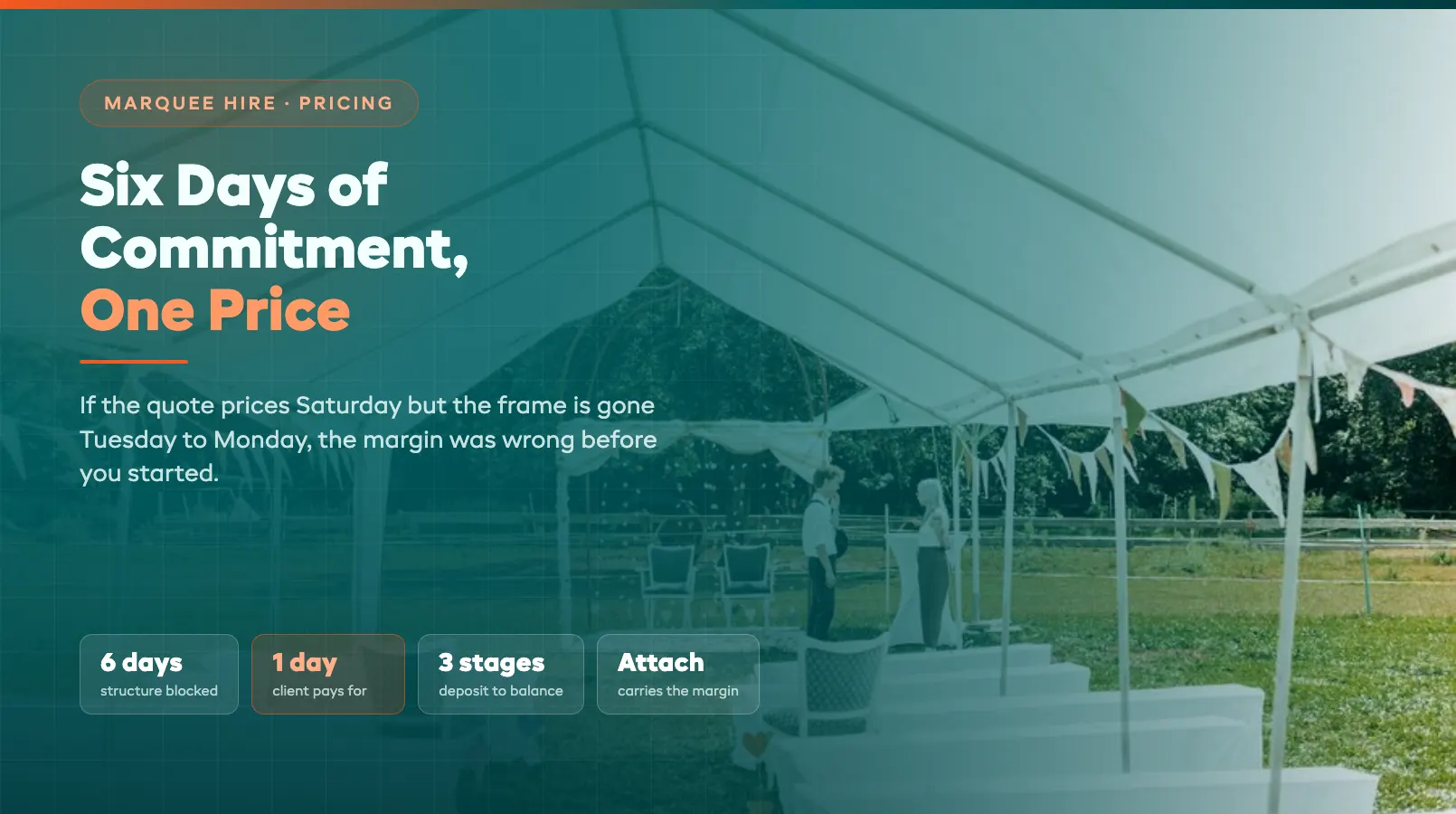
Quoting Marquee Work: Six Days of Commitment, One Price
A client asks what a 40×80 costs for Saturday. You say $8,400. They book. On Tuesday the frame leaves the yard. Wednesday and Thursday you build. Friday you dress. Saturday is the party. Monday you break it down and get it home. The structure was unavailable for six days. The quote priced one.
That gap is how marquee companies lose money while the diary looks full. Marquee hire is a six-day booking for a one-day event. Pricing has to match that shape, or every busy Saturday quietly underwrites itself.
This post is about marquee hire cost the way operators experience it: the whole commitment, the attach that carries the margin, the site that changes the day, the deposit that funds the work before the party, the terms that hold when the wind comes up, and the utilization number that tells you whether a frame is earning its keep.
Pricing the Whole Commitment
Start with days out of the yard, not hours of the party.
A useful quote for a mid-size frame usually has these bones:
| Cost block | What it covers | Typical share of a healthy quote |
|---|---|---|
| Structure days | Frame unavailable from load-out to return | 35–45% |
| Labor | Site visit, build, dress, break, travel | 25–35% |
| Transport | Truck, fuel, tolls, second trip if needed | 8–12% |
| Attach | Flooring, lining, lighting, HVAC | 15–25% |
| Site / access | Soft ground, long carry, permits, ballast | 0–15% |
Those shares move. A flat car park with a gate a truck can drive through looks nothing like a soft paddock with a 200-meter carry. The mistake is averaging them into one "Saturday rate" and hoping the easy jobs subsidize the hard ones. They do, until a season of hard ones shows up.
Work the quote from the commitment calendar. Book Tuesday load-out through Monday return as blocked time on that structure. Put provisional crew against the build and break days the same hour you take the booking — the same discipline as crew scheduling against the job. Then price the days you cannot sell to anyone else.
A structure that does 18 billable event days in a peak season but sits blocked for 70 calendar days is not an 18-day asset. It is a 70-day commitment with 18 paydays. Your rate has to clear the blocked days, not just the party.
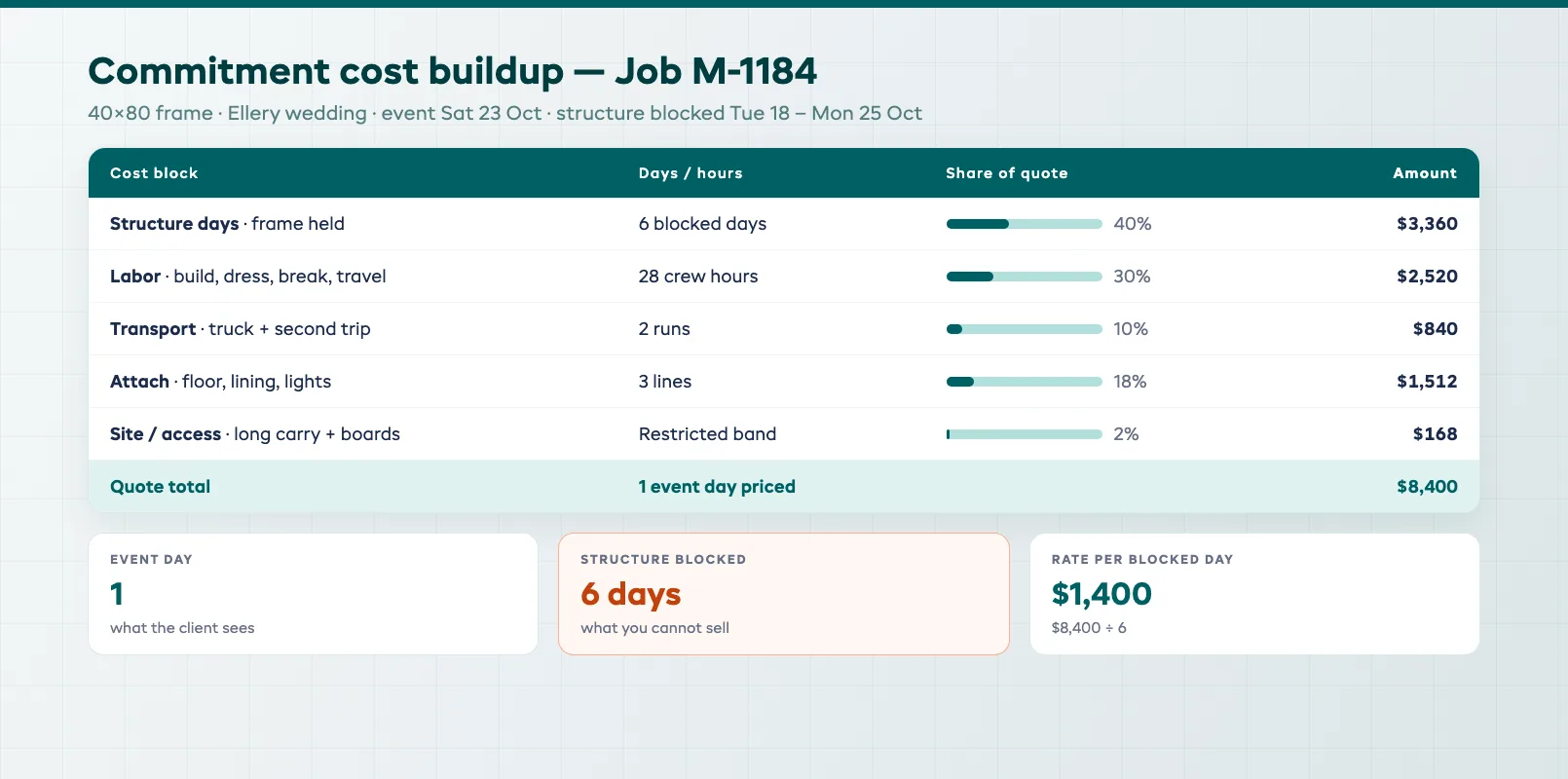
Three practical rules keep the math honest:
- Price the blocked window. If the frame is gone Tuesday to Monday, six days enter the cost model even when the client only sees Saturday.
- Separate labor from the frame. Crew hours on soft ground and long carries are not "included." They are a line, or they disappear into a margin you cannot defend.
- Re-quote when the site changes. A site visit that finds soft ground, a narrow gate, or a council permit is a new quote, not a favor.
Operators who keep labor hours against the booking for a season stop guessing. They know a 40×80 on a private site averages one number and the same frame on a showground averages another. That gap belongs in the price.
Flooring, Lining, and Lighting as Attach
The frame gets the booking. The attach often gets the margin.
Flooring, lining, lighting, heaters, and furniture are where a thin structure price becomes a healthy job. Clients compare frame rates. They rarely shop the full package the same way. That is useful, as long as you sell the package on purpose instead of giving it away to close the structure.
Treat attach as its own menu with its own costs:
- Flooring — cassette, board, or dance floor; install hours; leveling on slope
- Lining — roof and wall linings; steam or clean cycle; spare panels for damage
- Lighting — festoon, uplights, pendants; cable runs; generator if the site is dark
- Climate — heaters or coolers; fuel; overnight monitoring on multi-day builds
Each line should show on the quote. Bundling everything into "marquee package — $X" hides which jobs are profitable. When a client strips lighting and flooring to hit a number, you need to see what left the margin — not discover it in September.
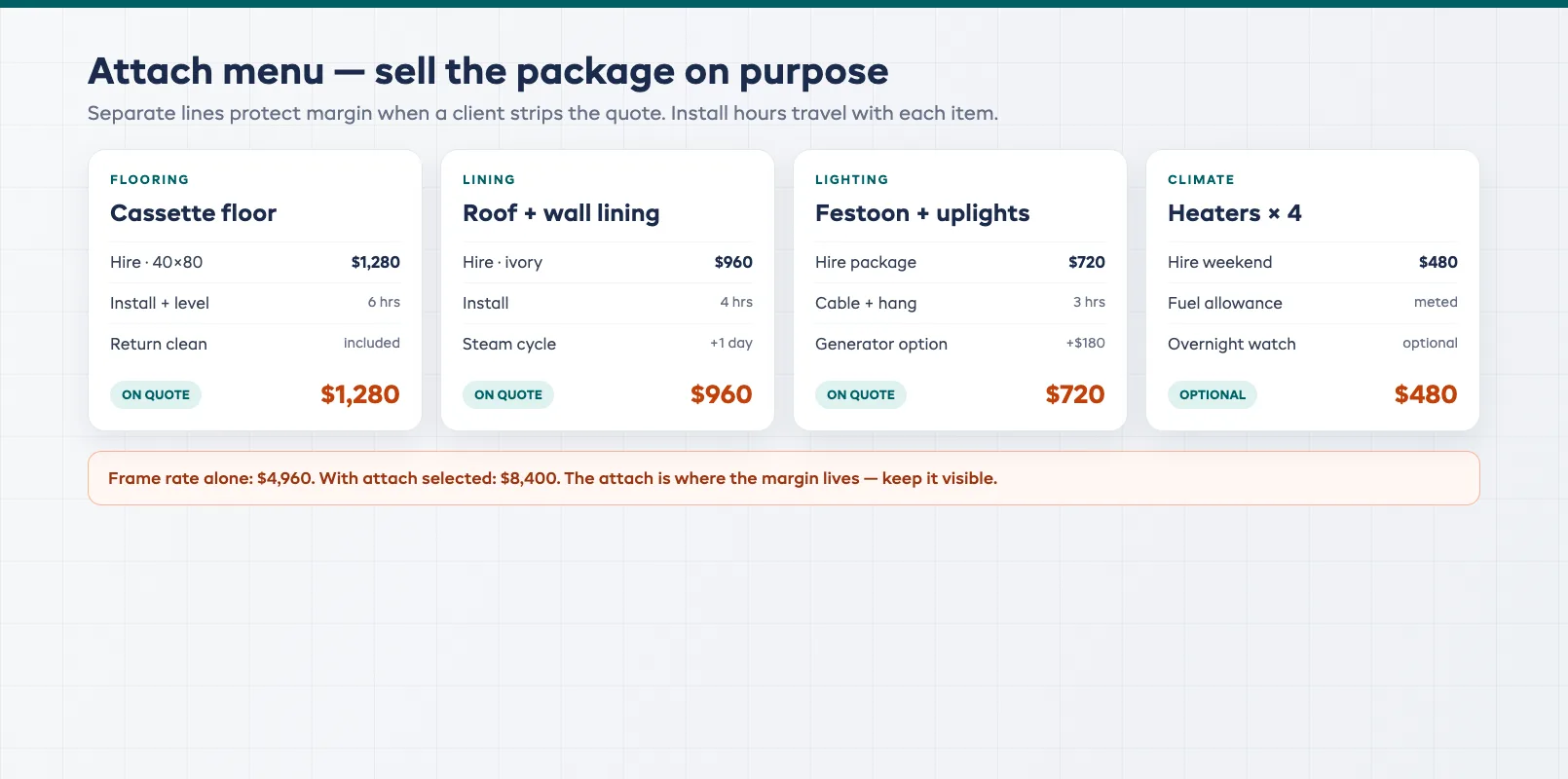
Attach also extends the commitment. Flooring that needs an extra half-day to level, or linings that cannot go up until the frame is signed off, push labor and sometimes block the next job. Price the install time. Price the clean and repair cycle when the gear comes home. A lining that spends three days in the laundry after a muddy break is not free stock.
A simple habit helps: every attach item on the quote carries an install estimate and a return condition note. The office sees the hours. The yard sees what "good" looks like when it comes back. Disputes shrink.
Access and Site Costs
Two jobs with the same frame and the same Saturday can be $2,000 apart before anyone unfolds a panel.
Access and site costs are the ones operators forget on the phone and remember in the field:
- Carry distance from hardstand to peg line
- Ground — soft, sloped, rocky, or protected turf needing boards
- Gate and turning — whether the truck enters or you hand-ball
- Ballast vs stakes — sealed surfaces change the kit and the time
- Permits and neighbor constraints — noise, hours, vehicle limits
- Power and water — or the generator and tank you bring yourself
Put a site band on the quote after the visit: standard, restricted, or complex. Standard is a truck to the pegs on firm ground. Restricted adds carry, boards, or ballast. Complex means permits, night work, or a site that needs a second vehicle. The band is visible to the client and to your scheduler.
If you skip the visit, you are guessing. Guesses on soft ground are how a four-person build becomes a six-person day and a next-day late start for whoever was next.
Site costs also protect the relationship. A client who sees "restricted access — long carry + boards — $X" before they sign is not surprised when the crew arrives with timber. A client who only sees a frame price will argue every extra hour.
Deposits and Staged Payments
Marquee work spends money weeks before the party. Pegs, casual crew holds, truck bookings, and attach pulled from the rack all happen on your cash, not theirs — unless the payment schedule says otherwise.
A pattern that fits long-lead marquee hire:
| Stage | When | Typical share | What it funds |
|---|---|---|---|
| Booking deposit | On signed quote | 25–30% | Holds the structure and dates |
| Progress payment | 60–90 days out, or on site confirmation | 30–40% | Crew holds, transport, attach pull |
| Final balance | 14–21 days before build | Remainder | Clears before load-out |
Adjust the percentages to your season and risk. Peak wedding months want more money earlier. Shoulder season can flex. What you should not do is take a small deposit in March for an October job and chase the balance the week of the build.
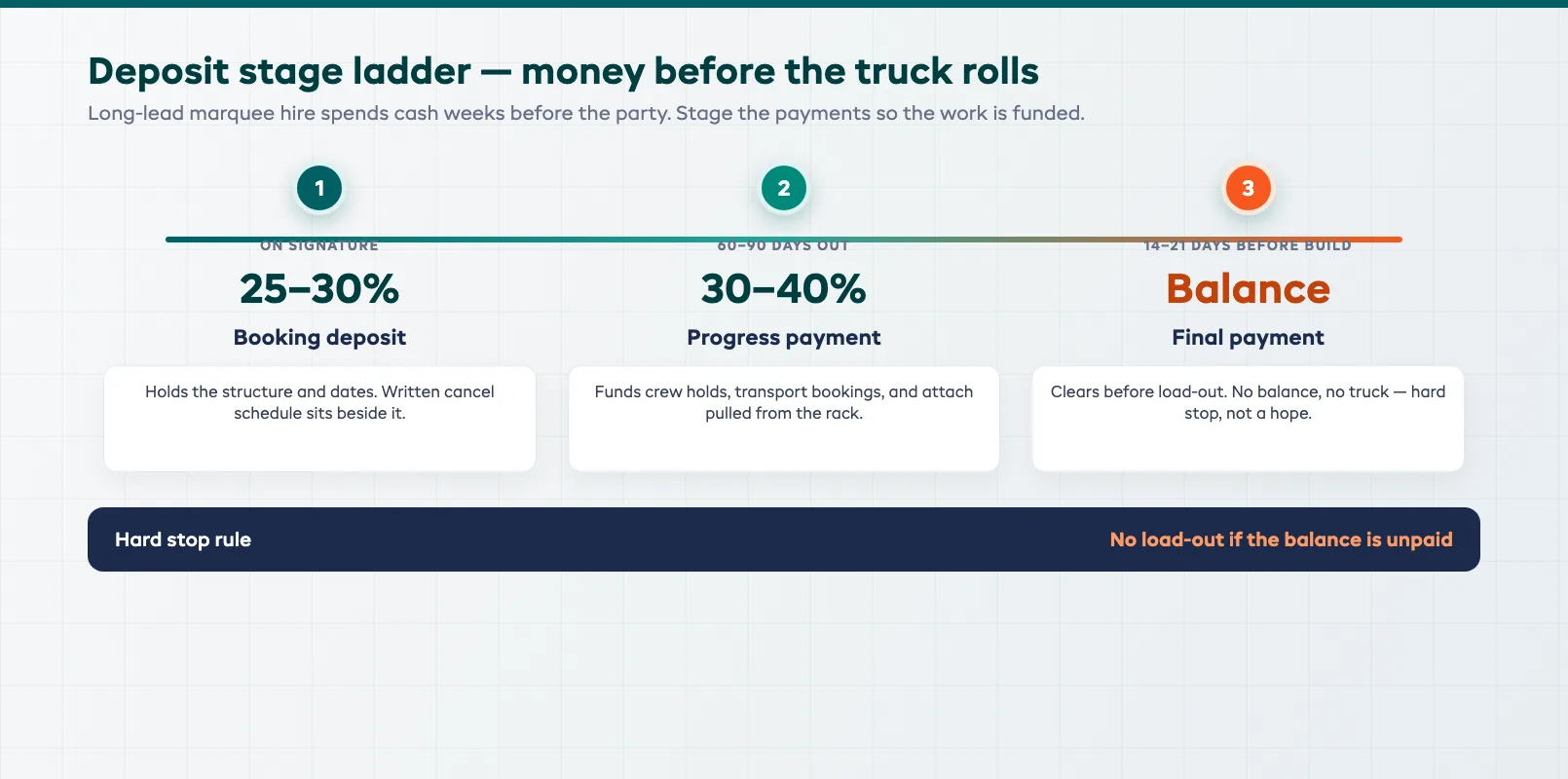
Automate the chase. Staged invoices with clear due dates, reminders before each stage, and a hard stop — no load-out if the balance is unpaid — beat heroic phone calls on Thursday afternoon. The pricing page for software that runs deposits and balances in the same system as the booking is usually cheaper than one written-off October job.
One more rule: the deposit is not a tip. Write what it covers and what happens if either side cancels. Vague deposits become arguments. Clear deposits become process.
Cancellation and Weather Terms
Wind stops builds. Saturated ground stops trucks. Clients cancel. If the terms are soft, you wear the cost of a week you cannot resell.
Write the rules before the season, not in a wet field:
- Client cancel — sliding scale by days to build (for example: 100% forfeit inside 14 days, 50% inside 30, deposit only beyond that)
- Weather / safety cancel by you — reschedule first; if the date cannot move, define credit vs refund against costs already sunk
- Weather delay — who pays the extra crew day when Thursday becomes Friday
- Access fail — client-caused site problems (locked gate, unmarked services) billed as a call-out or re-attend
Put wind and ground limits in the contract in plain language. "We will not lift in sustained winds above X" is clearer than "subject to safe working conditions." Your crew already knows the number. The client should see it once, in writing, before they pay the deposit.
Reschedule-first protects revenue and relationships. A Saturday moved to the following Saturday still needs crew and a free frame. Systems that show the ripple — structure, crew, truck, attach — make that move honest. That is the same weather reflow problem crew scheduling solves on the labor side; quoting has to price the risk on the money side.
Do not improvise goodwill discounts after every weather call. Track them. A season of "we'll sort it" is a margin line with no invoice.
Utilization per Structure
You cannot manage what you do not count. Utilization per structure is the number that tells you whether marquee rental pricing is working or whether busy Saturdays are hiding idle frames.
Measure three things per structure per season:
- Event days — days the client paid for
- Blocked days — days the structure could not be sold (build, event, break, transit, weather hold)
- Yard days — days available and unsold
A frame with 22 event days, 68 blocked days, and 40 yard days is telling you something. Peak is full. Shoulder is soft. The quote rate on peak must carry the shoulder, or shoulder needs different products (shorter structures, midweek corporate, package attach) so blocked capacity earns something.
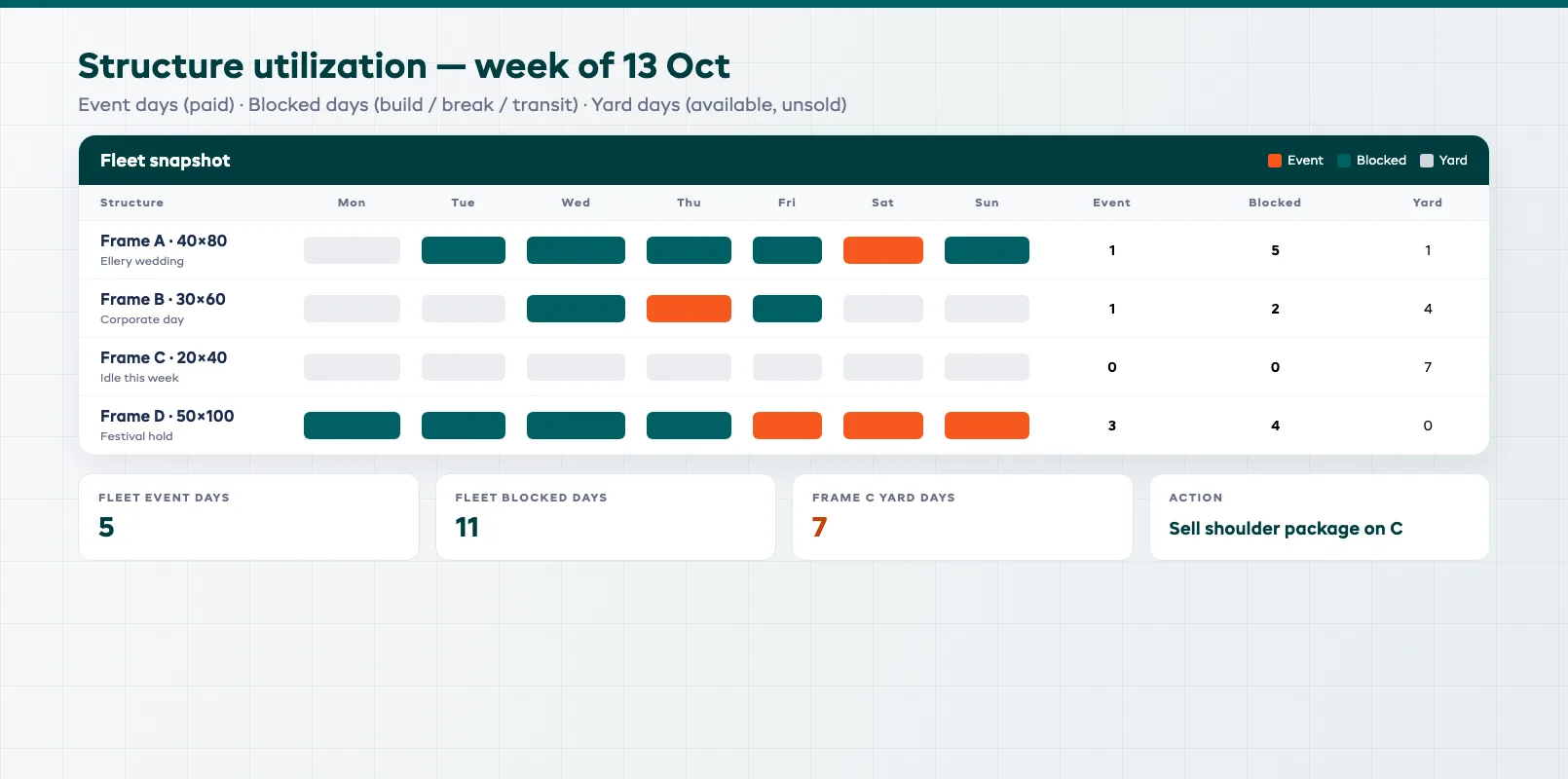
Utilization also catches silent underpricing. If two 40×80 frames have similar event days but one shows twice the labor hours per job, the "cheap" frame may be the expensive one. Hours against the booking make that visible. Rate cards alone do not.
Review utilization monthly in season, not once in April. Move rates, packages, or sales focus while there is still calendar left to sell. A Dash Agent can drop a weekly utilization brief in your inbox so the review actually happens — one reminder beats another spreadsheet nobody opens.
When utilization and quote templates live beside the booking — the promise of marquee and tent rental software built for multi-day commitments — the office stops re-typing the same six-day shape into a new PDF every inquiry.
Bring the Quote in Line with the Work
Marquee hire cost is not a Saturday number. It is the price of a commitment that starts when the truck rolls and ends when the frame is back, cleaned, and ready to sell again.
Price the blocked days. Sell attach as attach. Band the site. Stage the money. Write the weather rules. Count utilization per structure. Do those six things and the diary can be full without the margin being empty.
The operators who stay in business through a wet spring are rarely the ones with the lowest Saturday rate. They are the ones whose quote matched the work before the pegs went in.
FAQ
How should I calculate marquee hire cost for a multi-day commitment?
Start from days the structure is unavailable, not from the event date alone. Add labor for site visit, build, dress, and break, plus transport and any site band (standard, restricted, complex). Then add attach lines — flooring, lining, lighting — with their own install time. The party day is one line in that stack, not the whole price.
What deposit percentage works for long-lead marquee bookings?
Many operators take 25–30% on signature, a progress payment of 30–40% at 60–90 days out or on site confirmation, and the balance 14–21 days before build. Peak months often need more money earlier. Whatever split you choose, write what the deposit funds and the cancel schedule beside it.
Should flooring and lighting be bundled into the structure price?
Usually no. Clients compare frame rates and treat attach as optional. Separate lines protect margin when a client strips the package, and they show install hours so the yard is not surprised. Bundled packages are fine as a sales option, but your internal cost model should still see each line.
Who pays when weather delays a build by a day?
That belongs in the contract before the season. Common patterns: reschedule first at no extra structure fee if the diary allows; bill extra crew and transport if the delay is client-driven or if you held a reserve crew; define credit vs refund if the event cannot move. Vague goodwill every time the wind comes up becomes a silent discount line.
How do I explain a higher quote after the site visit?
Use a visible site band and name the causes: long carry, soft ground, ballast instead of stakes, permits, or night constraints. Show the delta as access and labor lines, not as a mysterious bump to the frame rate. Clients accept costs they can see. They push back on costs that appear after they thought the number was fixed.
What utilization rate should a marquee structure hit?
There is no single magic percentage. Track event days, blocked days, and open yard days per frame. Peak frames may show high blocked time and still be healthy if the rate clears those days. A frame with low event days and high yard days needs sales attention or a different package mix. Compare labor hours per job across similar frames to catch silent underpricing.
in one place