Table and Chair Rental Software: Answering "How Many on Saturday?" in Three Seconds
Table and Chair Rental Software: Answering "How Many on Saturday?" in Three Seconds
A planner calls at 2:40pm. She needs 220 banquet chairs, 28 round tables, and linens for Saturday. Two other yards already have her number. You open three sheets, a whiteboard photo from Monday, and a text thread about a soft hold on 80 chairs. Ten minutes later you still do not trust the number. She books the yard that answered during the call.
That is the whole game in bulk event hire. The product is not a serial-numbered kayak. It is a free quantity on a date. Table and chair rental software exists to answer that question in three seconds — and to keep the answer true when the next call comes in.
This guide is for operators who move hundreds of chairs a weekend: how quantity tracking differs from unit records, how per-date availability actually works, how hard limits stop overselling, why quote speed wins the job, how counting back in closes the loop, and the checklist to buy against.
Quantity Tracking vs Unit Records
Most rental platforms grew up around serialized gear. Each bike has a barcode. Each boat has a hull number. That model fails the moment you own 800 identical banquet chairs.
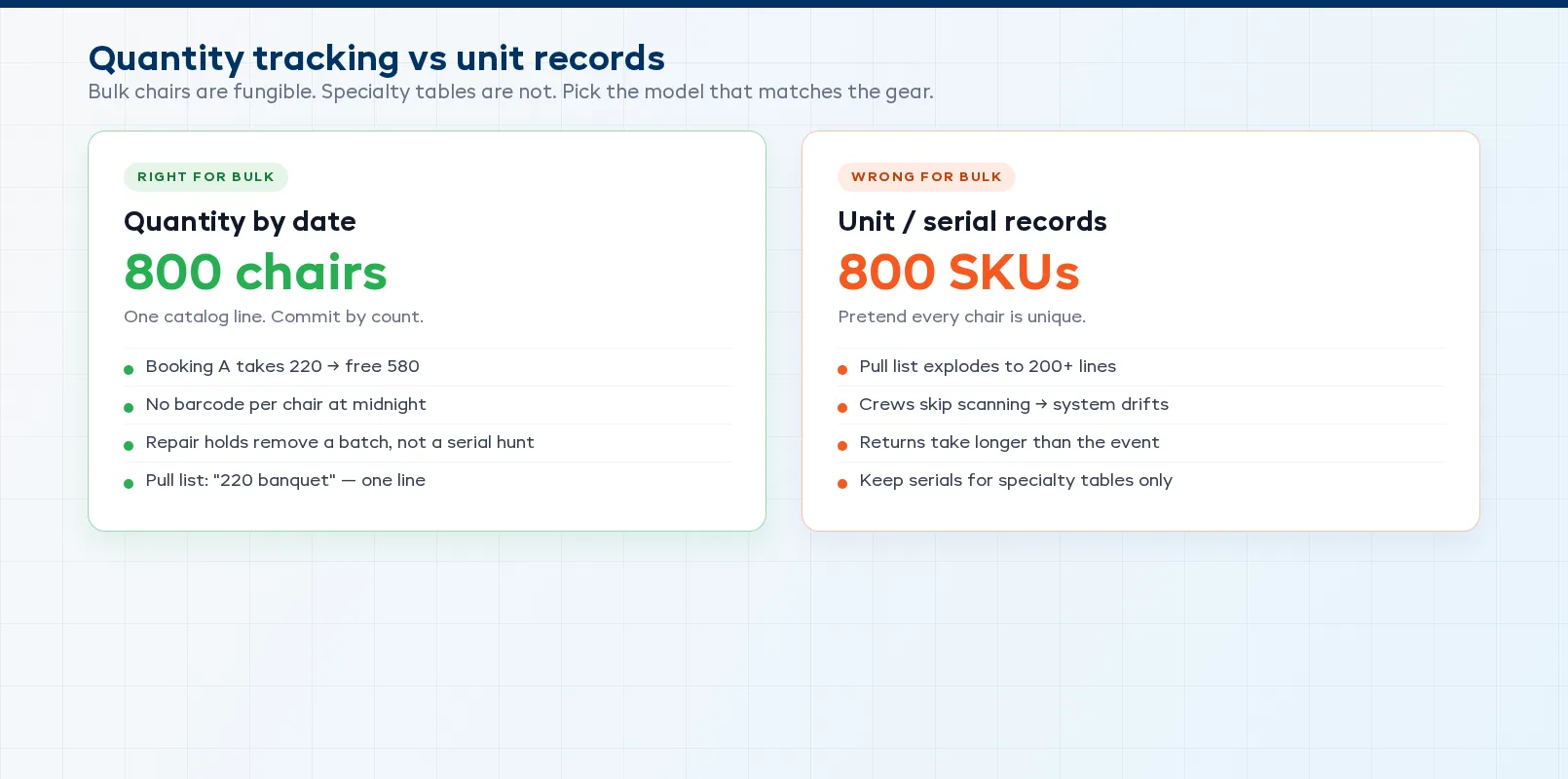
Bulk stock needs quantity tracking:
- Own 800 chairs — one catalog line, one photo, one rate card
- Commit by count — booking A takes 220, booking B takes 180, free becomes 400
- Ignore serials — you do not care which chair went to which wedding
- Still track condition at the type level — cracked frames, stained seats, repair holds
Unit records still matter for the odd assets that are not fungible: a specialty farm table with a known scratch, a branded bar, a dance floor that only fits one trailer. Those stay as individuals. Everything else — Chiavari, folding, banquet rounds, cocktail tables, basic linens — should live as quantities.
Operators who force bulk chairs into serial workflows pay for it every day. Pull lists become 200 line items. Returns take forever. Nobody scans 220 chairs at a barn at midnight. The yard invents workarounds, then the system and the real world drift apart.
A clean split looks like this:
| Stock type | Track as | Why |
|---|---|---|
| Banquet / Chiavari / folding chairs | Quantity by date | Fungible, high volume |
| Standard rounds and rectangles | Quantity by date | Same reason |
| Specialty tables, bars, stages | Unit or small lot | Not interchangeable |
| Premium linens and branded pieces | Unit or lot with condition | Damage attribution matters |
Get the model wrong and every report lies. Get it right and Saturday availability becomes a subtraction problem, not a detective story.
Per-Date Availability
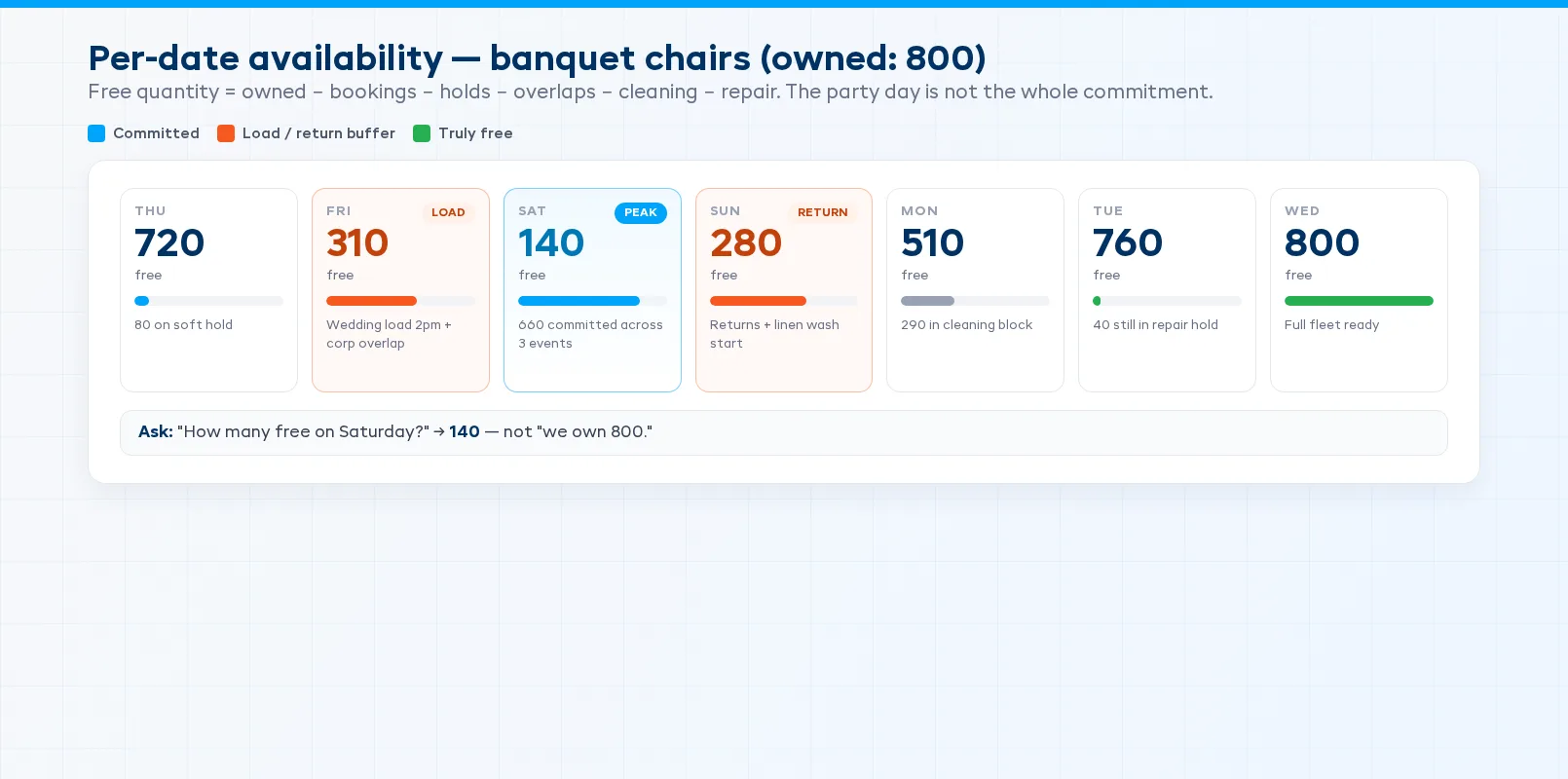
"How many chairs do we have?" is the wrong question. The right one is "How many are free on Saturday the 27th?"
Per-date availability holds a calendar against each quantity line. For every day, free stock equals owned quantity minus:
- Bookings that include that day
- Soft holds and unpaid quotes that still reserve the date
- Multi-day jobs that overlap the day (Friday load through Sunday return)
- Cleaning and repair blocks after return
- Sub-hire you promised out, or stock you borrowed in
Overlaps are where spreadsheets die. A Friday corporate dinner that returns Sunday morning still blocks Saturday. A Saturday wedding that loads Friday afternoon still blocks Friday. Buffer days for wash-and-fold on linens block the next midweek sale if you forget them.
Good party and event rental software shows the free number for the exact window the planner cares about — event day plus load and return — without making the office rebuild the math by hand.
Practical habits that keep the board honest:
- Book the window, not the party. Load Friday 2pm through return Sunday 10am is the commitment.
- Show soft holds as reserved. A "maybe" that sits for five days is capacity you cannot sell twice.
- Surface dirty stock. Returned-but-not-ready is not free, even if it is back in the yard.
- One source of truth. Phone holds, email quotes, and the diary cannot live in three places.
When the free quantity updates the moment a deposit clears, the next call gets a number you would defend in court. That is what three seconds looks like.
Hard Limits That Prevent Overselling
Speed without a hard stop just helps you oversell faster.
A hard limit means the system refuses a booking that would push committed quantity above owned stock for any day in the window. Not a warning you can click past. A wall. The quote cannot convert. The soft hold cannot save. The office has to choose: cut the order, move the date, sub-hire, or decline.
Why walls beat warnings:
- Peak Saturdays create pressure to "make it work"
- Soft holds pile up until nobody remembers who owned the 80 chairs
- Sub-hire promises made on the phone never hit the sheet
- Night crews load what the pull list says, not what the yard actually has
Configure limits per item type. Chairs and tables usually need a strict stop. Low-cost consumables might allow a small overbook buffer if you keep spares. Repair stock should sit outside availability until the repair is logged done — otherwise a cracked batch of 40 chairs looks free and gets sold.
Also cap soft holds. A hold older than 48 hours without a deposit should expire or convert to a reminder, not sit forever eating Saturday. The same discipline that protects party rental calendars applies harder when every unit is a chair somebody counted by hand last season.
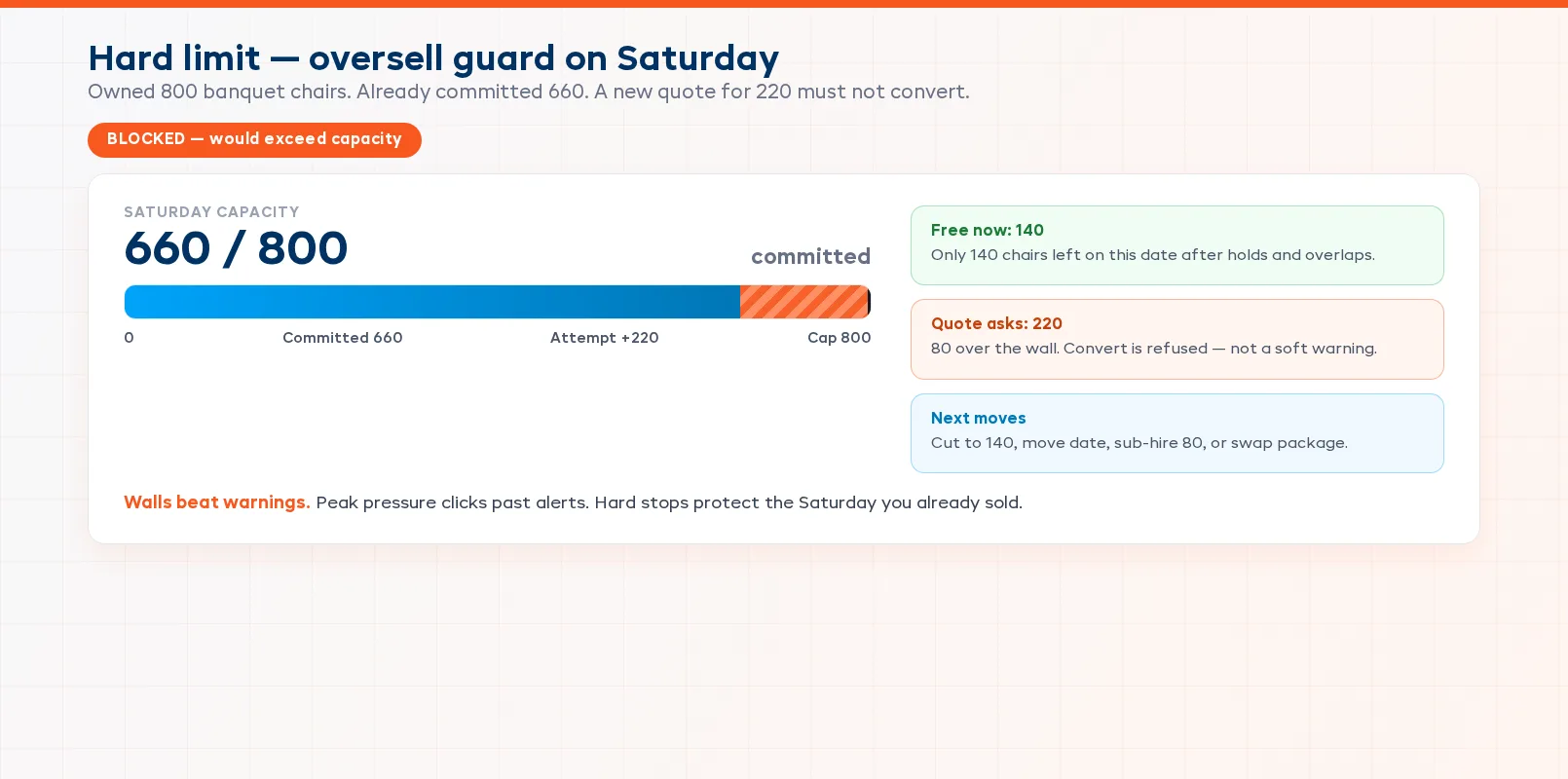
When the wall fires, give the office next moves in the same screen: nearest dates with enough free stock, current sub-hire partners, or a package swap that frees 40 chairs. A dead end loses the deal. A guided alternative often saves it without inventing chairs that do not exist.
Quote Speed
Event inquiries go to three or four yards at once. The first competent quote with a real availability number usually wins. "I'll get back to you tomorrow" is a polite way to lose.
Quote speed in bulk hire means:
- Pick the event date and load/return window
- See free quantity for chairs, tables, linens, and extras live
- Build lines against that free stock
- Attach a deposit link that holds the date when the card clears
- Convert quote to booking without re-keying
If the office has to open a spreadsheet to check chairs, then a PDF template to price them, then an email to send a deposit request, you are already behind. The planner has moved on.
Same-day quoting is the floor. During-the-call quoting is the target for phone inquiries. That only works when availability and pricing live in one place. Templates for common packages — 150-guest banquet, cocktail hour for 80, ceremony-plus-reception — cut build time further, as long as each package still commits the real component counts underneath.
Follow-up matters almost as much as the first send. Quotes that go quiet for 48 hours should get an automatic nudge that the date is still open. Track won and lost reasons. If you lose on speed more than on price, the fix is the board, not the rate card.
A single Dash AI assist is enough here: auto-build the first draft quote from the inquiry email so a human only checks quantities and hits send. Keep the human in the loop for the hard calls — sub-hire, discounts, site constraints — and let the system do the tallying you used to do by highlighter.
Counting Back In
Availability only stays true if returns update the count.
Every job needs a count-back against the pull list. Expected 220 chairs. Received 214. Six short. That shortfall belongs on that booking the same day — not in a mystery pile discovered at the next stocktake.
Count-back closes three loops at once:
- Availability — free quantity rises only by what actually returned and passed check
- Damage — cracked frames and stained seats leave the free pool until repaired or written off
- Customer charges — missing and broken items hit that event's deposit while memory is fresh
Do the count at the truck or at the dock, not "sometime Monday." Photos of damage on the booking beat arguments two weeks later. Linens and chair covers that need wash cycles should land in a cleaning block automatically so Wednesday's free number does not pretend dirty stock is sellable.
Shrinkage is a KPI, not a shrug. Track shortfalls per week and per event type. A recurring 2% miss on banquet chairs is a process problem — load discipline, venue exits, or dishonest tallies — not bad luck. Operators who wait for the annual stocktake to learn they are 90 chairs light have already oversold half a season.
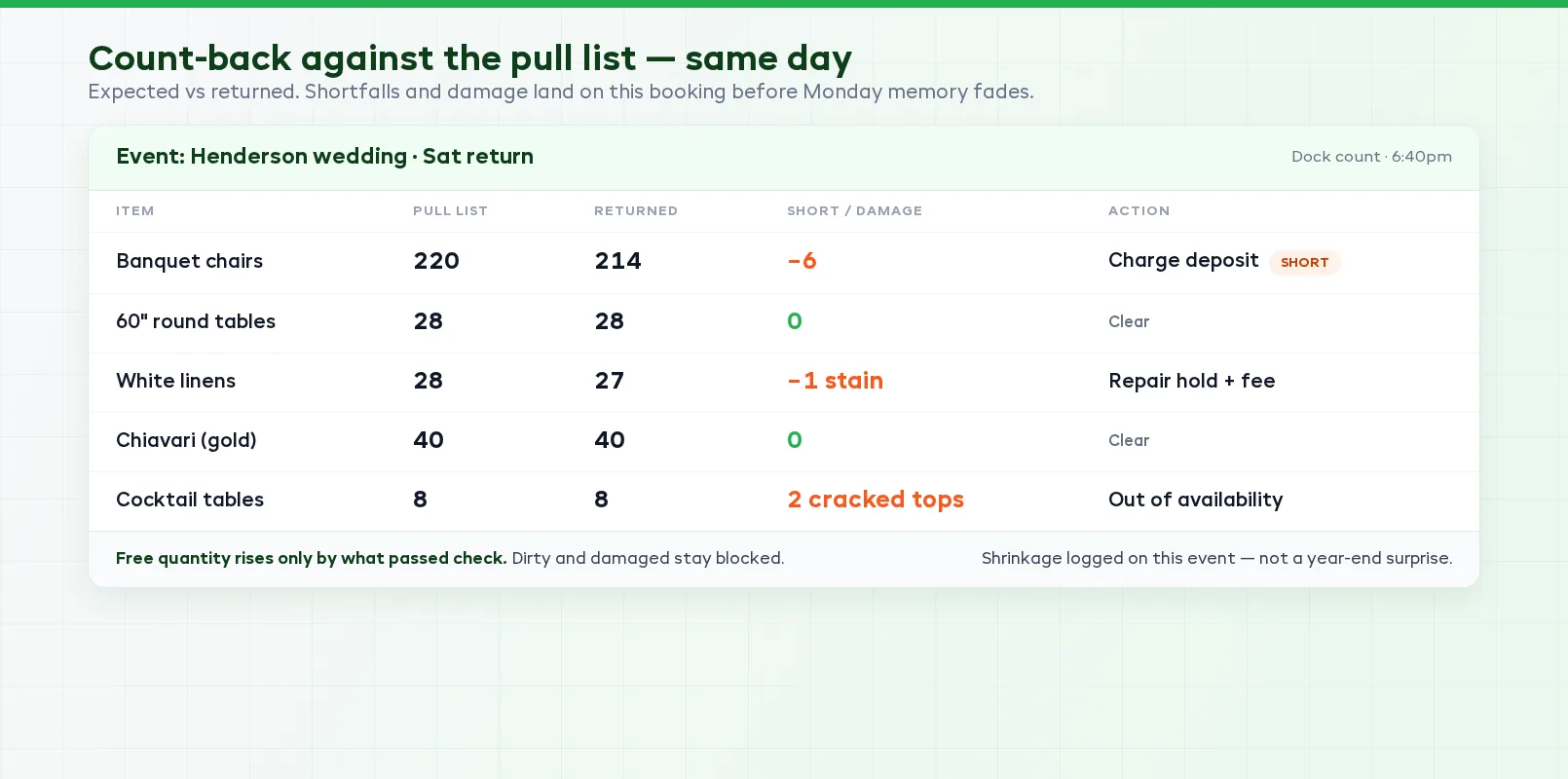
Pair count-back with repair holds. Damaged units leave availability until someone marks them ready. That single habit stops the classic failure mode: selling chairs that are in the "fix later" corner of the warehouse.
Checklist: Buying Table and Chair Rental Software
Use this when you evaluate any platform for bulk event hire. If a demo cannot show these live on a peak Saturday scenario, keep looking.
- Quantity lines for fungible stock — chairs and standard tables as counts, not fake serials
- Per-date free quantity — owned minus bookings, holds, overlaps, cleaning, and repair
- Hard oversell stops — convert blocked when any day in the window would exceed capacity
- Load/return windows on every job — buffers visible on the calendar, not tribal knowledge
- Quote from live availability — deposit holds the date; no re-key to book
- Package components committed underneath — one sellable line, real counts reserved
- Count-back against the pull list — shortfalls and damage on the booking the same day
- Cleaning and repair blocks — dirty or broken stock cannot show as free
- Soft-hold expiry — holds without deposits do not eat the weekend forever
- Mobile pull lists and returns — yard crew works from phones, not printed guesses
You do not need a feature museum. You need a true free number on Saturday, a wall that stops you lying about it, and a return process that keeps the number true next week.
Bring the Tally Into the System
Bulk hire loses deals in the gap between the phone and the sheet. The planner who needs 220 chairs will not wait while you reconcile three versions of the truth.
Track quantity, not pretend serials. Answer free stock by date with load and return included. Put a hard stop on overselling. Quote while the caller is still on the line. Count every return against the pull list before the next Saturday sells out.
That is what table and chair rental software is for — not another dashboard, but three seconds to a number you can stand behind.
FAQ
What is table and chair rental software?
It is rental software built for bulk, fungible stock — hundreds of identical chairs and tables committed by quantity against event dates. The core job is answering how many units are free on a specific day, with hard stops against overselling, fast quotes from live availability, and count-back on return so the next weekend stays honest.
Why shouldn't I track banquet chairs as individual serial numbers?
Because they are interchangeable and high volume. Serial workflows create pull lists with hundreds of lines, and crews will not scan every chair at a venue at midnight. Quantity tracking matches how the yard actually works, while still letting you hold damaged batches out of availability and attribute shortfalls to the event that caused them.
How does per-date availability differ from a stock count?
A stock count says you own 800 chairs. Per-date availability says how many of those 800 are free on Saturday after subtracting bookings, soft holds, multi-day overlaps, cleaning blocks, and repair holds. The same chairs can be fully free on Tuesday and fully committed on a June Saturday.
What should happen when a quote would oversell a date?
The system should block the convert — not only warn. The office then cuts the order, moves the date, arranges sub-hire, or declines. Warnings get clicked past under peak pressure. Walls protect the Saturday you already sold.
How fast should a bulk event hire quote go out?
Same day at minimum; during the call for phone inquiries when the package is standard. Event planners shop three or four yards at once. The first quote with a real free-quantity number and a deposit link usually wins.
When should we count stock back in after an event?
At return — truck or dock — against the pull list the same day. Log shortfalls and damage on that booking while memory and photos are fresh. Waiting until Monday (or the annual stocktake) is how shrinkage becomes a mystery and availability quietly lies.
in one place