Frames Don't Put Themselves Up: Scheduling Marquee Crews
Frames Don't Put Themselves Up: Scheduling Marquee Crews
Seven in the morning, a field an hour out of town, a truck with a 40ft x 80ft frame on it. Two people are standing next to it. The job needed four.
Nobody did anything obviously wrong. The structure was booked in the diary eleven months ago. The crew was written on a whiteboard in the yard some time in August. One of the four told the office he was away that week, and the office is a different person from whoever keeps the whiteboard. The build still has to happen, so the two who turned up start calling around, and the day that was supposed to end at four ends at nine.
Marquee hire is the event business where the booking runs longer than the event. The same thing is true of the labor. A Saturday wedding is not a Saturday of work. It is a site visit, two days of building, a handover and a break down, spread across six days and usually split between two teams. Roster that on a weekly shift pattern and you are describing the wrong shape of work.
Crews Belong to the Build, Not to the Day
The habit most operators inherit from other industries is rostering by day. Monday: three on. Tuesday: four on. It works when the work is a counter that opens at nine and closes at five. It falls apart the moment the work is a structure on a field.
Take job M-0442, the Ellery marquee. 40ft x 80ft frame, event on Saturday 23 October, $8,400 on the quote. Written out as work rather than as a date, it looks like this:
| Day | Task | Who is needed |
|---|---|---|
| Mon 18 Oct | Site visit and measure | 1 senior, half day |
| Wed 20 Oct | Frame up | Crew A, 4 people, truck |
| Thu 21 Oct | Lining, flooring, lighting | Crew A, 3 people |
| Fri 22 Oct | Client dressing and handover | 1 senior, 2 hours |
| Sat 23 Oct | Event | Nobody on site |
| Mon 25 Oct | Break down and load out | Crew B, 4 people, truck |
Six entries, four different shapes of work, two teams, one job. The useful fact is not that Crew A is working on Wednesday. It is that Crew A is building the Ellery marquee on Wednesday and Thursday. Those are different statements, and the difference shows the moment the build moves. If the assignment is attached to the job, moving the build takes the crew with it. If the assignment is attached to Wednesday, moving the build leaves four people rostered to a day with nothing on it and a Thursday with nobody.
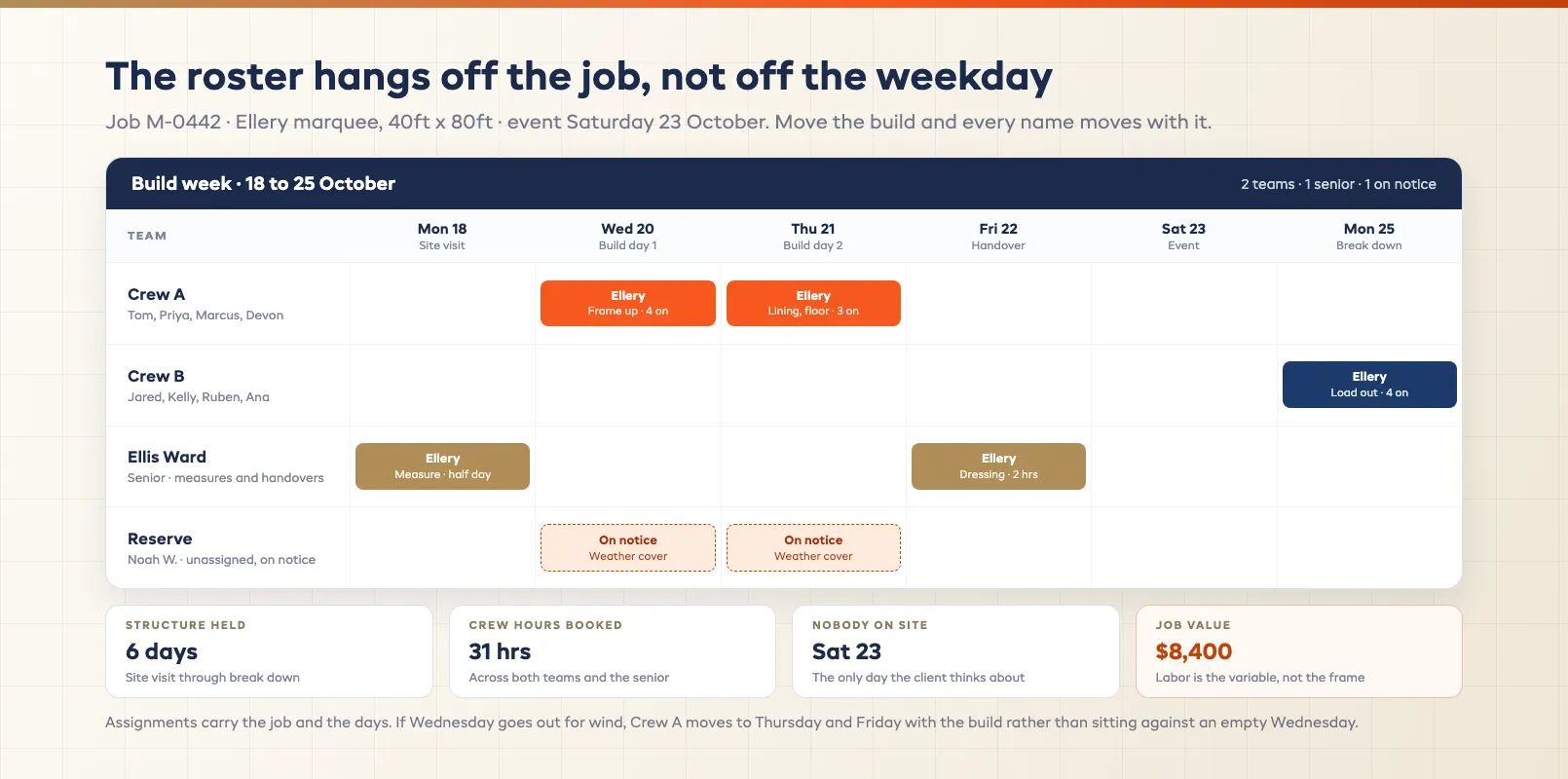
There is a second reason to hang people off the job. It is the only way to know what a build actually costs you. A job with two long days on a soft site and a difficult access route is not the same job as a flat car park with a gate a truck can drive through, even when the frame and the invoice are identical. If the hours sit against the booking you can see that at the end of the season. If they sit against the week, you can see your payroll and nothing else.
Three fields do most of the work here: the job, the named people, and the days they are on it. Staff rostering that lets you drag people into shifts with a location and a role attached covers the structure of it, and putting the roster in front of the crew on their phones covers the rest. They see the week, they get told when something changes, and they can flag availability without a phone call.
The site visit is a shift too
Site visits disappear from rosters because they do not look like builds. Half a day, one person, no truck, often six weeks before anything happens. So they live in somebody's personal calendar, and three of them quietly eat a Monday that the office thought was free for yard work.
Put the visit on the roster as committed time for whoever is doing it. It costs nothing to do and it stops the most common form of over-promising, which is telling a client you can fit a measure in next week when the person who does measures is already out twice.
The Clash Nobody Sees Until Thursday Morning
Ask an operator about double-booking crews and most will describe two builds starting on the same morning. That one is easy. It is visible, it is obvious, and somebody catches it.
The clash that actually happens looks like this. In March, Crew A is booked to build the Ellery marquee Wednesday and Thursday. In May, a different person books the Hartnell break down for that same Thursday and puts Crew A on it, because in May the Ellery build was a line in a diary nobody was reading. Two bookings, two months apart, one overlapping day. Nobody has done anything careless. The information to catch it existed, but it existed in two places at two different times.
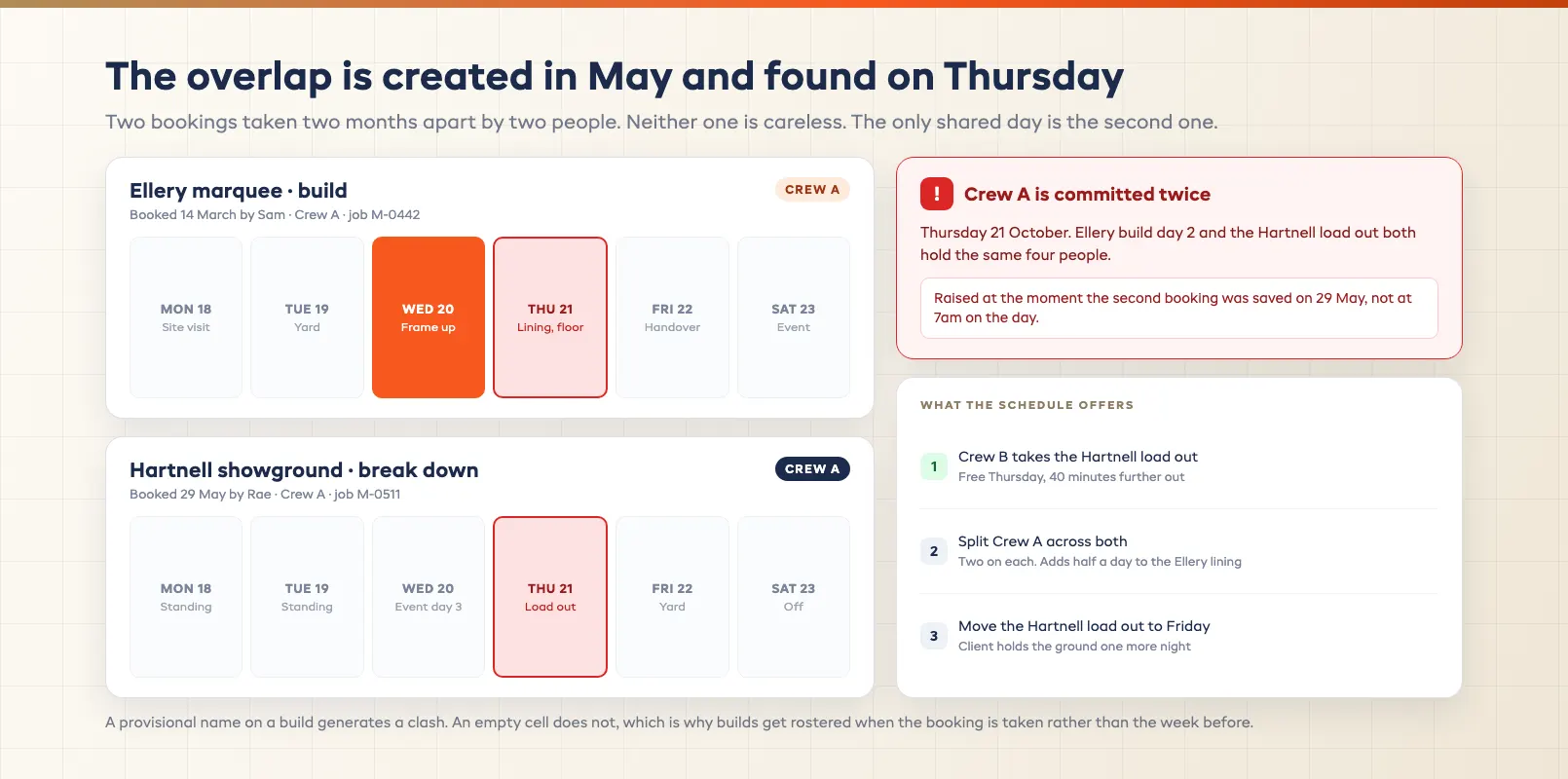
The fix is to make the overlap visible at the point it is created rather than at the point it bites. A scheduling system that knows Crew A is on the Ellery job Wednesday to Thursday should say so when somebody tries to put Crew A on anything else on the Thursday, in May, while it is still cheap to fix. Conflict detection is a standard feature of a real roster, and it is the single highest-value thing it does for a marquee company.
Two habits make it work better than the software alone.
Roster the whole commitment when you take the booking, not the week before. A build without crew against it is an unbooked build, no matter how far out it is. Provisional names beat empty cells, because a provisional name generates a clash and an empty cell does not.
Look at the week before the week starts. A fixed point, Thursday for the following week, where somebody reads the builds, the breaks, the site visits and the crew against them. A Dash Agent can send that build brief out on a schedule so the whole team is reading the same picture, but the value is in having the fixed point at all.
The cost of a clash found on Thursday afternoon is a phone call. The cost of the same clash found at seven on Thursday morning is a break down running a day late, a client whose field is still full, and a structure that cannot go out to the next job on Friday. One booking error, three jobs affected.
Not Everyone on the Van Can Rig
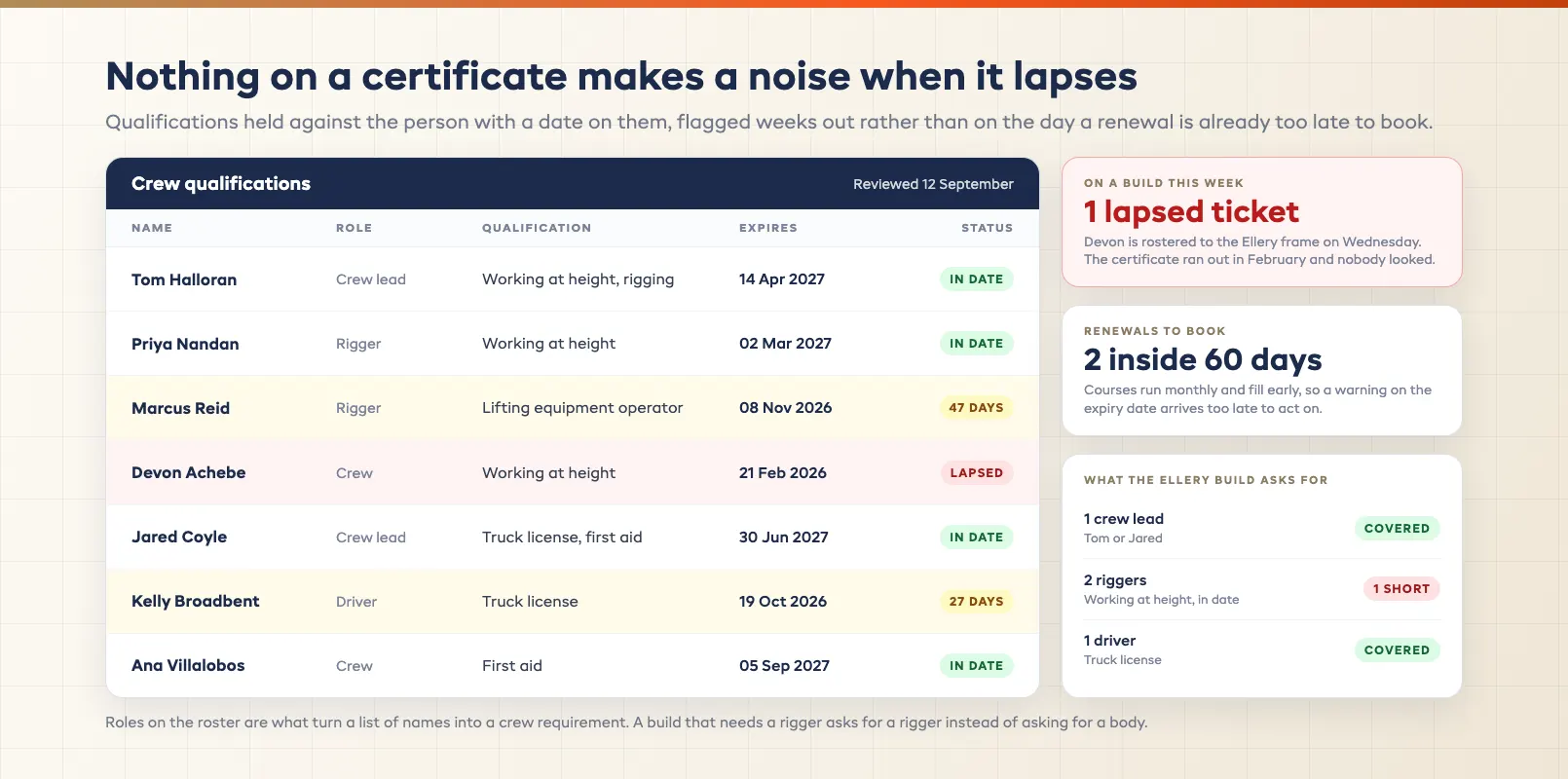
Marquee work has qualifications attached to it, and they expire quietly. Working at height, lifting equipment, the truck license, first aid, whatever your insurer and your local rules require. Nothing on a certificate makes a noise when it lapses.
The failure mode is not that somebody unqualified gets put on a build on purpose. It is that a ticket ran out in February, nobody looked, and in June that person spends a day on a frame. The work gets done, the marquee stands up, and the exposure sits there quietly until an incident or an insurance question turns it into a problem.
What this needs is dull and cheap:
- Every qualification recorded against the person, with the date it expires
- A flag well before the date, not on it, because renewals take weeks to book
- Roles on the roster that reflect capability, so a build needing a rigger asks for a rigger
- The certificate itself stored somewhere you can produce it, not in a folder in somebody's van
Roles are the part operators skip. If your roster only knows names, every person looks interchangeable and the constraint lives in the head of whoever builds the schedule. Give people roles and the roster starts telling you something useful: this build needs a crew lead and two riggers, you have assigned a crew lead and two general hands, and that is a gap you can see on a Tuesday rather than discover in a field.
Growth makes this worse before it makes it better. A four-person operation where everyone can do everything does not need a capability matrix. At twelve people with seasonal hires, half of whom joined in April, the owner is the only person who knows who can be trusted on a lift, and the owner is not always in the yard at six in the morning.
Hours on the Job, Not Reconstructed From Memory
Marquee builds do not respect a shift pattern. The ground is soft, the access is worse than the visit suggested, a panel is damaged and has to be swapped, and the day that was eight hours is eleven. That happens often enough that it is not an exception, it is the operating reality.
Two things go wrong when hours are captured loosely. Payroll gets guessed, which staff notice quickly and resent quietly. And job costing gets guessed, which nobody notices at all, which is worse.
Recording against the booking fixes both at once. A shared tablet in the yard where the crew clocks in with a PIN handles the punch, every punch stamps against the scheduled shift, and worked hours flow into timesheets without anyone adding up a column. Scheduled against actual sits side by side, so an eight-hour build that ran to eleven is visible as an over-run rather than as a vague sense that the Ellery job was hard work. Missed punches get fixed by hand, and the week exports as a CSV for whoever runs payroll.
The number that comes out of it is the one most marquee operators do not have: labor hours per structure per job. Once you have a season of that, quoting stops being a feel. You know that the 40ft x 80ft on a private site averages 31 crew hours across build and break, and that the same frame on a showground with vehicle access averages 24. That gap is real money and it belongs in the price, which is the argument for putting the crew and the structure on the same job record rather than in two systems that never compare notes. Check it against what the software costs across a season on the pricing page and the arithmetic usually answers itself.
When the Forecast Moves the Week
Wind stops a build. Saturated ground stops a truck getting onto a field. A marquee company that has been running more than a couple of seasons treats weather as a weekly operating condition rather than as bad luck.
The scheduling problem is not the decision. The decision is usually clear by Tuesday afternoon. The problem is everything the decision drags with it. Push the Ellery build from Wednesday to Thursday and here is what has to move:
- Crew A, who were on Wednesday and Thursday, are now on Thursday and Friday
- Crew A were booked on the Hartnell break on Friday, which is now a clash that did not exist an hour ago
- The truck is committed a day later, which affects whatever it was doing on Friday
- The flooring and lining that follow the frame slide by a day
- The Friday client handover slips toward the event
- The break down on the Monday may need to move if the schedule behind it is tight
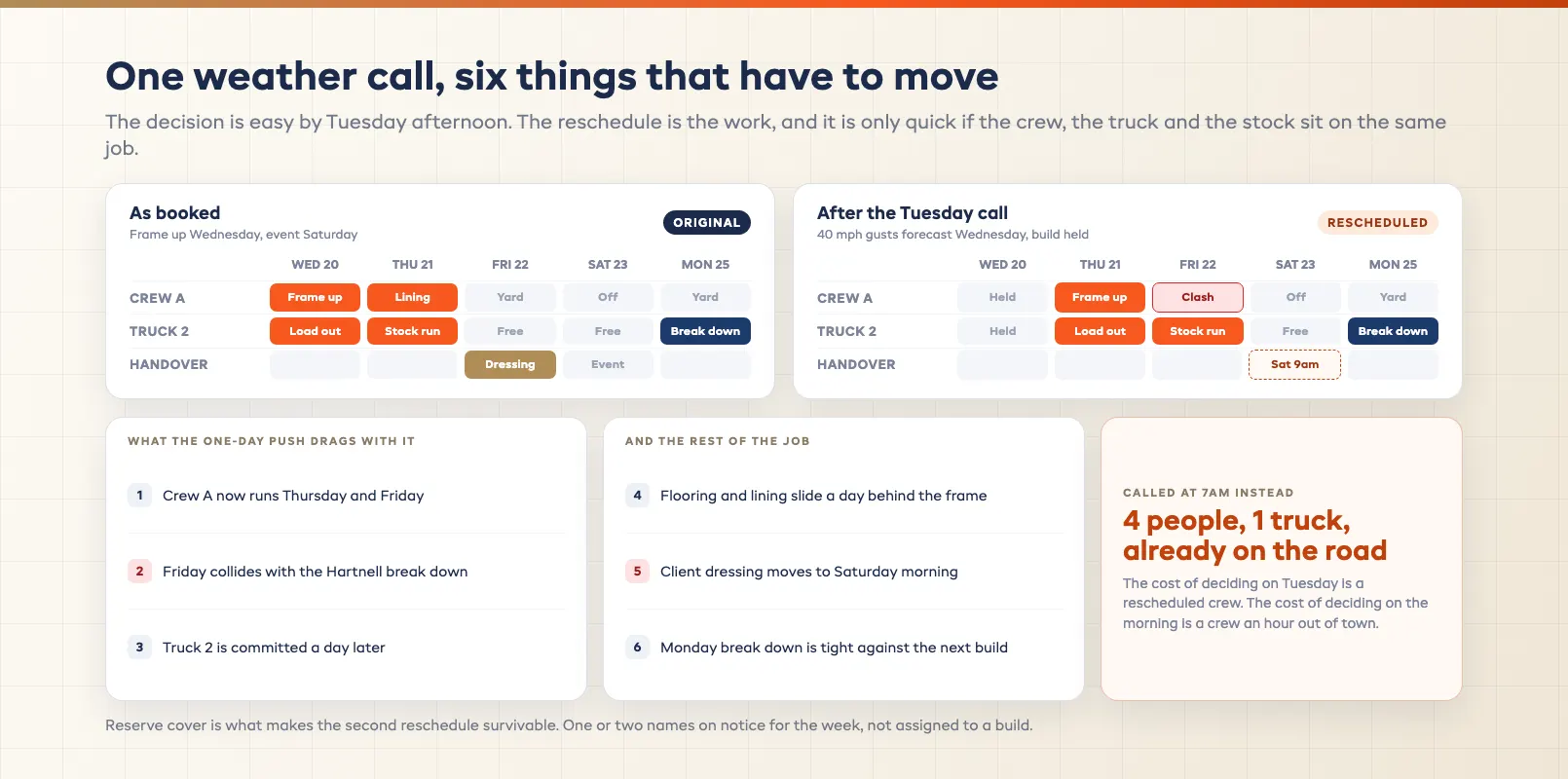
Six consequences from one decision. When crews, structure and stock all sit on the same job, moving the build date moves the commitment and the new clash surfaces immediately. When they live in a whiteboard, a spreadsheet and three phones, a weather call on Tuesday becomes an afternoon of calling people, and at least one of them does not get the message.
A few things make weather weeks survivable:
Decide at a fixed time. Check the forecast against every build at the same hour each day in season. A build called off on Tuesday costs you a rescheduled crew. The same build called off at seven on Wednesday morning costs you a crew already in the van and an hour down the road.
Keep a named reserve. One or two people who are not assigned to a build but are on notice for the week. In peak season the reserve earns their money by the second reschedule.
Tell the crew and the client in the same hour. Most of the damage from a weather move is not the move. It is the four hours where the client does not know and the crew has already started loading.
Write the terms before the season. Wind limits, who wears the cost of a postponed build, what happens to a deposit if the client pulls out after the truck is loaded. Those belong in a signed contract, not in a conversation held in a wet field.
Builds That Run Longer Than a Shift
Bigger work breaks the daily model completely. A county show, a three-day festival, a corporate build with a phased handover: five to ten days on site, crews rotating, a skeleton team in the middle of it, and a break down that needs more people than the build did because everything is coming apart at once.
The scheduling questions change shape on a job that size.
Who is on which day, not who is on the job. A ten-day build with the same four names against the whole block tells you nothing about whether Thursday is covered. Assignments need days attached or the roster is decoration.
Rotation and rest. Ten consecutive days of frame work is not something a team does well at the end of. Plan the rotation in advance rather than discovering on day seven that the same three people have worked every one of them.
Travel and accommodation as committed time. If the site is three hours away, the travel is part of the job and the day is shorter than it looks on paper. Rostering a full build day at the far end of a three-hour drive is how a build slips into a second day.
A different break-down crew. Load out is faster, heavier and usually worse tempered than build. It often wants more bodies and fewer specialists, and it is rarely the same team who put it up two weeks earlier.
One person who owns the site. On a multi-day build somebody has to be the point of contact for the client, the ground, and the other suppliers working the same field. Name them on the job.
Multi-day work is also where the cost of getting scheduling wrong stops being a bad morning and starts being a real number. A four-person crew idle for a day on a festival build because the flooring truck was scheduled behind the frame instead of with it is a day of wages against a job that was already priced. Marquee and tent rental software that holds the structure, the crew, the vehicle and the stock on one job record is what stops that particular hole appearing, because the sequence is written down once rather than remembered separately by four people.
Scheduling crews properly does not make the work easier. The frame still weighs what it weighs and the field is still wet. What it changes is how often the day starts with a problem that somebody could have seen in May.
FAQ
What is marquee crew scheduling?
It is the practice of rostering build teams against specific jobs and days rather than against a weekly shift pattern. A marquee job is a site visit, one or more build days, the event itself and a break down, so the crew requirement is different on each of those days and usually involves more than one team. Scheduling it properly means the roster shows named people against the structure they are erecting, on the days they are erecting it.
Why is rostering by day a problem for a marquee company?
Because the work is a job, not a day. If Crew A is rostered to Wednesday and the build moves to Thursday for weather, the roster now says four people are working a day with nothing on it and nobody is working the day the frame goes up. When the assignment sits on the job instead, moving the build moves the crew with it and any new clash shows up straight away.
How do you stop two builds being assigned the same crew?
Roster crews when the booking is taken rather than the week before, and use a system that flags an overlap at the point the assignment is made. The clash that catches people out is rarely two builds starting on the same morning. It is a two-day build running into a break down that was booked weeks earlier by somebody else, where the overlapping day is the second one. Conflict detection against the existing roster catches that while it is still cheap to fix.
How should rigging and working-at-height certifications be tracked?
Against the person, with an expiry date, and with a flag that fires weeks before the date rather than on it. Renewals take time to book, so a warning on the day the ticket lapses is a warning that arrives too late. It also helps to give people roles on the roster that reflect what they are qualified to do, so a build that needs a rigger asks for a rigger instead of asking for a body.
How do you record crew hours on a build accurately?
Capture them against the booking as they happen instead of reconstructing them at the end of the month. A shared tablet in the yard where staff clock in and out with a PIN stamps each punch against the scheduled shift, and worked hours total up into timesheets automatically with scheduled against actual side by side. Missed punches can be corrected by hand and the week exports for payroll. The useful by-product is labor hours per job, which is what lets you price a difficult site properly next season.
What has to move when the weather pushes a build by a day?
The crew on that build, the truck, the flooring and lining that follow the frame, the client handover, and sometimes the break down behind it. Each of those can create a new clash with another job, which is why the reschedule is more work than the decision. If the crew, structure and stock sit on one job record, moving the build date moves the whole commitment and any conflict surfaces immediately rather than on the morning.
How is scheduling different on a multi-day festival or show build?
Crew assignments need specific days rather than a block, because a ten-day build with four names against the whole period does not tell you whether Thursday is covered. Rotation and rest need planning up front, travel time counts as committed hours, the break-down team is often larger and different from the build team, and one named person should own the site as the contact for the client and the other suppliers working the same ground.
Can general staff rostering software handle marquee builds?
Only partly. A standard roster gives you shifts, availability, conflict detection and notifications to the crew's phones, which covers a good share of the problem. What it does not do on its own is connect the roster to the structure, the stock and the vehicle, so moving a build still means editing several things by hand. Rostering inside the same system that holds the booking is what keeps the crew attached to the job rather than to a date.
in one place