Best Boat Rental Software in 2026: 9 Options Compared
We make EquipDash, and it's first on this list. It's built for self-drive pontoons, powerboats and jet skis, and costs $29/mo with pre-departure checklists, or $69/mo once you want signed waivers, with a 21-day free trial. One exception up front: it doesn't sync with Getmyboat or Boatsetter, so if those marketplaces fill your Saturdays, look harder at the others.
Booqable has the lowest fixed cost, RentalTide has a free plan for small fleets, and Checkfront or Peek Pro fit fleets that sell heavily through Viator and GetYourGuide. This post is about motor fleets. Kayak and paddleboard fleets: see the kayak rental software comparison.
We read each vendor's pricing page and its boat or watersports page in October 2026, and every price and fee below comes from there. We didn't run a trial of each competitor, so their entries describe what the vendor says the product does.
Starting out? See how to run a boat rental business.
Boat rental software compared
| Software | Starting price | Booking fee | Free trial | Best for |
|---|---|---|---|---|
| EquipDash | $29/mo, or $23/mo billed yearly; waivers from $69/mo | 1-2% on card payments, can be passed to the customer | 21 days, no card | Self-drive pontoon, powerboat and jet ski rentals |
| Booqable | $29/mo billed yearly, $35/mo monthly | No commission | 14 days, no card | A handful of boats on the lowest fixed cost |
| RentalTide | Free plan, or $19/mo (Lite) | 4.9% on the free plan, 1% on Lite | Free plan | Small fleets that want $0 upfront |
| BookingCentral | No monthly fee; one-time onboarding fee | Percentage per booking; rate not published | Not stated | Fleets that want setup done for them |
| Checkfront | $99/mo | 3% on online bookings, absorb or pass on | Not stated | Mid-size fleets selling through travel sites |
| Peek Pro | Quote-based | Commission; rate not published | Not stated | Jet ski and pontoon shops that want travel-site reach |
| FareHarbor | No monthly fee | Paid by the guest; rate not published | Not stated | Captained trips mixed with rentals |
| SpeedyDock | Not published | Not published | Demo only | Shops that also run a boat club or dry stack |
| Sharefox | From €99/mo billed yearly | Not published | Trial offered, length not published | Self-service pickup with smart locks |
Booqable's page shows local currency with no symbol; US listings such as Capterra quote it in dollars. Bokun is left out because it's built for tours and has no boat rental product page, BookMyBoat because it doesn't publish pricing or much feature detail, and Reboat because it's priced in euros for skippered trips on the Adriatic.
Getmyboat and Boatsetter aren't here either, because they're marketplaces where you list boats, not software to run the dock. If a big share of your bookings come through them, ask each vendor here to show you a boat sold on Getmyboat being blocked on its own calendar, so you don't sell the same ski twice.
What boat rental software has to handle
A two-hour pontoon gets the lanyard, the life jackets and a walk-around. A houseboat week gets a full walk-through, a test run off the dock and a signed inventory.
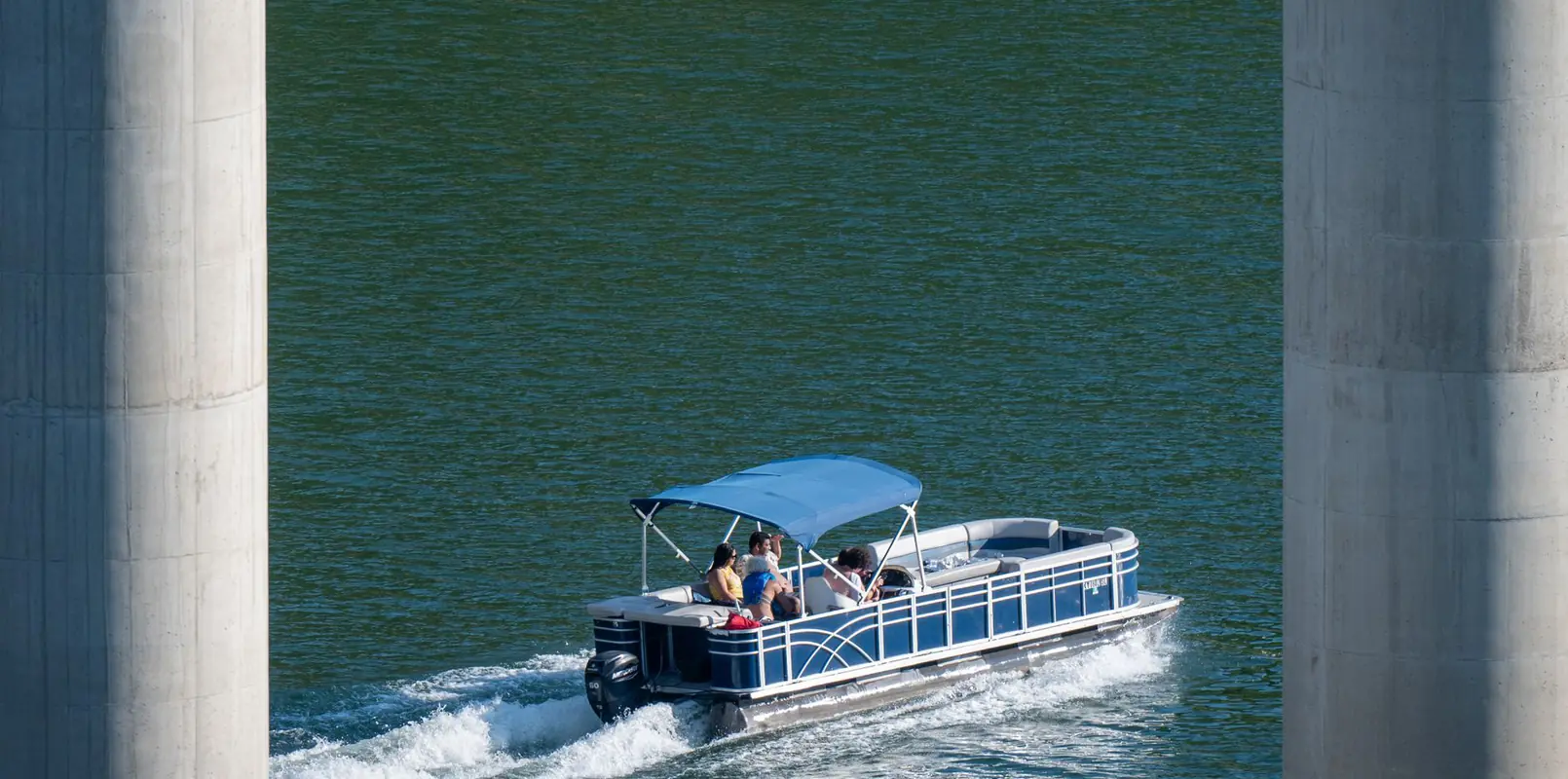
Either way, before anyone leaves, the waiver is signed, the boater card is checked or the briefing is logged, a deposit is held, and someone on your crew has signed off the boat. When it comes back, someone settles the fuel and anything else used, walks the hull, and gives back or keeps the deposit.
- Deposit holds set per boat, and still good on the day. A 16 ft skiff and a cruiser carry very different holds, and card holds lapse: an online card hold on Stripe is usually valid for 7 days, so a hold placed in February for an August houseboat week is gone long before August, and a hold placed at boarding on a 7-night rental runs out about the day the boat comes back. Charging the deposit and refunding it at return avoids the lapse, but a card refund takes about 5-10 business days to show on the renter's statement, so tell them before they leave. Ask each vendor when the hold goes on, and what happens if the renter ignores the request or changes the date.
- Boater safety cards and waivers before arrival. Cards cover motorboats and jet skis, not paddle craft, and each state writes its own rule, so write the waiver questions after you've read your own agency's page. In Florida, anyone born on or after January 1, 1988 needs one to run a boat with a 10 hp or bigger motor, and a renter without one can pass a temporary certificate exam that's valid for 90 days (s. 327.395). A few other rules:
- North Carolina uses the same 1988 birth date and 10 hp line (NC Wildlife).
- In Hawaii a jet ski operator needs a boating course and a separate thrill craft certification (DLNR).
- Maine's card rule covers personal watercraft operators born on or after January 1, 1999 (Maine IFW).
- In Australia each state issues its own boat and jet ski license, and New South Wales requires one to drive at 10 knots or more, and for any jet ski.
- A record of the briefing. Plenty of renters arrive without a card, and then the paper that matters is yours. A Florida livery must give pre-rental instruction, get a written statement from the renter covering each part of it, signed by the instructor, and keep it for 90 days. A Florida livery also can't rent anything but a human-powered boat to someone under 18 (s. 327.54). When a claim comes in, the first question is who briefed the renter and when, so you want that answer on the booking rather than in a binder.
- Checks that fit the craft. On a pontoon it's fuel, life jackets, the kill switch lanyard and the bilge. Jet skis get checked before every launch: oil, the hull for cracks, the ride plate, the hood latched, drain plugs in, the intake grate clear and the lanyard on the rider's wrist. The houseboat list is the longest and runs at boarding and again at return, with the holding tank pumped, generator hours written down, and propane and fresh water topped up.
- Fuel at return. Many jet ski shops build fuel into the hourly price and refuel the skis themselves, while pontoons and houseboats are where fuel gets billed: a prepaid tank, a top-off at the dock pump on return with the gallons charged at the posted price, or a charge by engine hours. Houseboats often bill generator hours separately, from readings taken at boarding. Ask each vendor where the readings go and how the charge reaches the bill.
- Turnaround time between rentals. A cleaning and fueling gap blocked on the calendar, so the 1pm booking isn't sold into a boat still at the pump. On a weekly houseboat that comes back at 10am and boards again at 3pm, those five hours are the whole turnover, and the calendar has to protect them.
- Weather reschedules. A check of tomorrow's forecast the night before misses the 2pm thunderstorm, and on a coast with a daily sea breeze it's the afternoon wind and a small craft advisory that bring the boats in (in Hawaii, trade-wind gusts, swell and high surf). You want the afternoon bookings flagged that morning, while guests are still at the hotel, and boaters able to pick a new time without phoning you. No forecast check replaces the lightning call on the dock when a cell pops up over the bay.
- Damage at return. Photos at launch as well as at return, so damage that was already there is on record before the renter leaves. The boat comes off the booking page until it's repaired, and the charge comes from the deposit.
The 9 options, one by one
1. EquipDash
Built for self-drive pontoons, powerboats and jet skis, with the deposit, the signed waiver and the fuel charge all on the booking.
Price: $29/mo, or $23/mo billed yearly, for up to 2 team members, 1 location and 20 rental products, with pre-departure checklists included. Waivers, forms and the workshop start at $69/mo ($55/mo billed yearly). Seasonal prices and a second location start at $149/mo.
A booking fee of 2% at $29/mo, 1.5% at $69/mo and 1% at $149/mo applies to card payments only, and you can pass it on to customers at checkout. 21-day free trial, no card. See pricing.
A rental product is one listing, such as a 24 ft pontoon, with every boat of that type under it, so 23 boats in six types is six products. Two team members is the limit a dock hits first; the $69/mo plan takes 10 and the $149/mo plan has no limit.
Prices go by the hour, half day, day or week. A shop that rents only by the week can fix the rental length to Friday 3pm to Friday 10am so the booking page offers only Friday pickups, though that setting covers the whole shop, not just the houseboats. Each boat gets its own minimum rental length and its own cleaning and fueling gap after a return, and prepaid fuel and the damage waiver are added at checkout.
The hold amount is set per boat. For a booking more than 7 days out, nothing is held at checkout, and EquipDash emails the boater a deposit link 7 days before pickup. If they ignore it, the booking still shows the deposit as owed, you can resend the link from the booking, and at the dock you take it on Tap to Pay, a card or in cash before the keys go over.
On a week-long rental, your team gets an email about two days before a card hold lapses, so you can charge it or place a new one.
The waiver can ask for the boater card number, date of birth and a photo of the card. Renters can sign on their phone before they arrive, or a walk-up signs on the tablet at your hut, where Someone else needs to sign clears the page for the next rider. A checklist attached to a boat or a whole category blocks pickup until every item is done, and each one records which staff member did it and when.
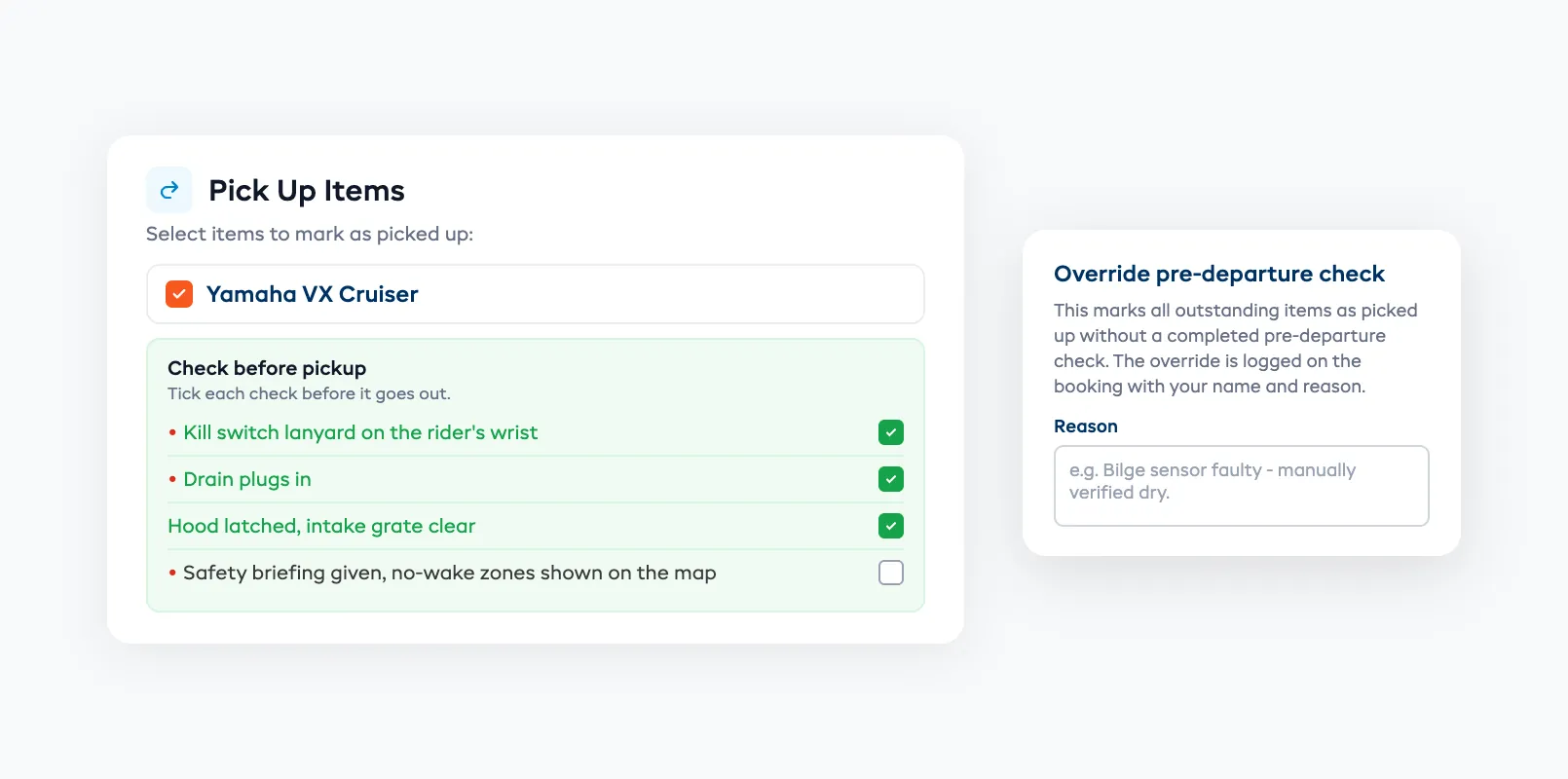
An item can be a tick, a number or a photo, so the houseboat list takes generator hours, the fuel reading and the holding tank level as numbers at boarding and again at return, plus a photo item for each side of the hull, the swim platform and the galley. Put "safety briefing given, no-wake zones shown on the map" on the jet ski list and the briefing becomes a timed record on the booking. The return window takes up to five photos per boat as well, and a boat marked damaged goes to the workshop and off the booking page.
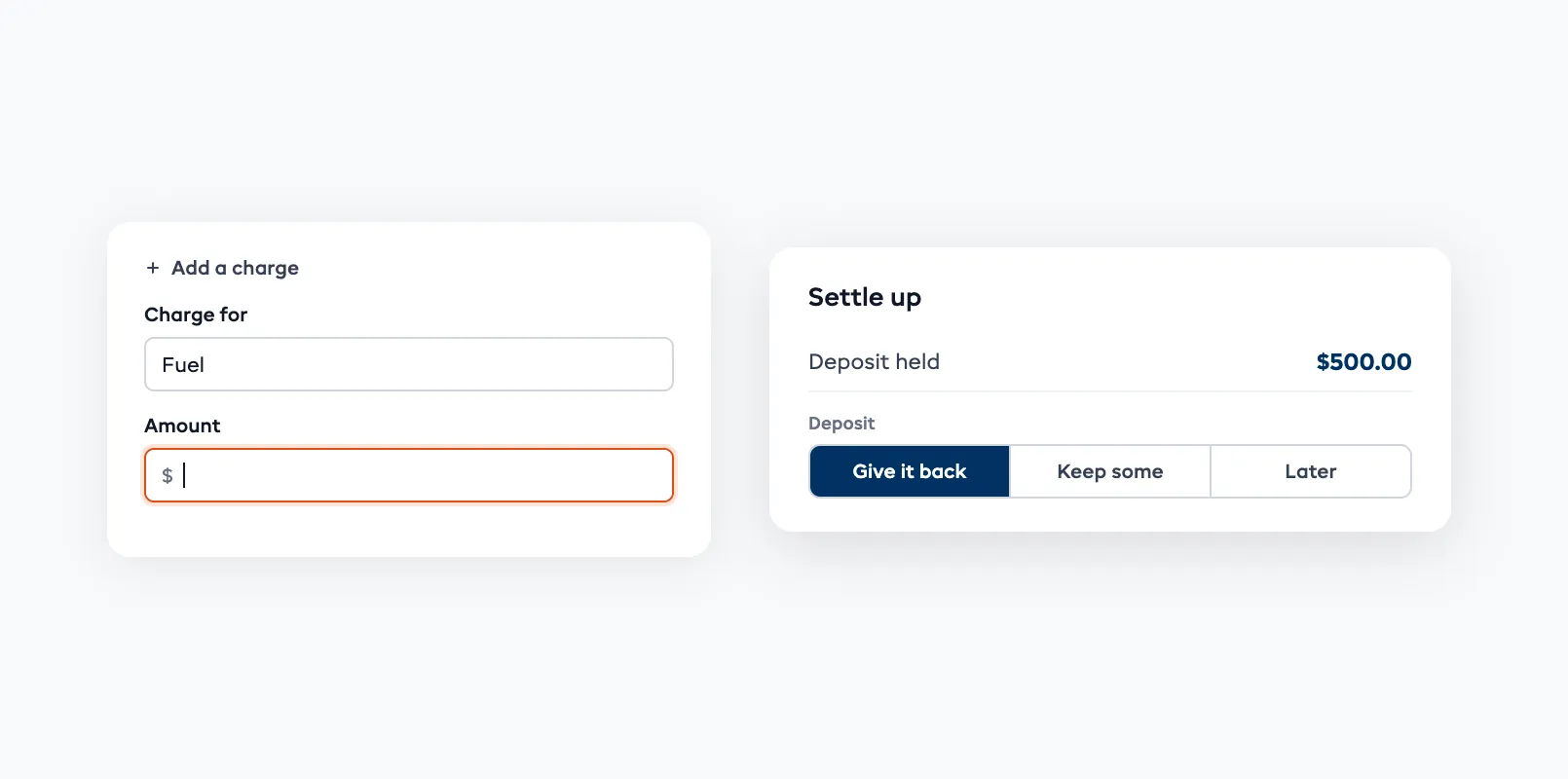
At return, the Settle up part of the return window shows what's still owed and the deposit, with Give it back, Keep some or Later. Add a charge puts the fuel, a pump-out or generator hours on the bill and notes who added it.
Your crew works out the amount from the readings and types it in. A damage charge can also go to the renter as a pay link with the photos attached.
Weather rules are set per location on wind speed, gusts, thunderstorms, wave height or a marine advisory, and checked against the forecast every 30 minutes, so an afternoon storm or a windy afternoon shows up the same morning. The small-craft preset is wind over 25 mph (22 knots), and you can change that number or build your own gust or wave-height rule. The marine advisory flag's own triggers, gusts of 25 mph or waves of about 4 feet, are fixed.
When a rule trips you get a dashboard banner and an email with a one-click Close bookings link, or the closure runs on its own if you set it to. The rule flags bookings whose pickup time falls in the bad-weather window, so a houseboat that left on Saturday isn't on the list. Boaters caught in it get an email, and a text when their phone is on file, with a link to pick a new time with no fee, even inside your normal notice cutoff.
Watch out for: EquipDash has no connection to Getmyboat or Boatsetter. It can import a Google or iCal calendar on the $69/mo plan, but an imported event closes the whole location for that time rather than one boat, so a boat sold on a marketplace has to be blocked by hand.
EquipDash is newer than Checkfront and FareHarbor, so ask any vendor here for a boat shop you can call. More on the boat rental software page.
2. Booqable
Booqable suits a shop with a handful of boats rented by the hour or day that wants the lowest fixed cost.
Price: the Start plan is $29/mo billed yearly or $35 billed monthly, with no commission on bookings. Grow, where e-signatures start, is $69/mo billed yearly or $87 monthly. 14-day free trial, no card.
Rates go by the hour or day. The deposit can be a fixed amount or a percentage, the card hold is only captured if the boat comes back damaged, and agreements and waivers are signed online.
Watch out for: a dock that needs signed waivers is on Grow, not Start. Extra locations cost more, and no travel-site connections are listed on its boat page.
3. RentalTide
RentalTide is for a small boat rental shop that wants to start with no upfront cost.
Price: a free plan with a 4.9% fee per online booking, or Lite at $19/mo with a 1% fee, covering 10 listings, one location and up to $50,000 a year. The Core plan is $2,400/yr.
Travel-site bookings cost $5 each. No setup fee and no trial, since the free plan is the trial.
Its boat page covers hourly through multi-day rentals, a deposit released or charged after the inspection, fuel charges on pontoons, captain scheduling for charters and more than one dock.
Watch out for: on the free plan, $250,000 a year in online bookings costs $12,250 in fees. Lite has no travel-site channels, one waiver and one location, so a growing fleet moves up to Core quickly.
4. BookingCentral
BookingCentral fits a US fleet renting by the hour or day that wants the setup done for it.
Price: no monthly fee and one plan with every feature. There's a one-time onboarding fee sized to your operation, and a percentage per booking that you pay or show to guests at checkout. Neither rate is published.
Rates run by the hour, half day, day or several days. The deposit is fixed or a percentage, a separate card hold covers damage, and fuel is sold as an add-on at checkout.
Watch out for: waivers run through a connected provider such as Smartwaiver, so that's a second bill. Get both rates in writing before the demo.
5. Checkfront
Checkfront is aimed at mid-size fleets that sell through Viator and GetYourGuide.
Price: one plan at $99/mo plus a 3% fee on online bookings, which you can absorb or pass on to guests. Offline bookings carry no fee, and there are no setup fees.
Guests can upload an ID or boater card, a rule can make certain boats captain-only, prices can differ by location, and damage holds and travel-site connections are included.
Watch out for: the 3% is $7,500 a year on $250,000 online unless guests pay it. Damage holds only work where the customer's payment method supports them, so ask what your crew does when a card declines at the dock with a line behind it.
6. Peek Pro
Peek Pro is pitched at US jet ski and pontoon shops that want reach on travel sites.
Price: quote-based. Its watersports page says there are no monthly fees, and it charges a commission without a published rate.
Its watersports page lists deposits and card holds, damage photos, waivers with an ID upload, and connections to Viator, GetYourGuide and TripShock.
Watch out for: ask for the commission rate in writing, and whether it applies to bookings your crew takes over the phone.
7. FareHarbor
FareHarbor suits operators mixing captained trips and tours with rentals. Of the 15 US boat rental operators we checked in November 2026 whose booking system we could detect, 12 use FareHarbor.
Price: no monthly fees and no setup fees. Guests pay a fee at checkout at a rate FareHarbor doesn't publish on its site, and you can fold it into your price instead. Ask FareHarbor for the rate in writing.
It's built around departures: you put a captain and crew on each one, hold or rebook it for weather, and sell it through more than 250 travel sites and partners. Waivers and card holds come with it.
Watch out for: guests see the fee on their checkout, so your price sits next to a shop down the shore that adds none. FareHarbor's terms also say guest booking fees are generally non-refundable, so a rained-out renter may lose the fee even when you refund the boat.
8. SpeedyDock
SpeedyDock is for businesses that run a boat club or dry stack storage alongside rentals.
Price: not published; demo only.
Hourly, half-day and full-day pricing, licenses and waivers uploaded as required documents, and multiple locations. Captain assignment and weather-day rebooking are described for charters.
Watch out for: there's no public price. If you only rent boats, ask for a quote without the club side.
9. Sharefox
Sharefox is for rentals with self-service pickup and return.
Price: Basic from €99/mo billed yearly or €108 monthly, depending on how many items and locations you have and which modules you add.
Rates can be hourly, half-day, daily, weekend or seasonal. Damage deposits run automatically, renters sign at booking, and smart locks handle pickup and return without staff.
Watch out for: pricing is in euros only, and the trial length isn't published.
What it costs at your volume
This table runs the published fees at two sizes: $60,000 and $250,000 a year in online bookings. Both assume you absorb every booking fee, and card processing is extra.
| Software | Subscription per year | Total at $60,000 | Total at $250,000 |
|---|---|---|---|
| Booqable (Start) | $348-$420 | $348-$420 | $348-$420 |
| EquipDash ($69/mo plan) | $660-$828 | $1,560-$1,728 | $4,410-$4,578 |
| EquipDash ($149/mo plan) | $1,428-$1,788 | $2,028-$2,388 | $3,928-$4,288 |
| Checkfront | $1,188 | $2,988 | $8,688 |
| RentalTide (free plan) | $0 | $2,940 | $12,250 |
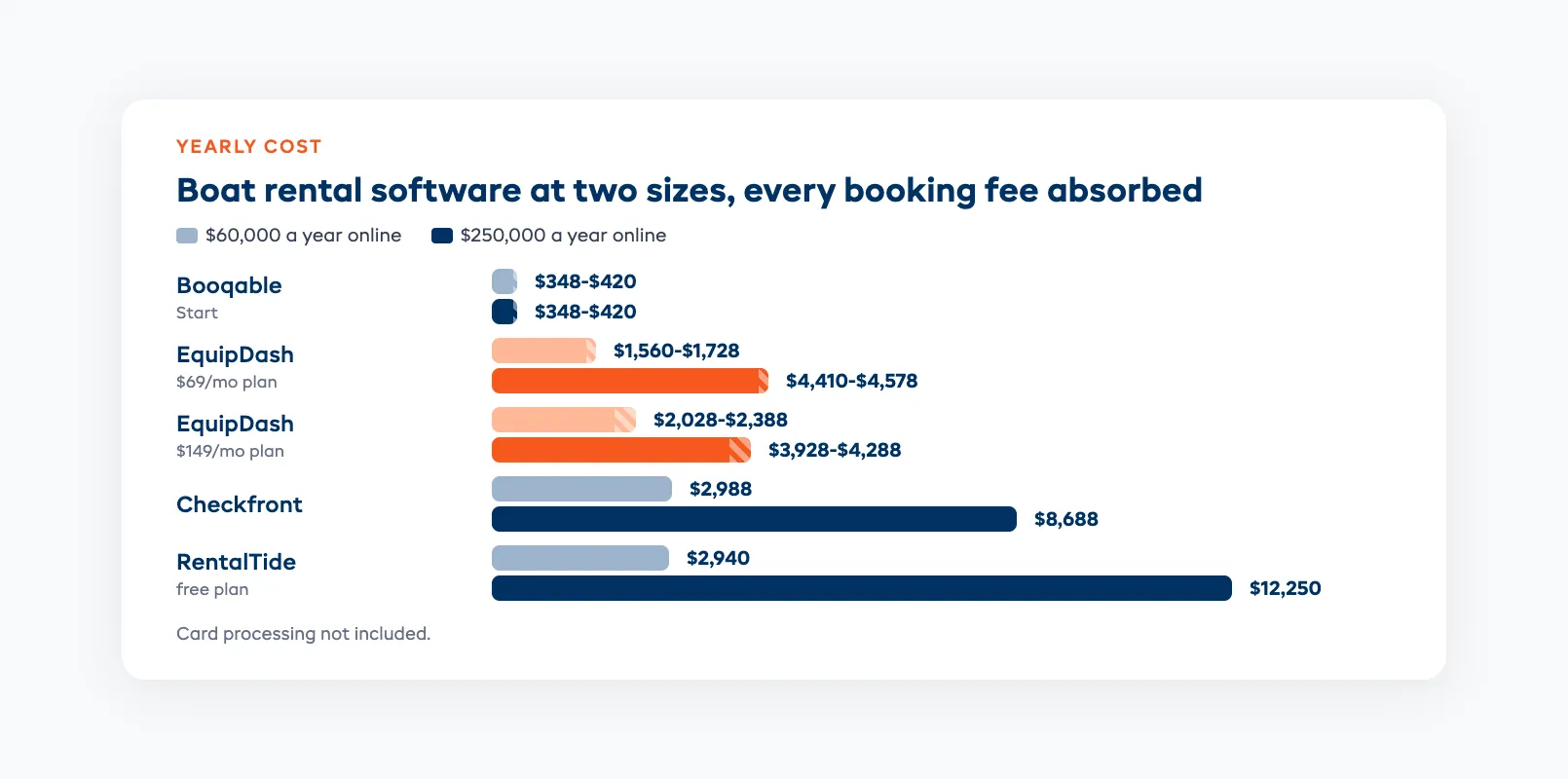
EquipDash is shown at $69/mo because that's where signed waivers start; at $29/mo, without them, $60,000 comes to $1,476-$1,548. From about $155,000 a year online, the 1% fee at $149/mo makes it cheaper than the $69/mo plan on yearly billing, and it adds seasonal prices and a second location. RentalTide's Lite plan would cost less at $60,000 but stops at $50,000 a year.
If you pass the booking fee on to customers, EquipDash and Checkfront come down to the subscription alone. BookingCentral, Peek Pro, FareHarbor, SpeedyDock and Sharefox don't publish enough to include.
How to choose
- You run self-drive boats and want the deposit, the briefing record and the fuel charge on the booking: EquipDash.
- You rent kayaks and paddleboards, not motors: read the kayak rental software comparison instead.
- You rent a handful of boats and want the lowest fixed cost: Booqable, or RentalTide's free plan if you'd rather pay per booking.
- Travel sites bring in much of your business: Checkfront or Peek Pro.
- You run captained trips as well as rentals: FareHarbor, or RentalTide for captain scheduling on a smaller budget.
- You also run a boat club or dry stack: SpeedyDock.
Before you sign, put these bookings through the trial: a pontoon with a $500 hold booked a month out, a 7-night houseboat rental where the renter never clicks the deposit link, a walk-up jet ski rider with no card who needs the briefing logged, a ski that comes back with a chewed impeller and a quarter tank of fuel, and a thunderstorm forecast for 2pm. Then move one booking to next week and see what happens to its deposit. Run the trial in your slowest month, but date the test bookings for a June Saturday so you see a full calendar.

Before you commit, ask what happens to the Memorial Day bookings already in your old system: whether they come across or someone retypes them.
For jet ski specifics, see jet ski rental operations. For the policies behind it, see boat damage deposits and boat rental fuel and provisioning.
Frequently Asked Questions
What is the best boat rental software for a small fleet?
For self-drive rentals that need deposit holds and a record of each briefing, EquipDash starts at $29/mo with pre-departure checklists, or $69/mo with signed waivers, and has a 21-day free trial. Booqable starts at $29/mo billed yearly with no commission, though e-signatures need its $69 Grow plan. RentalTide has a free plan with a 4.9% fee per online booking.
How much does boat rental software cost?
Booqable's Start plan is the lowest published price with no booking fee, at $29/mo billed yearly. EquipDash is $29/mo plus 1-2% on card payments, Checkfront is $99/mo plus 3%, and RentalTide is free but takes 4.9% of each online booking. BookingCentral, Peek Pro, FareHarbor and SpeedyDock don't publish their rates.
Can boat rental software hold a security deposit?
Most of the nine list deposits or card holds, and the part to test is timing: an online card hold usually lasts about 7 days, so a hold taken in February for an August week is gone by August. In EquipDash the hold amount is set per boat, a booking more than 7 days out gets an emailed deposit link 7 days before pickup, your team is warned about two days before a hold lapses, and staff give the deposit back or keep some in the return window. Charging the deposit and refunding it at return avoids the lapse, but the refund takes about 5-10 business days to reach the renter's card.
Can I collect boater safety cards before the rental?
Only some renters need one: cards cover motorboats and jet skis, not kayaks or paddleboards, and the birth-year and horsepower rules vary by state. In Florida and North Carolina it's anyone born on or after January 1, 1988 running a 10 hp or bigger motor. EquipDash's waiver can take the card number and a photo of the card, Checkfront lets guests upload an ID or boater card, and SpeedyDock treats licenses as required documents.
How does boat rental software handle fuel?
EquipDash and BookingCentral sell prepaid fuel at checkout. In EquipDash, staff can also record the fuel reading or engine hours on the pickup and return checklist and add the fuel used as a charge at return, typing in the amount. RentalTide adds fuel charges on pontoons after the rental.
in one place