Cyber Week Experience Gifts: Holds, Bundles and No-Show Rules

Cyber Week experience gifts sell best when you decide three things before Black Friday: what a gift holds (money or a seat), which bundles a card should cover, and what happens when a gift recipient books and never turns up.
Black Friday lands on November 27 this year and Cyber Monday on November 30. Last year the National Retail Federation counted a record 202.9 million shoppers from Thanksgiving Day through Cyber Monday, and 75.9 million of them shopped online on the Monday. In the same season, 43% of shoppers planned to buy at least one gift card.
Some of those cards will be for a kayak tour, a ski lesson or an e-bike day. The person who turns up next spring didn't pick the date, didn't pay, and hasn't read your terms.
Our gift card program guide covers pricing, breakage and the liability on your books, and the Black Friday gift card push covers the emails and the offer. This one is about the rules underneath, the ones your staff will need when a recipient calls in March.
Three gift shapes, and what each one holds
Every gift you sell this week falls into one of three shapes. Each one ties up something different, so decide which you'll sell before the first order lands.
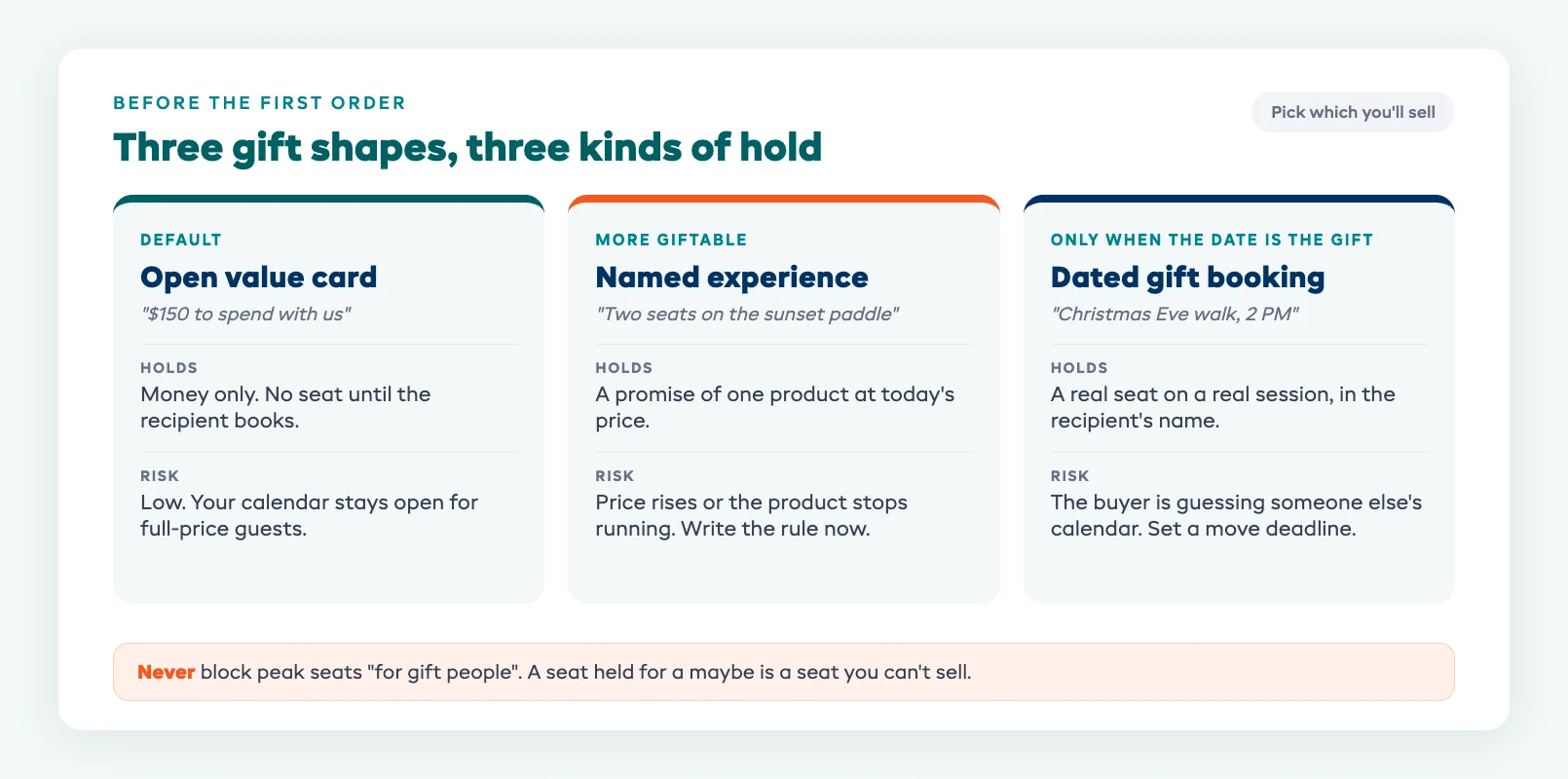
An open value card ("$150 to spend with us") holds money and nothing else. No seat is taken until the recipient books, so your spring calendar stays open for full-price guests.
A named experience ("two seats on the sunset paddle") feels like a better present, but it promises a product at a price you set today. Write down what happens if that tour runs at a higher price next season or stops running.
A dated gift booking ("Christmas Eve snowshoe walk, 2 PM") takes a real seat on a real session. It's the right call when the date is the gift, and the wrong one when the buyer is guessing at somebody else's calendar.
Don't hold peak seats for undated gifts
The quiet mistake is blocking seats on a June Saturday "for gift people." Nobody knows when those recipients will book, and a seat held for a maybe is a seat you can't sell to someone with a card in hand.
Sell open cards, let the recipient book like any other guest, and keep your capacity rules exactly as they are. If you already cap peak sessions, the Thanksgiving week capacity guide walks through setting those limits by the tightest constraint.
When the buyer insists on a date
Book it in the recipient's name, not the buyer's, so the waiver, reminders and weather messages reach the person who's actually coming. Then tell the buyer in writing how far ahead the date can be moved, because that's the first call you'll get in January.
Your code won't work on a marketplace listing
A gift code you sold can only be spent where your own checkout takes it, which is your booking page or your counter. If most of your seats sell through Viator or GetYourGuide, put "book on our website with your code" in the gift email, or expect a confused recipient who already paid the marketplace.
Price bundles so one card covers one booking
A $100 card for a $112 experience creates a top-up conversation at the counter. Pick your preset amounts by working back from the bookings people actually give.
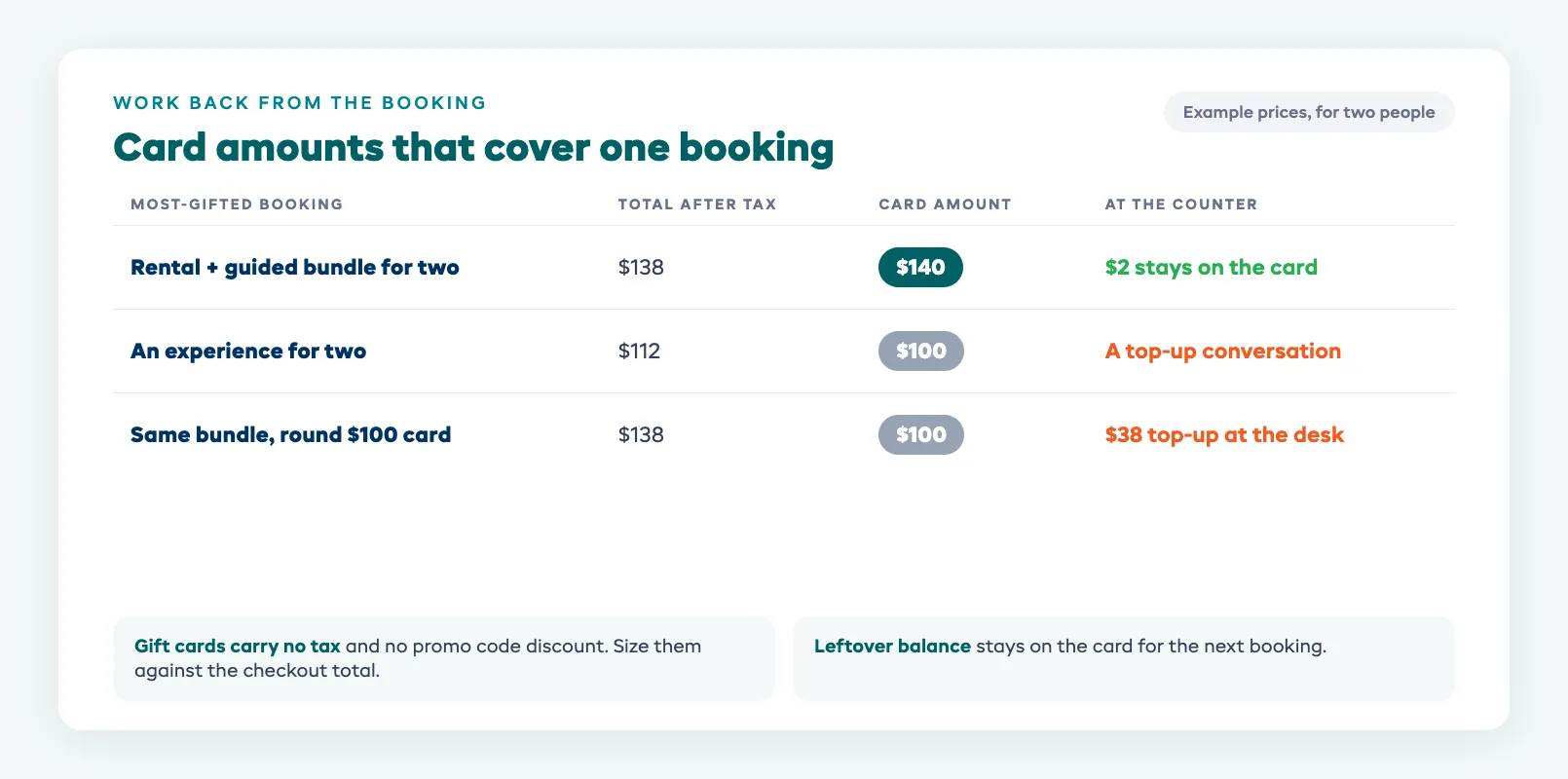
Start with your three most-booked products for two people, then round each total up to a clean number. If a rental-plus-tour combo costs $138 for two after tax, a $140 card covers it with $2 left on the card, where a $100 card would leave a $38 top-up at the desk.
Watch the tax gap
In EquipDash, gift cards are never taxed and can't be discounted by a promo code, while the booking they pay for may carry sales tax. So size the amount against the total the guest sees at checkout, not your shelf price.
Bundles make a better present
A mixed bundle pairs a rental with a guided session, such as a paddle tour plus the board for the afternoon, and books as one item with one confirmation. As a gift it reads as a plan rather than a voucher, and the recipient makes one booking instead of two.
Keep the security hold on a real payment card, never on the gift balance. A gift card should pay for the experience, and the damage hold should sit on the guest's own card, which also keeps a later dispute simple.
Bonus value beats a discount in Cyber Week
"Buy $100, get a $20 bonus card" protects your price and still feels like a deal. Keep the bonus as its own voucher with its own short end date, separate from the card the buyer paid for.
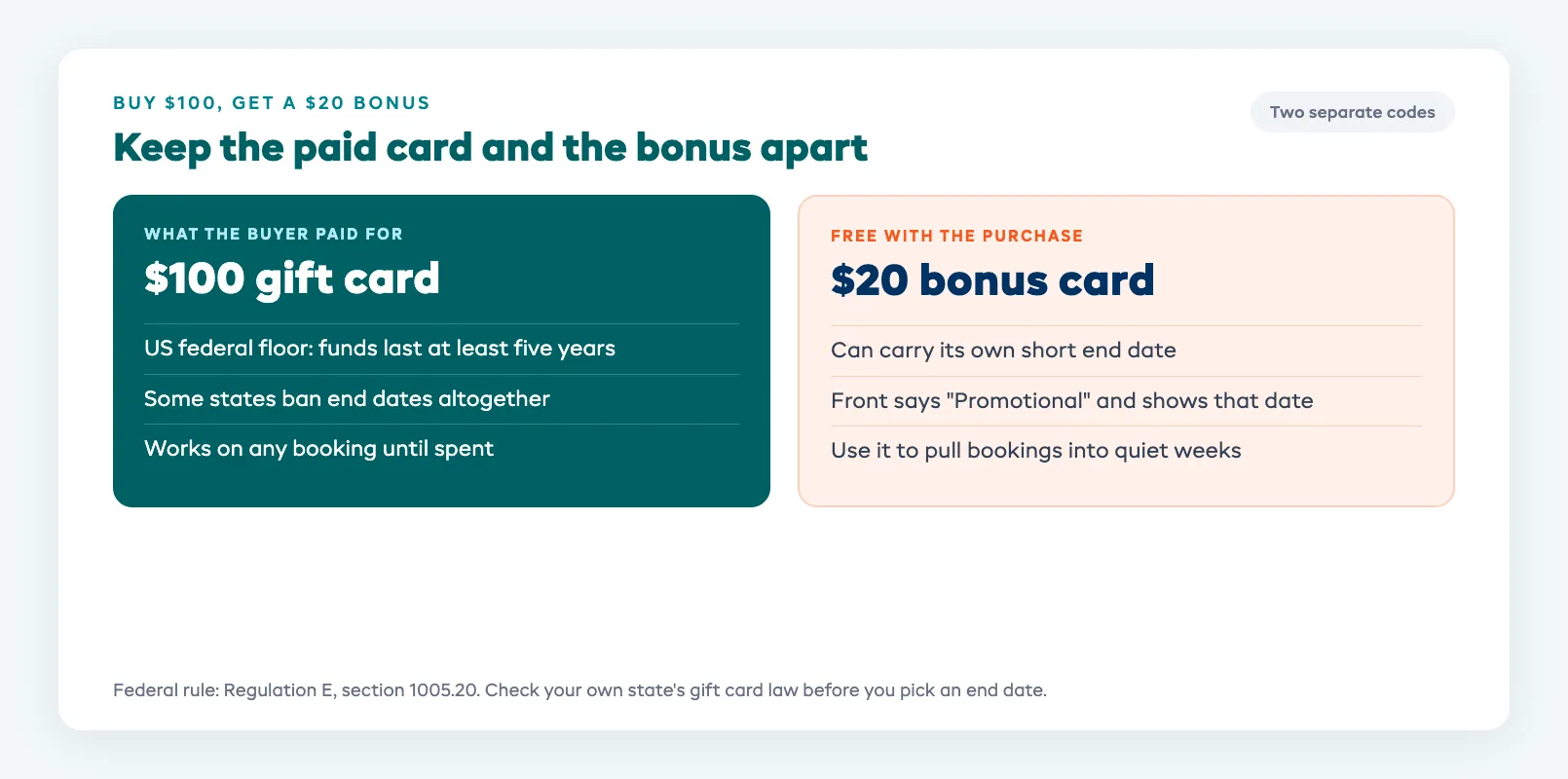
That split matters legally in the US. Under the federal gift card rule in Regulation E, section 1005.20, funds on a paid gift card generally can't expire sooner than five years from issue or the last load. A card issued free as part of a promotion is excluded if it says "Promotional" (or similar) on the front and shows its end date there too.
Read the CFPB's official commentary on experience vouchers before you print "One sunset paddle for two." A voucher for a specific experience with no dollar amount generally falls outside the rule, while one that states a value, such as "a $150 value," is covered.
States can go further. In California, a gift certificate generally can't carry an expiration date or a service fee, and since April 1, 2026 a balance under $15 has to be paid out in cash when the holder asks. Check your own state before you pick an end date, and ask your accountant if you're unsure.
Write the no-show rules before you sell the gift
A gift recipient who books and doesn't show is not the same as a guest who paid and forgot. They didn't spend the money, so "you lose it" lands harder, and the buyer often hears about it.
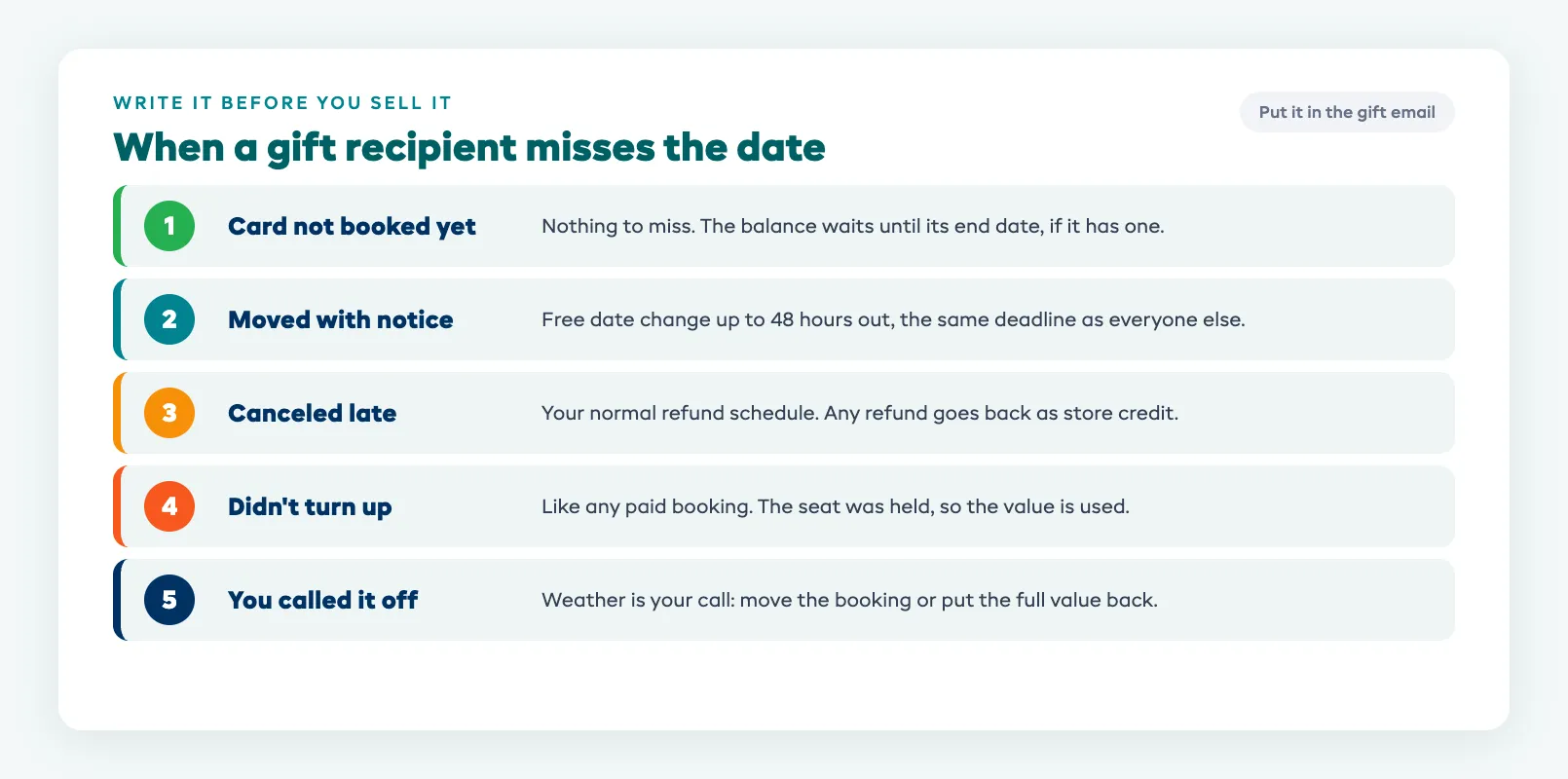
Here's the ladder we'd set for a tour or lesson booked with a gift card:
- Card not yet booked. Nothing to no-show. The balance sits on the card until its end date, if it has one.
- Moved with notice. Let gift recipients move the date for free up to 48 hours out, the same deadline as everyone else.
- Cancelled inside the window. Your normal refund schedule applies. Send any refund back as store credit, not cash to the buyer's card.
- Didn't turn up. Treat it like any paid booking. The seat was held and nobody else could take it.
- You called it off for weather. Move the booking, or put the full value back on the card. Never count your own call against the guest.
If you want one softer step, offer a single goodwill rebooking on a quiet weekday. Make it a rule your staff can apply, not a favor they negotiate. Our no-show and cancellation strategy goes deeper on deposits and reminders.
When half the group shows up
Gift bookings are often for two, and sometimes only one comes. Check in the person who came and mark the other as a no-show on their own, so the booking still counts as attended and nobody gets a "we missed you" email by mistake.
For a rental, the gear should go back on the shelf the moment you call it, so you can rent it for the rest of the day. For a session, the seat stays sold, because it already cost you a guide and a spot on the boat.
Put the rules where both people will see them
The buyer reads your terms on Black Friday and the recipient reads them in March, so put them in both places. Show the end date, the move deadline and the no-show rule on the purchase page and again in the gift email.
Age floors belong there too. If your brewery van or sailing session is 21 and over, say so before checkout, because the buyer may be shopping for a 19-year-old nephew.
NRF found 46.9 million people shopped on a mobile device on Cyber Monday 2025, so buy one of your own cards on your phone before Friday and read every screen. The early Black Friday checklist has the rest of the counter prep.
Your Cyber Week gift setup, day by day
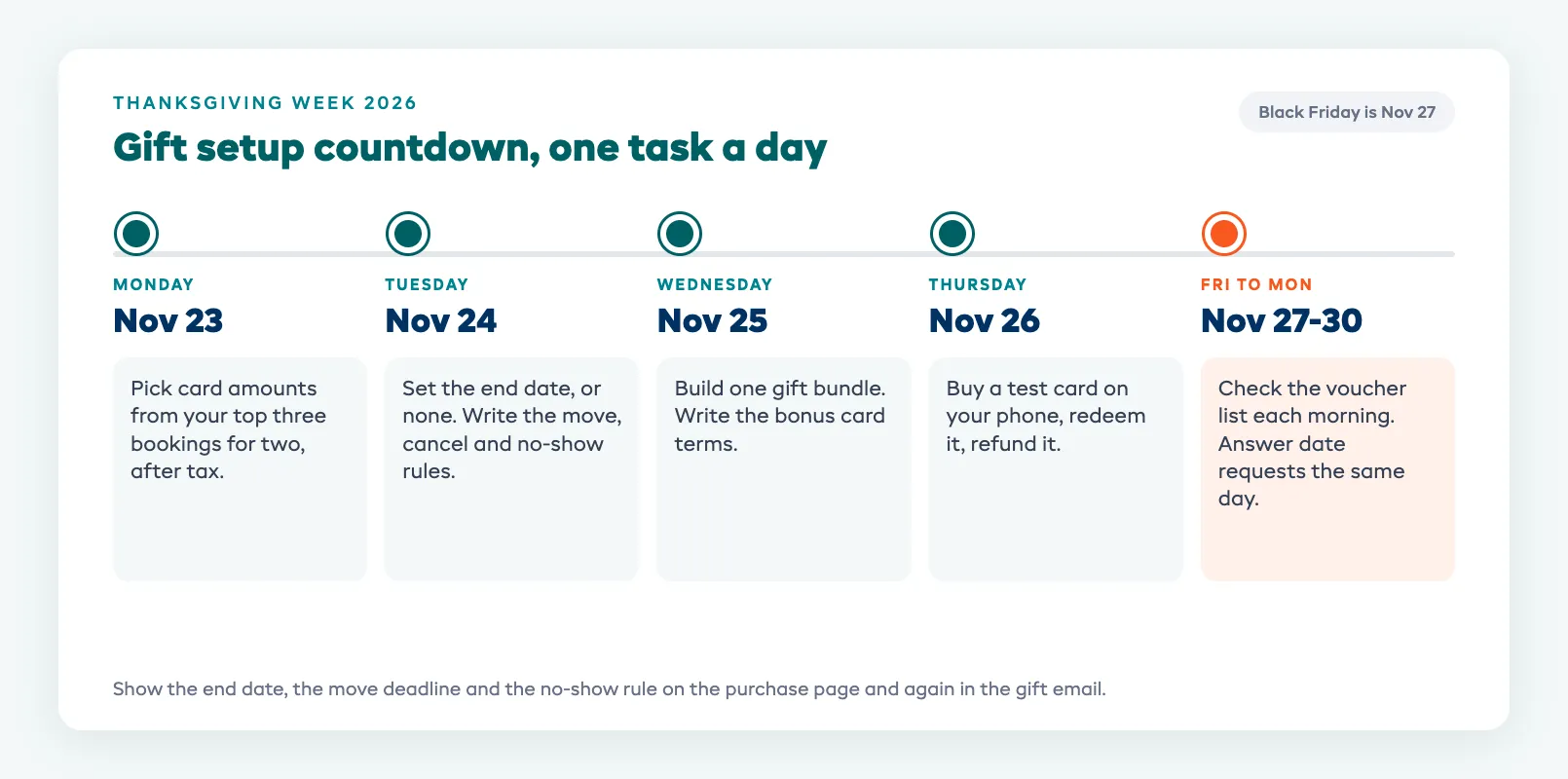
- Mon Nov 23: pick your preset amounts from your top three bookings for two, after tax.
- Tue Nov 24: set the gift card end date, or none, and write the move, cancel and no-show rules.
- Wed Nov 25: build one gift bundle and create the bonus voucher terms.
- Thu Nov 26: buy a test card on your phone, redeem it on a test booking, then refund it.
- Fri Nov 27 to Mon Nov 30: check the voucher list each morning and answer date requests the same day.
Where EquipDash fits
Turn on gift cards under Settings, Booking widget, Sell gift cards, then pick How long gift cards last or No end date. A buyer online sees the end date before they pay, it's in the gift email with the code, the value and their personal message, and the recipient types the code into the Promo or gift card code field at checkout.
Whatever the card doesn't spend stays on it for the next booking. Every card, its balance and where it was spent sits under Promotions, Vouchers, and staff can sell one at the counter in POS. The gift cards and vouchers page shows the full feature.
Your cancellation policy sets the refund windows and lets you choose store credit as the refund method; see refunds and cancellations. When a guest doesn't come, Mark as no show keeps the booking paid and the seat sold, puts rental gear back on the shelf, releases a held deposit, and can send a We missed you email that you word yourself. Nobody gets marked by the software on its own, so a guest whose check-in got missed isn't emailed by mistake.
FAQ
Should I sell dated experience gifts or open gift cards over Cyber Week?
Sell open value cards by default and let the recipient book like any other guest. Only book a dated gift when the date is the present, such as a Christmas Eve tour, and put it in the recipient's name with a clear move deadline.
How do I pick gift card amounts for experiences?
Take your three most-booked products for two people, use the total after tax, and round up to a clean number. A card that covers the whole booking avoids a top-up at the counter, and a small leftover stays on the card for next time.
Can my Cyber Week gift cards expire after 12 months?
In the US, usually not for paid cards. Regulation E sets a floor of five years from issue or last load for most paid gift cards, and some states, such as California, ban expiry dates on gift certificates altogether. A free promotional bonus card can carry a shorter end date if it is labeled as promotional and shows the date on the front.
What happens if a gift recipient books and doesn't show up?
Treat it like any paid booking: the seat was held, so the value is used. We'd allow free date changes up to 48 hours out and one goodwill rebooking on a quiet day, and put both rules in the gift email so the recipient knows before they book.
Should a gift card cover the security deposit on a rental?
No. Use the gift card for the rental or experience itself and take the security hold on the guest's own payment card. Mixing the two makes damage claims and disputes much harder to sort out.
in one place