Marketing Strategies for Tour Operators: What to Do First, and How to Track It
Most lists of marketing strategies for tour operators hand you twenty ideas and no order to run them in. A two-guide company can't do twenty things in June. It can do five well, if they're the right five and you can tell which ones brought the bookings.
This guide puts them in the order we'd suggest for a small tour business: the free things first, then the ones that cost a commission, then the ones that cost ad money. Each one comes with a way to count what it brought in, because the hardest part of marketing a tour company is knowing which channel actually filled Saturday.
It's written for day tours: walking, food, bike, kayak, wildlife and similar trips that people book days or weeks ahead, often on their phone.
Start with the searches that already include your name
Someone who searches your company name, or "kayak tour" plus your town, is close to booking. Win those searches before you pay for anyone else's.
Fill in your Google Business Profile like a booking page
Google says local results are ranked mainly on relevance, distance and prominence, and that the number of reviews and positive ratings feed prominence. Complete details help with relevance.
So pick "Tour operator" or the closest specific category, set hours for the season you're actually in, and add photos from real departures every few weeks. A guide pointing at something with eight guests looking is worth more than another sunset.
Put your booking page as the website link, not your homepage. Every tap you remove between "this looks good" and "pick a time" matters on a phone.
Booking links on Google itself
Google also shows booking links for tours in its Things to do listings, fed by booking systems and resellers. Google keeps a list of approved Things to do connectivity partners and recommends that a single tour operator go through one of them rather than connect directly.
Ask your booking software whether it's on that list. If you sell through OTAs, their prices for your tours can show there too, which is one more reason your own listing needs to be the better-looking result.
Turn every departure into reviews
Reviews help you rank on Google, and they're what a stranger reads before trusting you with a day of their vacation.
Our guide to review velocity for tour operators goes deeper on volume and replies. Here's the part that belongs in your marketing plan.
Ask on the same day
Ask while the guest still remembers the guide's name. By next week they're home, back at work and the trip is a photo on their phone.
Send it a couple of hours after the tour, when people are at dinner talking about it, not days later. Send one reminder to anyone who didn't answer, then stop.
Never trade a discount for a review
Google's Maps policy forbids offering discounts or free goods in exchange for a review, and forbids asking only your happy guests. Its tips to get more reviews repeat the same warning.
In the US, the FTC's 2024 rule on consumer reviews also bans rewards for reviews that have to say something positive. Ask everyone, offer nothing for the review, and reply to the bad ones politely.
Setting it up in EquipDash
In EquipDash this is a survey that goes out after each booking. Under When to send you pick Right away, 2 hours, Next morning, 24 hours or a custom delay, and One reminder, 7 days later catches the people who forgot.
Everyone who finishes the survey sees your review pages, such as Google and TripAdvisor, whatever score they gave. If you add a Thank-you reward, it's for finishing the survey, never for leaving a review.
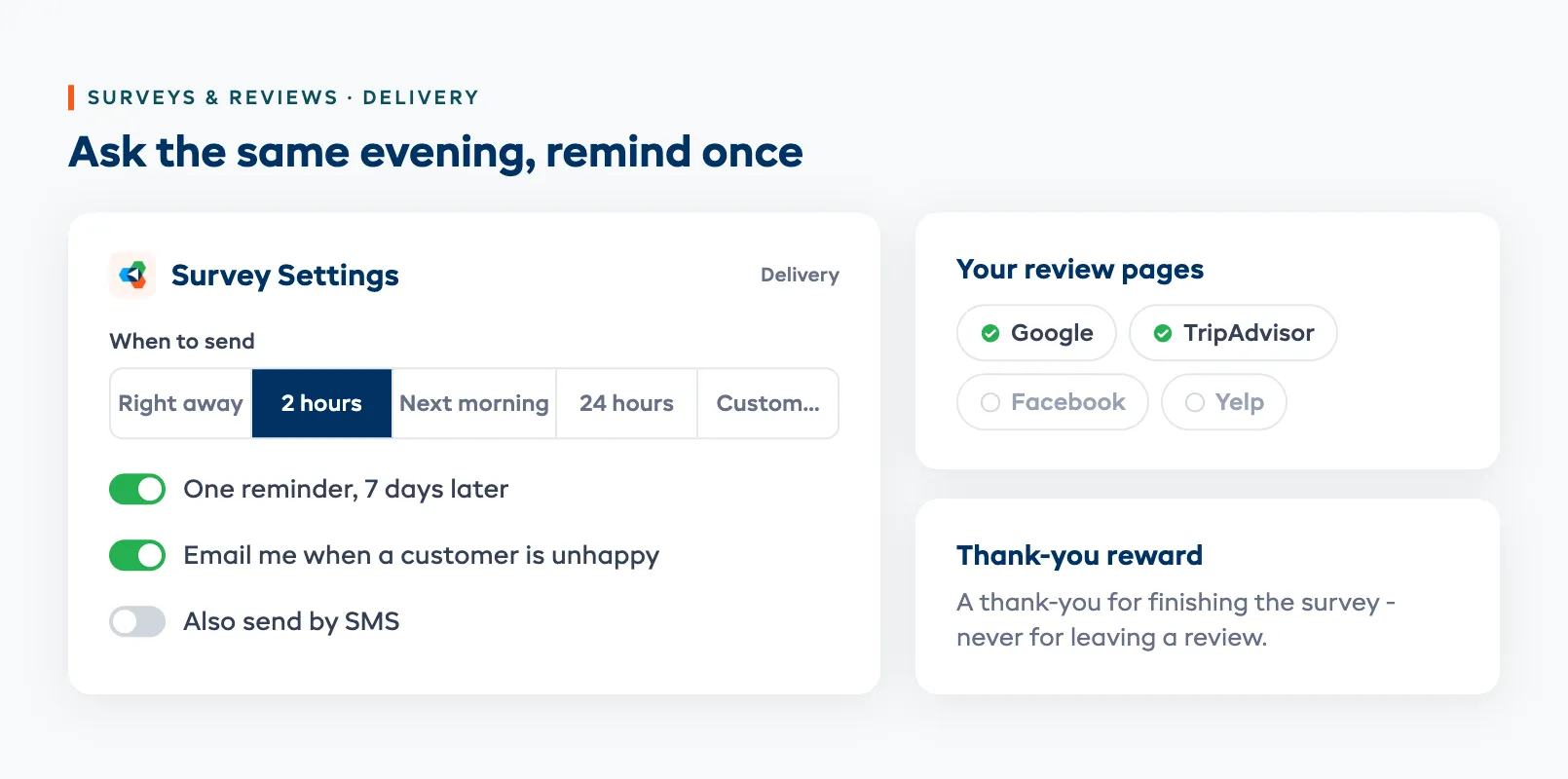
Turn on Email me when a customer is unhappy too. You get the chance to call that guest before they write the review.
Treat OTAs as paid discovery, not the whole plan
Viator, GetYourGuide and the other marketplaces bring travelers who've never heard of you. You pay for that with a commission on every booking, so treat it like advertising you only pay for when it works.
The risk is letting them become your only channel. Then the OTA owns the customer relationship and sets the terms, and your margin goes down each time it raises the commission or you pay extra for placement.
Our post on OTA distribution for tour operators covers which tours to list and how to price them. In EquipDash, Viator and GetYourGuide bookings land on the same calendar as your direct ones, so a seat sold on one is gone everywhere. GetYourGuide shows up as its own line in the Booking channel report, which tells you how much of your month you're paying commission on.
The guest who found you on an OTA can still book direct next year. Make sure your business name is on the meeting-point sign, the van and the guide's jacket, so they can find you without the OTA.
Partners who send you guests
Hotel front desks, visitor centers, campgrounds and the bike or kayak rental shop down the street all get asked "what should we do tomorrow?" Most will happily point people to you if it's easy and they get something for it.
For a hiking company, the outfitter near the trailhead that sells boots and maps often sends more people than a big hotel. The staff there talk to exactly the guests you want.
Agree on the deal in writing before the season: a discount for their guests, a referral fee per booking, or both. Then give each partner something they can hand over at the desk, like a card with a QR code to your booking page.
One promo code per partner
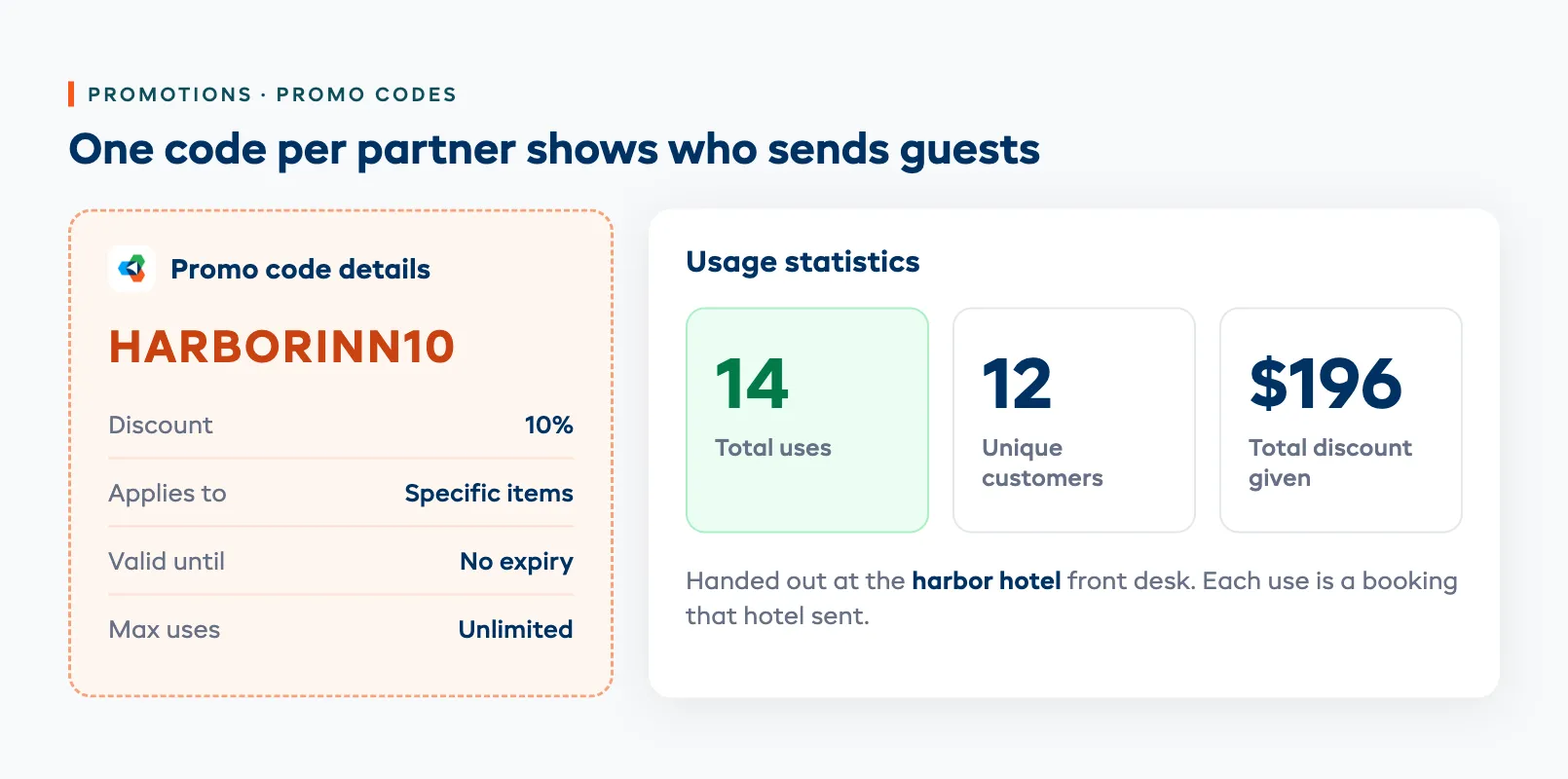
Give every partner their own code so you can see who actually sends people. In EquipDash you make one under Create promo code, set the Discount Type, cap it with Max Total Uses or Valid Until if you want, and limit Applies to to the tours that partner sells.
Say the front desk at a harbor hotel hands out HARBORINN10, which takes 10% off. On a two-person $140 booking that's $14 off.
By the end of the season the code's page shows 14 total uses from 12 unique customers. At $14 off each $140 booking, that's $196 total discount given.
That's the number you take to the hotel when you renew the deal, and the one that tells you whether the campground that promised the world sent anyone at all.
Email the people who already booked
Past guests are the cheapest bookings you'll get. They already trust you, and many of them have a friend, a parent or a work team who'd do the same tour.
Our tour operator CRM guide covers what to keep on each guest. For marketing, the list itself is what counts.
Get consent first
Ask at checkout whether people want news from you, and keep that answer. In the US, CAN-SPAM requires your postal address in every marketing email and a working opt-out you honor within 10 business days.
Australia's Spam Act is stricter: you need consent before you send a marketing message at all. If you sell to guests from several countries, follow the stricter rule for everyone.
Three emails that send themselves
Before you write a single newsletter, switch on the emails that run without you. In EquipDash they sit under the Automations tab in Promotions, each with an on and off switch.
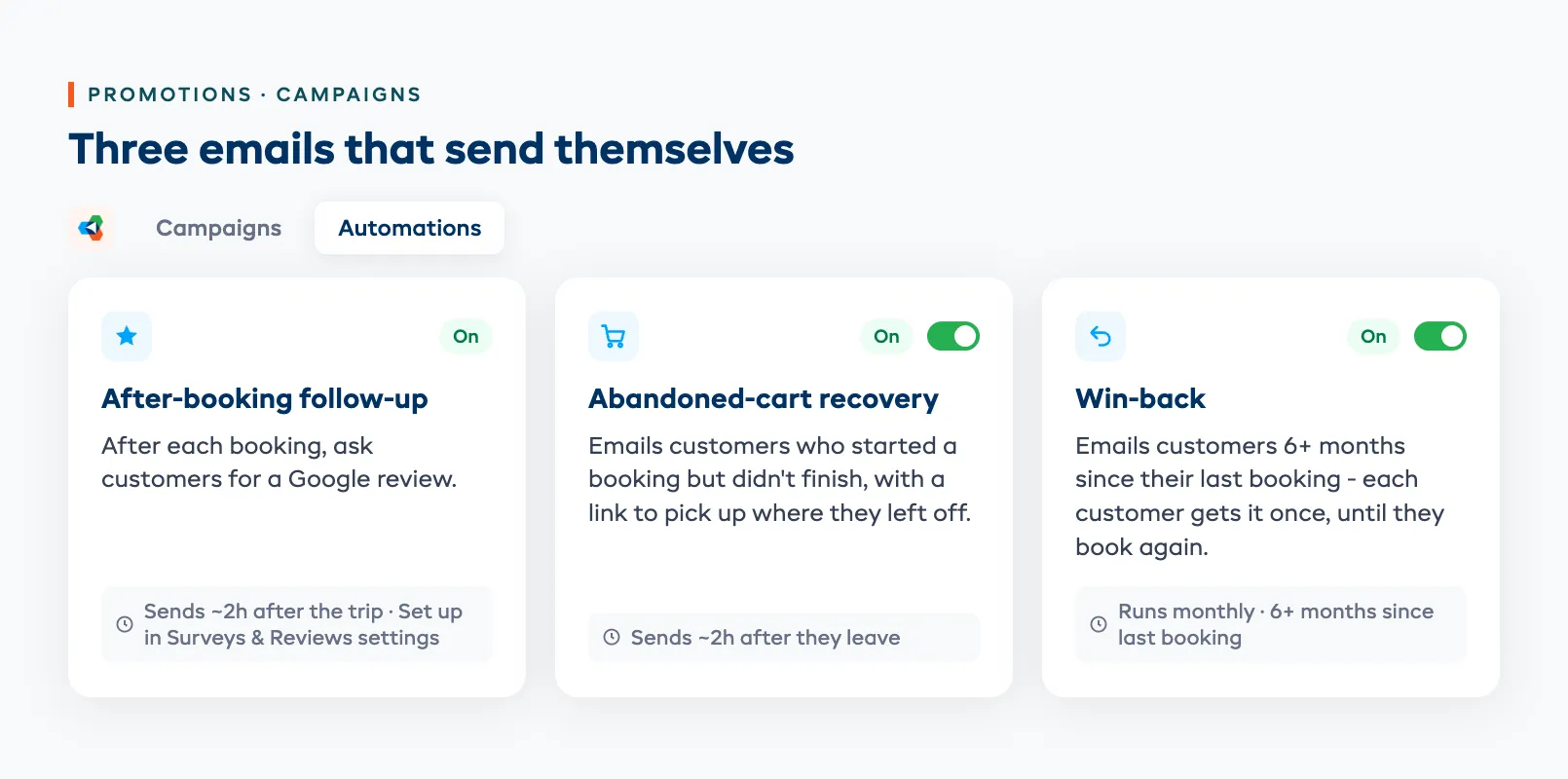
Abandoned-cart recovery emails people who started a booking and didn't finish, about 2 hours after they leave, with a link back to where they stopped. Win-back runs monthly and, by default, emails customers 6 or more months after their last booking, once each until they book again.
After-booking follow-up is the review request from the section above, so you only set its timing once.
One campaign a season, not a newsletter a week
A small tour company doesn't need a weekly newsletter. Send one useful email at the start of each season: the new tour, the dates that sell out first, and a code for past guests to bring a friend.
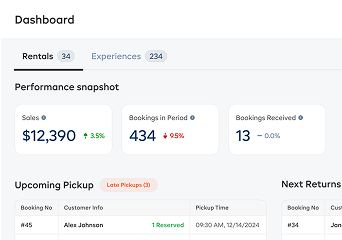
In EquipDash, pick Recent bookers or Locals as the audience, attach the promo code, and anyone who opted out is skipped. The campaign page then shows who opened, clicked and booked, plus the revenue from attributed bookings.
Paid ads: start with your own name
If you're going to spend money on Google Ads, start with searches for your own business and tour names. They're cheap, and they stop a reseller from sitting above you when someone searches for you by name.
Next, bid on specific searches that match a tour you need to fill, like "sunset kayak tour" plus your town, and send each ad to that tour's booking page. Skip broad terms like "things to do" plus a city. The OTAs and big publishers own those, and you'll pay for clicks from people planning a trip two years out.
Social posts: show a real departure
Social posts work best when they show a real departure: the guide, the group, the thing you stopped to look at. Phone video from the actual tour beats a polished brand film for a small operator, and it costs a minute after the tour.

Ask guests at the start whether anyone minds being in a photo, and post the ones where people are looking at the place, not the camera. Put the booking link in your bio with a UTM tag, so you can see whether any of it books.
A season calendar for a small tour company
Marketing for tours follows the booking season, and most of the work happens before the busy months arrive.
| When | What to do |
|---|---|
| Slow season | Fix your Google profile and photos, sign partner deals, make partner codes, set up the review request and automations |
| 6 to 8 weeks before busy season | Email past guests about the new dates, start brand-name ads, check your OTA listings and prices |
| Busy season | Ask every group for a review the same day, reply to reviews weekly, post real departures |
| End of season | Check each partner code's uses, pause what didn't book, plan the shoulder season |
In Australia or New Zealand the busy season is December to February, so shift the calendar to match.
If your tours only run a few months a year, the slow season is where you win. Nobody has time to sign up a hotel in the busiest week of the year.
Count bookings per channel, not clicks
Every channel above should end in a number you can compare: bookings it brought and what each one cost you. Views, likes and email opens only matter if bookings follow.
Tag every link you control
Add UTM tags to the links in your emails, partner QR codes and social bios. Google's guide to campaign URLs with UTM parameters shows the format, and its URL builder writes them for you.
In EquipDash, Reports, then Marketing, lists each attributed booking with its Source / Medium and Campaign, so a tagged partner QR code shows up as that partner. Promo code pages count the rest.
A simple cost-per-booking check
At the end of each month, write down one line per channel:
- Google profile and reviews: bookings from your booking-page link, cost is your time
- Partners: uses of each partner code, cost is the discount plus any referral fee
- Email: bookings on each campaign page, cost is your time
- OTAs: bookings in the booking channel report, cost is the commission
- Ads: bookings tagged from ads, cost is the ad spend
Cut the channel that costs the most per booking, unless it's the only one bringing new people in. For most small tour companies that ends up being the OTAs, and that's fine as long as they aren't the only line.
If you run tours on EquipDash, everything above lives under Promotions, Surveys and Reports. The EquipDash page for tour and activity operators shows the rest, the promo codes and campaigns page covers the marketing tools, and our online booking features guide covers the booking page your links point to.
FAQ
What is the best marketing strategy for a small tour operator?
Start with what's free and closest to a booking: a complete Google Business Profile that links to your booking page, and a review request after every tour. Then add partner codes and past-guest email, and only then pay for OTAs and ads.
How do tour operators get more reviews?
Ask every guest the same day, a couple of hours after the tour, with one reminder a few days later. Send the same link to everyone, never only happy guests, and never offer a discount for the review, which Google's policy forbids.
Should a tour company list on Viator and GetYourGuide?
Usually yes, as paid discovery for travelers who don't know you yet. Keep them as one channel among several, check how many of your bookings carry a commission each month, and work on your own listing so repeat guests book direct.
How do you track which marketing brings tour bookings?
Give each partner and campaign its own promo code, and add UTM tags to every link you control. Then count bookings per channel each month and compare what each one cost, whether that's commission, a discount, ad spend or your time.
How much should a small tour company spend on marketing?
There's no fixed percentage that fits every tour. Spend your time on the free channels first, then put money behind whichever channel shows the lowest cost per booking after a month or two of counting.
in one place