Best Camping Gear Rental Software in 2026: 9 Options Compared
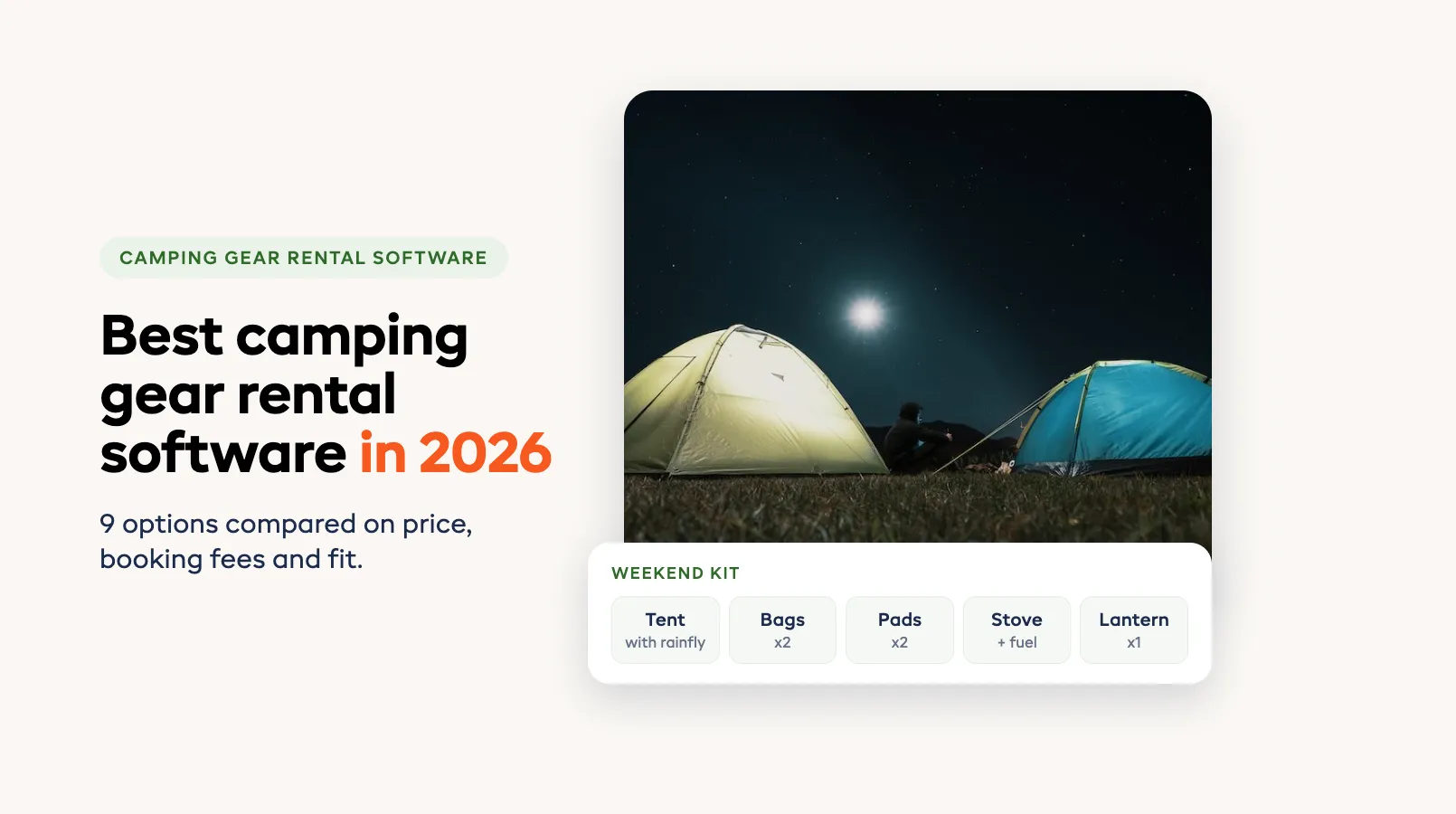
On a Friday at a camping shop, a four-person tent leaves at 3pm inside a family kit, and at 4pm someone rents the last spare of the same tent on its own. Camping gear rental software has to count both from one shelf.
For the lowest monthly bill, look at Booqable, as long as customers collect at the counter, because delivery and drying time cost extra there. RentMy has delivery zones, a driver app and proof of delivery; kits and signed waivers need its $199 Growth plan.
EquipDash, our product, fits shops that need kits, delivery, cleaning holds and waivers in one place. Kits and waivers start on Growth at $69/mo and delivery is on Pro at $149/mo, so budget from Growth, not the $29 Starter plan.
Prices are from each vendor's pricing page on October 27, 2026, with Louez and Booqable rechecked on November 15, 2026. Feature notes are from their own sites, so confirm them in a trial.
Setting up a shop first? See how to run a camping rental business.
Camping gear rental software compared
| Software | Starting price | Booking fee | Free trial | Best for |
|---|---|---|---|---|
| EquipDash | $29/mo Starter; kits and waivers from $69/mo, delivery from $149/mo | 1-2% on card payments, can be passed to the customer | 21 days, no card | Kits, campsite delivery, cleaning holds, and gear plus guided departures in one booking |
| Booqable | $29/mo billed yearly, $35/mo monthly (shown in your local currency) | No commission | 14 days, no card | Kit-heavy shops wanting a ready-made booking page |
| RentMy | $39/mo Nano (up to 20 products); packages and waivers from $199/mo Growth; delivery +$20/mo on Nano | Card processing; rate not published | 14 days | Shops that deliver kits to campsites |
| Checkfront | $99/mo | 3% on online bookings, absorb or pass on | Not stated | Outfitters that also sell guided departures |
| Louez | No monthly fee on pay-as-you-go, or $49/mo Pro | 4% of rentals on pay-as-you-go; none on Pro | Free to start (pay-as-you-go) | Small or seasonal shops |
| Renta | Free plan, or $300/mo flat | 2.5% paid by renters on the free plan; none on the flat plan | Free to start | Shops renting high-value single items |
| Twice Commerce | €99/mo for the first location | 1.5% per processed payment | 14 days, no card | Outdoor retailers adding rentals |
| Sharefox | From €99/mo billed yearly | Not published | Trial offered, length not published | European outdoor shops |
| Rentrax | $29/mo for 30 transactions, plus $395 setup | $0.80 per transaction above 30 | Not stated | Shops renting camping gear alongside bikes, boats or snow gear |
Card processing sits on top of every row. On a $60 weekend kit, Stripe's US rate takes $2.04, and the cost table below runs that over a full season.
Kitloop (invitation-only while in testing) and GearDash (built around repairs, no camping page) are left off.
Fleetwire is built for vehicle fleets. RV and party-rental shops have different needs; see RV rental booking software and the event rental software guide.
What camping gear rental software has to handle
A weekend kit is a dozen parts: a tent with its poles, stakes and rainfly, two sleeping bags, two pads, a stove, a lantern, and for trips into Olympic National Park's wilderness a bear canister, which the park requires there; it lends them free but can't reserve one and occasionally runs out on very busy weekends. The fuel canister isn't rented at all; it's sold, because nobody takes one back half full.
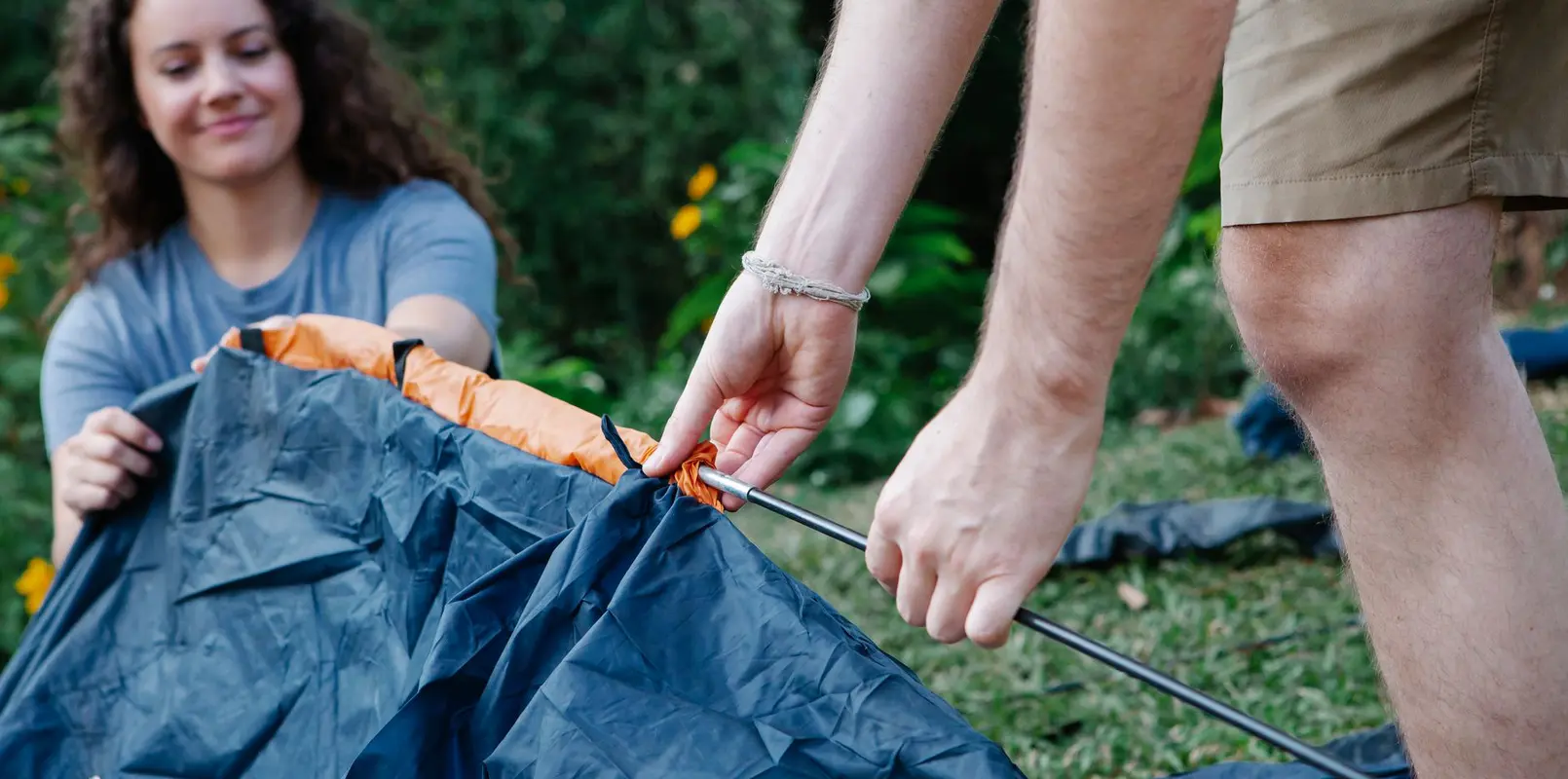
So the software has to sell the kit as one item while counting each part from the same shelf as your single rentals, hold all of it Friday to Sunday, charge for the fuel, and keep the sleeping bags off the booking page Monday until they've been washed.
Run each vendor through these six in the trial:
- Kits from single items. Book the last tent alone, then book the package on the same dates. Have the salesperson do it live on screen; being told it can't double-book means nothing.
- Rental-date booking. Most camping rentals are Friday to Sunday, so look for a set weekend price and a separate three-night price for holiday weekends, not only a daily rate with a discount ladder. Ask whether "weekend" means Friday noon to Monday morning or a flat three days, because that's the argument at the counter on Monday. A minimum length matters too, or someone books your six-person tent for one night of Memorial Day weekend.
- Delivery to campsites and trailheads. Deliveries in the same day list as pickups, with a delivery area you set, and the van's load visible before it leaves.
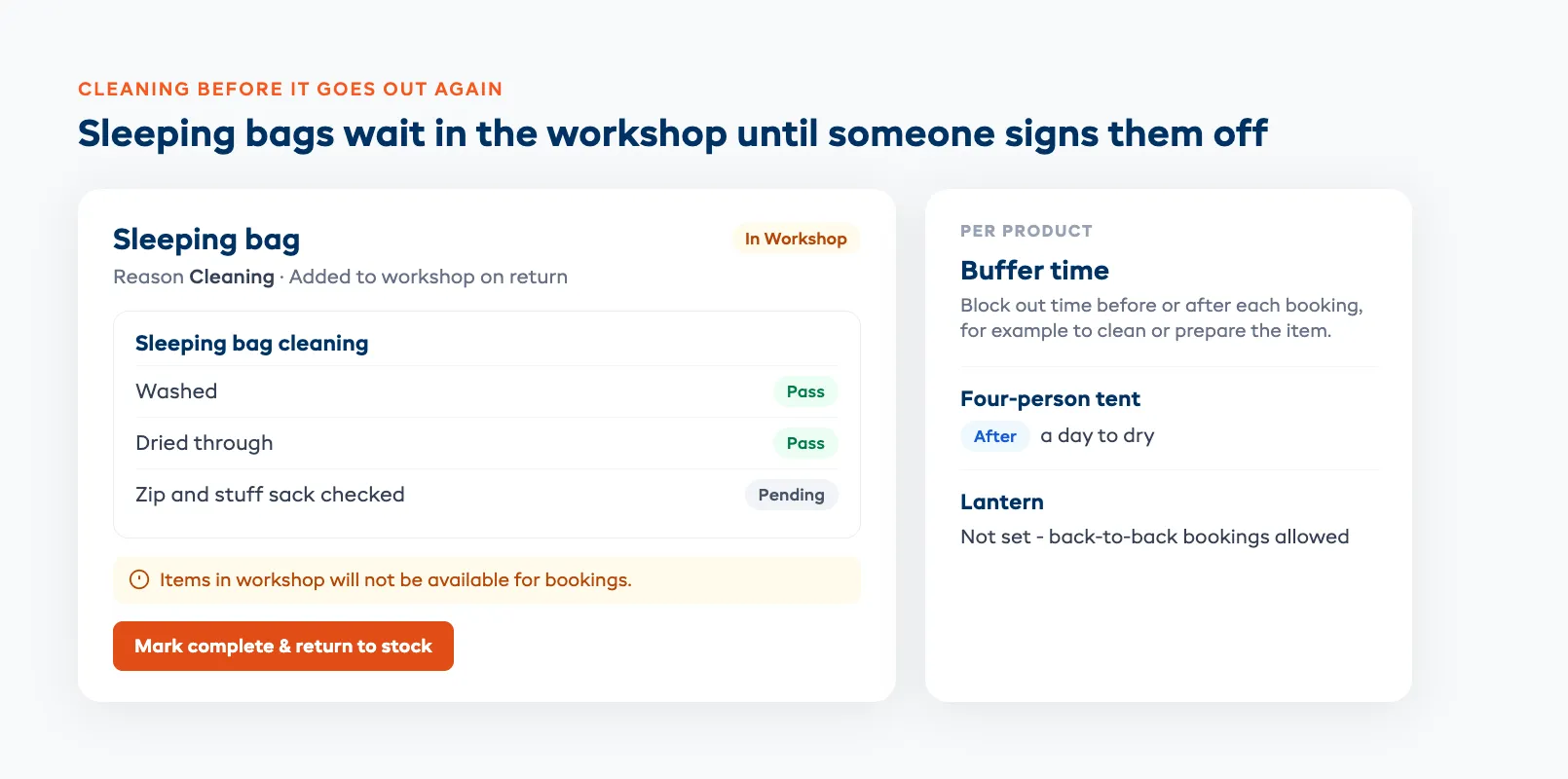
- Cleaning between rentals. Sleeping bags, cookware and water filters held off the booking page until they're cleaned. A tent that came back wet needs a day to dry, and a bag that goes through the washer and dryer is gone a day too, so check whether the hold is set per item or one fixed number for everything.
- Missing items at return. Each part checked back in, with anything missing charged against the deposit. Photos of the poles and rainfly stitching at pickup end the "it was already torn" argument. Keep them on the booking, not on a staff phone.
- Waivers before the counter line. The waiver goes out with the booking and gets chased until it's signed, so nobody is filling one in at pickup while four people wait behind them. A parent signs for kids.
Then there's weather. A Thursday storm forecast brings calls to move Friday pickups, so check how a customer moves their own dates and what happens to the deposit.
Where it rains all season, as in the Pacific Northwest, people camp anyway and the problem lands Monday: every tent comes back wet and has to be pitched and dried before it's packed, or it mildews. Our rain and weather policy guide covers the policy side.

The 9 options, one by one
1. EquipDash
Best for: outfitters that rent complete kits, deliver to campsites, need gear cleaned before it goes out again, or sell guided departures next to rentals.
Price: Starter is $29/mo ($23/mo billed yearly) for 2 team members and 20 rental products, with no bundles or waivers. Five tent models, three bag ratings, two pads, a stove, a lantern, a bear canister and a water filter is 14 products before cookware and packs, so most kit shops outgrow it.
Growth is $69/mo ($55/mo billed yearly) and adds kits and waivers, with up to 10 team members and 100 rental products on one location. Pro is $149/mo ($119/mo billed yearly) and adds delivery and seasonal pricing, with no cap on team members or products and more than one location. A crew of 15 or a catalog of a few hundred lines is a Pro shop.
The booking fee is 2% on Starter, 1.5% on Growth and 1% on Pro, on card payments only, and you can pass it to customers at checkout. 21-day free trial, no card. See pricing.
Bundle a tent, bags, pads, stove and lantern into one kit with one price, with every part listed down to the stakes and rainfly, and drawn from the same shelf as your single rentals. Each product can carry a set price for a given length, such as a weekend price and a three-day price, plus a minimum rental length.
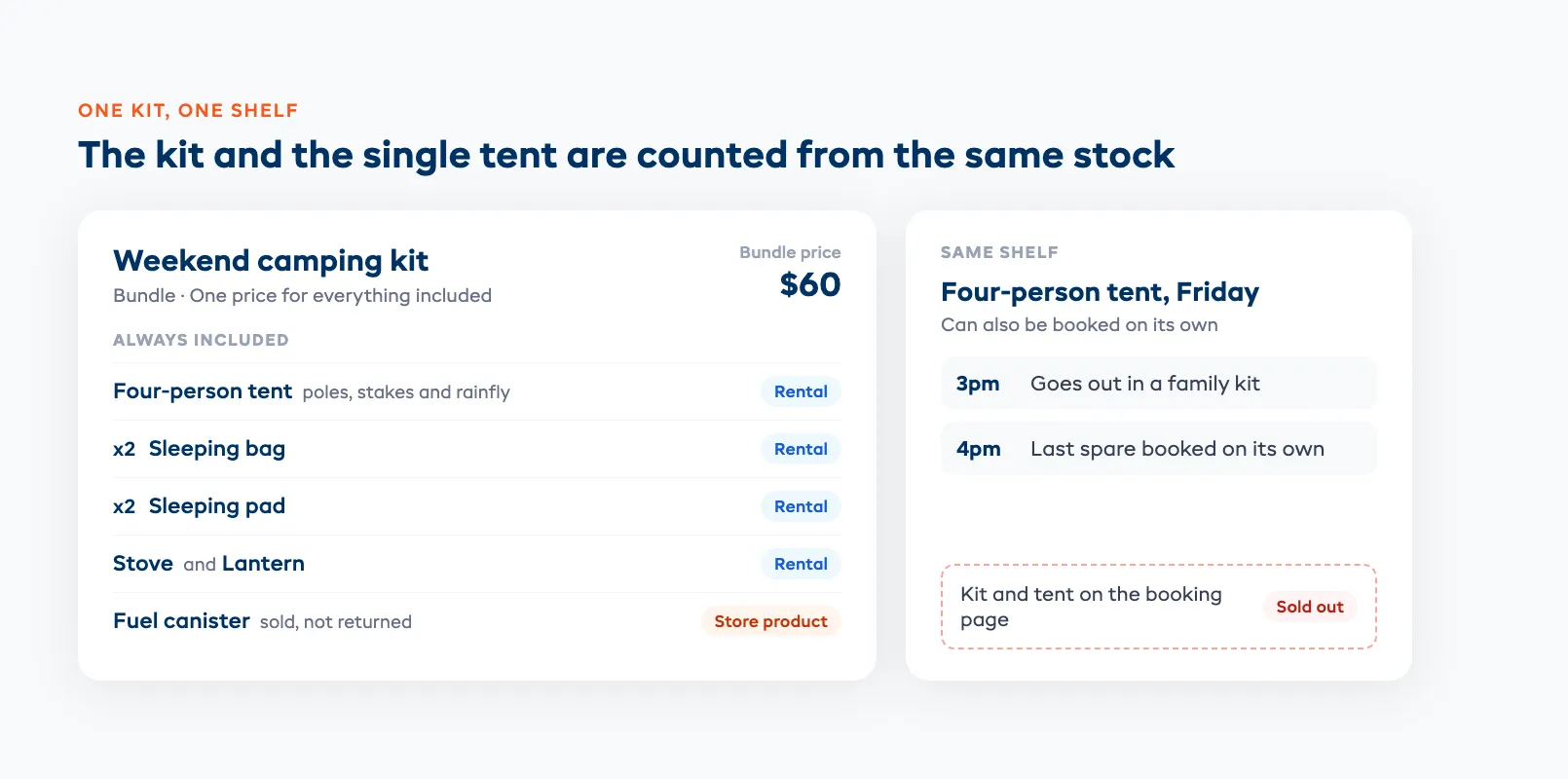
Fuel canisters go on as store items, so they're charged and counted off stock instead of being expected back. Kits are picked up or delivered, and the day's drop-offs and collections sit on one run sheet with what's on the van.
Booked customers get the waiver with the booking and are chased by email or text on a schedule you set until they sign. Walk-ups scan a QR poster at the counter, or staff open the form on a shop tablet. At return, staff tick off every part against the list and add condition photos to the booking; anything missing is logged and its replacement cost comes out of the deposit.
Sleeping bags, cookware and water filters go to the workshop with their own cleaning checklist and stay off the booking page until someone signs them off. Each product can also carry its own gap after a rental, so a tent gets a day to dry while a lantern doesn't.
A camper who wants one more night opens the extend link on their booking, picks a later return date and sees the extra cost before confirming. If the tent is already booked for Monday, the page says those dates aren't available. If you also run guided hikes or paddles, the guided departure and the gear go in one booking with one signing link for the group.
EquipDash is newer than most names here, so there are fewer independent reviews to read. The delivery run sheet lists each drop and what's on the van, but it doesn't plan the route or the load order; your driver still does that.
Cards run through your own Stripe account, so that's the processing rate you pay. More on the camping gear rental software page.
2. Booqable
Best for: kit-heavy shops that want a ready-made booking page.
Price: the Start plan is $29/mo billed yearly or $35/mo billed monthly on Booqable's pricing page, shown in your local currency, with inventory, bundles, a booking page and payments included and no commission on bookings. 14-day free trial, no card.
Product bundles handle tent kits and deposits. It suits a weekend where most customers collect at the counter.
Deliveries, barcode scanning and extra locations are paid add-ons, and downtime between rentals (time to clean or dry gear) only comes with the Grow plan. Price those add-ons before you count it as the cheapest option.
3. RentMy
Best for: shops that deliver kits to campsites and trailheads.
Price: the Nano plan on RentMy's pricing page is $39/mo for up to 20 products and three users, billed monthly, with delivery as a $20/mo add-on. Packages and signed waivers aren't on Nano; they start on the Growth plan at $199/mo.
The card processing rate on Nano isn't published, so ask for it first. 14-day trial.
On Growth, its package builder checks availability for each product in the package. Delivery zones come with a driver app and proof of delivery. Extra locations are an Enterprise feature at an additional price.
Twenty products goes fast too: the tents, bags, pads and stoves of a typical kit shop pass that before cookware is listed. Either way, a kit shop should budget from Growth at $199/mo, not $39.
4. Checkfront
Best for: outfitters that rent gear and also sell guided departures.
Price: one plan on Checkfront's pricing page at $99/mo plus a 3% fee on online bookings, which you can absorb or pass on to guests. Offline bookings carry no fee, and there's no setup fee.
It covers packages and add-ons, multi-day rentals, digital waivers, policies for damaged or lost equipment, and multiple locations.
Its rentals page doesn't mention delivery or time between rentals for cleaning, so test both. The 3% fee grows with your revenue, which is the bigger issue for a busy shop.
5. Louez
Best for: small or seasonal shops that want to pay only when they rent.
Price: Louez's pricing page has a pay-as-you-go plan with no monthly fee that takes 4% of rental amounts (deposits excluded), so a month without rentals costs nothing. The Pro plan is $49/mo for up to 50 products and two team members with no commission, and Ultra is $159/mo with no product or team limit. The 4% includes VAT; Pro and Ultra prices exclude it.
Its site describes a complete hiking pack booked in one click, weekend or full-week packages, deposits held on the card, damage flagged at return, and delivery and collection.
Past about $1,225 a month in rentals (ignoring VAT), the 4% costs more than Pro's $49. And Pro's 50 products and two logins are tight for a shop with staff.
6. Renta
Best for: shops renting fewer, high-value items one unit at a time.
Price: a free plan where renters pay a 2.5% fee at checkout, or a flat plan at $300/mo with no booking fee. Card processing is extra on both.
The $300 plan only buys you out of that renter fee. At 2.5%, it breaks even at $12,000 a month in bookings, so most camping shops stay on the free plan.
Deposits are released automatically, and there's a condition check with a damage process, signed waivers, and unlimited locations. Its site doesn't mention kits or delivery, which most camping shops rely on, so test both before committing.
7. Twice Commerce
Best for: outdoor retailers adding rentals alongside sales.
Price: €199 per location per month on Twice Commerce's pricing page, with the first location at half price (€99/mo), plus 1.5% of payments processed. Self-serve onboarding is free; guided onboarding is €999. 14-day free trial, no card.
It has bundles, local delivery, items held for maintenance, deposits, waivers, and multiple warehouses, and its customers include outdoor brands and retailers.
Pricing is in euros, there's no camping-specific page, and returns are handled with condition reports rather than a missing-item charge.
8. Sharefox
Best for: outdoor gear shops in Europe.
Price: Basic from €99/mo billed yearly or €108 monthly on Sharefox's pricing page, depending on how many items and locations you have and which modules you add.
Multi-day pricing, damage deposits, digital waivers, product bundles and multiple locations are all listed, with pages for outdoor gear and tents.
For a US shop, euro-only pricing makes it hard to compare. Its outdoor page also doesn't mention delivery or time between rentals, so ask.
9. Rentrax
Best for: shops renting camping gear alongside bikes, boats or snow gear.
Price: the Starter plan is $29/mo for businesses up to $10,000 a month in revenue, including 30 transactions, then $0.80 each (counted per item in an order). There's a one-time $395 setup fee.
Bundles book in one click, waivers are signed online, and one dashboard covers multiple locations.
Before signing, ask whether a kit counts as one item or one per part. At $0.80 a transaction past the first 30, that answer decides the bill, and its camping page doesn't say.
What it costs at your volume
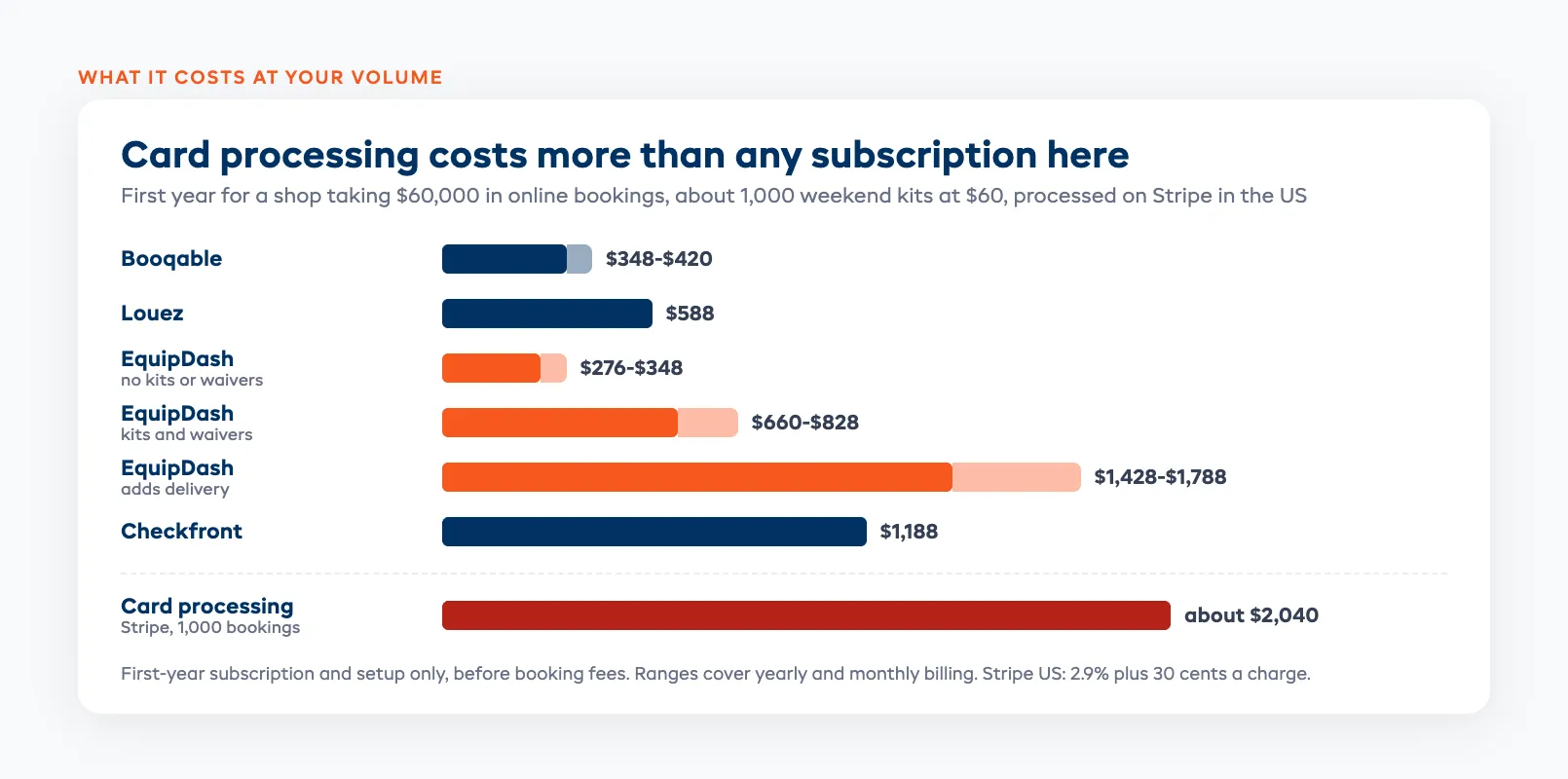
Here's what the published fees add up to in the first year for a shop taking $60,000 a year in online bookings, about 1,000 weekend kits at $60 each, assuming the shop absorbs every booking fee.
| Software | Subscription and setup | Booking fees | First-year total |
|---|---|---|---|
| Booqable (Start) | $348-$420 (local currency) | None | $348-$420 |
| Louez (Pro) | $588 | None | $588 |
| EquipDash (Starter, no kits or waivers) | $276-$348 | $1,200 (2%) | $1,476-$1,548 |
| EquipDash (Growth, kits and waivers) | $660-$828 | $900 (1.5%) | $1,560-$1,728 |
| EquipDash (Pro, adds delivery) | $1,428-$1,788 | $600 (1%) | $2,028-$2,388 |
| Checkfront | $1,188 | $1,800 (3%) | $2,988 |
On Stripe's US pricing, a card charge costs 2.9% plus 30 cents, so those 1,000 bookings cost about $2,040 to process. That's more than every subscription above, so ask each vendor for its card rate and who sets it before you compare anything else.
In Canada, Stripe charges 2.9% plus CA$0.30 on domestic cards. In New Zealand, Stripe's domestic card rate is 2.65% plus NZ$0.30.
A busier shop changes the order. Take a made-up example: delivered family kits at $150, about 2,700 a year with 800 in a peak month. That's $405,000 online.
EquipDash Pro's 1% is $4,050, Growth's 1.5% would be $6,075, Checkfront's 3% is $12,150, and Louez pay-as-you-go at 4% is $16,200, while Booqable and Louez Pro stay flat. Stripe alone is about $12,555. A shop that size also has more than Growth's 10 logins and 100 products.
If most of your bookings come by phone today, the EquipDash fee only starts on the ones that move online. Counter and phone bookings never carry it.
Rentrax is left out because its cost depends on how it counts kit parts. RentMy's processing rate and Sharefox's fees aren't published, and Twice Commerce is priced in euros.
If you pass the booking fee on to customers, EquipDash and Checkfront come down to the subscription alone.
EquipDash plans are billed in US dollars, with GST or HST added to the subscription where it applies. Canadian, Australian and New Zealand shops still charge their customers in their own currency, with their own tax rate for sales tax, HST or GST.
How to choose
- You rent complete kits, deliver to campsites, and need cleaning tracked: EquipDash on Pro, or Growth if customers collect and you have 10 staff or fewer.
- You rent kits and want the lowest fixed cost: Booqable, adding delivery and downtime as you need them.
- Delivery is a big part of your business and your catalog is small: RentMy.
- You're small or seasonal and want to pay only when you rent: Louez pay-as-you-go, until your monthly rentals pass about $1,225.
- You sell guided departures and gear, and want both in one booking: EquipDash or Checkfront. Ask Checkfront how a guided hike and a tent kit check out together.
Before you sign, load one of last season's Fridays into the trial: two weekend kits going out, one delivered to a campsite 20 minutes away, a kit back on Monday short a lantern, and three sleeping bags that need washing before Wednesday.
Then check that the delivered kit's tent disappears from Friday's booking page, the lantern charge reaches the deposit without a phone call, and the sleeping bags stay unbookable until someone signs them off.
For the gear itself, see camping rental pricing and packages and camping gear hygiene and cleaning.
Moving off a spreadsheet without a lost weekend
Switch after the season ends: in the US that's fall, not the week before Memorial Day, and in New Zealand it's after Easter, not the run-up to Christmas.
Enter every booking you've already taken for next season before the new booking page goes live. Otherwise the new system sells the tent your spreadsheet already promised.
In the first week, watch for staff still writing in the old sheet out of habit. On switch day, make the spreadsheet view-only so there's one place to book.
With EquipDash, the concierge setup (free for a limited time) has a person import your products, customers and pricing from a spreadsheet or from Booqable or Checkfront, and connect Stripe. Most shops take bookings within 2 business days.
Send your current waiver as a PDF, a scanned printout or a link to the online version, and it's laid out as a draft form you approve before anyone signs it.
Frequently Asked Questions
What is the best camping gear rental software for a small shop?
For a small shop that mostly rents kits over the counter, Booqable is the cheapest fixed cost at $29/mo billed yearly in your local currency, with no commission. Louez has a pay-as-you-go plan with no monthly fee that takes 4% of rentals, which suits a short season. If you need waivers and cleaning holds as well, EquipDash Growth is $69/mo ($55/mo billed yearly) with a 21-day free trial.
How much does camping gear rental software cost?
Published prices run from no monthly fee with a percentage per rental (Louez at 4%, Renta at 2.5% paid by renters) to $29-$99 a month for most entry plans (EquipDash, Booqable, RentMy, Rentrax, Checkfront). Kit features often cost more: RentMy charges $20/mo for delivery and puts kits and waivers on its $199 Growth plan, Booqable charges extra for delivery and downtime, and EquipDash puts kits on its $69 plan and delivery on its $149 plan. Card processing usually costs more than the software, about 2.9% plus 30 cents a charge on Stripe in the US.
Can rental software track every part of a camping kit?
Not all of them do. EquipDash draws each part of a kit from the same shelf as single rentals and checks each one back in at return, and RentMy's package builder, on its $199 Growth plan, checks availability for each product in a package. To test any vendor, book the last tent on its own, then try the kit for the same dates; if the kit still books, the software isn't counting parts.
Can camping rental software handle delivery to campsites?
Yes. EquipDash, RentMy, Louez and Twice Commerce all handle delivery, and Booqable offers it as a paid add-on. RentMy includes a driver app with proof of delivery, and EquipDash puts the day's campsite drop-offs and collections on one run sheet with what's on the van.
How do rental shops handle cleaning sleeping bags between rentals?
The software should hold cleaned items off the booking page until they're ready. EquipDash sends sleeping bags, cookware and water filters to cleaning with their own steps, and Booqable's downtime scheduling and Twice Commerce's maintenance holds do a similar job.
in one place