Best Fishing and Boat Charter Booking Software in 2026: 9 Options Compared
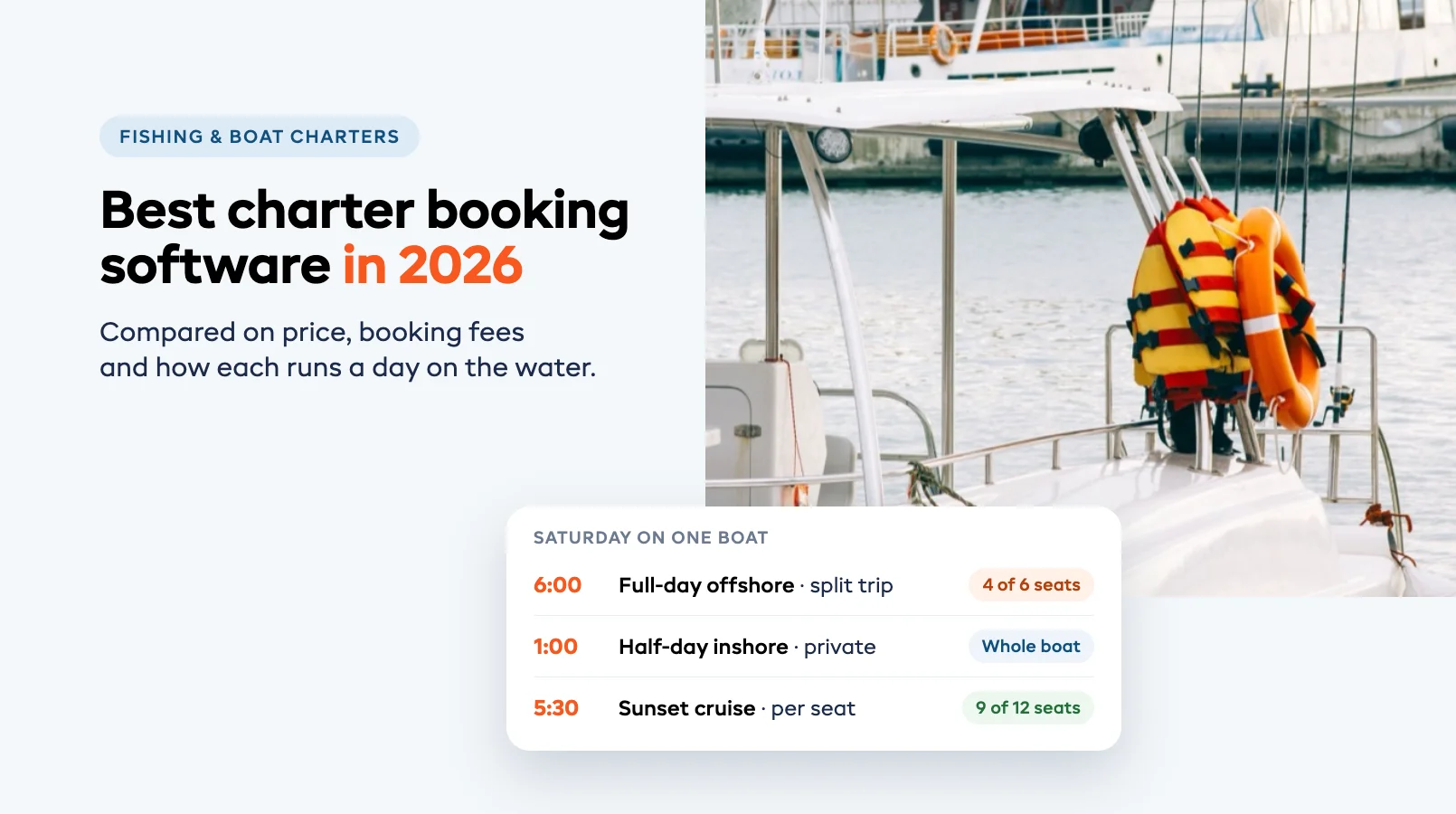
Charter booking gets hard when one boat sells two ways: by the seat to anglers, and whole to a family who calls the week before. Add a forecast that turns overnight and every party needs to hear before they drive to the ramp. This guide compares nine fishing charter booking software options on that work and on what they cost, for skippered charters and for fleets that rent out pontoon boats, small aluminum boats, jet skis or kayaks.
FishingBooker keeps 10-30% of each fishing charter it books. Getmyboat and Boatsetter list day boats, jet skis and yachts, Getmyboat in Australia as well as the US, and Viator, GetYourGuide and hotel tour desks sell to tourists. Every one of them takes a commission on what it sells, so at 20% a $500 charter leaves you $400.
If most of your bookings come from Google Maps, a Facebook message or a local who books every summer, they land in the software below. Look at last season before you list a date on a marketplace: if that date sold out on your own site anyway, a marketplace booking on it only cost you the commission.
EquipDash is our product. We haven't used the other eight, so their entries come from each vendor's own pages, checked in November 2026, and say where a page is silent.
If you're still setting up, start with how to start a fishing charter business. Already on a system? Switching from a system you already run covers when to move.
Charter booking software compared
| Software | Starting price | Booking fee | Free trial | Best for |
|---|---|---|---|---|
| EquipDash | US$29/mo, or US$23/mo billed yearly; waivers from US$69/mo | 1-2% on card payments, on top of card processing, can be passed to the customer | 21 days, no card | Private, split and per-seat charters plus self-drive rentals, with captains, manifests and weather moves in one system |
| FishingBooker | No subscription | Marketplace: 10-30% of the booking, set by the captain. Direct bookings: no commission, 2.65% + 3¢ processing (US only) | Free to list | Captains who want marketplace anglers |
| FareHarbor | No monthly software fee | A charge on confirmed bookings; rate not published | Demo only | Fleets selling on many travel sites |
| Peek Pro | Not published | Commission; rate not published | Demo only | Boat tour operators focused on direct online sales |
| Charterfy | $99/mo, or no monthly fee on the 4% plan | None on $99/mo; 4% per booking (min $2), paid by the guest, on the other plan | No card to start | One to five boats on a flat monthly fee, up to 300 bookings a month |
| CaptainBook | €49/mo for 1 boat and 3 logins; €199/mo for up to 5 boats | 0% on direct bookings; €14.99 per product a month for Viator and GetYourGuide | 14 days, no card | Multi-captain fleets selling on Viator and GetYourGuide |
| Checkfront | $99/mo | 3% on online bookings, absorb or pass on | Demo only | Operators who run charters and rentals and take lots of phone bookings |
| Rezdy | $49/mo | 3% on online bookings, absorb or pass on; $1 per offline booking | Demo only | Charters selling through agents and resellers |
| Bookeo | From A$14.95/mo; waivers add-on from A$12/mo | No commission | 30 days, no card | Small charters on a flat monthly fee |
Card processing is extra on every option unless noted, and EquipDash's booking fee sits on top of it. On a $500 US charter, Stripe's 2.9% + 30¢ is $14.80 and EquipDash Growth's 1.5% is $7.50, so $22.30 in all, unless you pass the 1.5% to the customer at checkout. Stripe's rate for a domestic card online:
- US: 2.9% + 30¢ (Stripe's pricing)
- Canada: 2.9% + CA$0.30 (Stripe's Canadian pricing)
- Australia: 1.65% + A$0.30 (Stripe's Australian pricing)
- New Zealand: 2.65% + NZ$0.30 (Stripe's New Zealand pricing)
On an A$500 charter in Australia paid on a local card, the same two fees are A$8.55 to Stripe and A$7.50 to EquipDash. Overseas visitors' cards cost more: Stripe charges 3.5% + A$0.30 on them, plus 2% when the currency is converted, so Stripe's share of that A$500 charter is A$17.80 to A$27.80. On a CA$500 charter in Canada the two fees are CA$14.80 and CA$7.50.
EquipDash bills its subscription in US dollars everywhere, with sales tax such as GST added where it's due, so an Australian or Canadian fleet pays US$69 a month for Growth and the booking fee in its own currency. The A$ cost of that US$69 moves with the exchange rate, and your card may add a foreign transaction fee on top. Bookeo showed us Australian dollars, CaptainBook bills in euros, and Charterfy and Rezdy show a $ sign without naming the currency, so ask them and Checkfront which currency you'd be billed in.
We also looked at Xola, TicketingHub, Mallard Bay, Fishing Outfitter and Booqable and left them out. Xola doesn't publish its fee, and Mallard Bay and Fishing Outfitter are built for hunting and fishing guides and lodges more than boats. Booqable is a real option for a self-drive jet ski or pontoon fleet, but it has no captains or seat sales, so it sits in our boat rental software comparison instead.
What charter booking software has to handle
We checked each product against one Saturday we made up for this guide, on a two-boat fishing charter: a six-passenger offshore boat and an inshore skiff.
The 6am offshore departure is a split charter: four anglers from three parties, two seats left. Four seats may not cover fuel and a deckhand, so you're already deciding whether it runs. Then a family of five calls wanting the whole boat that morning.
Overnight the forecast goes past the skipper's limit: a small-craft advisory in the US, a strong wind warning from the Bureau of Meteorology in Australia or Environment Canada, plus a swell that closes the bar. Three parties need reaching before they drive to the ramp. The skiff's 7am inshore charter still goes, and by evening you need tomorrow's manifest with emergency contacts, with two guests still unsigned.
Seats, deposits and captains
A private charter is one price for the boat, by the half or full day, and often more on weekends and in peak months. A split charter or a party boat is priced per angler, sometimes with a child rate. Whichever books first has to take the other off sale, so the family can't buy the boat that already has four anglers on it.
Sunset sails and split-charter seats are usually paid in full at booking. A full-day private or an overnighter more often takes a deposit to lock the date and the rest a set number of days out, because the skipper and the fuel get paid whether the group shows or not, so the deposit needs setting per charter. The ones that hurt are the private group who say they'll settle the rest on the day and show up without it, and the card that declines two days out.
Hourly rentals are the other way around. On jet skis you lose money on phone bookings that never show up and on riders who arrive without the license or ID you need and get sent home. Take full payment at booking, say when it stops being refundable, and ask for the license before the day.
The captain has to hold the right ticket. In the US a six-pack needs a Coast Guard OUPV license, a bigger inspected boat a Master license, and a sailing charter the sail or auxiliary sail endorsement on top.
In Australia, AMSA's Coxswain Grade 1 covers commercial boats under 12 m in what AMSA calls inshore waters, and most bigger charter cats need a Master <24m certificate. The boat's certificate of survey and certificate of operation set how many people you carry.
In Canada a small passenger boat needs a skipper with Transport Canada's Small Vessel Operator Proficiency, and New Zealand operators run under a Maritime NZ operator plan.
The skipper's ticket and the boat's survey (the Certificate of Inspection on a US inspected boat) both carry dates, and either one lapsing ties the boat up. Survey is the one to watch: the slip and the surveyor are booked weeks ahead, so a month's warning is too late.
Manifests and the safety briefing
The manifest lists each passenger's name, age and emergency contact, the head count, the captain and who has boarded, ready before the lines come off. Our guide to charter manifests and waivers covers what to keep. In Australia and New Zealand it's the head count you check against the passenger limit on your certificates and the number you give if you log on with your local marine rescue group, and NZ Coastguard's reporting service sits outside your booking system.
On an inspected US boat the master has to make sure passengers get a safety orientation before getting underway, or as soon as practicable after, by announcement or a printed card. On a six-pack you may read it off a laminated card and check off a clipboard. In Australia, every domestic commercial vessel needs a safety management system under Marine Order 504, and NZ operators work to their operator plan.
Weather and boats back late
On a wind day, make the call off the early marine forecast, text every party, then call the private groups and anyone who hasn't replied by first light. Guests on vacation rarely open email, and a text they never see means a family at the ramp who didn't know you'd called it off.
Call early and some parties will take a run up the river or in sheltered water instead, and some move to the next calm day. The ones flying out before then want their money back, so refund them fast, because a slow refund is what ends up in the review.
A strong wind warning, gusts past the skipper's limit or lightning is a call you and the skipper make before first light, and a cyclone watch sends the whole fleet to its moorings.
The skiff is 40 minutes late, waiting on the tide to get back over the bar, and the next group is standing on the dock. You raise the skipper on the VHF or the deckhand's phone and get a time. Then someone at the desk texts the waiting group how long, and the gap you held for fuel and a wash-down gets eaten.
Self-drive rentals
A renter driving your boat needs no commercial ticket, so the briefing and the paperwork are yours.
Florida requires pre-rental instruction signed by the renter, New South Wales and Victoria require a safety briefing, and in Canada a renter without a boating card can drive on Transport Canada's signed rental checklist. Check the rules where you operate.
At a paddle desk the briefing happens at the water's edge: getting in, holding the paddle, what to do if you tip, and where not to go. On jet skis each rider gets their own at the ramp. Either way, record who gave it and when, because that's what your insurer asks to see.
On a walk-up Saturday, put the waiver's QR code on a sign so the line signs on their own phones while you take cards.
On a jet ski, photograph every side and the hour meter at pickup. On a pontoon, the dock hand checks the pontoons, prop and lower unit and notes the fuel before the renter signs, and on a small aluminum boat it's the hull and fuel.
Hold a bond on the card for boats and jet skis. On an A$45 kayak hour a card bond is more trouble than it's worth, so keep a phone number or ID instead. Count life jackets out and back in on all of them.
When the wind gets up on a river or lake after lunch, the dock calls every boat in by radio or phone, then deals with the renters at the dock who want their money back.
What you need on screen is the list of who's still out, with their cell numbers, and every afternoon booking you have to move or refund.
Between rentals a jet ski needs fuel, a fresh-water flush, a check of the kill-switch lanyard and a look over the hull, and a pontoon needs fuel and the trash emptied. On a full Saturday that time gets squeezed unless it's blocked out between bookings.
Extras, licenses and crew
A fishing charter sells rod rental, bait, ice, fish cleaning and rain gear, and if tackle is in the price, the booking should say who keeps the fish. Rental customers add crab nets, a cooler and a bag of ice, a bigger motor for the weekend or a fuel bond, and a rod and reel may go out with a bond of its own. A jet ski rider adds a wetsuit, gloves, boots or a helmet.
A whole-boat party charter runs the same way as a private charter: a deposit at booking, the balance a week or two out, and the head count locked a couple of days before. A bachelorette party booked for 30 that arrives as 18 has then already paid for the boat.
Ask for a fishing license at checkout only where the angler needs one. A licensed Florida charter's for-hire license covers its paying customers in saltwater, and in Tasmania rod and line at sea needs no license. On an Alberta lake each angler needs their own license and a WiN number, except under-16s and Albertans 65 and over (Alberta's license rules).
An overnighter needs a skipper, a host and a cook on the roster, a berth plan per cabin, dietary needs on every booking and provisions that match the head count. Bareboat out of the Whitsundays means checking the guest's sailing résumé (or putting a skipper on for the first day), holding a bond on the card, a proper briefing, then a chart marked with the reefs to avoid and the anchorages that suit the forecast.
The 9 options, one by one
1. EquipDash
Price: $29/mo on Starter, or $23/mo billed yearly. Most charters need Growth at $69/mo ($55/mo billed yearly), which covers 10 team members and adds waivers, captain certificates, and Viator and GetYourGuide. Past 10 team members you need Pro at $149/mo ($119/mo billed yearly), which also adds unlimited locations, seasonal prices and your own checkout questions on rental bookings.
The booking fee is 2% on Starter, 1.5% on Growth and 1% on Pro, on card payments only, and you can pass it on at checkout. Viator and GetYourGuide bookings carry no EquipDash fee. The free trial runs 21 days with no card.
Selling the boat whole or by the seat
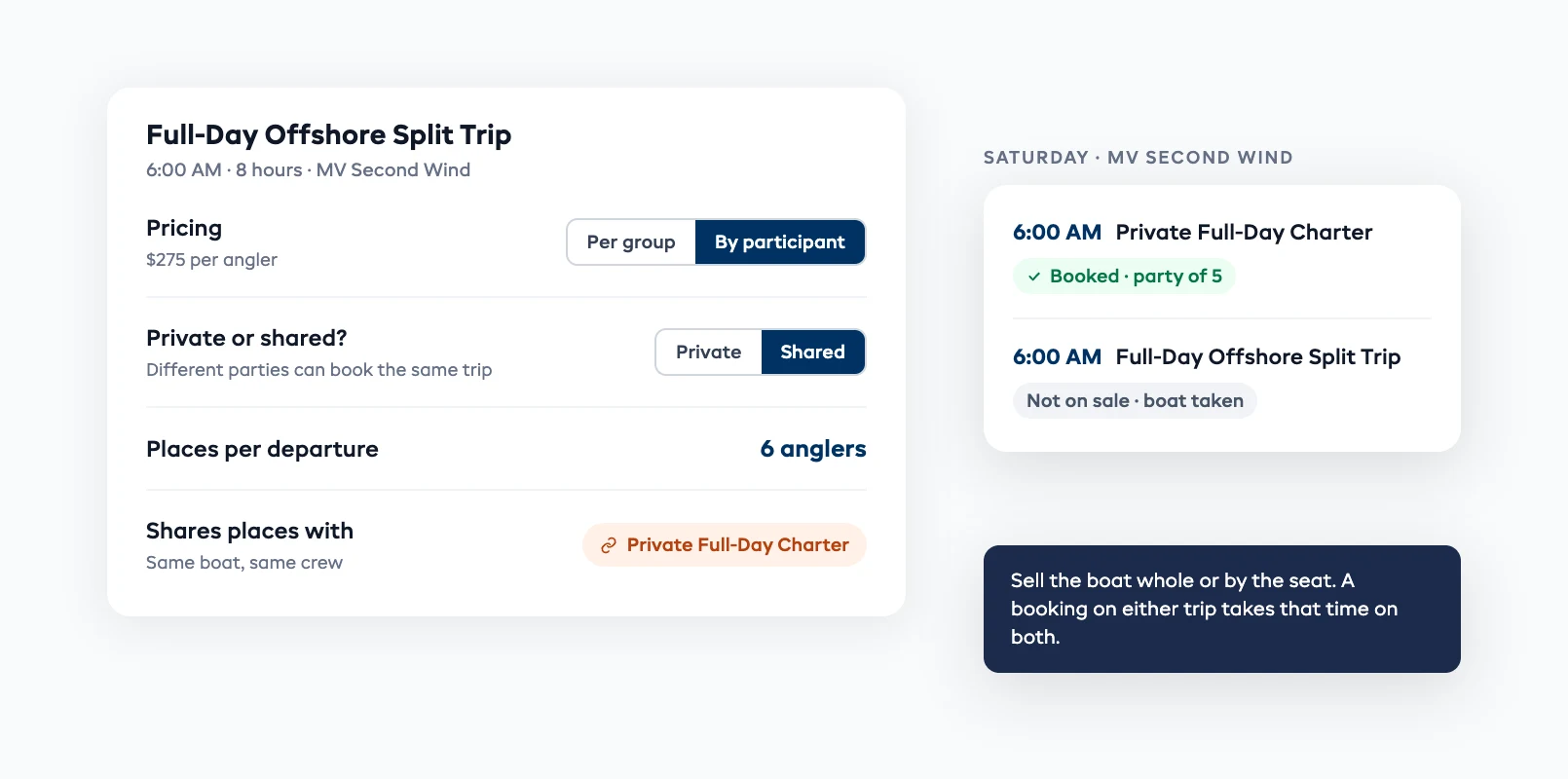
Each charter is priced Per group or By participant, then set Private or Shared. Set the split charter to Shares places with the private charter on the same boat, and a booking on either takes that time on both. There's no cabin or berth plan, so a liveaboard selling by the cabin should look elsewhere.
With Runs with at least set, a short split charter shows Needs 2 more to run on Today. If it's still short 24 hours out you get an email, and Cancel session refunds everyone.
Deposits and balances
The deposit is set per charter as a percentage, a fixed amount or an amount per person. How the balance is collected is one setting for the whole business: at the boat, by payment link, or charged to the saved card a set number of days out, with a payment link emailed if the card declines. To see who still owes money, filter bookings by payment status Partial for next week's dates.
Cards go through Stripe, or Authorize.net on request if you already have a merchant account. There's no Square connection, so tackle sold through Square stays there, or moves into EquipDash's POS.
Captains and boat papers
Each charter has a Required certifications setting: USCG OUPV, USCG Master, offshore or towing endorsements, first aid or CPR. There's no Coxswain or Master type, so an AMSA certificate of competency, or a Maritime NZ or Transport Canada ticket, goes under Boat License, the type EquipDash treats as a skipper's ticket, with its real name typed in.
Tickets sit on each captain's profile with an expiry date, turn amber 30 days out and show in a Monday email to admins. A captain whose ticket is missing or runs out before the date is flagged. Ask Dash, the built-in assistant, for anything expiring in the next 90 days when you plan the haul-out.
Turn on Need a guide to run? and a charter only sells while one of its assigned captains is free. Each boat's Compliance tab holds an Inspection expiry date and insurance expiry, and bookings on a boat with lapsed papers are blocked by default.
Manifests, waivers and the briefing
Turn on Coast Guard passenger manifest in a charter's Compliance tab: a PDF for every departure with the captain, head count and each passenger's age, emergency contact, waiver status and whether they boarded.
The setting is named for the US Coast Guard. In Australia nobody files it with a coast guard; it's your passenger list, checked against the limit on your certificate of operation. Answers to the questions you ask each person, such as whether they're keeping the catch, show on the departure's regular manifest.
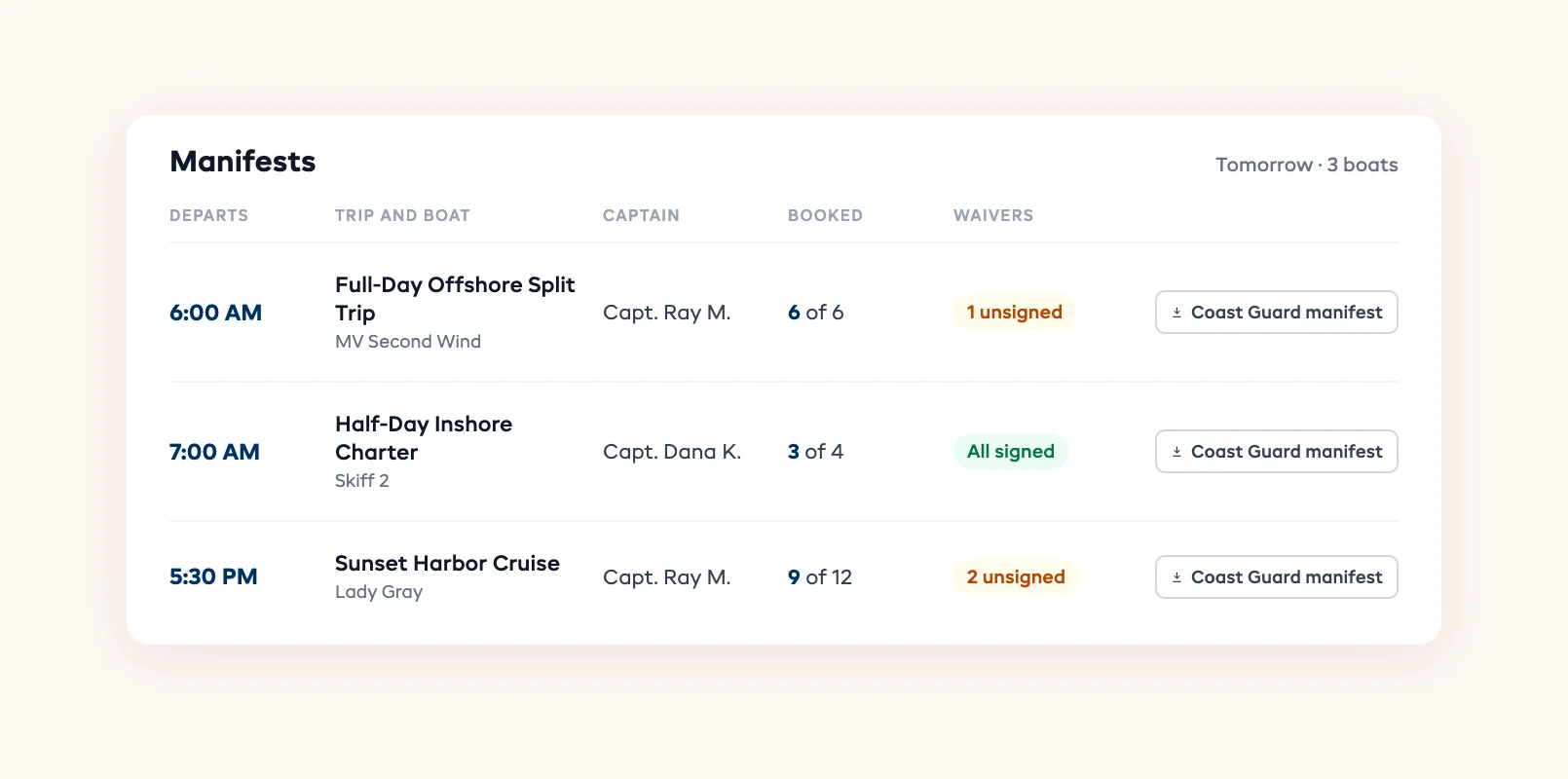
The waiver link goes out with the booking, and reminders go only to guests who haven't signed, by email, text or both, on a schedule of days you set. Parents sign for kids.
If guests meet you at the marina gate, that's how it gets done before they arrive. Each waiver has a QR code for the line to scan, and a guest whose phone is dead can sign on a tablet at the desk from the booking's signing link. A business set to French gets its booking page and waiver link in French on any plan, and a second language is a Pro feature.
In Australia the waiver can be your risk warning and indemnity form; have a lawyer check it first.
A pre-check-in checklist, such as Charter Tour Pre-Boarding, can block check-in until the safety briefing is checked off. Every completed checklist, and any override with its reason and who made it, is saved on the booking's History tab, a record you can show your insurer if they ask.
Weather days
Weather lines are set in km/h or mph, not knots: multiply by 1.85, so BOM's 26-knot strong wind warning goes in as 48 km/h (BOM's wind warning bands).
The forecast at each location is checked every 30 minutes, up to 72 hours ahead, against your lines for wind, gusts, waves, swell, rain, thunderstorms or temperature. There's no line for fog or visibility, hail or wildfire smoke, so on a fog-prone coast or an inland lake those calls stay yours.
A line for wind below a number can warn you a sunset sail will be a motor-sail. At a coastal location the Small-craft advisory preset is EquipDash's own trigger (gusts of 40 km/h or waves of 1.2 m), not an NWS or BOM bulletin, and it has no number to change. To use your skipper's limits, add your own wind, gust or wave lines.
When the forecast crosses a line, EquipDash asks whether to close bookings and says how many fall in those hours. Confirm, and the charters and boats that rule covers stop taking bookings at that location until the forecast clears.
Reschedule slot then moves everyone on a departure to a new time you pick, and each party gets an email (and a text, if SMS is on) with a link to choose another day if it doesn't suit. Anyone flying out before the next calm day can be refunded to the card or given store credit as a voucher.
Self-drive rentals, extras and bonds
Rod rental, bait, crab nets, a cooler or a wetsuit go on the booking as extras, and a surcharge adds a fuel levy or weekend rate. Rental questions, like a jet ski rider's license number, a paddler's swimming ability, weights for a tandem kayak or a bareboat guest's sailing experience, need Pro's own checkout questions.
A security deposit is held on the card and released after a clean return, or charged against with photos on a condition report. A card hold lasts about 7 days. If most of your rentals run a week, switch the deposit method in Settings > Payments to Charge, which charges every deposit up front and refunds it after the walk-through.
A pickup checklist can hold the handover until the briefing is checked off and the hour meter read, and life jackets are checked out and back in.
On the water and back at the dock
Set Buffer time on the boat for fuel and a wash-down.
A charter that ends with anyone checked in still out shows Not back in red on Today. Self-drive boats sit on the Gear for today timeline. Remind sends a late renter your overdue message by email, and by text too if you've turned those texts on, which is the one a paddler on the water will see.
Calls and travel sites
The AI Front Desk add-on ($99/mo on Growth or Pro) answers the calls you miss from your charters and prices, takes or moves bookings inside your cancellation policy and texts a payment link, without ever taking card details over the phone. The $99 covers 400 call minutes a month, about 130 calls, plus about 500 booking-page chats. Past that, 75 more minutes cost $15 and 100 more chats cost $10, and top-ups you don't use carry over.
When it can't answer something, it tells the caller a team member will call back and passes you their question. Every call lands in an inbox with the transcript.
It doesn't decide whether a departure runs. A Pass some calls on rule can send "are we still going?" calls to your cell, but only while you're open, so a 5:30am caller gets a message taken and the skipper's call at the ramp stands.
Viator and GetYourGuide sell from your booking page's availability. Expedia and the rental directories don't connect. Airbnb or any site with an iCal link can block time, but its bookings come in as closures for the whole business, not one boat.
If FishingBooker or Getmyboat fills most of your boat, EquipDash won't replace that. It has no marketplace, so your bookings come from your own site and the travel sites it connects to (Viator, GetYourGuide, and Manawa in New Zealand). It's also newer than most names here, with fewer independent reviews, so judge it on the charter booking software page and a trial with your own boats.
2. FishingBooker
FishingBooker is a marketplace first. Anglers search it by port and book your charter there, and it also offers captains a way to take bookings on their own site.
Price: no subscription and no fee to list, per FishingBooker's payment and pricing terms. On marketplace bookings, the captain sets a commission between 10% and 30% of the booking price, and FishingBooker keeps the guest's deposit as that commission. Customers may also pay a service fee; the amount isn't published.
FishingBooker Direct takes bookings on your own website with no commission, for US captains only, with a processing fee of 2.65% + 3¢ per transaction that you can pass on to guests (FishingBooker's Direct pricing). It isn't available in Connecticut, Massachusetts, Maine or Oklahoma.
FishingBooker's page for captains lists a calendar that syncs with outside calendars and links several listings, instant booking, a captain app for bookings and messages, and deposit payment, or paid in full for US captains. When you cancel for weather, the customer gets a full refund.
You pick the rate, so do the sum with yours: at 20%, a $900 full-day charter booked through the marketplace leaves $180 with FishingBooker.
3. FareHarbor
Price: no monthly fees and no setup fees, per FareHarbor's fishing charters page. A small charge applies only to confirmed bookings.
FareHarbor doesn't publish the rate, so ask in the demo who pays it. If you're on it now, your payouts already show what you pay, so the question is what it doesn't do.
The fishing charters page lists bookings matched to the right vessel, captain and crew scheduling, private and shared pricing, digital marine waivers, a live souls-on-board manifest and mobile tickets that scan at check-in even offline. There's a dock POS, add-ons such as bait and fish cleaning, and over 250 travel-site and API connections, including Viator and GetYourGuide.
Weather holds go on specific departures, then you send guests an update and rebook them from the dashboard. Ask in the demo whether one hold can move a whole day of departures. The page doesn't mention flagging a boat that's late back, so expect to keep calling the skipper.
The page mentions payment schedules for private charters (Private Events), but not what happens when a balance card declines. Ask whether the guest gets a payment link or you chase it.
4. Peek Pro
Peek Pro's boat page leans on what the guest sees: booking online, rescheduling themselves when the weather turns, tipping at the POS.
Price: not published. Peek's homepage describes its pricing as commission-based without a rate, and quotes come through a demo request, so get the commission and the notice period for leaving in writing.
Peek's boat tours page covers the fleet side: which boats are down for maintenance, a manifest with check-in per guest, and phone apps that keep working offline. Waivers are digital, it connects to Viator, GetYourGuide and TripShock, and it offers dynamic pricing.
Rescheduling there sits with the guest. In the demo, ask to see a whole departure moved at once on a wind day, a part deposit taken and a captain's license expiry tracked.
5. Charterfy
Charterfy is built for boat charters, and its flat plan is sized for one to five boats.
Price: two plans on Charterfy's pricing page. The flat plan is $99/mo with no cut of your bookings and 300 bookings a month included.
The other plan has no monthly fee and charges 4% per booking (minimum $2), paid by the guest. Bookings you enter yourself carry no fee on either, Stripe's 2.9% + 30¢ applies to both, and every account starts on the 4% plan with no card needed.
The $99 covers up to five boats and five crew logins on one account. Extra boats are $15/mo each or $59/mo for five more, and each extra crew login is $10/mo, on either plan. Charterfy lists a deposit and balance through your own Stripe, security deposits, digital waivers, a fleet calendar and an AI assistant connection.
For hourly rentals, check the 300 bookings a month: a busy kayak desk can pass it in a week. Ask too whether each kayak counts as a boat, because at $59 per five extra boats a big paddle fleet costs more than the $99.
Per-seat split charters, Viator, GetYourGuide and an offline app don't appear on the pricing page. If you only sell the whole boat, the $99 plan is the simplest bill here; if you sell seats on a party boat, ask Charterfy whether it sells by the seat.
6. CaptainBook
Price: shown to us as Starter €49/mo, Extended €199/mo and Ultra €349/mo, with up to 15% off billed yearly, per CaptainBook's pricing page. Starter covers one boat and three user logins, and Extended covers five boats and 10 logins.
Direct, online and offline bookings carry no booking fee. GetYourGuide, Viator, Google Things to do and Project Expedition cost €14.99 per product a month instead of a percentage, and other travel sites cost 3.5% on Starter down to 2.5% on Ultra. Three charters listed on Viator cost €44.97 a month between them, however many seats they sell.
Card processing is extra, and the free trial runs 14 days with no card.
Per its fishing tours page, captains are scheduled through two-way Google Calendar sync and assigned automatically, and they collect tips and balances in the phone app, paid into your Stripe account. Private tours are covered on its boat tours page.
Waivers aren't on Starter, and Extended includes two waiver forms with unlimited signatures. Its coast guard paperwork add-on is for the Hellenic Coast Guard in Greece, not the US Coast Guard.
7. Checkfront
If you rent boats or kayaks as well as running charters, Checkfront handles both, and phone bookings carry no extra fee.
Price: one plan at $99/mo plus a 3% fee on online bookings, which you can absorb or pass on to guests, per Checkfront's pricing page. Offline bookings and travel-site bookings carry no extra fee. Checkfront notes that pricing may vary by region and currency, and it offers a demo rather than a trial.
Waivers are built in at no extra cost. If you pay for Smartwaiver on top of Checkfront, check whether the built-in waiver takes your current form before you renew.
The pricing page names Google Things to do, Viator and GetYourGuide among its connections. Checkfront's own guide to public and private boat tours shows how to sell both on one boat with a shared capacity.
Its fishing charters page lists boats and captains shared across bookings without double-booking, a Daily Manifest with QR check-in, deposits at booking with the balance charged later to the saved card, and private charters alongside shared ones. Weather comes up only as rules and seasonal changes to capacity, not a forecast check.
8. Rezdy
When a hotel tour desk or reseller sells a seat through Rezdy, the agent keeps their commission and Rezdy charges you the same flat fee as for a booking you phone in, with no cap on agent connections. That suits a boat whose seats are mostly sold by tour desks, visitor centers and resellers.
Price: Foundation is $49/mo with a 3% fee on online bookings, which you can absorb or pass on, and $1 per offline or agent booking. Accelerate is $99/mo ($0.85 per offline booking) and Expansion is $249/mo ($0.70), all with unlimited travel-site and agent connections, per Rezdy's pricing page.
There's no free trial, only a demo. Prices exclude GST in Australia.
Rezdy has a charters page for boat and fishing charters, and its pricing page lists a guest manifest and pick-ups. Waivers, captain scheduling and weather aren't on it, so on Rezdy who skippers which boat stays in your spreadsheet. The charters page still shows older booking fees, so go by the pricing page.
Phone bookings add up. At 100 phoned-in bookings a month, the $1 fee is $100 on top of the $49, more than the plan itself.
9. Bookeo
Bookeo charges a flat monthly fee, takes no commission and adds nothing for the guest at checkout.
Price: per Bookeo's tours pricing page, plans run from A$14.95/mo (Solo) to A$119.95/mo; Standard at A$39.95/mo covers 20 guides and vehicles and 1,000 bookings a month. Bookeo charges no commission, waivers are an add-on from A$12/mo, and the free trial runs 30 days with no card.
Bookeo's boat reservation page covers group tours with a set passenger count, private charters, and departures where the customer picks private or shared. It lists deposits and pay-later options, rostering of boats and captains, online rescheduling and integrated waivers (the add-on above), and its distribution page shows Viator, GetYourGuide and Expedia.
If you're already on Bookeo in Australia, it's the cheapest bill here and a fair reason to stay. Move off it only if you need what its boat page leaves out: a manifest for every departure, captain tickets tracked with expiry dates, or a forecast check on your own wind limits.
What it costs at your volume
Say you take $150,000 a year online, about 300 charters at $500, and absorb every booking fee. That's an example to compare fees, so swap in your own season's takings.
A lumpy season changes the booking fees month to month, but the subscriptions bill the same. At about four people a booking, that's roughly 100 waivers a month, so where waivers cost extra we priced the cheapest plan that covers 100.
| Software | Subscription | Booking fees | First-year total |
|---|---|---|---|
| Bookeo (Standard + waivers) | A$479 + A$144 waivers | None | A$623 (about US$414) |
| Charterfy ($99 plan) | $1,188 | None | $1,188 |
| CaptainBook (Extended, includes waivers) | €2,388 | None on direct bookings | €2,388 (about US$2,622) |
| EquipDash (Growth, waivers included) | $660-$828 | $2,250 (1.5%) | $2,910-$3,078 |
| Rezdy (Foundation) | $588 | $4,500 (3%) | $5,088 |
| Checkfront (waivers included) | $1,188 | $4,500 (3%) | $5,688 |
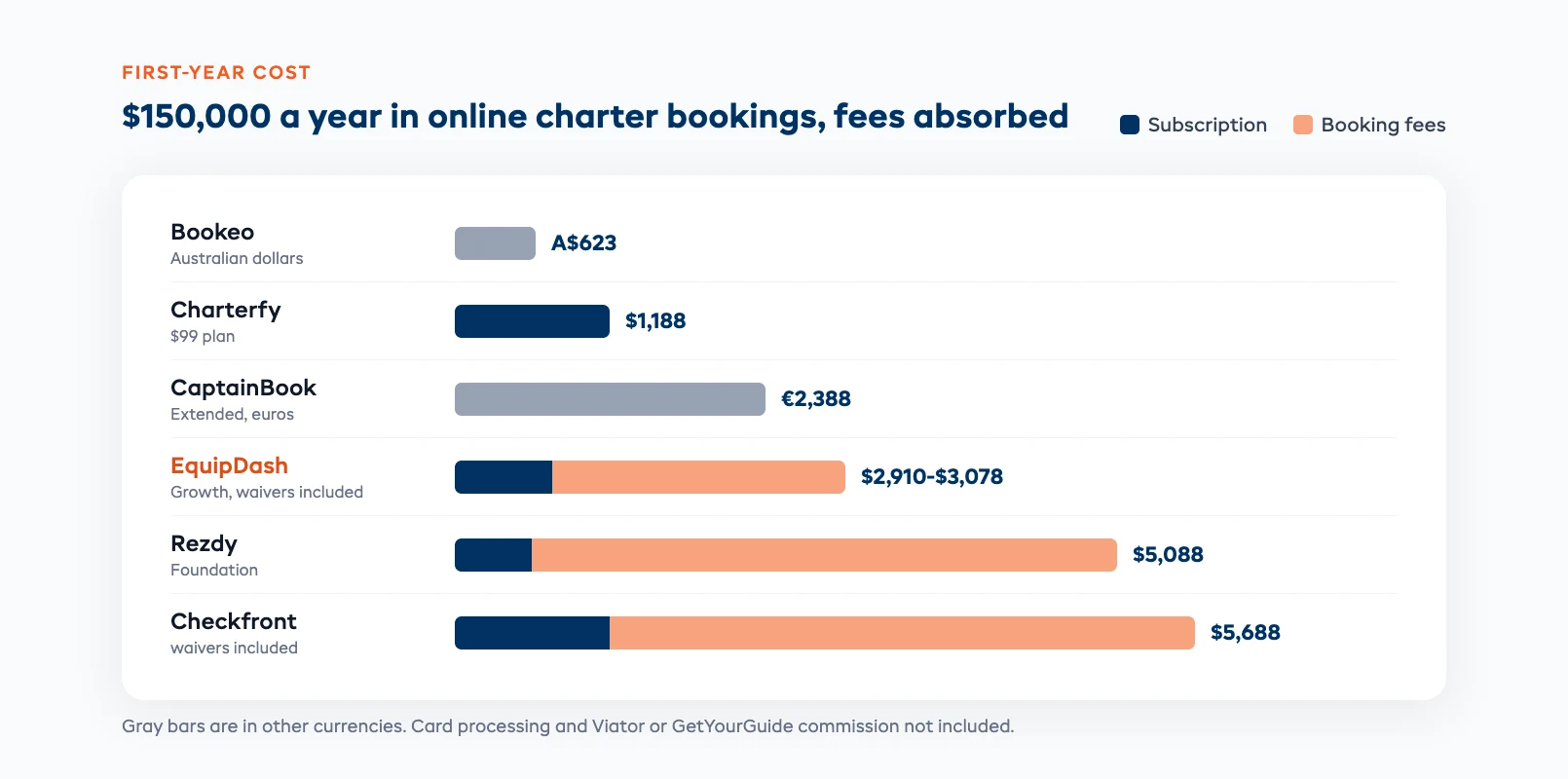
Each row is in the currency that vendor bills you in, with a US$ figure for the two that aren't in dollars. EquipDash's range runs from yearly to monthly billing at list price, before the 50% off the first three months on monthly plans, which takes $103.50 off Growth's first year.
At the RBA's rate on 23 November 2026 (US$0.6638 and €0.6045 to the Australian dollar), EquipDash Growth's US$660-$828 a year is A$994-A$1,247 and CaptainBook's €2,388 is A$3,950.
Charterfy's 4% plan costs you nothing a year, but your guests pay $6,000 between them at checkout. FishingBooker isn't in the table because it depends on where the booking comes from: on the marketplace at a 10% commission, $150,000 of charters costs $15,000, and at 30% it's $45,000. Booked through FishingBooker Direct, there's no commission and the 2.65% processing fee takes the place of Stripe's.
At $50,000 a year online, Bookeo is still the cheapest at A$623 and Charterfy stays at $1,188. EquipDash Growth comes to $1,410-$1,578, Rezdy to $2,088 and Checkfront to $2,688, while CaptainBook Extended stays at €2,388.
On small hire tickets the fixed 30 cents bites. On an A$45 kayak hour in Australia, Stripe's 1.65% + A$0.30 is A$1.04 and EquipDash Growth's 1.5% is A$0.68, so A$1.72, or 3.8%, and at 300 rentals a month that's about A$516 a month. Rezdy's 3% would be A$1.35 of the A$45, plus $1 on every rental phoned in.
On an A$180 jet ski hour the same two fees are A$3.27 and A$2.70, about 3.3%, because the fixed 30 cents matters less.
At the other end, a 20-plus-boat fleet doing $1,000,000 online pays mostly in percentages. EquipDash Pro at 1% comes to $11,428-$11,788 a year and Checkfront at 3% to $31,188. Charterfy's flat plan for 27 boats is $99 plus four 5-boat packs at $59 and two extra boats at $15, or $4,380 a year before crew logins past the first five ($10/mo each), with 300 bookings a month included; ask Charterfy what happens past 300.
None of the rows count what Viator or GetYourGuide keep from each sale.
Most monthly plans bill every month you keep them, so on a six-month season $69 a month is still $828 a year. Bookeo can freeze the account off-season at 30% of the monthly fee.
On EquipDash's monthly billing you can cancel when the season ends, and bookings, customers and signed waivers stay in the account until you subscribe again. Your booking page stops taking bookings while you're canceled, so don't cancel if next season's charters sell over the winter. A yearly plan runs to the end of the year you paid for.
If you pass the booking fee on to customers, EquipDash, Checkfront and Rezdy come down to the subscription alone, plus Rezdy's offline booking fee. FareHarbor and Peek Pro don't publish enough to include.
How to choose
- Most of your bookings come from a marketplace: on a fishing charter that's FishingBooker, and add Direct for the bookings that come from your own site.
- You sell private charters and split charters on the same boat: EquipDash, FareHarbor, Bookeo and Checkfront all handle both. In a trial, the test is whether the family's private booking takes the split charter off sale.
- You rent boats out self-drive as well: you need bonds, a handover checklist and a view of who's late back. EquipDash and Checkfront run rentals and charters in one system, and FareHarbor, Peek Pro and Bookeo also list rentals, so ask each to show you a boat that's late back.
- You take bookings through Getmyboat or Boatsetter: keep the listing, and check how its bookings reach your calendar. EquipDash has no connection to either, so you'd keep those dates in step yourself.
- You want a flat monthly bill with no cut of your bookings: Bookeo from A$14.95, CaptainBook from €49 for one boat (€199 on Extended for up to five boats, with waivers) or Charterfy at $99/mo.
- You sell heavily through Viator and GetYourGuide: CaptainBook charges a flat fee per product instead of a percentage, and Checkfront adds no fee of its own on those bookings.
- You run US passenger boats and need a manifest with emergency contacts: EquipDash builds a Coast Guard manifest PDF for each departure. FareHarbor's is a live souls-on-board list, Peek Pro's comes with check-in per guest and Checkfront's is a Daily Manifest with QR check-in. Our USCG charter compliance guide covers what the Coast Guard expects.
- You run short of captains on busy days: with Need a guide to run? turned on, EquipDash only sells a charter while one of its assigned captains is free, and it warns you about a missing or lapsed ticket. CaptainBook syncs captains' Google Calendars into your availability and assigns the best available captain to each new booking, FareHarbor assigns captain and crew roles to each departure so staffing is set before dock call, and Checkfront shares captains across bookings without double-booking them. Our guide to building a charter captain bench covers rostering around that.
Switching from a system you already run
Switch while the boats are out of the water for antifouling and survey, and keep the old system live until the last booking taken there has gone out. Mid-season, a cutover that goes wrong costs you a weekend of bookings.
In southern Australia and New Zealand the haul-out usually falls in winter. In the northern US and Canada it's after the boats come out in fall. Jet ski and kayak fleets don't slip at all: switch after you pack up for the season, with the old system running until the last bond is back.
Florida and the Gulf plan around hurricane season, June 1 to November 30. When a storm is named you're moving a week of bookings at once and keeping deposits as credit, so try exactly that in any trial.
Tropical Queensland runs the other way: the dry winter is peak, and the quiet months fall in the wet, inside BOM's cyclone season of November to April. If you run all year, switch in the slowest month on last year's bookings. In cyclone or hurricane country, set up that cancellation policy in the new system before anything else.
Before you move, pull a list of what the old system still owes people: bookings for later dates, deposits it's holding, gift cards or certificates not yet used, and Viator or marketplace bookings.
If your bookings live in a diary, WhatsApp threads and deposits on a bank statement, that list is the job. Go through the statement and the messages, and write every future booking into one spreadsheet with the date, boat, party, phone number and deposit paid.
Get the new vendor to put in writing who enters those future bookings and by what date. If you keep a marketplace listing, check how its bookings reach your new calendar so the same boat can't sell twice.
On EquipDash, a person on the setup team imports your charters, customers and pricing from FareHarbor, Peek Pro, Rezdy, Booqable, Checkfront, Rentle or a spreadsheet, connects Stripe and embeds your booking widget. Our pricing page lists that setup as a $500 service, free at the moment, and says most shops are taking bookings within 2 business days.
Charters arrive as drafts, and nothing goes live until you approve it, so the old system keeps selling meanwhile. Send the team your upcoming bookings and gift card balances and they enter them.
Past payments stay with your old system and your card provider. So if you're coming off Booqable with half-paid charters, export them from Orders and mark what each party has already paid, or the balance in the new system will be wrong.
Before you sign, run a fake Saturday through the trial: two boats out, one seat sold on the 6am split charter, two waivers half signed. Try to sell the whole boat on that departure; it shouldn't let you. Take a booking with a deposit and set the balance to charge two days out.
Then call off the 6am for wind and see how long it takes to move every party. Check one party in and leave them past the end time, and leave one rented jet ski or boat out past its return; both should show late before you'd spot them from the ramp. Pull the manifest and see who's still missing an emergency contact.
Hand the booking page to a seasonal staffer who has never seen it and have them book a seat on their phone. If they get stuck, so will a guest. Then run one real weekend with the old system still live, because a test afternoon won't show you the Saturday pile-up at the ramp.
If you're coming off FareHarbor, the FareHarbor switch guide walks through exporting customers and open reservations and running both systems side by side until you cut over.
For your written go and no-go numbers, see our charter weather cancellation policy guide. For deposits and seasonal rates, see charter pricing strategy.
Frequently Asked Questions
What is the best booking software for fishing and boat charters?
Charterfy's $99/mo plan is the simplest if you only sell the whole boat and want a flat bill. If most anglers find you on a marketplace, that's FishingBooker, at a 10-30% commission. For private and split charters, captain tickets, Coast Guard manifests and self-drive rentals in one system, EquipDash runs them on Growth at US$69/mo (Starter is US$29/mo), with a 21-day free trial.
How much does charter booking software cost?
On $150,000 a year online, with you absorbing the fees, the first year runs from A$623 on Bookeo and $1,188 on Charterfy to $2,910-$3,078 on EquipDash Growth and $5,688 on Checkfront. Subscriptions start at A$14.95 a month on Bookeo, $29 on EquipDash, €49 on CaptainBook and $49 on Rezdy, and reach $149 on EquipDash Pro, $249 on Rezdy Expansion and €349 on CaptainBook Ultra. FishingBooker, FareHarbor and Charterfy's 4% plan charge no monthly fee and make their money per booking, up to a 10-30% marketplace commission on FishingBooker, and card processing is extra everywhere.
Can booking software sell private and split charters on the same boat?
EquipDash, FareHarbor, Bookeo and Checkfront list it. In EquipDash you set the private charter as private and the split charter as shared, then link them, so a booking on either takes that time on both; Bookeo lets the customer choose private or shared, FareHarbor lists pricing for both, and Checkfront sells both from one boat's capacity. In a trial, book one seat on a departure, then try to sell the whole boat on it, which it should refuse.
Can charter booking software build a Coast Guard passenger manifest?
EquipDash collects each passenger's emergency contact at booking and builds a Coast Guard manifest PDF for each departure, with the captain, head count, ages, waiver status and who boarded. It's for your own records, not an official Coast Guard form, and outside the US it works as the passenger list and head count. FareHarbor's manifest is a live souls-on-board list and Peek Pro's comes with check-in, but neither page mentions the Coast Guard.
How does charter booking software handle weather cancellations?
EquipDash checks the forecast every 30 minutes against the wind, gust and wave lines you set and asks whether to close those hours. Reschedule slot then moves every party on a departure at once, with a link to pick another day. On FareHarbor you apply a weather hold, send guests an update and rebook them from the dashboard, Peek Pro guests can reschedule themselves, and FishingBooker refunds the customer in full when you cancel for weather.
in one place