Twenty Chairs Short — But From Which Event?
Twenty Chairs Short — But From Which Event?
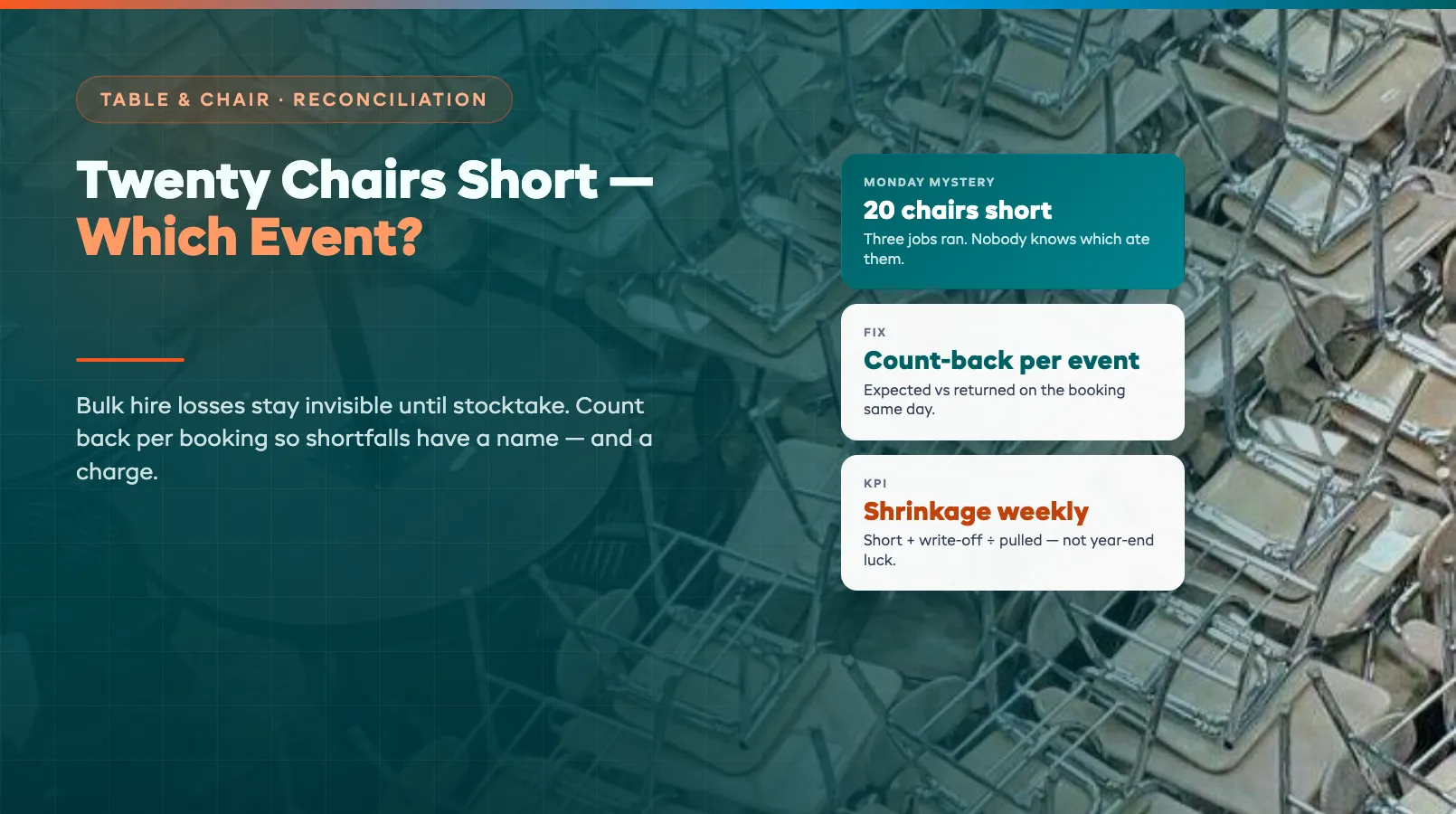
Monday morning. The yard counts banquet chairs. The sheet says 800. The stack says 780. Twenty chairs short after a weekend that ran three weddings and a corporate dinner.
Which event ate them? Nobody knows. The deposit windows closed. The planners already paid the balance. The cracked frames in the "fix later" corner still show as free on Tuesday's board. That is bulk hire shrinkage: invisible until stocktake, then unattributable.
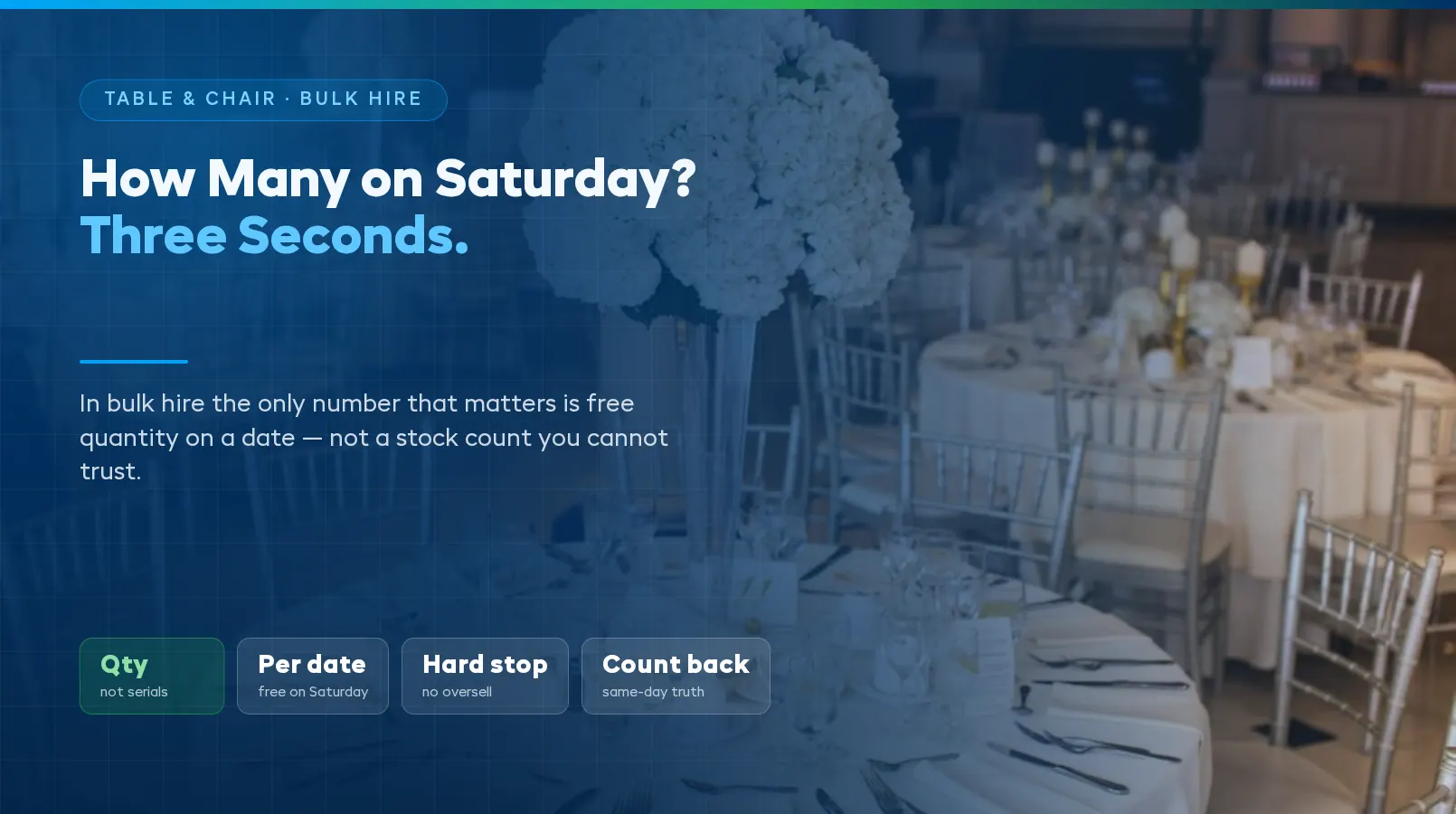
This is the operations companion to our table and chair rental software guide. That post is about answering free quantity on a date. This one is about keeping that number honest after every return — count-back per event, same-week shortfalls, damage on the booking, repair stock out of availability, shrinkage as a KPI, and how to cut it.
Counting Back Per Event
A weekend stocktake that only says "short" is useless. You need a count-back tied to the booking that sent the gear out.
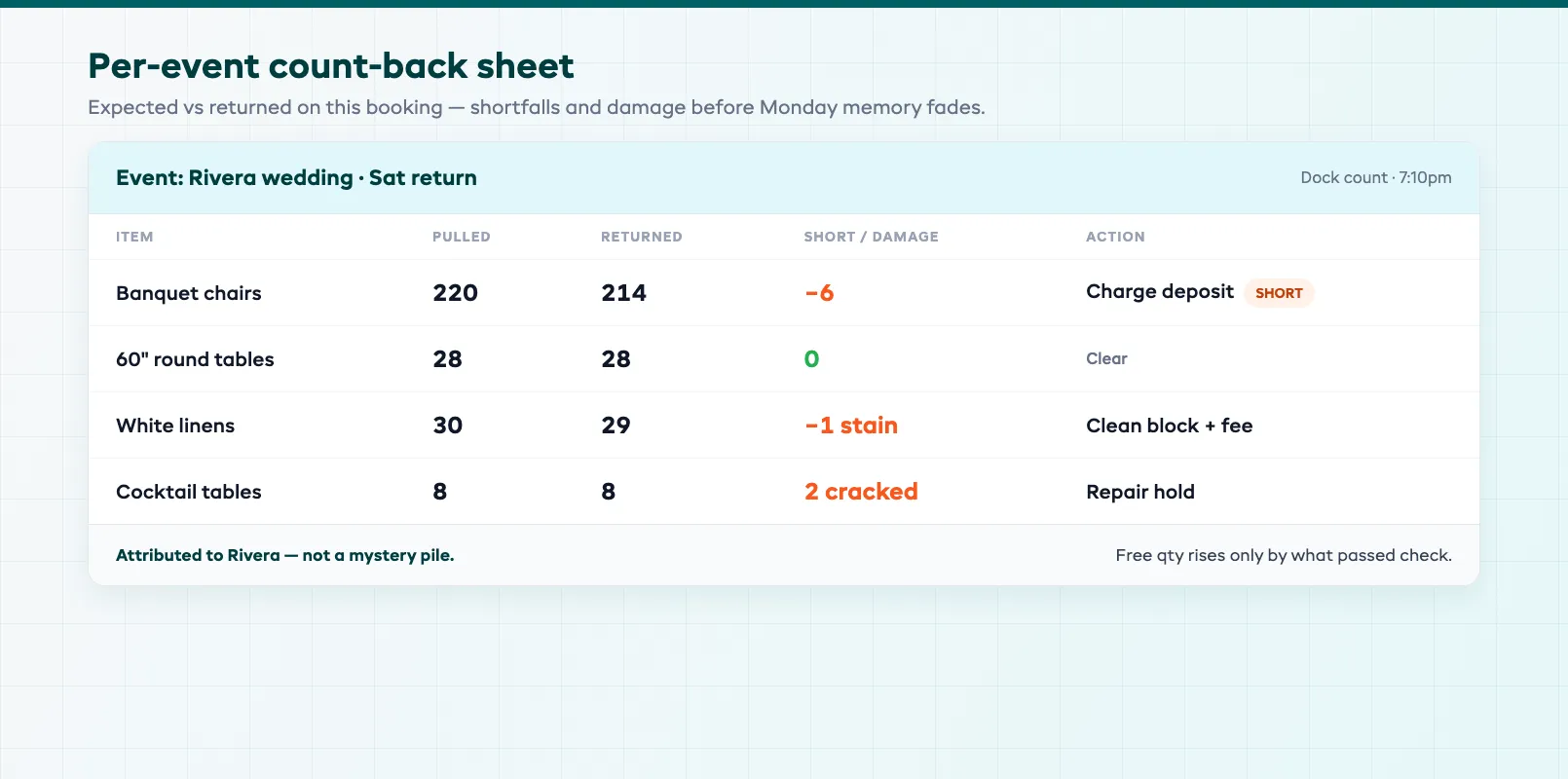
Every job should close with expected vs received against the pull list:
| Line | Pulled | Returned | Short | Damaged | Note |
|---|---|---|---|---|---|
| Banquet chairs | 220 | 214 | 6 | 2 | 2 cracked backs on dock photos |
| 60" rounds | 28 | 28 | 0 | 1 | Edge chip — repair hold |
| White linens | 30 | 29 | 1 | 0 | Charge linen line |
Do it at the truck or the dock the same day the gear comes home. Not "sometime Monday." Memory fades. Photos get lost. The planner who would have accepted a damage charge on Sunday night will fight it two weeks later.
Count-back is not a warehouse hobby. It is how free quantity rises only by what actually returned and passed check. If you skip it, the next Saturday quote is guessing with last weekend's missing chairs still in the free pool.
Practical rules that stick:
- One sheet per booking — never a combined weekend tally that blames nobody
- Photos on the booking — cracked frame, stained seat, missing stack edge
- Crew signs the variance — who counted, when, and what they saw
- Office closes the loop same day — charge, write-off, or repair hold before the next quote
If your table and chair rental software cannot put shortfall and damage on the booking, you will keep learning about losses at stocktake — the moment when attribution is already dead.
Catching Shortfalls the Same Week
Annual stocktakes find the body. Same-week reconciliation finds the cause.
Bulk yards that wait for a quarterly count absorb three months of mystery loss. Peak season makes it worse: you oversell chairs that left in May and never came back cleanly. The planner on the phone in June gets a free number that includes ghosts.
Same-week means:
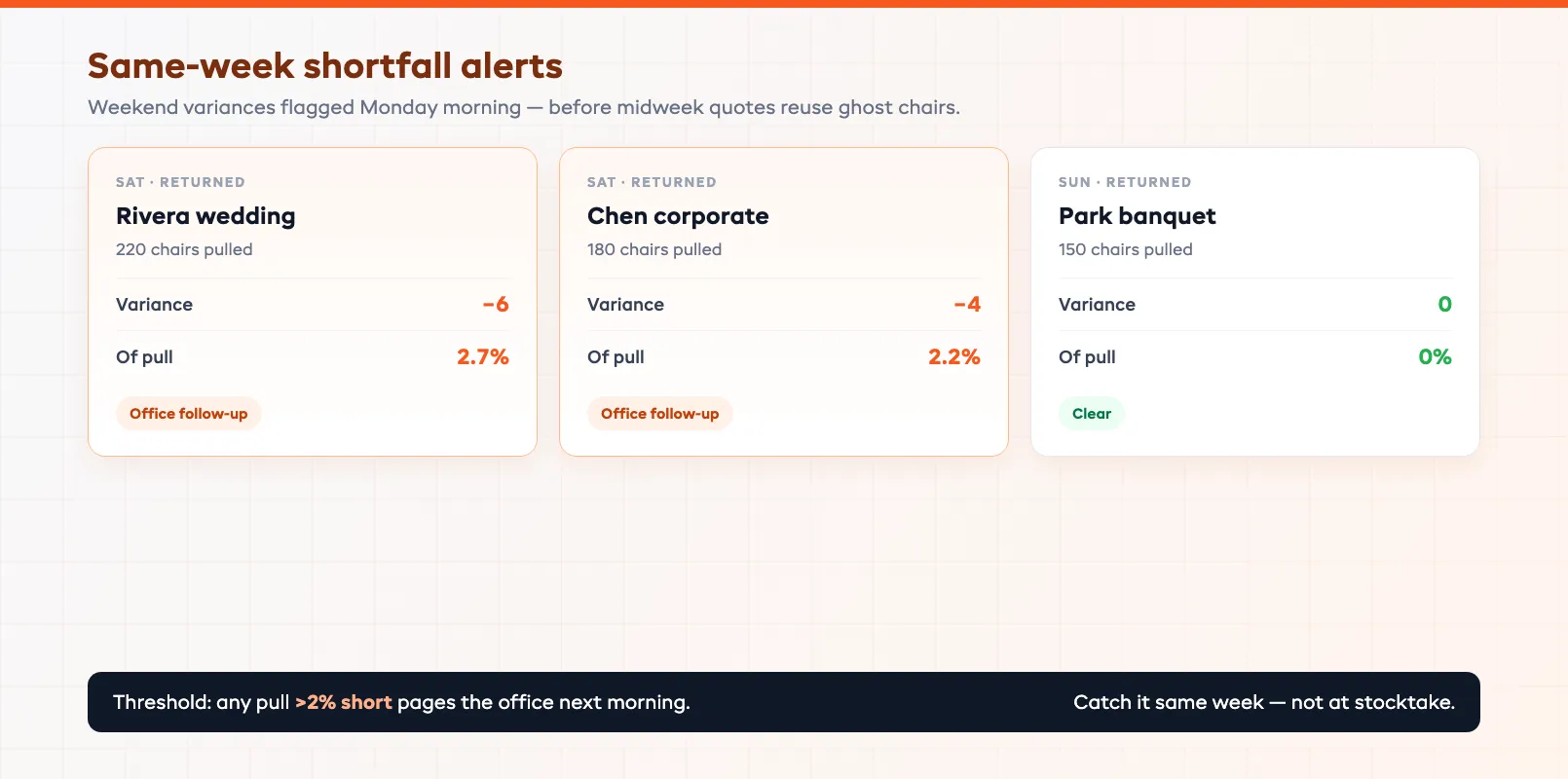
- Every return gets a variance logged within 24 hours
- Shortfalls over a threshold (for example 2% of the pull, or any specialty piece) page the office the next morning
- A Friday–Sunday cluster of jobs gets a Monday roll-up before new quotes go out
- Soft holds and sub-hire outs are checked against what actually moved
The goal is not perfection on every folding chair. The goal is that a six-chair miss on a 220 pull is named, charged or written off, and removed from free stock before Wednesday's corporate inquiry.
Operators who already run hard oversell stops still lose money if returns never update the board. The wall only protects capacity you still own. Shrinkage that never hits the system is capacity you sell twice.
Damage on the Booking
Missing chairs and broken chairs are different problems. Treat them the same way on the paperwork: on that booking, with evidence, while the deposit still means something.
Damage workflow that holds up:
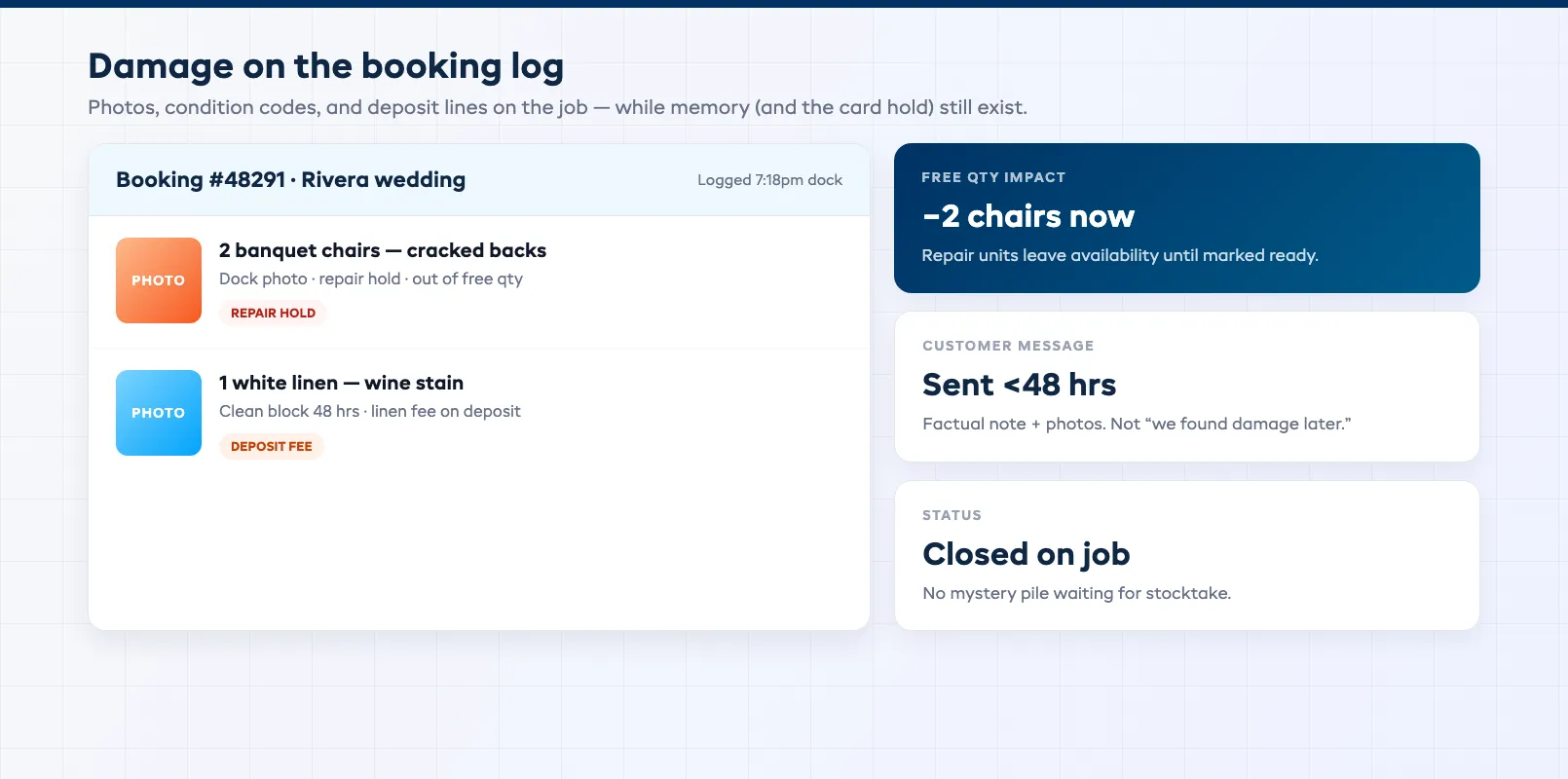
- Photo at dock — timestamped, tied to the booking ID
- Condition code — repair, clean, write-off
- Charge path — deposit claim, invoice line, or absorb with a reason code
- Customer message — short, factual, sent within 48 hours
Arguments start when the yard waits. "We found damage later" sounds like a shakedown even when it is true. "Two chairs returned with cracked backs; photos attached; $X from deposit" is a normal hire conversation.
Linens and chair covers need the same discipline. A stained banqueting cloth is not free stock for next Saturday. It is a cleaning block or a charge. If dirty goods still show as available, you will quote capacity you cannot deliver.
Keep human judgment for the edge cases — was the crack pre-existing, did the venue's crew stack badly, is the planner a long-term account. Automate the logging. Decide the money with a person looking at the photos.
Repair Stock Out of Availability
The classic failure mode: forty cracked chairs in the corner, still counted as free, still sold into next weekend's pull list. Night crew loads what the system says. The planner gets chairs that fail at set-up.
Repair holds exist so broken units leave the free pool until someone marks them ready.
In resource management for rental fleets, that pattern is ordinary for serialized gear. Bulk hire needs the same idea at quantity level:
- Damaged count moves from available to repair
- Free quantity for quotes drops immediately
- When repair finishes, units move back — or to write-off if they are done
- Reports show repair backlog as a capacity risk, not a footnote
Do not wait for a full stocktake to discover that your "800 chairs" is really 740 sellable and 60 in limbo. Limbo that still looks free is how you promise 220 and deliver 200 with excuses.
Cleaning blocks work the same way for linens and covers. Returned-but-not-ready is not free. A wash cycle is a calendar hold, not a vibe.
Shrinkage as a KPI
If you do not measure shrinkage, you will explain it as bad luck forever.
Define it simply for bulk event hire:
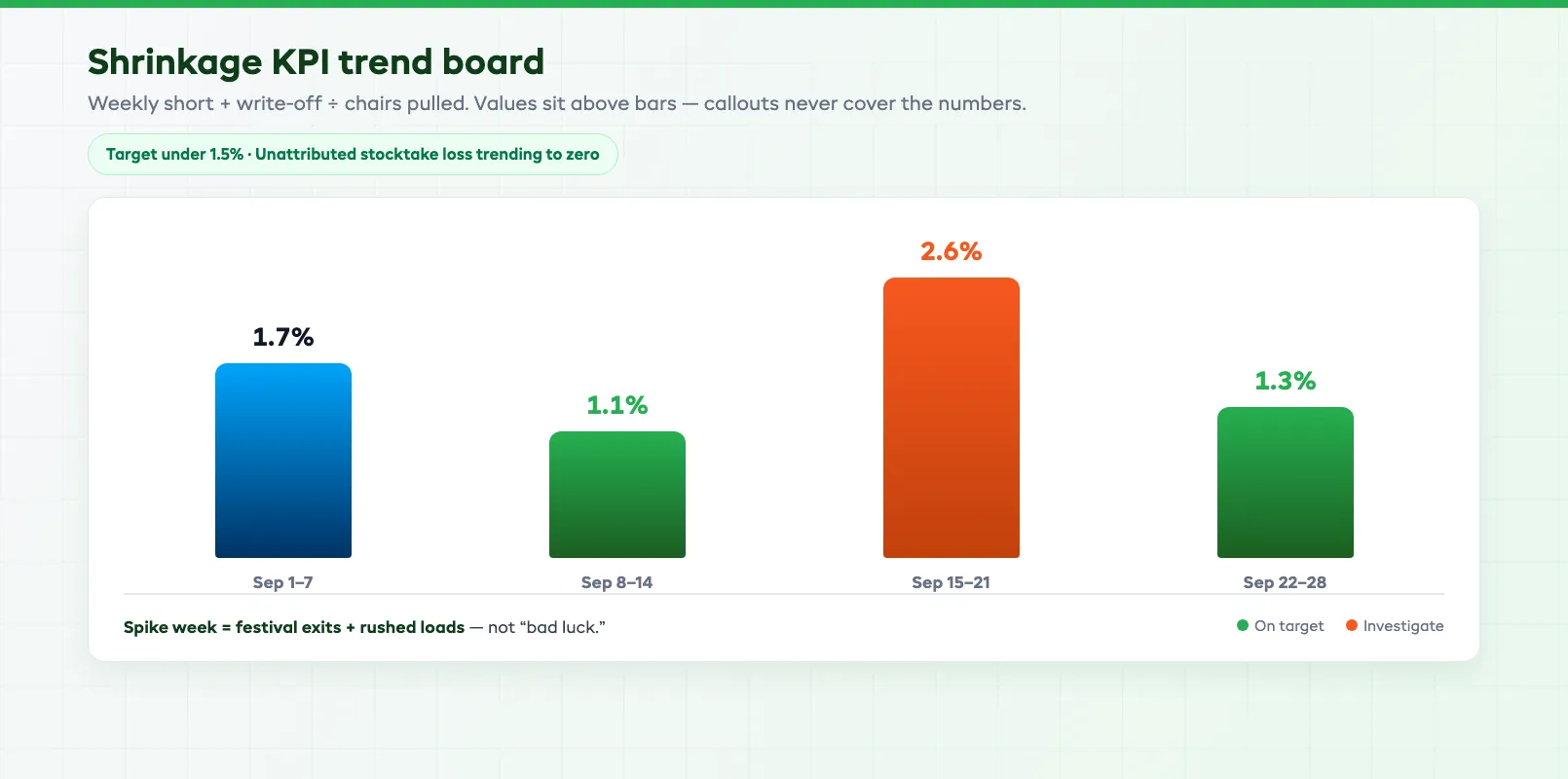
Shrinkage % = (units short + units written off from damage) ÷ units pulled, over the period
Track it weekly and by event type:
| Week | Chairs pulled | Short | Write-off | Shrinkage |
|---|---|---|---|---|
| Sep 1–7 | 2,400 | 28 | 12 | 1.7% |
| Sep 8–14 | 2,800 | 22 | 8 | 1.1% |
| Sep 15–21 | 3,100 | 61 | 19 | 2.6% |
A spike after festival weekends often means venue exits and rushed loads. A steady 2% every week often means count discipline, not thieves. A spike on one planner's jobs is a customer conversation. A spike on one crew's returns is a training conversation.
Pair shrinkage with two supporting metrics:
- Unattributed loss — shortfalls found only at stocktake (should trend to near zero)
- Repair backlog days — how long damaged quantity sits before return to availability or write-off
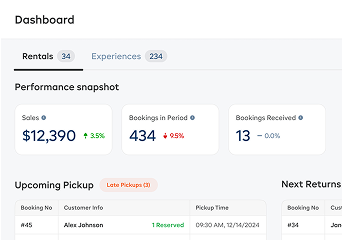
Dash can surface the weekly roll-up from booking variances so nobody builds the sheet by hand. Keep one AI mention where it earns its keep: flagging the outlier week and the bookings that drove it — not rewriting your ops manual.
Reducing It
Measurement without habits is just a sad chart. Cut shrinkage with a short list the yard can run every weekend.
- Pull list matches the truck — load against the booking, not a memory of "about 220"
- Venue exit check — a two-minute stack count before the truck leaves the site catches chairs left in a side room
- Same-day count-back — dock variance on the booking before the crew goes home
- Photo everything damaged — no photo, no charge, no repair hold half-done
- Repair and clean out of free stock — broken and dirty never quote as available
- Monday roll-up — office reviews weekend variances before new peak quotes
- Threshold alerts — auto-flag pulls over 2% short or any specialty miss
- Write-offs with reasons — "unknown" should be rare; force a code (venue, load, count error, theft, wear)
Sub-hire deserves a special note. Borrowed-in stock that returns short is still your customer problem, but the variance must hit the booking and the sub-hire PO. Otherwise you eat the loss and your partner never hears about it.
None of this requires serial numbers on every banquet chair. It requires quantity truth per event. The same systems that answer "how many free on Saturday" in the table and chair rental software guide should close the loop when Saturday comes home light.
Close the Loop Before the Next Stocktake
Twenty chairs short with no event attached is an accounting entry. Twenty chairs short on the Johnson wedding, with photos and a deposit line, is operations.
Count back per booking. Catch shortfalls the same week. Put damage on the job. Hold repair and dirty stock out of availability. Watch shrinkage weekly. Fix the habits that create it.
Do that and the free quantity you quote on the next call is a number you can defend — not a hope waiting for the next stocktake to prove you wrong.
FAQ
What is event stock reconciliation in bulk hire?
It is the process of comparing what you pulled for an event to what came back, logging shortfalls and damage on that booking the same day, and updating free quantity so the next quote does not include missing or broken stock. Without per-event reconciliation, losses stay invisible until a stocktake — when nobody can attribute them.
When should we count chairs and tables back in?
At return — truck or dock — against the pull list the same day. Waiting until Monday or the next full stocktake is how shortfalls become unattributable and deposits close before you can charge for real loss or damage.
How is shrinkage different from a stocktake variance?
A stocktake variance says the yard is short overall. Shrinkage as a KPI ties short and write-off units to pulls over a period, ideally by event. Stocktake finds the total hole. Per-event count-back explains which jobs and habits dug it.
Should damaged chairs still show as available?
No. Move them to a repair hold so free quantity drops immediately. Return them to availability only when repair is done, or write them off. Selling from the "fix later" corner is how pull lists lie and set-ups fail on site.
What shortfall threshold should trigger an office alert?
Pick a simple rule the team will honor — for example any pull more than 2% short, any specialty piece missing, or any variance over a fixed count (five chairs, one table). The number matters less than reviewing alerts before midweek quotes go out.
Do we need serial numbers on banquet chairs to reconcile stock?
No. Fungible chairs and standard tables reconcile as quantities per booking. Serials help for specialty pieces you cannot swap. Forcing barcodes on 800 identical chairs usually slows returns without improving attribution if you never close count-back on the job.
in one place