Fall Shoulder Season: Filling Tours with Foliage, Harvest, and Local Demand

Fall Shoulder Season: Filling Tours with Foliage, Harvest, and Local Demand
Labor Day empties the calendar. The families go home, the college kids go back, and the operator who ran three full departures a day in July is staring at a week with eleven bookings across it. Most tour businesses treat September and October as a slow fade toward closing. That is a choice, not a law. The same eight weeks carry three demand sources that summer never had: foliage travelers who plan around a specific window, harvest and food weekends that pull day-trippers out of the nearest city, and locals who finally have their own town back.
This guide covers how to fill fall capacity on purpose: timing departures to peak color, building harvest and food variants without inventing a new business, pricing midweek so locals show up, and cutting the operation down to match shorter days. It builds on our full guide to running a tour operator business, which covers the year-round fundamentals.
Fall Is a Different Market, Not a Smaller Summer
The mistake is running the summer product on a summer schedule to an audience that left. Fall guests differ in four ways that change how you sell.
They are older and travel in twos. Couples, retirees, and friend groups replace families. Average party size drops from four to two and a half, which means more bookings to fill the same seats.
They plan around a date range, not a date. A foliage traveler wants "peak color," and peak color moves a week or two either way with the weather. They book earlier than summer guests and they change dates more often.
They are weekend-heavy. Summer demand spreads across the week because everyone is on vacation. Fall demand stacks on Saturday and Sunday because most of these guests still work. Weekday fill without a plan runs at 30 to 40 percent of weekend fill.
They are closer to home. A larger share drives in from the nearest metro area or lives in your county. That audience responds to different channels and different prices than a fly-in visitor does, and it is the audience you keep for next spring.
Build the Calendar Around Peak Color
Foliage is the one fall demand source with a hard time limit, so build the schedule around it first. Peak color in most northern regions runs a two to three week window between late September and late October, and it shifts by elevation and latitude. Your job is to be sellable across the whole plausible window while concentrating capacity where the color actually is.
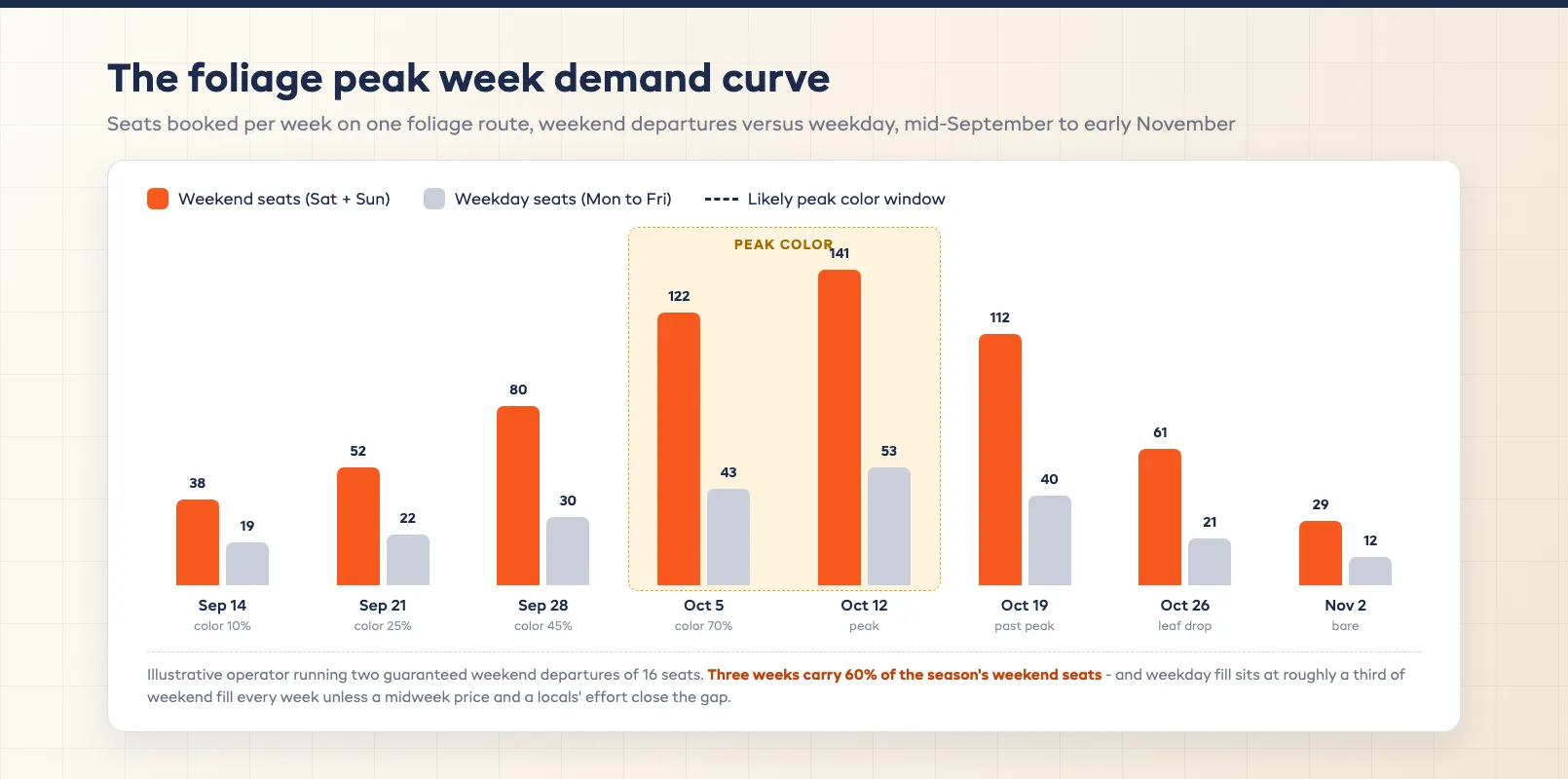
Practical rules that hold up across regions:
- Open the fall calendar by mid-August. Foliage travelers book four to six weeks out. If your October dates are not live in August, they are booking someone else's tour.
- Publish a color forecast, not a promise. A short page updated weekly ("color at 40 percent on the ridge, peak expected the week of October 12") gets bookmarked and shared. It also sets expectations so a guest who arrives a week early does not blame you.
- Guarantee departures on peak weekends and run on-demand elsewhere. Two guaranteed departures on each Saturday and Sunday inside the likely window, plus a minimum-two-guests trigger on weekdays and shoulder weeks. Guests book a guaranteed departure with confidence, and you do not send a guide out with one seat sold.
- Offer a free date change inside the season. Guests who can move their booking to chase color book earlier and cancel less. Make it a one-click change rather than an email to the office. This works alongside the policy framework in our no-show and cancellation guide.
- Add a late departure. In September the light is best after 4 pm and the day-trippers have thinned out. A "golden hour" departure at a small premium fills a slot that sat empty in July.
One thing to resist: adding a dozen route variants. One or two foliage routes with strong photography stops beat five that split demand and confuse the booking page.
Harvest and Food Variants Without a New Business
Foliage sells itself for three weeks. Harvest and food sell for eight, and they sell to people who would not book a hike. The trick is to bolt a harvest element onto a route you already run rather than launching a separate product with separate insurance, separate guides, and a separate learning curve.
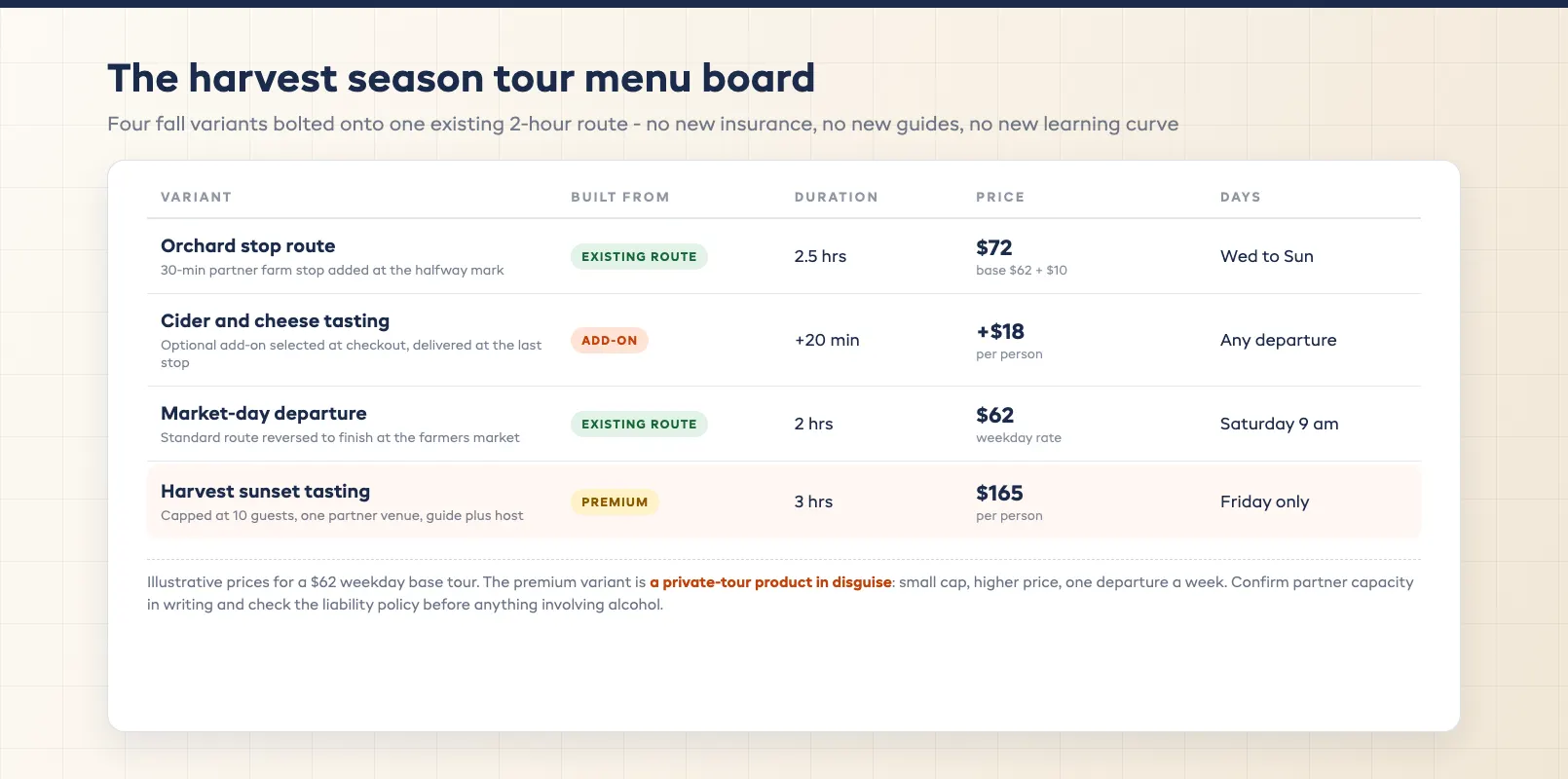
Variants that operators add with the least friction:
- Orchard, farm, or vineyard stop on an existing route. A 30-minute stop at a partner farm turns a walking or cycling tour into "a harvest tour." The partner gets foot traffic and retail sales; you pay a per-head fee of a few dollars or nothing at all.
- Tasting add-on at checkout. Cider, cheese, or a local pastry box as an optional extra at $12 to $25 per person. Add-ons lift revenue per booking without changing the departure.
- Market-day departure. Anchor one weekly departure to the town farmers market and end there. It gives the tour a natural finish and gives guests a reason to stay in town and spend.
- Harvest dinner or sunset tasting. One premium departure a week, capped small, priced two to three times the base tour. This is a private-tour product in disguise, and the economics in our private versus group tour breakdown apply.
Two cautions. Check your liability cover before adding anything involving alcohol; some policies exclude it or require a rider. And confirm the partner's capacity in writing, since a farm that can host twelve guests comfortably cannot host thirty on a peak Saturday.
Harvest variants also give you something new to send past guests. Anyone who toured with you in the last two seasons is the cheapest booking you will get this fall. A short reactivation message with the fall menu and a returning-guest code, sent in late August, typically converts at three to five times the rate of a cold ad. Operators on EquipDash run this with the pre-season customer reactivation agent, which segments past guests and sends the sequence without anyone building a list by hand.
Price Midweek for Locals
Weekends fill themselves in October. Tuesday does not. The gap between weekend and weekday fill is where most of the fall upside lives, and closing it takes a price the local market will respond to rather than a blanket discount.
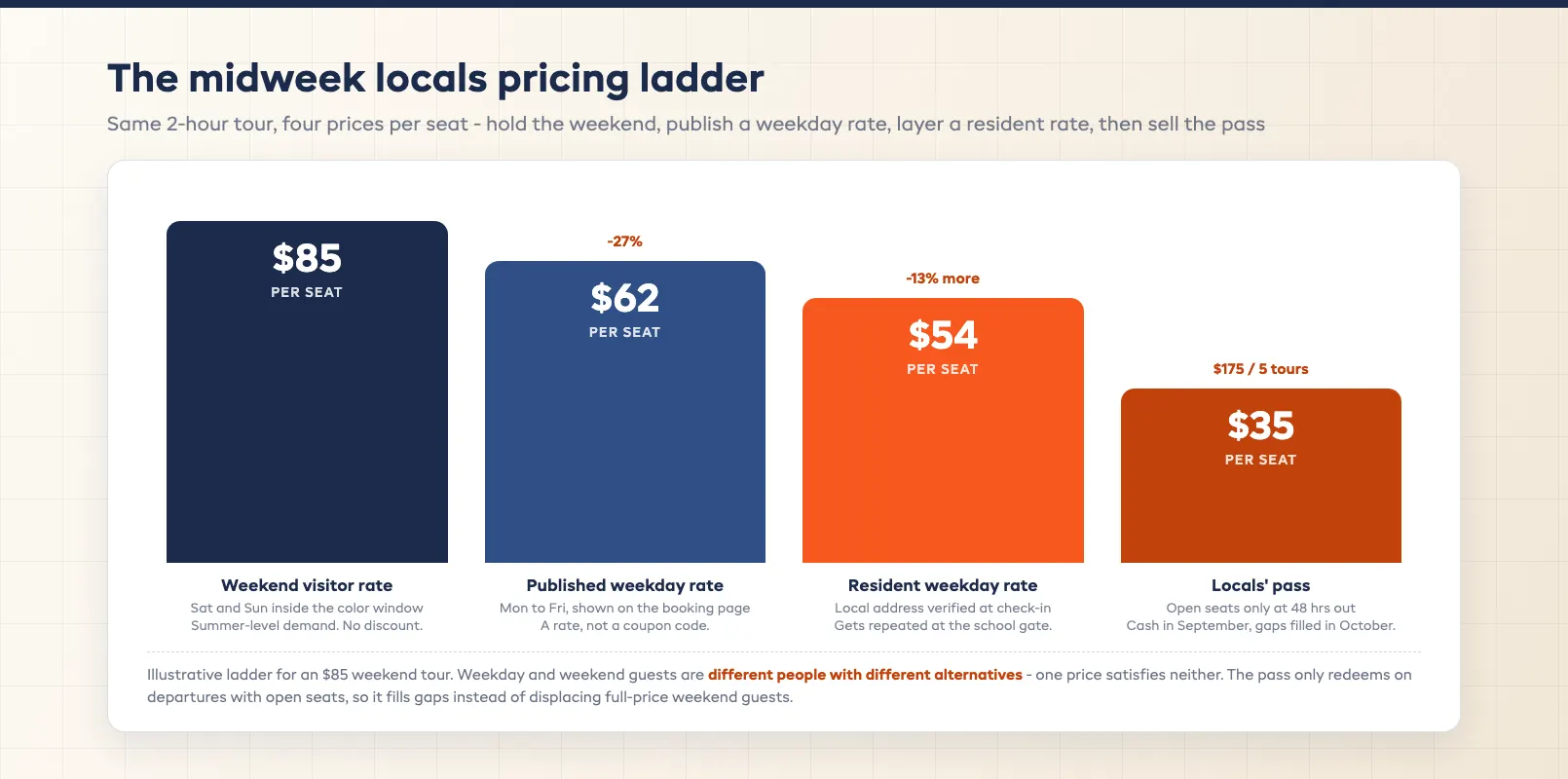
A structure that works:
- Hold the weekend rate. Foliage weekends carry summer-level demand. Discounting them gives money away.
- Set a published weekday rate 20 to 30 percent lower. Not a coupon, a rate. Coupons train people to wait for coupons. A visible weekday price trains people to book Wednesday.
- Add a resident rate on top, verified at check-in. Another 10 to 15 percent off the weekday rate for anyone with a local address. Locals talk to each other, and a resident rate that feels like a genuine favor gets repeated at the school gate and the hardware store.
- Run one locals-only departure a week. Early evening, short, cheap, guided by whoever knows the most town gossip. It is a marketing cost that happens to pay for itself.
The broader logic of tiered pricing by day and demand is covered in our tour operator pricing strategy guide. For fall specifically, the point is that the weekday and weekend guests are different people with different alternatives, so charging them the same price satisfies neither.
Local groups are the other midweek lever. Schools are back, and a Tuesday morning departure that would otherwise run empty is exactly what a class trip needs. Set a group rate with a minimum head count and a single-invoice checkout so the teacher is not collecting cash. Our guide to group pricing for tour operators covers the tiers and the deposit terms.
Sell a Locals' Pass
A resident rate fills seats one at a time. A locals' pass fills them in advance and puts cash in the bank in September. The format is simple: a fixed price for a set number of departures over the fall season, sold to residents of a defined area, redeemable on any non-guaranteed departure with seats open.
Pricing that has worked for operators of different sizes:
- Five-tour pass at the price of three weekday seats. For a $60 weekday tour, roughly $175. Buyers rarely use all five, and the ones who do bring friends who pay full price.
- Household pass covering up to four named people for the season at around the price of eight weekday seats. This is the one grandparents buy for visiting family.
- Add-a-guest at the weekday rate. Pass holders can bring one non-resident per departure at the standard weekday price. This is how the pass reaches out-of-town visitors you would never have found.
Restrict the pass to departures with open seats at 48 hours out, so pass holders fill gaps rather than displacing full-price weekend guests. Track redemptions per pass in your booking system rather than on a punch card, because a punch card cannot tell you which departures the pass is actually filling. Many operators find the pass also becomes their best source of reviews, since pass holders tour repeatedly and know the guides by name. That feeds directly into the review velocity that decides your ranking next summer.
Trim the Operation to the Season
Filling fall departures only pays if the cost base shrinks with the calendar. Summer staffing and summer fleet in October eat the margin on the seats you worked to sell.
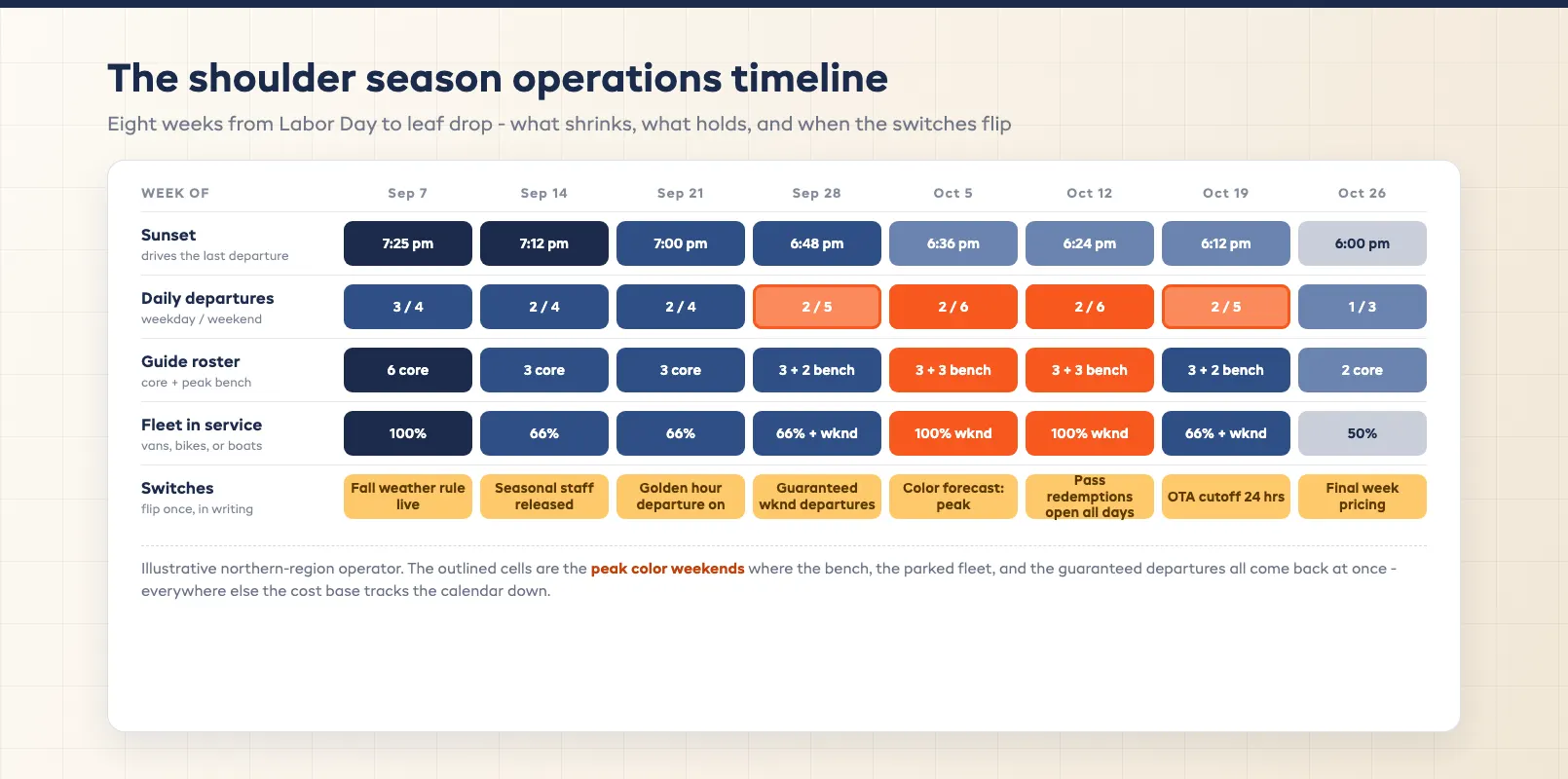
Changes to make in the first two weeks of September:
- Compress the daily schedule around the light. Sunset moves from 8 pm to 6 pm across the season. Drop the early departure first, since fall guests do not book 8 am the way summer families did, and protect the mid-morning and late-afternoon slots.
- Cut to a core guide roster and a bench. Keep two or three guides on regular days, release the seasonal staff on a clear date, and hold a short bench for peak weekends. Tell them the bench dates in August so they plan around them.
- Park part of the fleet. If you run vehicles or bikes, pull a third of them into maintenance in September rather than paying insurance and wear on units that carry two guests. Rotate the parked units back in for peak weekends.
- Move weather rules to fall conditions. Rain and cold cancel differently than summer storms. Publish the fall threshold (sustained rain, wind above a set speed, temperature below a floor) and the alternative you offer, whether that is a rescheduled date or a shortened route. Automated weather alerts to booked guests the evening before save the morning phone calls; the tour weather alert agent handles that on EquipDash.
- Shorten the booking window on OTAs. Marketplace guests who book foliage tours weeks ahead are valuable, but a 24-hour cutoff on third-party channels in fall gives you time to confirm minimum numbers. Our guide to OTA distribution for tour operators covers the channel mix.
Guest communication also changes. Fall guests want to know what to wear, when the light is best, and whether the color is there yet. Fold the answers into the confirmation and the day-before reminder so the guide is not repeating them at the meeting point. The automated guest communication guide covers the sequence.
Measure Fill by Day, Not by Month
A month-level fill rate hides everything that matters in fall. October at 55 percent fill could be full weekends and empty weekdays, or steady 55 percent every day. The fixes are different.
Track three numbers weekly:
- Weekday fill and weekend fill as separate figures. The target by mid-October is weekday fill at 60 percent or more of weekend fill. Under 40 percent means the weekday rate or the locals' effort is not landing.
- Bookings by lead time. If foliage bookings are arriving within seven days of departure, your calendar opened too late or your color forecast is not reaching people.
- Revenue per departure, including add-ons. Harvest add-ons and pass redemptions should lift this figure even on departures where seat count is flat.
Pull these from your booking system rather than from memory. Operators who look at the numbers every Monday in September adjust weekday rates and pass promotion in time to matter; operators who look in November write off the season and try again next year.
Fall is not the tail end of summer. It is a shorter season with its own guests, its own product, and its own price list, and the operators who treat it that way run October at margins summer never gave them. For the trade vocabulary that comes with this, from guaranteed departures to lead time, the tour operator glossary has it, and the tours hub collects the rest of our operator guides.
FAQ
When should tour operators open bookings for fall foliage season?
By mid-August at the latest. Foliage travelers book four to six weeks out because they are planning around a specific color window, and if your October dates are not live when they search, they book a competitor. Open the calendar with guaranteed departures on likely peak weekends and on-demand departures elsewhere.
How much lower should weekday tour prices be in fall?
A published weekday rate 20 to 30 percent below the weekend rate, with a further 10 to 15 percent resident rate for locals verified at check-in. Keep weekend prices at summer levels, since foliage weekends carry full demand. Make the weekday price a visible rate rather than a coupon so guests learn to book midweek instead of waiting for a code.
What is a locals' pass and how should it be priced?
A season pass sold to residents of a defined area, good for a set number of departures on any tour with open seats at 48 hours out. A common format is a five-tour pass priced at about three weekday seats, or a household pass for up to four named people priced around eight weekday seats. Track redemptions in the booking system, not on a punch card.
How can a tour operator add harvest or food tours without launching a new product?
Bolt a harvest element onto an existing route: a 30-minute partner farm, orchard, or vineyard stop, a tasting add-on at checkout, or one weekly departure anchored to the farmers market. Confirm partner capacity in writing and check your liability cover before including alcohol. One premium harvest dinner or sunset tasting per week, capped small, adds a high-margin option on top.
Should I guarantee fall departures or run them on demand?
Both. Guarantee two departures on each Saturday and Sunday inside the likely peak-color window so guests can book with confidence, and set a minimum of two guests to trigger weekday and shoulder-week departures. Offer a free date change inside the season so guests can move toward peak color instead of canceling.
How should staffing change for the fall shoulder season?
Cut to a core roster of two or three guides on regular days, release seasonal staff on a clear date announced in August, and keep a short bench for peak weekends. Compress the daily schedule around the shorter daylight by dropping the early departure first and protecting the mid-morning and late-afternoon slots.
in one place