Winter Tour Capacity Caps for Thanksgiving Week Family Groups
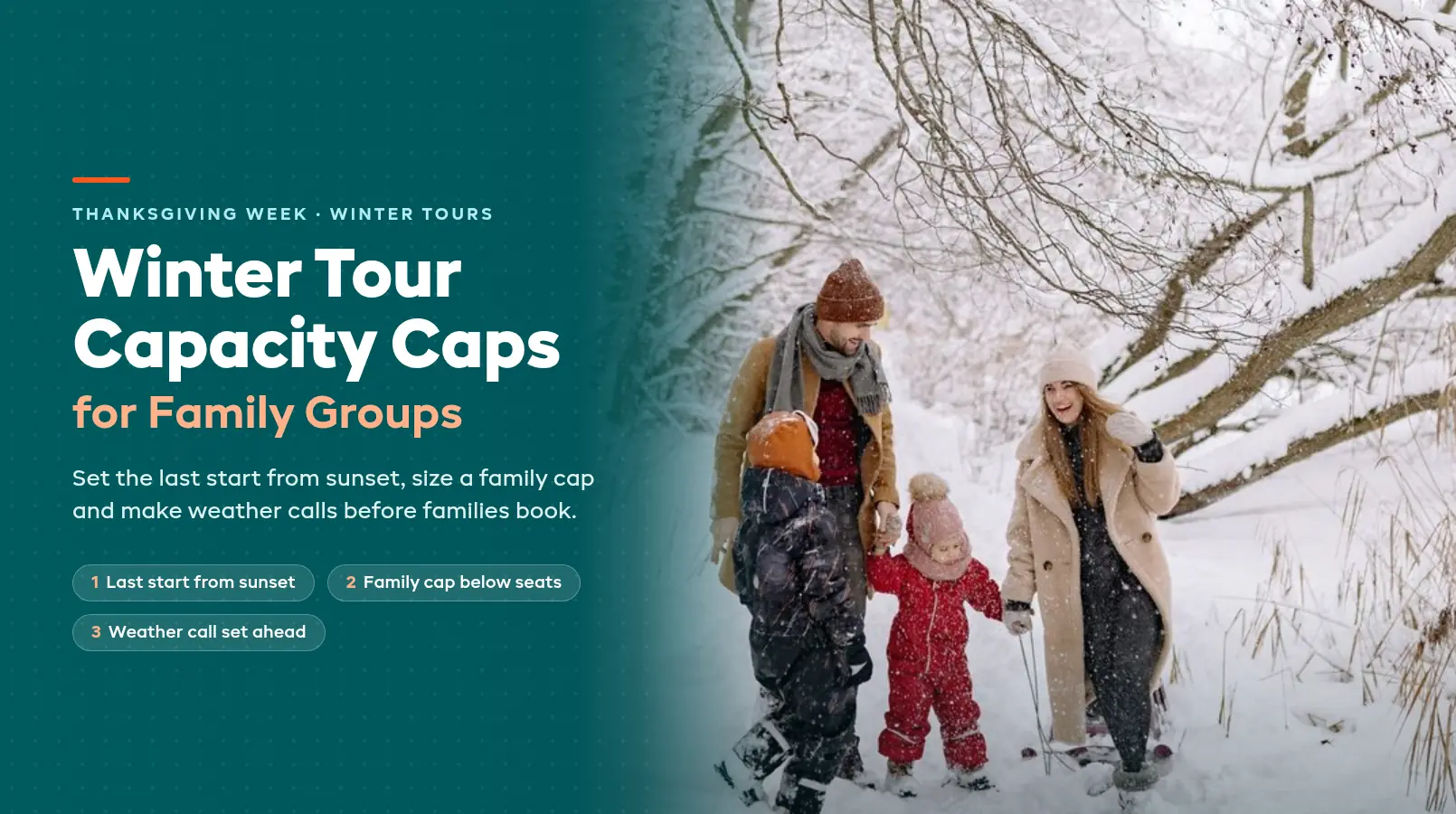
A winter tour for a mixed-age family moves at the pace of its slowest, coldest guest, and it has to be back before dark. Set Thanksgiving week caps around group fit, daylight and the forecast, then write the decision rules down before families book.
Thanksgiving falls on Thursday, November 26 this year, close to the shortest days of the year. If you run guided snowshoe walks, winter hikes, snowcat outings or wildlife tours, the families booking that week bring grandparents, teenagers home from college and kids who still need a hand on the icy bits. Our Thanksgiving week booking guide covers the basics: holiday hours, party-size limits, guest details and waivers for minors. This post is about the outdoor side, where cold, snow and an early sunset change how many people a departure can really take.
Why a winter family group needs a smaller cap
Your seat count assumes adults who walk at the same speed and stay warm. Thanksgiving week families don't.
The slowest guest sets the pace. A six-year-old in snow boots covers ground a lot slower than the adults, and a grandparent may want to stop on every climb. A loop your guides finish in two hours with adults can take half an hour longer with a family.
Cold shortens everyone's day. Small kids and older guests chill faster. That means more stops to swap gloves, fix a boot or warm up, and every stop costs minutes you don't get back before dark.
The light runs out early. On Friday, November 27, the sun sets at 4:13 PM in Boston, 4:21 PM in Seattle, 4:34 PM in Minneapolis and 4:36 PM in Denver. In the woods or behind a ridge, it gets dim well before that, and the temperature drops with it.
Small gear runs out first. You might have plenty of adult snowshoes and poles and only six pairs of kids' boots, helmets or snowshoes. The small sizes set your cap.
Put those together and a departure that takes 12 adults in October might safely take 8 family guests in late November. Eight guests back on time, warm and happy, are the ones who book the same week next year.
Work back from sunset to set your last departure
Set the latest start time for each tour by working back from sunset. Do it before the week opens for booking, because changing a start time after three families have booked means a lot of messages.
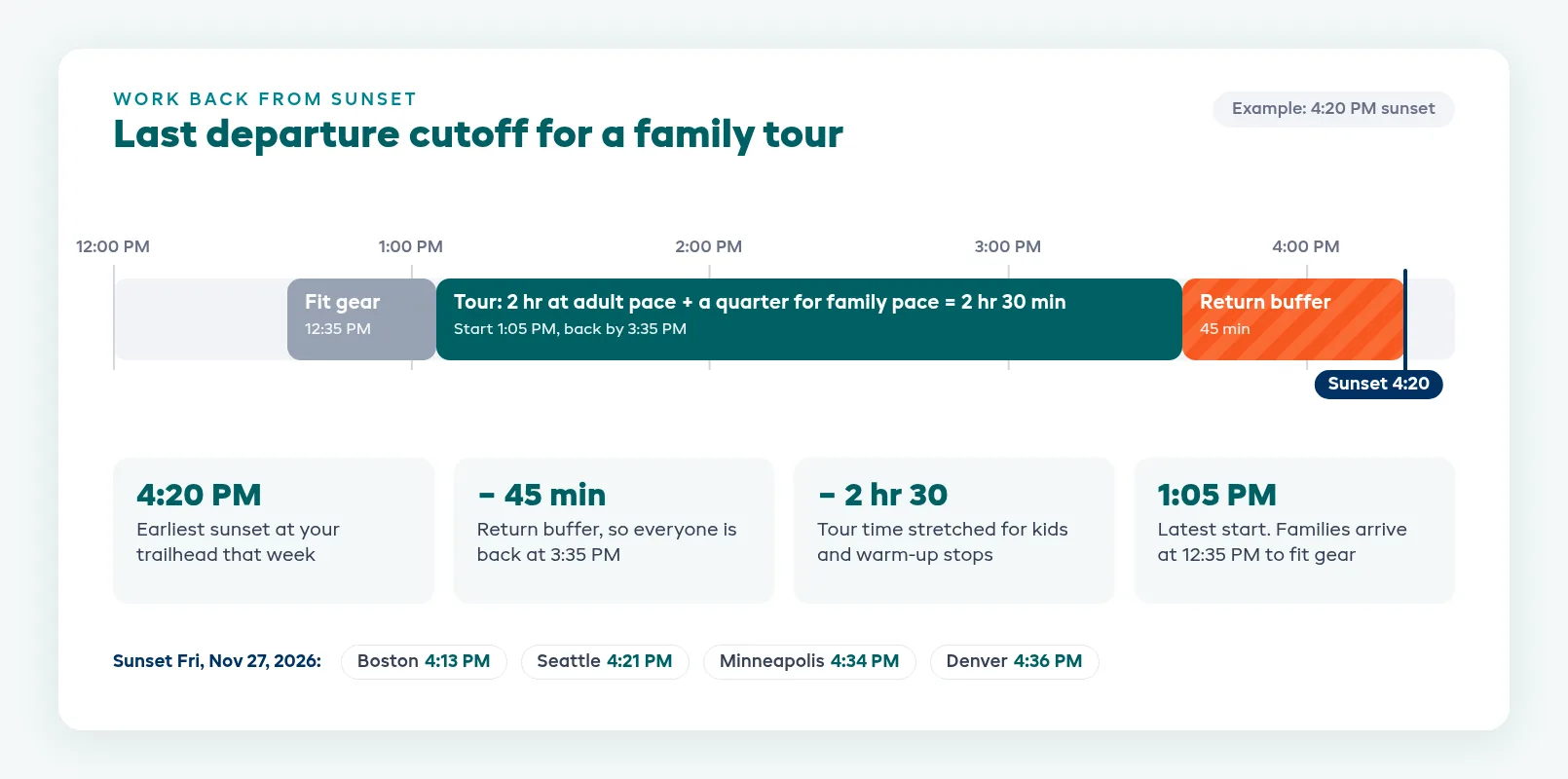
Here's the math, using a 4:20 PM sunset and a tour your guides normally run in 2 hours:
- Look up the sunset at your trailhead for each day of the week. It moves by a minute or two over the week, so use the earliest one.
- Pick a return buffer. Say you want every group back at the trailhead 45 minutes before sunset. That puts the latest return at 3:35 PM.
- Stretch the tour time for families. Add about a quarter for mixed-age pace and warm-up stops. Two hours becomes two and a half.
- Subtract. 3:35 PM minus 2 hours 30 minutes gives a latest start of 1:05 PM.
- Leave room for check-in and fitting. If families need 30 minutes to get boots and snowshoes on, they arrive at 12:35 PM.
Run the same math for every tour. Longer routes often end up morning-only that week, and families who can see the last start time book earlier in the day.
Size a family cap below your seat count
Treat a family departure as its own session with its own cap, instead of squeezing families into your standard tour. The cap for that session is the lowest of the numbers that can run out in winter.
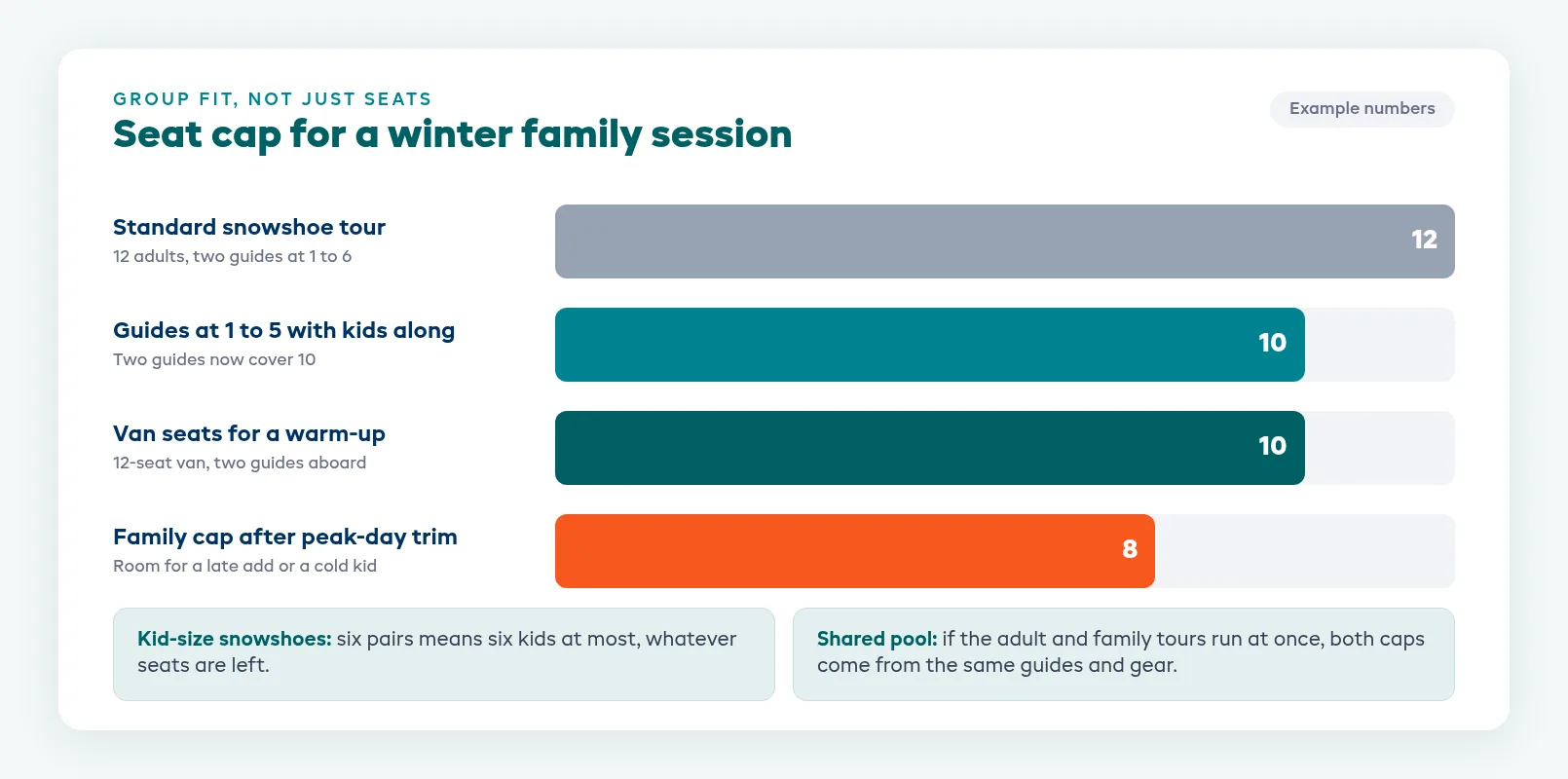
Say your standard snowshoe tour takes 12 adults with two guides. For a family departure the same week, check:
- Guide ratio with kids along. If you normally run one guide to six adults, you might tighten that to one guide to five when under-10s are on the trail. Two guides now cover 10.
- Kid-size gear. Six pairs of child snowshoes means no more than six kids, however many adult seats are left.
- Warm-up space. If the plan for a cold snap is the van, everyone needs a seat in it at once, guides included. A 12-seat van with two guides caps you at 10 guests.
- Pace on the route. A family group of 12 strings out a long way on a narrow trail. Fewer guests keep the back of the line in sight.
The lowest number here is 10. Trim one or two for the peak days so a late add or a cold kid doesn't push you past the sunset cutoff, and you land on a family cap of 8.
If the adult tour and the family tour run at the same time and share guides or gear, set both caps from the same pool. Selling 12 adult seats and 8 family seats only works if you have the guides and gear for both at once.
Write the mixed-age rules before families book
Nobody wants to find out at check-in that grandma can't do the climb or the youngest is too small for the route. Decide these rules now and put them on the booking page.
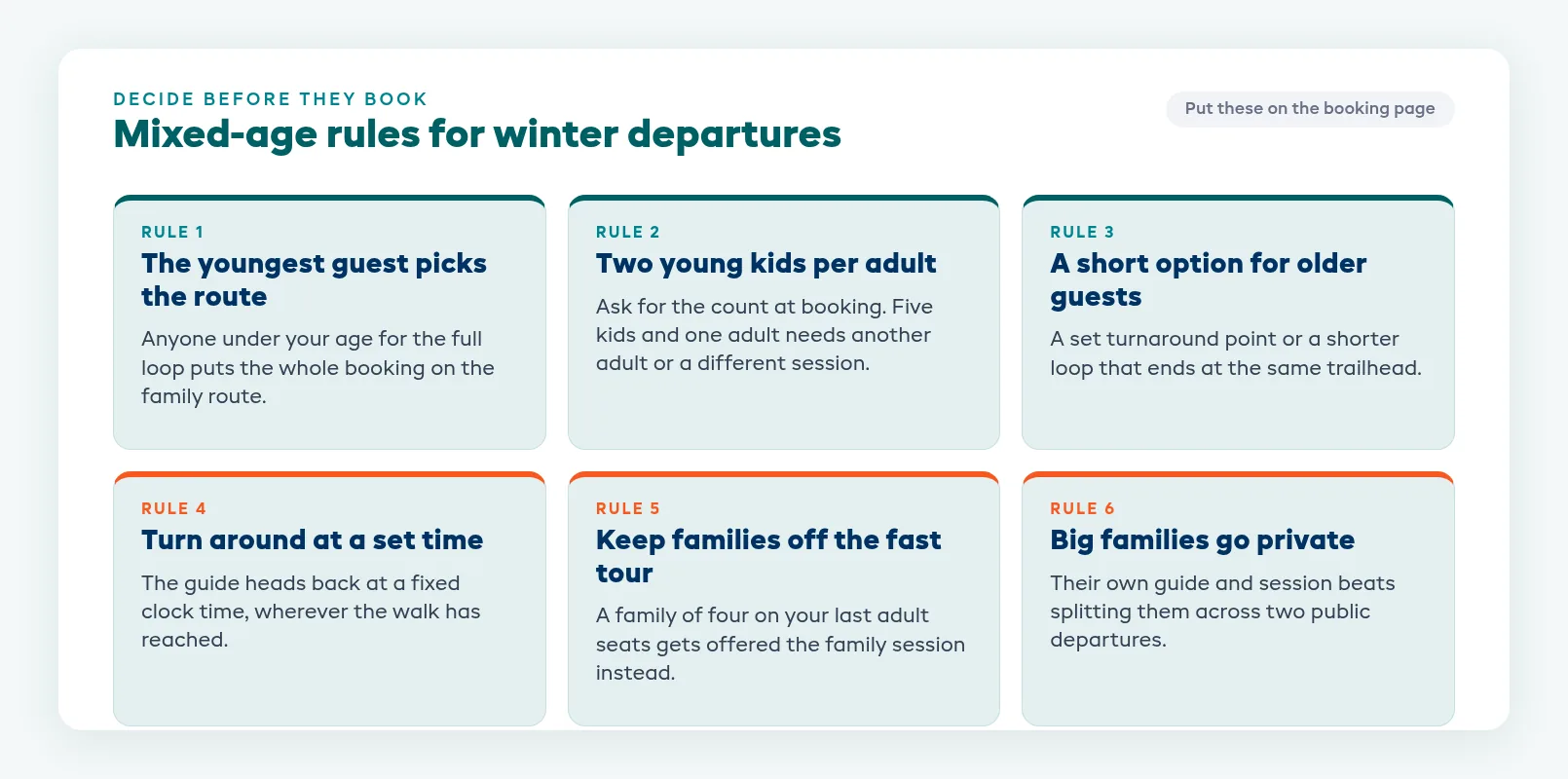
The youngest guest picks the route. If anyone in the booking is under your age for the full loop, the booking goes on the family route. Don't make the guide decide at the trailhead.
Kids stay with their own adult. On snow or near open water, set a number of young kids per adult, say two, and ask for it at booking. A booking with five kids and one adult needs a second adult or a different session.
Give older guests a short option. Pick a turnaround point on the route where a guest can head back with a guide, or a shorter loop that finishes at the same place. Say so on the booking page, so a grandparent can book knowing there's an easy way out.
Set a turnaround time, not just a distance. The guide turns the group around at a fixed clock time, wherever they've reached. That's the rule that keeps a slow family inside the daylight cutoff.
Keep families off the fast adult tour. Two groups who want different paces make each other unhappy. If a family of four books your last adult seats, offer the family departure instead.
For big families who want their own guide, a private session usually beats splitting them across public ones.
Decide your weather calls ahead of time
Make your winter weather rules before the week starts. A family coordinating eight people across three households needs to hear early whether the trip is on.
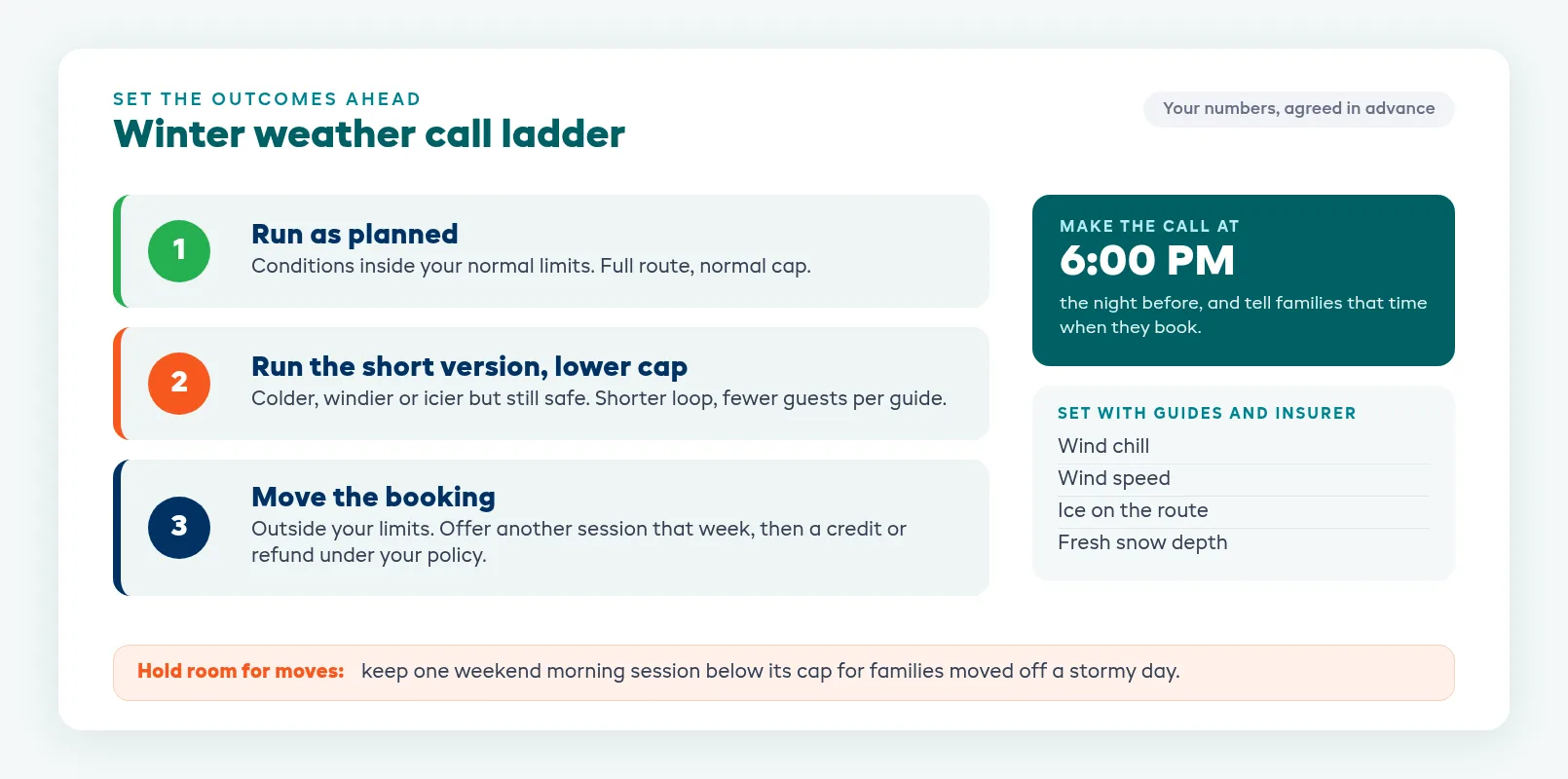
Set three outcomes for each tour, and the conditions that trigger each one:
- Run as planned. Conditions are inside your normal limits.
- Run the short version. It's colder, windier or icier than you'd like but still safe. Switch to the shorter loop and lower the cap, because slower going means fewer guests per guide.
- Move the booking. Conditions are outside your limits. Offer another session that week first, then a credit or refund under your policy.
Agree the actual numbers with your guides and your insurer, such as the wind chill, wind speed, ice on the route or fresh snow that moves a tour down a rung. Then pick a fixed time to make the call, such as 6:00 PM the night before, and stick to it.
Hold back some room for moves. If you keep one Saturday or Sunday morning session below its cap, a family bumped from a stormy Friday has somewhere to go. The weather policy guide covers what to offer when you call it off.
Tell families the rules before they book
Most trail problems start with a booking page that said too little. For each winter tour, show:
- Route length, rough time and how much climbing there is
- Which ages the full route suits, and where the family route or short option fits
- What to wear, including boots, layers, hats and gloves for the kids
- The turnaround time rule and the time you'll make the weather call
- That you'll ask each guest's age and boot or shoe size when they book
With each guest's age and size in hand, your team sets out kid-size gear before the family arrives, and the guide knows who's coming before leaving the trailhead.
Where EquipDash fits
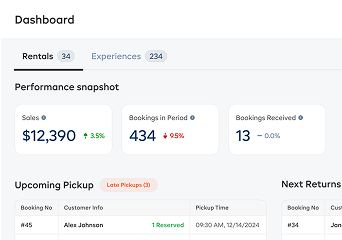
In EquipDash's software for tour and activity operators, each session on an experience has its own start time, length and seats, so a family departure can have a lower cap than the adult tour that runs the same day. EquipDash stops selling a session when it's full and shows customers the seats left. When you change a time, your booking page, website and connected marketplaces all follow.
Turn on Needs a guide and set how many guides each departure needs, and a session sells only while those guides are free. Sessions can be shared, or private ones that go to the first booking.
Custom forms ask each guest for a size or a skill level as they book, not just the person paying. The answers show on the session's manifest, which also shows the weather for the departure, who is guiding it and how many guests have arrived. If you move a session for weather, customers can reschedule or cancel from the email inside your policy.
FAQ
How many guests should a winter family tour take?
Fewer than your adult tour, set by whatever runs out first in winter: guides at a tighter ratio with kids along, kid-size gear, warm-up space and pace on the route. A tour that takes 12 adults might take 8 family guests once you trim for late adds and slow sections.
How do I set the last departure time in late November?
Work back from sunset at your trailhead. Subtract a return buffer, such as 45 minutes, then the tour time stretched by about a quarter for family pace, then your check-in time. With a 4:20 PM sunset and a two-hour tour, that gives a last start around 1:05 PM.
Should families and adult groups share a winter departure?
Usually not. Families with young kids move slower and stop more, and adults who booked a faster tour get frustrated. Run a separate family departure with its own cap and route, and offer it when a family tries to book the adult tour.
When should I make the weather call for a holiday week tour?
At a fixed time you've told guests in advance, such as 6:00 PM the night before. Families are coordinating several households, so an early call matters more than usual. Decide in advance which conditions mean run as planned, run a shorter version, or move the booking.
What if the youngest guest is too young for the full route?
Put the whole booking on the family route or short version, and make that rule clear on the booking page. Ask each guest's age at booking so you can catch it before the day instead of at the trailhead.
Do I need a lower cap for the short weather version of a tour?
Yes, in most cases. Cold, wind and ice slow a group down and make each guest take more of a guide's attention, so fewer guests per guide is safer. Set the short-version cap when you set your weather rules, before the week starts.
in one place