Bounce House Rental Software: Built for the Weekend Rush
Bounce House Rental Software: Built for the Weekend Rush
Friday at 9:40 p.m. a parent books the princess combo for Saturday noon. Your phone is on the charger. The yard is locked. Rain hit hard on Thursday, so half the fleet is still on the drying line. The booking form never asked about fence gates, hose bibs, or whether the birthday is in a HOA park that bans stakes.
That is the bounce house weekend in one scene. Demand piles up after dinner. Weather decides what you can actually deliver. Site truth decides whether the crew spends twenty minutes setting up or forty arguing about power. Generic booking software handles a clean Saturday timeslot. It does not handle the three things that break inflatable shops every peak weekend.
If you already looked at inflatable and bounce house rental software as the hub for this vertical, this guide goes deeper on the ops that sit behind the catalog: after-hours booking, drying as blocked downtime, site questions at checkout, waivers before drop-off, deposits that stick, and a weekend checklist you can run every Friday.
Online Booking After Hours
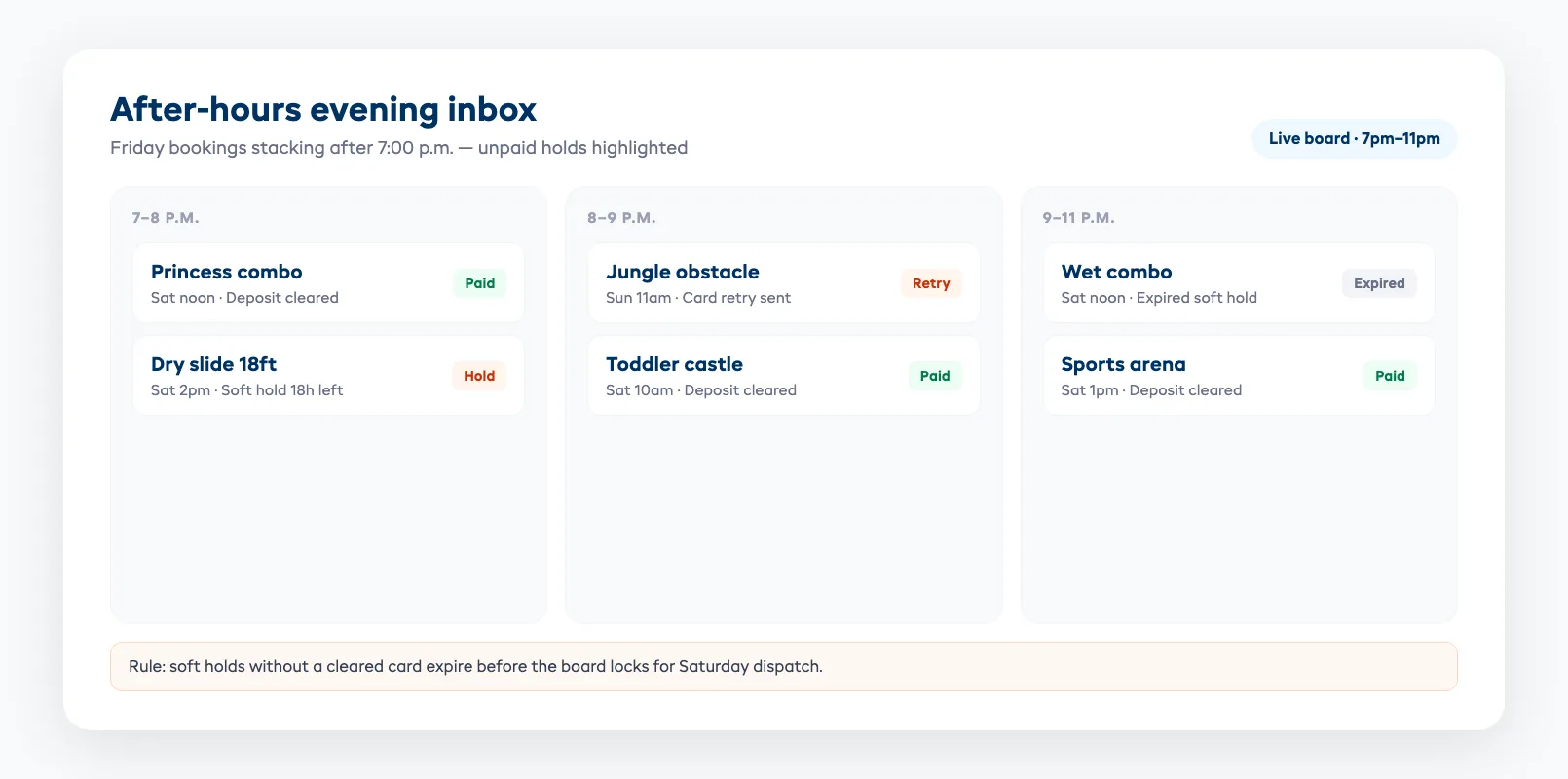
Most bounce house inquiries do not arrive at 10 a.m. on a Tuesday. They arrive while kids are in bed and parents are scrolling on the couch. If your only path is "call during office hours," you are training weekend demand to book the shop that answers at night.
After-hours booking is not a widget bolted onto a brochure site. It is real availability with rules the customer can finish alone:
- Show only units that can turn for the delivery window — not every castle that exists in the shed
- Block units already committed for overlapping load, event, and pickup windows — a Saturday noon drop still eats Friday pull and Sunday return
- Apply weather and drying holds automatically — a wet combo should not appear as Free
- Collect the deposit or card hold before the slot is firm — otherwise Monday's inbox is full of ghosts
Phone-tag shops lose the Friday night booking to whoever confirmed in under two minutes. That competitor did not work harder. They let the parent finish without waiting for a callback.
What "open" has to mean in this vertical:
- Package clarity — combo vs dry slide vs wet unit, blower included, stake vs water barrel, age band
- Delivery radius and fees — parents should see mileage cost before they hit pay
- Same-day cutoffs — if you stop accepting Saturday adds after Thursday 6 p.m., the form must say so
- Add-ons that matter — generator, attendant, extra mats, themed backdrop — sold in the flow, not as a later surprise
Operators who already run party and event rental software for tables and tents still need bounce-specific turnaround rules. A chair returns clean. A wet castle does not. After-hours inventory that ignores that truth will oversell the fleet the weekend after a storm.
Soft holds without a timer are the other leak. A "maybe" on the jungle combo from Tuesday night should expire if the card never clears. Peak Saturdays fill with soft holds that never convert while real buyers bounce to another yard.
Drying as Blocked Downtime
Rain is not a note on a sticky. Rain is inventory offline.
When a wet unit comes back, it is not free for the next birthday until it is dry, inspected, and back on the rack. Treat drying like a blocked status on the calendar — the same way a shop treats a blower in for repair. If the board still says Available, someone will sell it for Sunday morning.
A practical drying rule many inflatable shops can run:
| Condition | Block | Who owns it |
|---|---|---|
| Light dew / short party, dry weather | Same-evening wipe + overnight air | Crew lead |
| Moderate rain during event | Full dry line, inspect seams next morning | Ops |
| Heavy soak / mud | Multi-day dry, deep clean, photo before rack | Owner / lead tech |
| Suspected mold risk | Quarantine until cleared | Owner |
The software job is simple: when a unit is marked Wet Return, free quantity for the next sellable window drops until someone marks Dry Ready. No second spreadsheet. No "we will know by Friday."
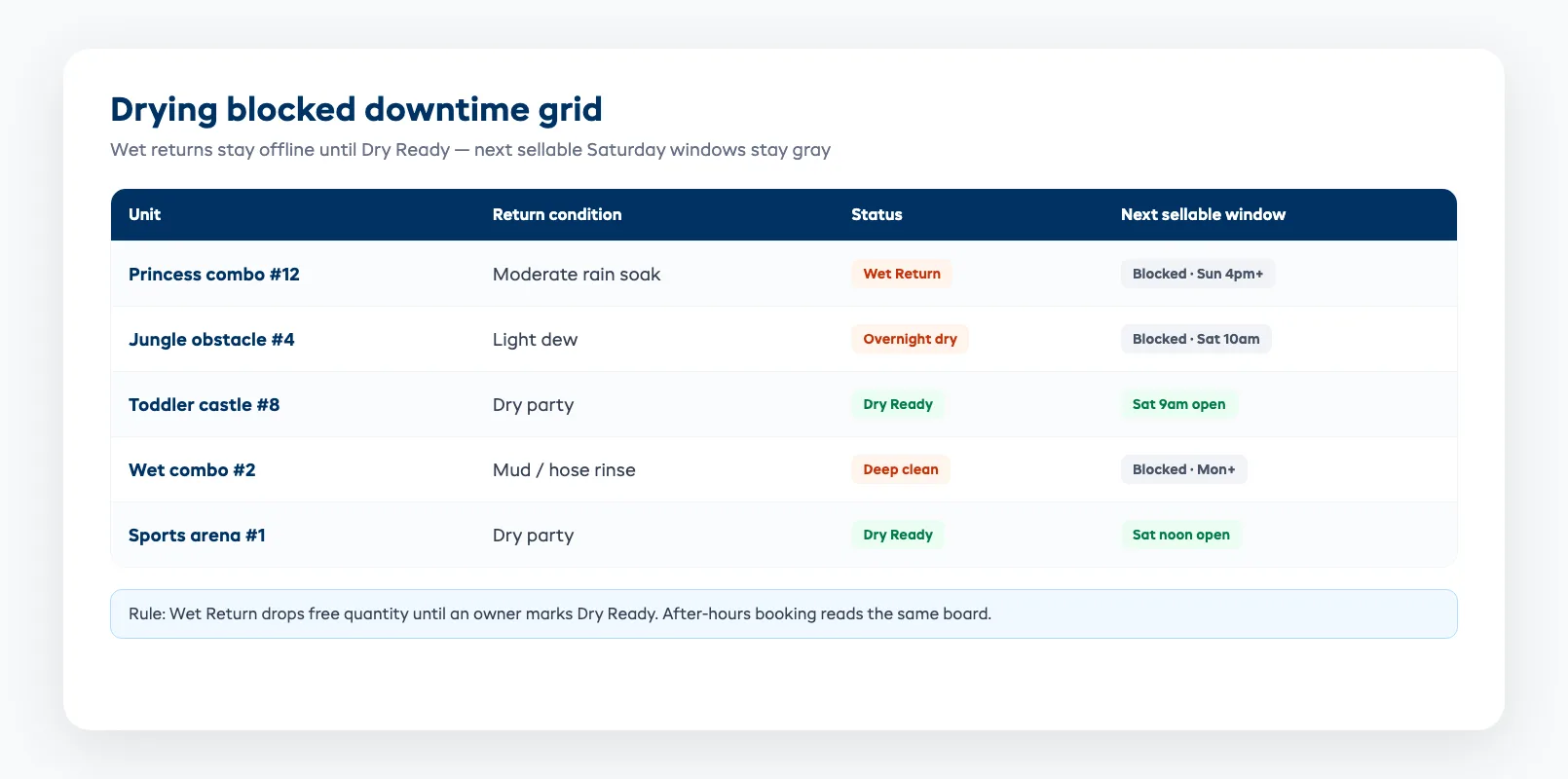
Drying also collides with weekend density. A Friday night wet return can wipe Saturday if the dry line is full and the weather stays humid. That is why after-hours booking and drying status have to share one board. Selling a wet unit because the catalog looked green is how you get a noon call that the castle smells musty — and a chargeback on Monday.
Tips that stick in peak season:
- Cap how many wet units can sit before you stop selling rain-prone packages for near-term dates
- Photograph wet returns so disputes about pre-existing stains do not turn into "he said / she said"
- Track blower hours and GFCI trips on the same job — a dry castle with a dead blower is still a failed drop
- Build a spare dry unit into Saturday math when the forecast is ugly — not after the first cancel call
Weather-dependent fleets lose money when downtime is invisible. Make drying a first-class block, not a side chat in the group text.
Site Questions at Booking
The truck does not fail at the shop. It fails at the gate that is two inches too narrow, the HOA that bans stakes, or the backyard with no outdoor outlet and a landlord who will not allow a generator.
Site questions belong in the booking flow — before the deposit clears — not on a clipboard the driver invents on arrival. Minimum set for bounce house work:
- Surface — grass, concrete, dirt, deck (and whether the deck can take the load)
- Access width — gate, side yard, stairs, elevator for indoor units
- Power — outdoor outlet distance, amps, GFCI, generator allowed?
- Anchoring rules — stakes OK, water barrels required, no stakes in HOA parks
- Overhead hazards — trees, lines, low eaves
- Crowd plan — kids-only, mixed ages, attendant required by venue
Parents will skip vague fields. Ask concrete questions with short choices. "Can we stake into the lawn?" beats "Describe the site." Photos help — one phone shot of the side yard prevents half the Friday surprises.
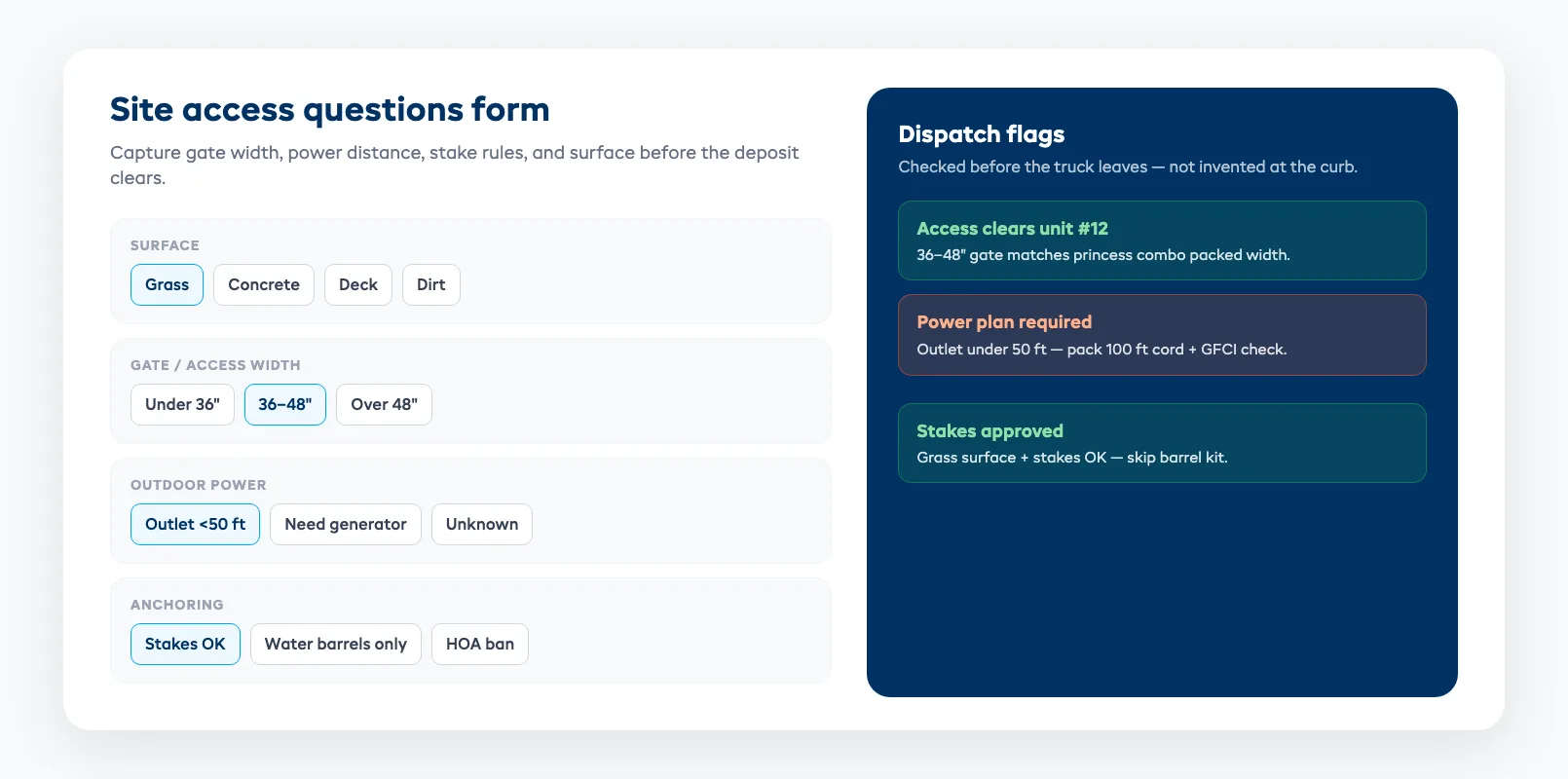
When answers conflict with the unit you sold, the system should flag it before dispatch — not after the crew is on the road. A wet combo booked for a second-floor apartment with a 28-inch gate is not a delivery problem. It is a quote problem that escaped the form.
Site data also feeds reroutes. If Saturday morning rain pushes you to an indoor gym backup, you need the venue rules and power notes already on the job. Re-asking the parent while the truck idles is how a one-hour window becomes a refund.
Waivers in Advance
Bounce houses are high-fun and high-liability. Collecting signatures on a clipboard while kids climb the steps is late. Late waivers create three problems: incomplete forms, rushed parents, and a driver who is now also a notary under pressure.
Advance waivers mean:
- Link goes out with the confirmation — not the morning of
- Names match the guest list you care about — at least the hosting adult plus supervising adults
- Unsigned jobs do not leave the yard — or leave only under a documented exception your insurer accepts
- Copies stay attached to the booking — searchable when a claim shows up six weeks later
Digital waivers are not about looking modern. They are about finishing paperwork while the parent still has attention, usually the night they booked. That pairs cleanly with after-hours checkout: book, pay deposit, sign, done.
Keep the language plain. Parents abandon walls of legalese on a phone. Cover the rules you actually enforce — shoes off, no flips if that is your policy, weather cancels, damage responsibility — without writing a novel.
Deposits and Payment
A bounce house Saturday without a real deposit is a rumor. Peak weekends fill with soft maybes that vanish when the weather turns or Aunt May offers a free backyard instead.
Deposit rules that work for this vertical:
| Rule | Typical setting | Why |
|---|---|---|
| Hold timer | 12–24 hours on peak Saturdays | Clears ghosts before the board locks |
| Deposit size | 25–50% or flat fee per unit | High enough that no-shows hurt |
| Balance due | 48–72 hours before delivery | Avoid day-of card fights at the curb |
| Weather credit | Written policy, not a vibe | Stops every rain call becoming a custom deal |
| Damage hold | Optional pre-auth on blower / unit | Speeds post-event damage talks |
The payment record has to update availability the moment it clears. A "paid" flag that never frees or locks inventory is decoration. Same for refunds: when you cancel for wind, the credit path should already be written so the office is not inventing policy under a five-star threat.
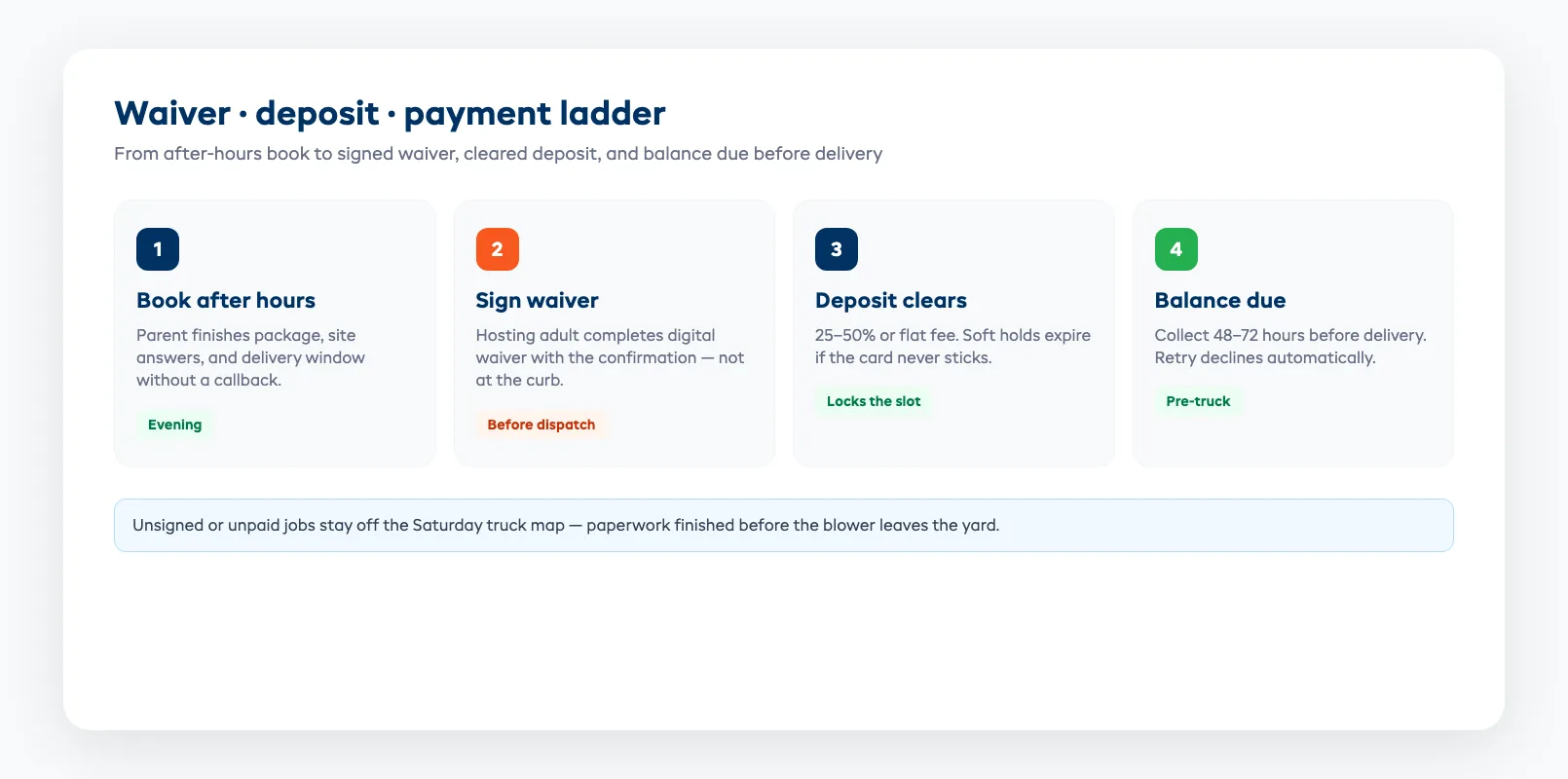
Card declines on Thursday night for Saturday jobs are common. Send a short retry path automatically. Do not wait until the truck is loaded to discover the deposit never stuck.
Damage and late returns need the same clarity. If a unit comes back torn, the photos from drop-off and pickup should already live on the job. That is operations, not extra admin — and it is why bounce house work belongs in purpose-built rental ops, not a generic calendar that only knows "event start."
Checklist
Use this as a Friday gate before the weekend rush. If a line fails, fix it before you sell one more Saturday slot.
- Confirm after-hours inventory is honest — drying blocks and overlapping load windows reflected; soft holds expired
- Walk the dry line — every Wet Return has an owner and a Dry Ready target before its next sellable window
- Open tomorrow's jobs — site answers complete, access photos attached, power plan clear
- Waiver status green — hosting adult signed; unsigned jobs flagged and held
- Deposits cleared — balances scheduled; decline retries sent; weather policy linked on rain-risk jobs
- Crew and truck map — delivery order by geography, blower spares loaded, stake vs barrel kits matched to site answers
- Customer texts queued — ETA window, setup rules, cancel/weather line — not improvised at 7 a.m.
Run the list out loud in a ten-minute huddle. The shops that stay calm on Saturdays are not lucky. They finished Friday.
A bounce house business is a weekend machine with weeknight demand, weather downtime, and site risk baked in. Software that only sells a timeslot will keep surprising you. Software that blocks wet units, asks site questions up front, collects waivers and deposits before the truck rolls, and keeps after-hours booking honest will not remove the rush — it will keep the rush from running you.
FAQ
Why does bounce house rental need different software than a generic booking tool?
Because the product is weather-sensitive, needs multi-hour load and dry windows, and depends on site access and power that a simple timeslot never captures. Generic tools sell a Saturday hour. Bounce shops sell a unit that may still be wet, a truck route, and a backyard that might not take stakes.
When should drying take a unit offline?
As soon as it returns wet enough that you would not put a paying family on it. Light dew may clear overnight. Moderate rain and mud need a real dry-line block until someone marks Dry Ready. If the board still says Available, you will sell it too soon.
What site questions should be mandatory at booking?
Surface type, gate or access width, outdoor power distance and GFCI, whether stakes are allowed, overhead hazards, and whether an attendant or generator is required. Short multiple-choice fields beat open text. Ask for one access photo when the answer is uncertain.
Should waivers be signed before delivery day?
Yes. Send the waiver with the confirmation so the hosting adult finishes it while they still have attention. Unsigned jobs should not leave the yard unless your insurer has a documented exception. Clipboard signing at the curb is how forms get skipped.
How large should a bounce house deposit be?
High enough that a no-show hurts — often 25–50% or a flat per-unit fee — with a short hold timer on peak Saturdays so unpaid ghosts expire. Take the balance before delivery day, not at the curb when kids are already waiting.
How do after-hours bookings avoid overselling wet inventory?
After-hours availability must read the same drying and load-window blocks the day crew uses. A parent booking at 9 p.m. should only see units that can turn for that delivery window. Soft holds need timers. Wet Returns must drop free quantity until Dry Ready.
What belongs on a Friday checklist before the weekend rush?
Honest inventory (including drying), complete site answers, signed waivers, cleared deposits, truck and crew routing, and customer ETA texts. If any line fails, fix it before you accept another Saturday add. The calm Saturday starts Friday afternoon.
in one place