Deposits That Hold: Partial Payments Without the Spreadsheet Chase
Deposits That Hold: Partial Payments Without the Spreadsheet Chase
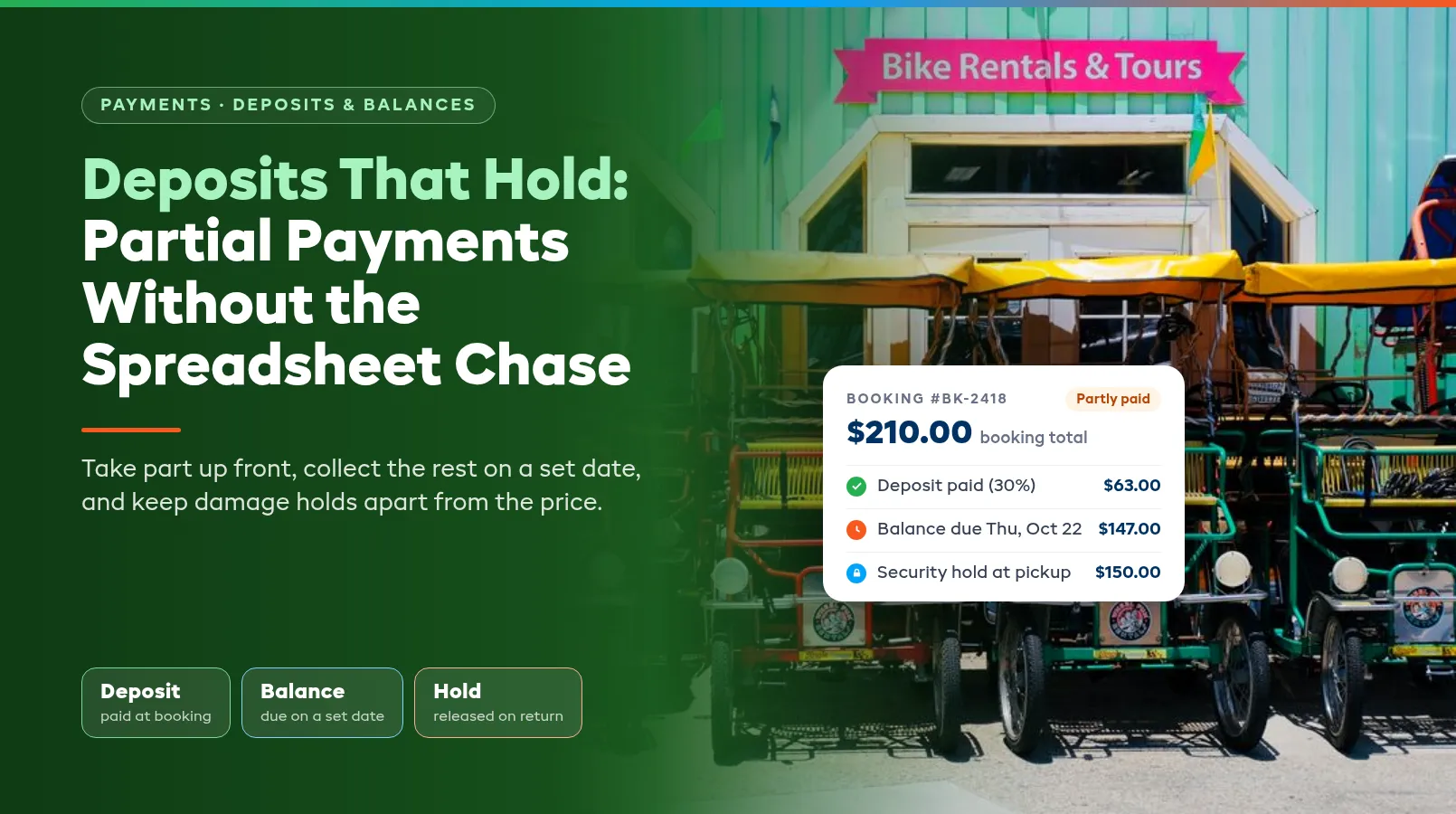
A customer paid $63 toward a $210 weekend booking three weeks ago. On Saturday morning nobody at the counter remembers, the spreadsheet cell says "dep?", and the line waits while someone scrolls through card statements. Partial payments work when the booking itself records what was paid, what is still owed, and when the rest is due.
Deposits cut no-shows and give customers a reason to turn up. They also create a second job, which is collecting the balance. This guide covers how to tell the two kinds of deposit apart, how much to take up front, when the balance should land, how to run security holds, what happens to a deposit when someone cancels, and how to stop chasing balances by hand.
Booking deposits and security holds are different money
Most deposit arguments start because one word covers two things.
A booking deposit is part of the price, paid early. A customer books a $210 rental, pays $63 now, and owes $147 later. It counts toward the total, it reserves the gear or the seat, and your cancellation policy decides whether any of it comes back.
A security deposit sits outside the price. It covers damage, loss, or a late return. On a card it is usually an authorization hold: the money is set aside on the customer's card and only moves if you capture it. On a clean return you release it and the customer never pays it.
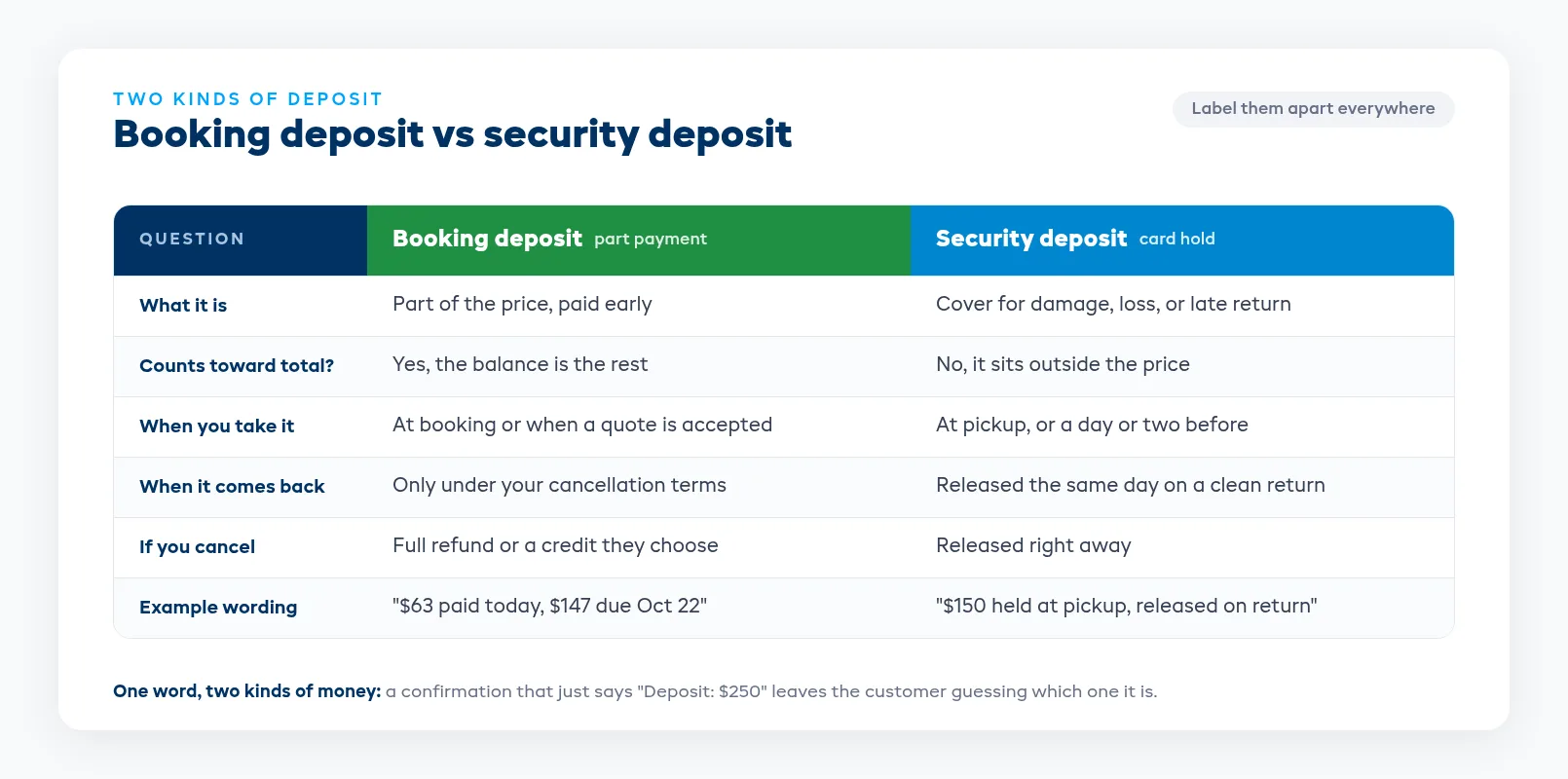
Keep the two separate everywhere: on the booking page, in the confirmation, and on the receipt. When a confirmation says "Deposit: $250" and nothing else, the customer cannot tell whether that $250 comes off their bill or comes back to them. The chargebacks and payment disputes guide shows how vague deposit wording turns into a dispute months later.
Decide how much to take up front
No single percentage suits every shop. The deposit has to be big enough that a customer thinks twice before skipping the booking, and small enough that it does not stop them booking at all. Most shops end up with a few rules by type of booking:
- Same-day and next-day bookings. Take the full amount. There is no balance to chase and no time to chase it.
- Standard bookings a week or more out. A part payment, for example 25-30% of the total, with the balance due before pickup.
- Large groups, events, and custom packages. A bigger deposit, often half, taken when the customer accepts the quote, because you are turning other customers away for them.
- Long rentals and monthly hire. The first period paid up front, plus a security hold sized to the gear.
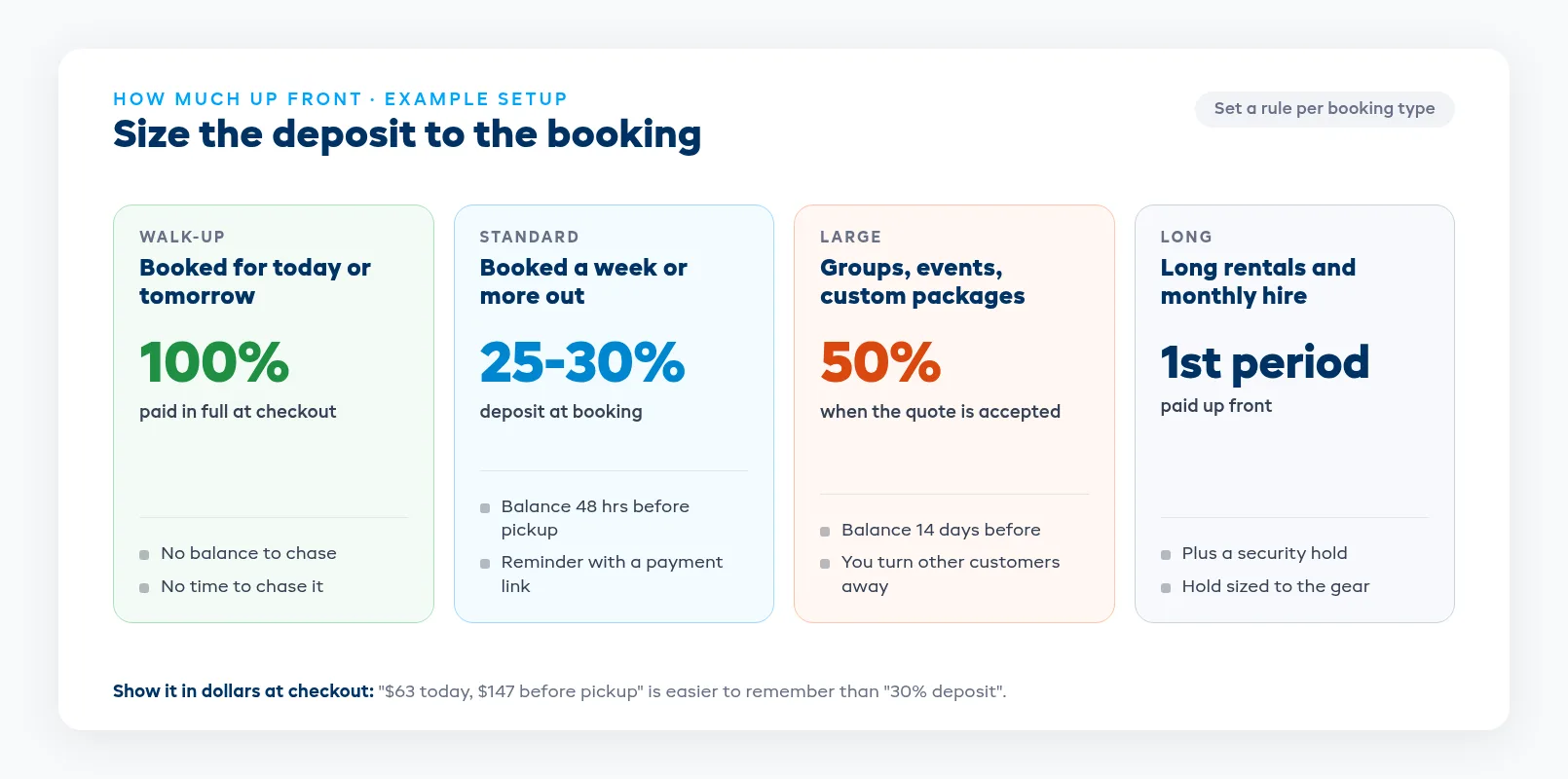
Show the deposit as a dollar figure at checkout, even if you set it as a percentage. "$63 today, $147 before pickup" is easier to remember than "30% deposit", and it is the number the customer will look for on their card statement.
Give the balance a date, then hold to it
A balance with no due date gets collected whenever someone remembers. Usually that is pickup morning, at the counter, with a line behind the customer.
You have two real options. Balance at pickup is simple and customers like it. The cost is counter time and the chance that the card declines on the day, so it suits short, low-value rentals.
Balance a set number of days before pickup works better for anything bigger. For example, 48 hours before for a weekend rental, or 14 days before for a large group booking. You find declined cards while there is still time to fix them or release the gear, pickup turns into a handover, and fewer customers skip a booking they have already paid for in full.
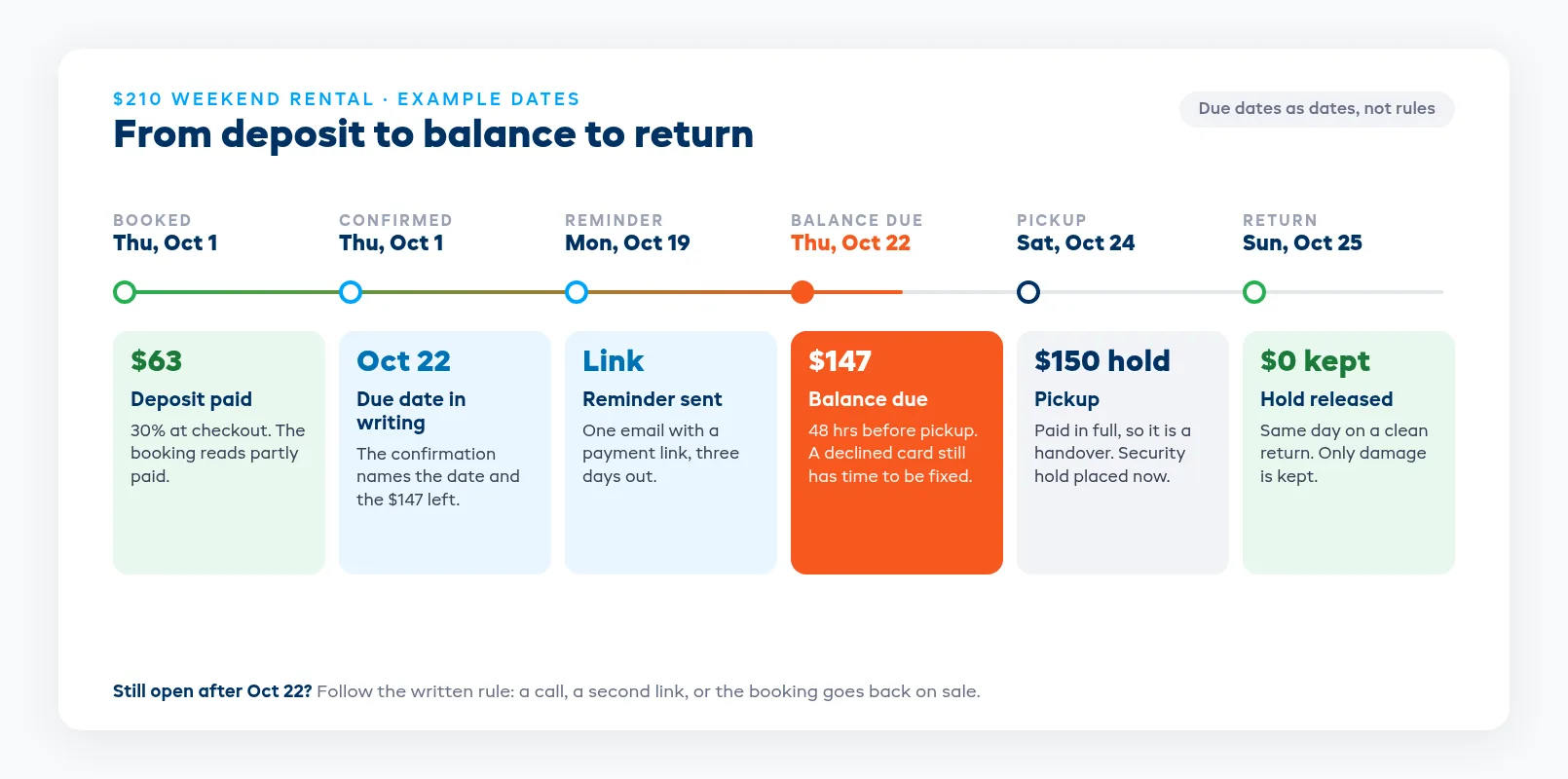
Whichever you pick, put the due date in the confirmation as a date. "Balance of $147 due Thursday, October 22" gets paid. "Balance due 48 hours prior" gets missed. Send one reminder before the due date with a payment link the customer can use in under a minute. If the balance is still open after the due date, have a written rule for what happens next: a call, a second link, or the booking released back to sale.
Run security holds on a clock
Card holds expire. Depending on the card network and your payment provider, an uncaptured authorization usually lapses after about a week. A hold placed when a customer books three weeks out will be gone by pickup day.
Place the hold close to the rental instead, at pickup or a day or two before. Size it to the most common damage on that item rather than its replacement cost, and print the amount on the product page so nobody is surprised at the counter.
On return, check the gear and release the hold the same day if it is clean. If something is damaged, keep only the amount that covers it, release the rest, and send the customer the photos and the line item. Some customers will hand over cash instead of a card. Record that cash against the booking as a held deposit so whoever is on shift at return knows to give it back.
Write down what happens to a deposit on cancellation
Customers ask one question when they cancel: do I get my deposit back? The answer should already be on the booking page and in the confirmation.
Tie it to notice. A common setup refunds the deposit in full with plenty of notice, keeps part of it inside a shorter window, and keeps all of it for late cancellations and no-shows. If some of the deposit is non-refundable no matter what, say so next to the amount at checkout and have the customer accept it.
Decide what happens when you cancel, too. Bad weather, a broken unit, or a staff member calling in sick is not the customer's fault, so the deposit should come back in full or turn into a credit the customer chooses. The weather policy guide covers rain checks, credits, and refunds in more detail.
Stop chasing balances by hand
Plenty of shops track partial payments in a spreadsheet column or a note on the booking. It works at ten bookings a week. At fifty, balances slip, two staff members chase the same customer, and someone hands over gear on a booking that is still $147 short.
Every booking should carry one of three states, unpaid, partly paid, or paid, with the amount still owing beside it. Then the daily check is a single list: partly paid bookings with pickup in the next three days. Send each one a payment link, and call anyone still open the day before.
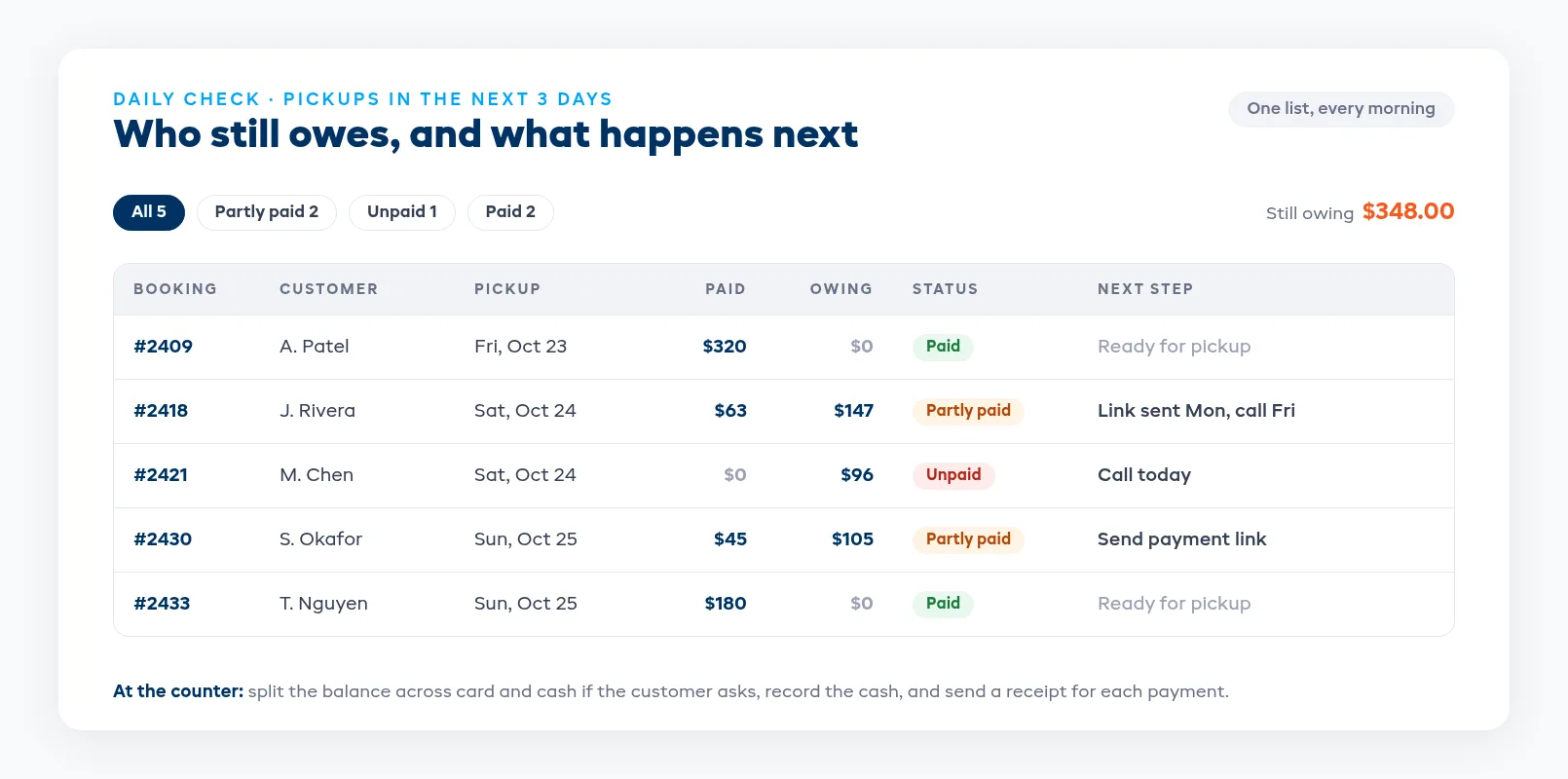
At the counter, let customers settle up however they like. Split it across a card and cash if they want, record the cash against the booking, and send a receipt for every payment so the customer has a record of each one. The automation guide for rental businesses covers the other messages worth putting on a schedule.
How EquipDash handles deposits and balances
In EquipDash, your booking page payment settings decide whether online customers pay a deposit or the full price at checkout, and the deposit terms are saved on each booking. Every booking shows whether it is unpaid, partly paid, or paid, and how much is still owing. From the booking you can email a payment link for the outstanding amount, split a payment across card and cash, and record cash or bank transfers by hand. An automatic balance-due reminder email can be switched on, and every payment sends the customer a receipt.
Security deposits are tracked apart from the booking total. Where your payment provider supports card holds, the deposit is held on the card, and you release it or keep all or part of it from the booking. A deposit taken in cash can be recorded as held and given back later. Deposit rules let you ask for a larger amount on long rentals or from customers who live far away, and a group booking can split the deposit so each person's share is collected and released on its own.
For cancellations, refund and cancellation policies set refund percentages by notice period and non-refundable deposit amounts per product, and EquipDash works out the refund when a booking is canceled. For large jobs, a quote shows the deposit due on acceptance. Once the customer accepts, it becomes a booking and the deposit request goes out automatically.
On a busy morning, you can ask Dash AI for a booking's outstanding balance or have it send the payment link without opening the booking yourself.
A deposit policy you can adapt
Edit this short policy for your own numbers:
Deposits and payments. We take a 30% deposit when you book. The balance is due 48 hours before pickup, and we email a reminder with a payment link before then. Bookings made within 48 hours of pickup are paid in full at checkout. If you cancel more than 7 days before pickup, we refund your deposit in full. Between 7 days and 48 hours, we keep half of it. Inside 48 hours, the deposit is non-refundable. If we cancel for weather or any reason on our side, you choose a full refund or a credit. A separate security hold of $150 is placed on your card at pickup and released the same day you return the gear in good condition.
Put it on every product page and in the confirmation, and have customers accept it at checkout. Then train everyone who takes payments on the same three questions: is this the booking deposit or the security hold, what is still owing, and when is it due.
If your balances still live in a spreadsheet column, compare EquipDash plans and see what it takes to move deposits, reminders, and holds onto the booking itself.
FAQ
What is the difference between a booking deposit and a security deposit?
A booking deposit is part of the rental price paid early, and it counts toward the total. A security deposit sits outside the price and covers damage, loss, or late return. It is usually a hold on the customer's card that you release on a clean return, so the customer never pays it.
How much deposit should a rental business take?
Set it by type of booking. Take full payment for same-day and next-day bookings, a part payment such as 25-30% for standard bookings made a week or more out, and a larger deposit, often half, for big groups and custom packages. Show the deposit as a dollar amount at checkout so customers know exactly what they paid.
When should the balance on a rental booking be due?
Either at pickup or a set number of days before. Balance at pickup suits short, low-value rentals. Collecting 48 hours before a weekend rental, or 14 days before a large group booking, finds declined cards early and turns pickup into a handover. Put the due date in the confirmation as a calendar date.
Should a security deposit be a hold or a charge?
A hold is usually better, because no money moves unless you capture it. Card holds expire, often after about a week, so place the hold at pickup or a day or two before rather than at booking. On return, release it the same day if the gear is clean, or keep only the amount that covers any damage.
Is a rental deposit refundable if the customer cancels?
It depends on your written policy, and that policy should be tied to notice. A common setup refunds the deposit in full with plenty of notice, keeps part of it inside a shorter window, and keeps all of it for late cancellations and no-shows. If you cancel, the customer should get the full deposit back or a credit of their choice.
How do I stop customers forgetting to pay the balance?
Give every balance a calendar due date, send one reminder with a payment link before that date, and check a daily list of partly paid bookings with pickup in the next three days. Have a written rule for balances still open after the due date, such as a call, a second link, or releasing the booking.
in one place