E-Bike Winter Storage and Spring Pre-Book: One Fleet, Two Seasons
The last e-bike of the season comes back with a muddy chain and a pack showing one bar. Leave it like that until March and you find out which batteries didn't make it on the first warm Saturday, with a line at the counter.
E-bike winter storage for a rental fleet is two jobs on one calendar. The packs need the right charge, the right room and a regular check, and the booking page needs to start selling spring while the doors are shut.
This guide is for bike rental shops and guided operators who close or slow right down for winter. It covers how to put the fleet away, what to fix while it's quiet, and how to fill April and May from December.
Why e-bikes need their own winter plan
A pedal bike can hang in a cold shed all winter and come out needing air in the tires. An e-bike carries a lithium-ion pack that keeps aging while it sits.
Bosch says a battery ages even when it isn't used, and faster when it's stored hot or at a low or high charge. Across a fleet, that's the gap between packs you reuse next season and packs you replace before opening weekend.
The rest of the bike adds to the list. Brake pads, chains and tires wear faster on a heavy e-bike, so the off-season is when the workshop catches up.
Storage runs from your last rental to your spring wake-up check. Pre-book runs over the same months, from the day you close to the day you reopen, and it's what pays for the storage work.
If your off-season is summer
In hot places like Arizona or south Florida, the quiet months can fall in summer instead. The same steps apply, but heat is the problem, not frost.
Bosch says to keep packs out of excessive heat and direct sunlight, and its storage range tops out at 20°C (68°F). In practice that means an air-conditioned room, never a metal container in the sun, and open dates that run from fall to spring.
E-bike winter storage, step by step
1. Log each pack before it goes on the shelf
Run a workshop check on each bike before you pull its pack, so you have a fall reading to compare in spring. In EquipDash, the E-Bike & E-Scooter Check workshop template has a Battery voltage reading field, a Battery charge cycle count (if available) field and a Photo of battery / electrical condition.
That record stays on the bike's service history. In spring, a pack that lost far more voltage over winter than the rest of the fleet is the one you test first.
Tag every pack with its bike's item code before it leaves the frame. Matching forty packs to forty bikes from memory in March is a morning you don't want.
2. Set the storage charge your maker gives
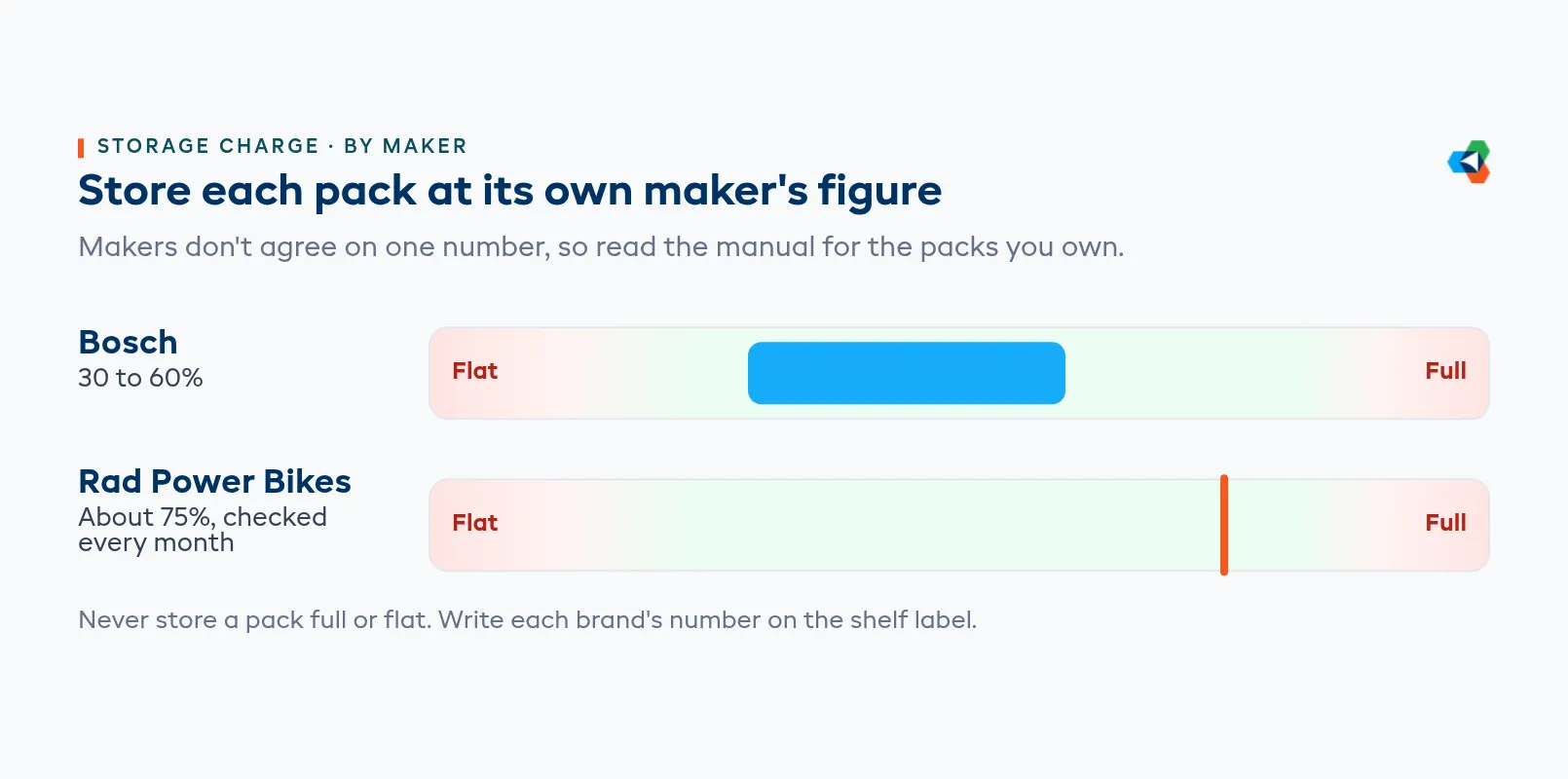
Makers don't agree on the number. Bosch says to store a battery at 30% to 60% charge for longer periods, while Rad Power Bikes says to keep a battery stored for more than two weeks at around 75% and check it every month.
Use the figure in the manual for the packs you own. If your fleet mixes brands, write each brand's number on the shelf label, and never store a pack full or flat.
A pack that comes back near empty gets a short charge up to the storage level. A pack that comes back nearly full needs to come down, and a staff loop on high assist does that faster than waiting for it to drain.
3. Pick the room before the first frost
Bosch's figures are 0 to 20°C (32 to 68°F) in a dry room, or 10 to 20°C (50 to 68°F) where it's damp enough for dew to form. It also asks for a well-ventilated room with a smoke detector, away from heat sources and anything that burns easily.
That rules out most shipping containers and lean-to sheds in a northern winter. A heated storeroom or back office usually works, and the room next to the furnace doesn't.
Space the packs out on a shelf that won't burn, and keep keys, screws and loose tools away from the contacts. Bosch warns that small metal objects can bridge the contacts and short a pack.
The bikes themselves can live somewhere colder, as long as it's dry. When a cold bike comes into a warm shop, let it sit until any condensation is gone before the pack goes back on.
4. Check the packs once a month
Check intervals vary by maker, and Rad's is monthly. Pick one day a month, look over every pack's casing, read the charge and top up any pack that has dropped below its storage level.
Only charge while someone is in the building. The US Consumer Product Safety Commission says to always be present when charging micromobility batteries, and never to charge them while you're asleep or away.
A pack that's swollen, cracked, hot or smells odd doesn't go on a charger. Move it out of the storage room and call the maker before you do anything else with it.
5. Put the bikes away clean and without packs
Clean and dry each bike before it's stored, by hand. Bosch says not to clean the battery with a direct water jet or a high-pressure cleaner.
Store the packs out of the frames, since Bosch also says to remove the battery when the bike won't be used for a longer period. Hang the bikes or rack them with the tires pumped, so no tire sits flat on one spot for four months.
On e-MTBs, check tubeless tires before storage, since sealant dries out over a long sit and a tire that held air in October can be flat in March. Hanging the bikes keeps weight off the tires either way.
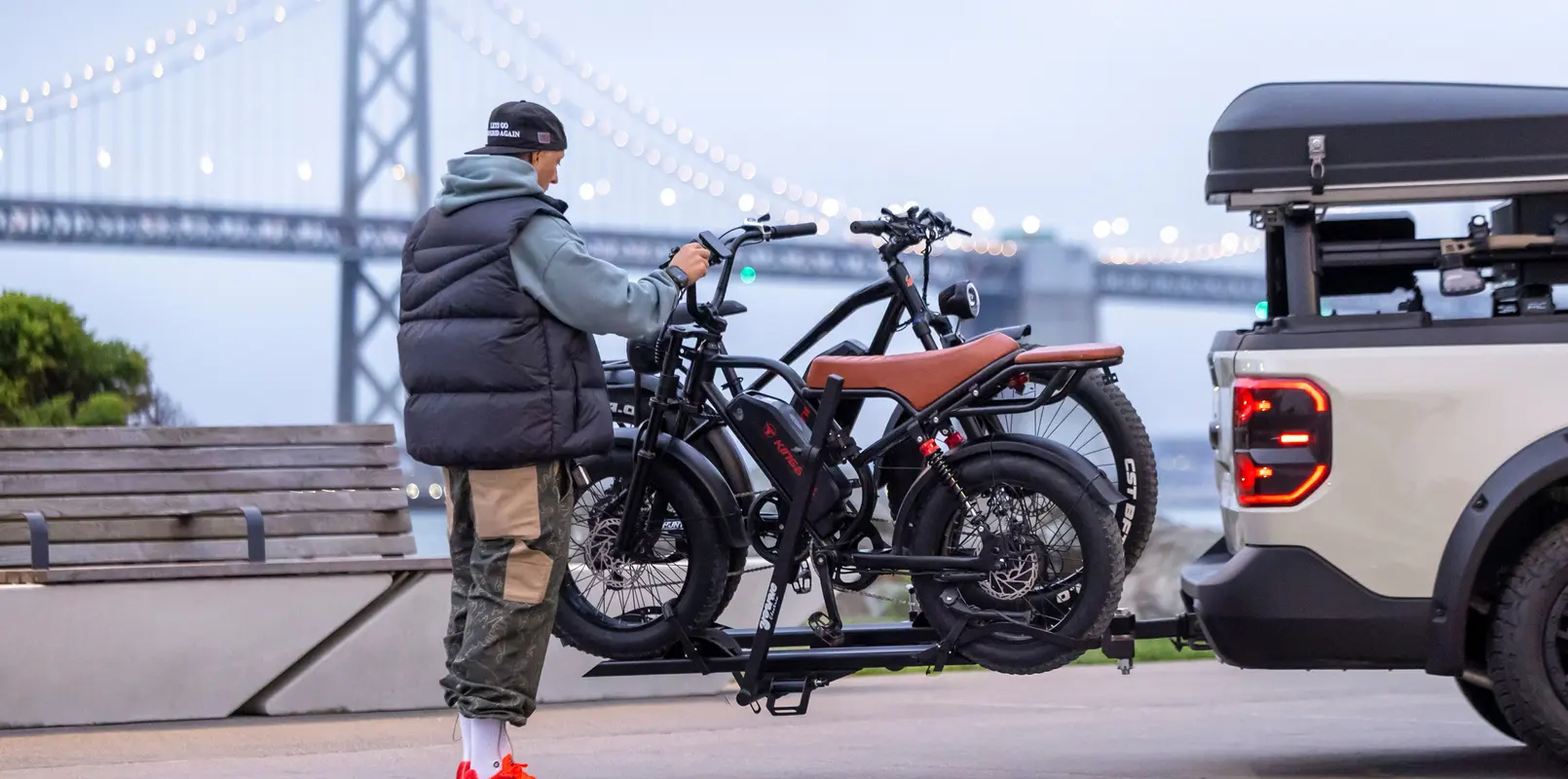
If the fleet goes to an off-site storage unit, take the packs off before the bikes go on a van or a car rack. Bosch says to remove the battery when you carry an e-bike on a car rack, and the packs travel inside the vehicle instead.
A hitch rack or a van is the usual way the bikes themselves make that trip.
Use the quiet months in the workshop
Work the list in Asset Health
Winter is the one stretch when nobody needs a bike back by 9 AM. In EquipDash, Workshop > Asset health lists every asset on a product with Track maintenance turned on, and its bars fill as each one gets close to its next service or its retirement target.
Sort by Most urgent and work down the list. Anything showing Service due goes on the stand in December, not in the week before you open.
Suspension is the job that most often gets pushed to spring and then skipped. Fork and shock services follow the maker's hours, and an e-MTB fleet that ran shuttles all summer has usually passed them, so book those bikes into the workshop first. For the service intervals by part, our bike fleet maintenance schedule has the full list.
Retire tired packs now
A pack that can't cover your shortest rental doesn't belong in next season's fleet. A Bosch dealer can read a pack's remaining capacity with the brand's CapacityTester, and other motor brands have their own dealer tools.
Order replacements while suppliers have winter stock, and only packs the bike's maker approves. In New York City, e-bikes offered for rent must be certified to UL 2849, and replacement batteries sold there to UL 2271, according to the city's Department of Consumer and Worker Protection.
Check every model for recalls
Run each make and model in the fleet through the CPSC recalls list while the bikes are inside. E-bike recalls cover parts like brake calipers as well as batteries, and a recall fix is easier with the bike already on the stand.
Pull bikes that are waiting on parts
A bike waiting on a motor or a pack shouldn't look available for April. On the asset's page, Out of service stops it being booked, and Back in service makes it bookable again once the part is fitted.
Spring pre-book: sell April while the shop is closed
People plan spring trips in winter, and gift buyers shop in December. If your booking page just says closed until March, those riders book with whoever's page is open.
The order matters more than any one setting. We'd open the spring calendar and set the deposit rule in December, email last season's riders in January, and leave the waitlist for when the first weekends fill.
Set your open dates
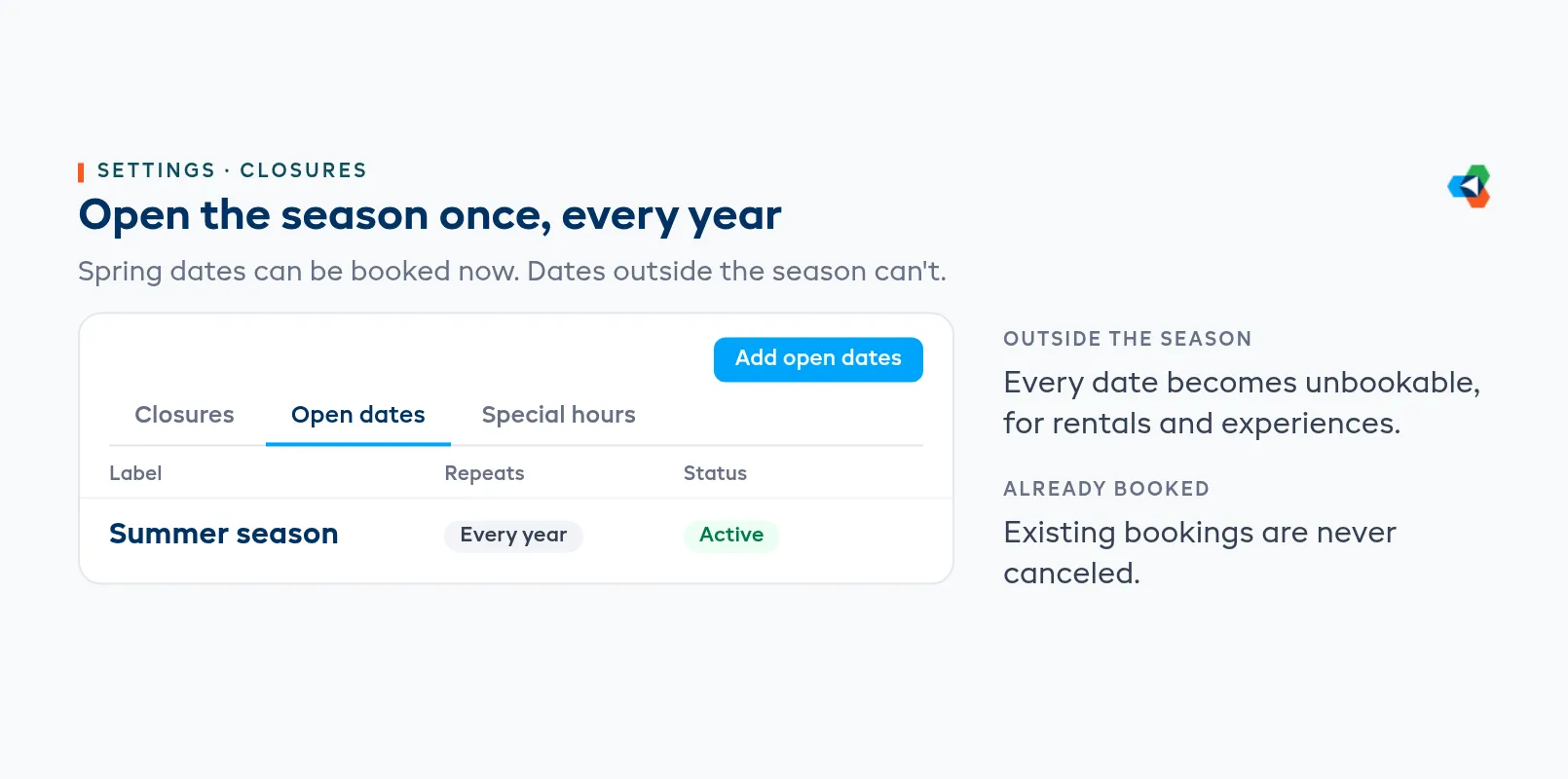
In EquipDash, Settings > Closures has an Open dates tab. Add your riding season as open dates, label it something like Summer season, and set it to Every year.
Every date outside that range becomes unbookable everywhere, for rentals and experiences, while dates inside it can be booked now. Existing bookings are never canceled.
For a single holiday week off, add a Closure instead. Open dates are for the season itself.
Add bikes you've ordered with an Available from date
New e-bikes ordered for spring can go into EquipDash before they arrive. Each item has an Available from date, and it only counts as available from that date on.
Set that date a couple of weeks after the promised delivery. Bike deliveries slip, and holding a new bike back for a week costs less than moving a customer who booked it.
Price the season, and the early bookers
Settings > Seasons lets you set date periods so you can charge different prices across the year, and Duplicate for next year copies last year's dates forward. On a product's pricing, Seasonal lets you pick a different pricing template and base price for each season.
For an early-booking price, a promo code is simpler than another season. Under Promotions > Promo Codes, set a Valid Until date and the code expires on its own.
Take a deposit now and the balance before the ride
Asking for the full price in December for a ride in May puts some people off. Under Settings > Payments, online checkout can take Deposit only (balance due later), as a percentage or a fixed amount.
For the rest, Remaining balance collection can Auto-send payment link before booking or Auto-charge before booking, a set number of days ahead. Nobody on your team chases balances in April.
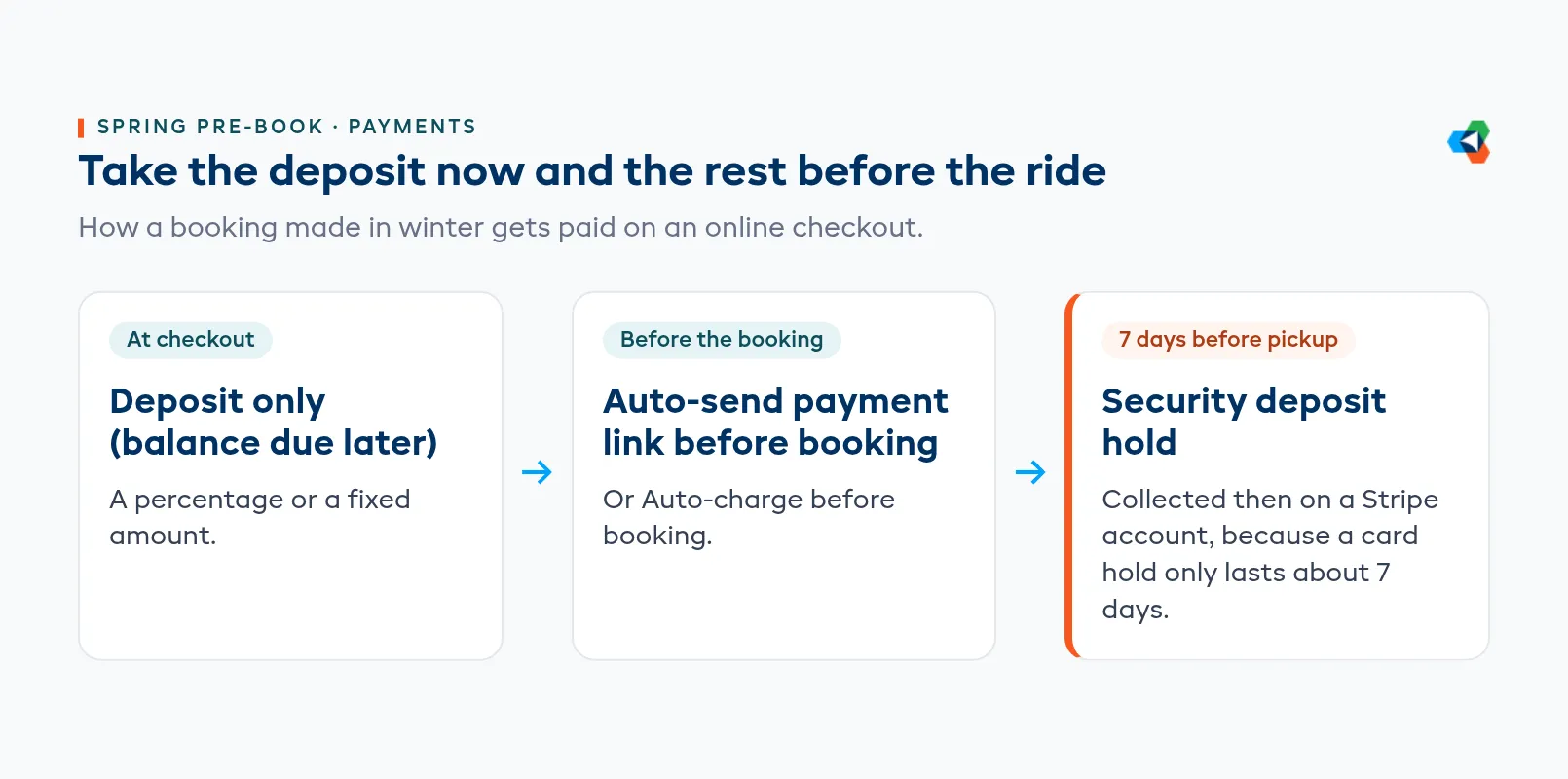
Security deposits work differently. An online card hold usually lasts 7 days, according to Stripe's documentation, so on a Stripe account EquipDash collects the hold 7 days before pickup for bookings further out, and emails the customer a link if the card is declined.
For how much to hold on an e-bike, see our bike rental damage policy guide.
Write refund and reschedule rules for spring weather
Spring weather cancels rides. Under Settings > Policies, a policy can set Refund windows by how far ahead someone cancels, and Allow customers to re-schedule? with a Reschedule deadline.
We'd let pre-booked riders move a rained-out day before we'd refund it, as long as the new date falls inside the same season.
Email last season's riders
Last season's customers are the cheapest spring bookings you'll get. Under Promotions > Campaigns, the Customers from a season audience reaches people who booked during a season you pick, or you can filter by what they booked so only e-bike riders hear about e-bikes.
Attach a promo code to the campaign and Schedule it for the date you want, so the email lands before people make spring plans.
Sell spring as a December gift
Under Promotions > Vouchers, fill in Gift card recipient (optional) and EquipDash sends that person a gift card email. A voucher sold in December is a spring ride already paid for.
Catch the overflow with a waitlist
Once a spring Saturday sells out, Settings > Waitlist lets customers join a list, and Auto-notify when space opens emails them when a rental frees up.
Wake the fleet up two weeks before opening
Bring the packs to room temperature before they go on a charger. Bosch gives a charging range of 0 to 40°C, ideally room temperature, so a pack from a cold room sits inside for a few hours first.
Charge each pack to full, run the E-Bike & E-Scooter Check again and compare the voltage with the fall reading. A pack that comes in well below the others goes to the dealer for a capacity test before it goes out with a customer.
Then the bike itself: firmware updates with the dealer tool, brakes, and a test of every assist level and the display.
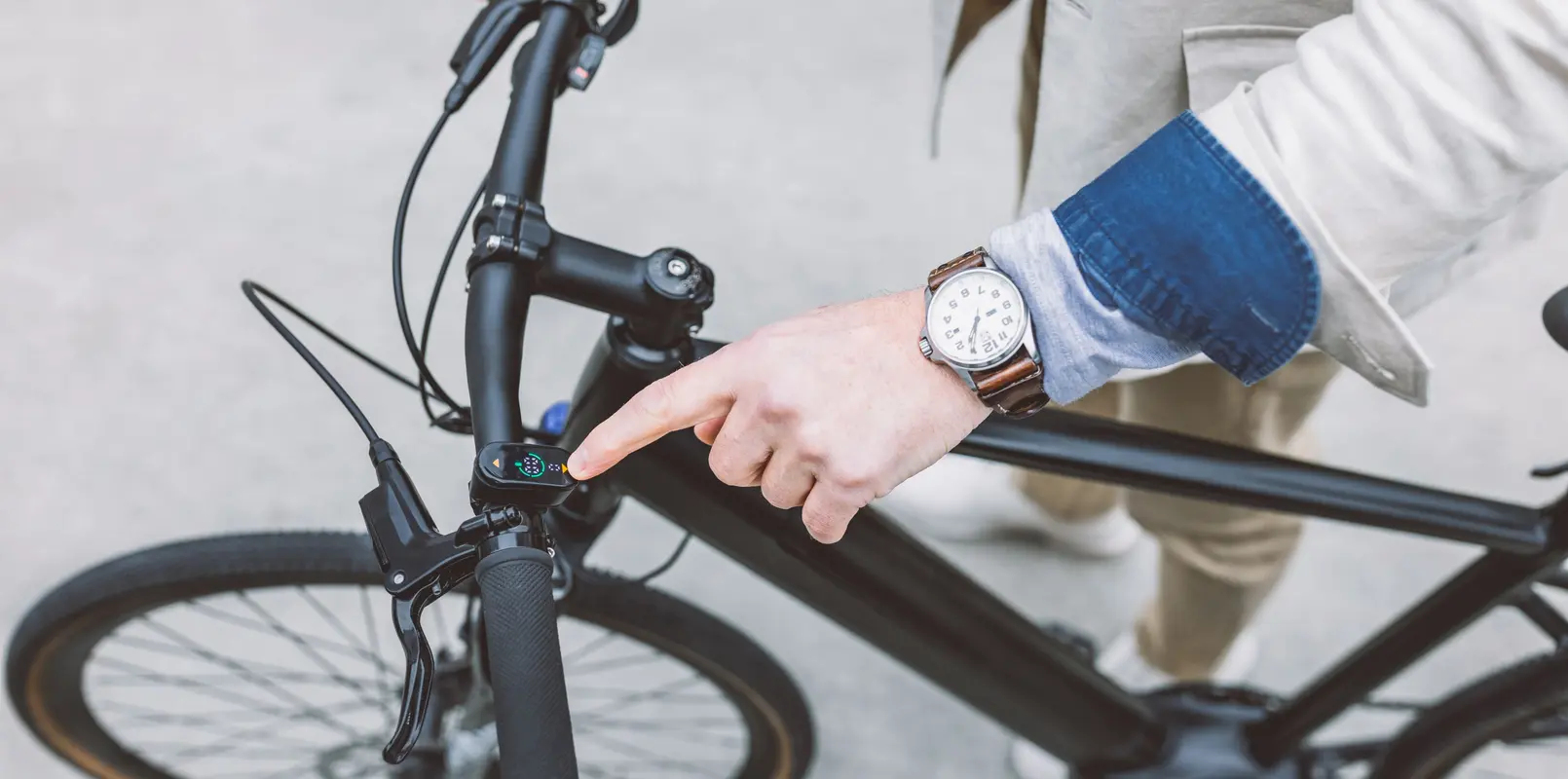
For the first pickups, apply the E-Bike Pre-Ride Check to your e-bike products. Its critical item, Battery charge sufficient for booking, blocks pickup until staff pass it, unless someone with override permission lets the bike through, so the pack someone forgot on charging night gets caught at the counter.
Charging during the season is a different job, covered in our e-bike rental operations guide. If your insurer asks where packs are stored over winter, our bike rental insurance guide covers what brokers look for.
Where EquipDash fits
EquipDash runs a bike shop's bookings, workshop and payments in one place, from the winter service list to the spring booking page. See how it fits a bike shop on the bike rental software page, compare plans on the EquipDash pricing page, or start with our complete bike rental business guide.
FAQ
What charge should e-bike batteries be stored at over winter?
Use the figure in your maker's manual. Bosch says 30% to 60% for longer storage, and Rad Power Bikes says around 75%. Never store a pack full or flat.
Where should a rental shop store e-bike batteries in winter?
In a dry, well-ventilated room with a smoke detector, away from heat and anything flammable. Bosch's range is 0 to 20°C (32 to 68°F) in a dry room. An unheated container in a northern winter is too cold.
How often should I check stored e-bike batteries?
Once a month is a safe habit, and it's what Rad Power Bikes asks for. Check the casing, read the charge and top up any pack below its storage level, with someone in the building while it charges.
Can customers book spring rentals while my shop is closed?
Yes. In EquipDash, set your season as open dates under Settings > Closures. Dates outside it can't be booked, and dates inside it stay open for booking now.
How do I take a deposit on a spring booking without charging the full price?
Set online checkout to Deposit only (balance due later) under Settings > Payments. EquipDash can then send a payment link or charge the card for the balance a set number of days before the booking.
in one place