Ski Shop Opening Weekend: Fit Tickets, Waivers and the First Rush
Opening weekend at a ski shop usually jams in the same place, the stretch between the front door and the boot bench. Start every fit ticket and clear every waiver before guests reach the line, and your bench spends the first rush fitting boots instead of chasing paperwork.
This post is about the weekend itself. If you're still selling season packages and fitting slots, start with the ski pre-book push. For the hour before the doors open (POS test, size signage, staff briefing), run the ski shop opening-day checklist. And for how a good boot fit actually goes, see ski boot fitting for rental shops.
Do the first-hour math before Saturday
Most of your opening Saturday happens in about 90 minutes. Lifts open, a lot of people who booked want to be on the first chair, and most of them arrive in the same window. Work out what that window looks like for your shop before it hits you.
Say 140 people are booked to pick up on opening Saturday and the lifts open at 9:00. If 60 percent of them turn up between 7:30 and 9:00, that's 84 people in 90 minutes, before a single walk-in. Now time your own bench. In this example, a skier with nothing on file takes about 12 minutes from foot measure to out the door. A skier whose details came in online and whose waiver is already signed takes about 6.
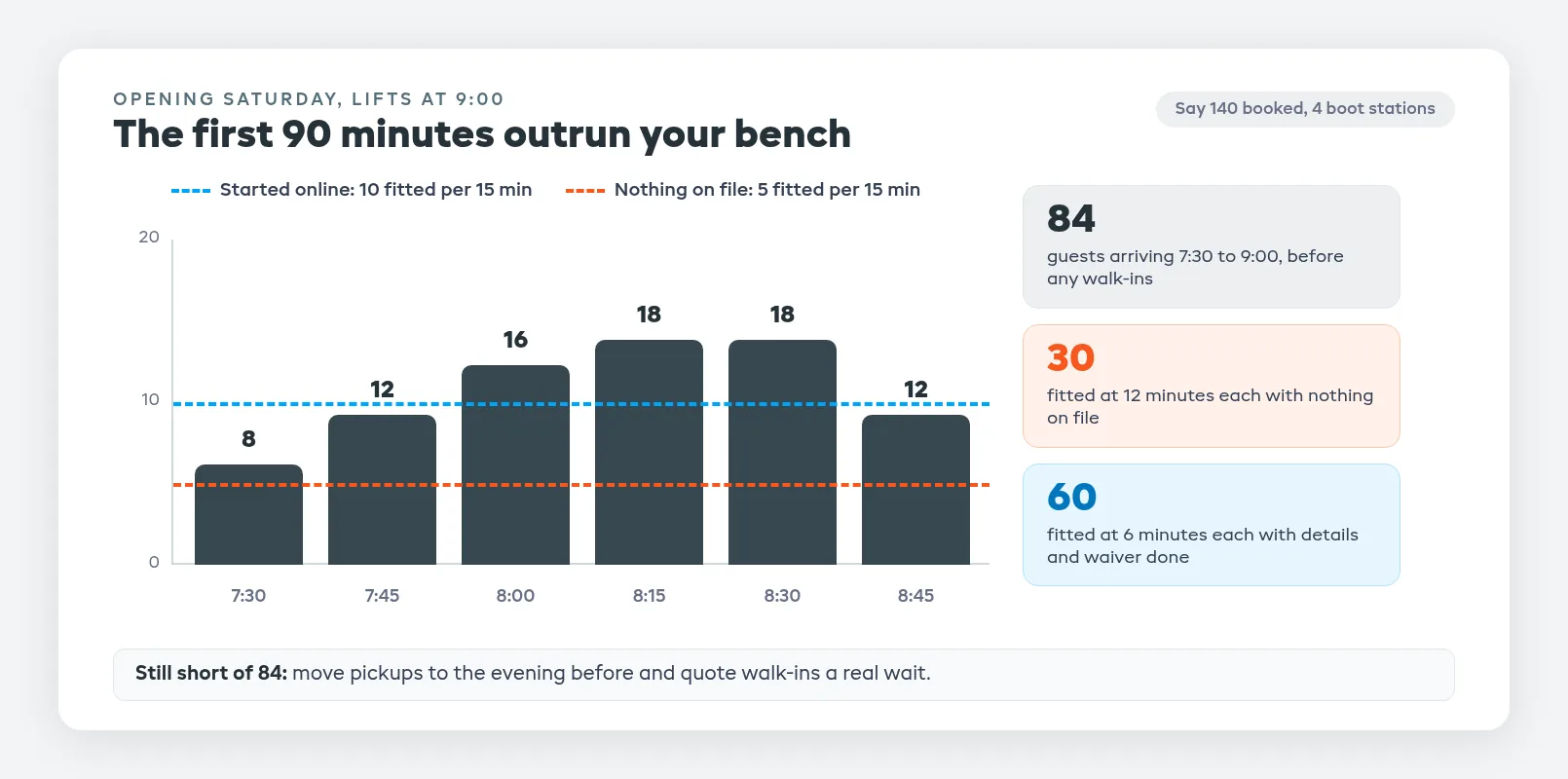
Four boot stations give you 360 station-minutes in that 90-minute window. At 12 minutes a guest, that's 30 people. At 6 minutes, it's 60. Neither number reaches 84. More fitters won't close that gap on their own, so some of the work has to move out of the first hour.
Three moves do most of it:
- Halve the time per guest by getting details and signatures done before they arrive. That's most of this post.
- Spread the arrivals. Offer pre-booked guests a pickup the afternoon or evening before, when the shop is quiet. A family of four that picks up on Friday is four people who aren't in Saturday's line.
- Tell walk-ins the truth. Post a realistic wait at the door and offer a later pickup time instead of letting them stand in a queue you already know won't move.
Run the same math for Sunday. It's usually a smaller peak, but it's a different crowd, and many of them will show up with the same blank paperwork.
Start the fit ticket before they leave home
In EquipDash, a ski, snowboard or ski boot product gets a fit ticket for each person on the booking. You choose where the fit details come in: at online checkout, or only from your staff at the bench.
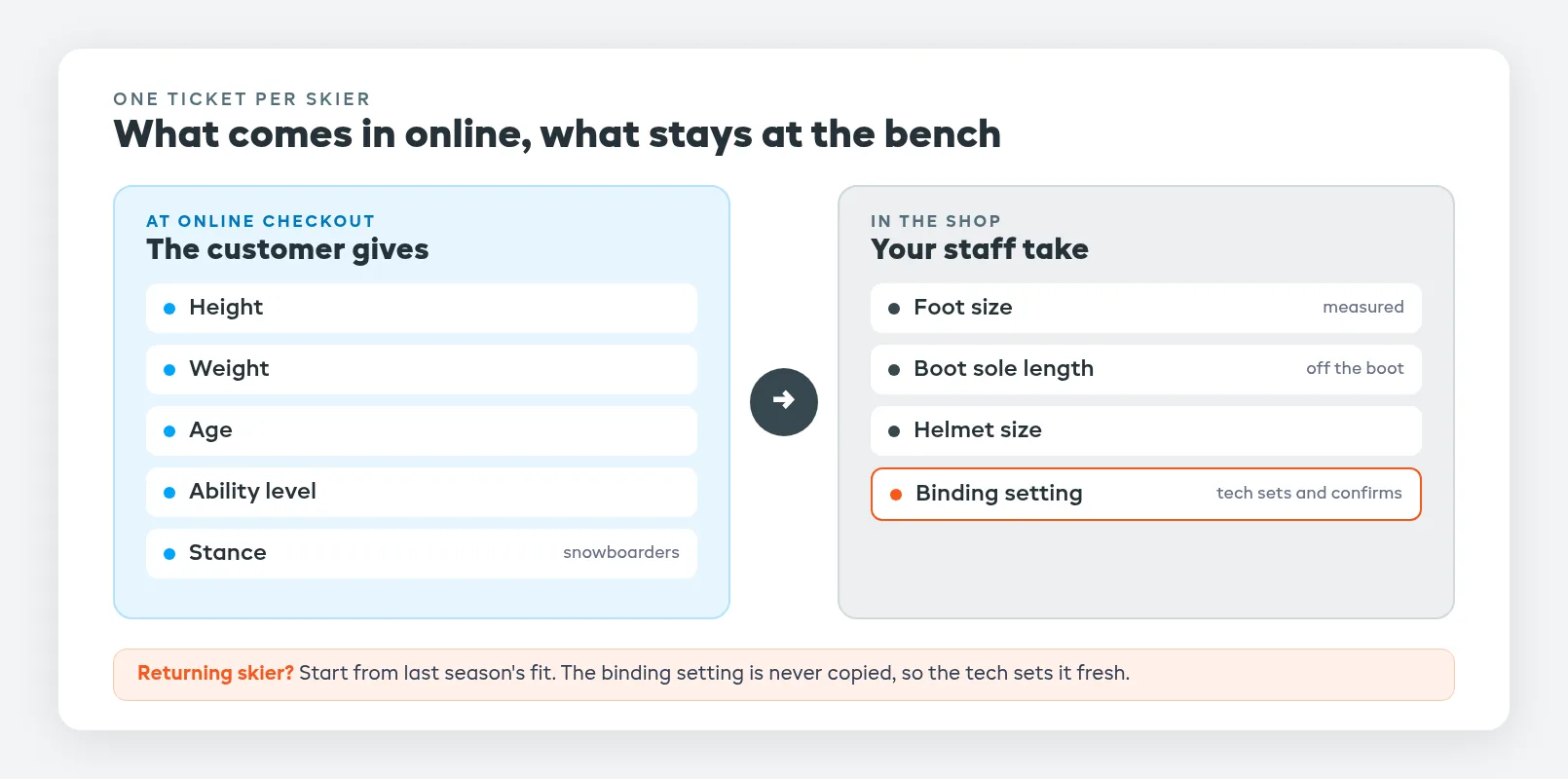
For opening weekend, choose online checkout. The default ski-fit fields ask each skier for height, weight, age and ability level at checkout (snowboarders also give their stance). That's the part of the fit your customer can do from the couch.
The rest stays at the bench, and should. Your staff measure the foot, read the boot sole length off the boot they hand over, pick the helmet size, and your tech sets the binding using the manufacturer's procedure. The tech then enters the confirmed setting on the ticket, and EquipDash holds pickup until that's done. Nothing about opening weekend should speed that step up.
A few habits make the online part pay off:
- Ask for real numbers. Say in the confirmation email that the bench uses height, weight and ability to set them up, so a hopeful ability level only slows them down.
- Use last season's fit. When a returning customer books again, the new fit ticket can copy their last fit in one tap. It never copies the binding setting, so the tech still sets and confirms that on the day.
- Decide what happens to blanks. Someone usually skips a field. Fill the gaps at the front of the shop, not at the boot bench, so the bench only fits boots.
Print group tickets the night before
The evening before each opening day, go through tomorrow's bookings and print the fit tickets. On a booking's fit ticket tab, Print all (group) stacks every person on that booking into one printout, half a page each by default. A family of four arrives to one sheet, not four people at the counter spelling their names.
Sort the sheets by pickup time, not by last name. Your 7:30 families are at the front of the tray, and whoever is at the door can pull the next sheet without asking anyone.
If you stage boots ahead for returning customers whose last fit you copied, keep those bags beside the matching sheet and treat them as a starting point. Feet change between seasons, kids most of all, so the bench still measures and tries the boot on.
Clear waivers before the line
An unsigned waiver at the counter is one person holding up everyone behind them, usually while a parent hunts through email for the link. Treat every unsigned waiver on Friday night as a job for Friday, not for Saturday at 8:10.
Waivers are on EquipDash's Growth and Pro plans. With them, you get:
- Sign inside checkout. With a waiver assigned to your ski and board rentals, customers sign it as a step in the booking, before payment. Turn on participant details if you want every skier to sign their own copy, not only the person paying.
- Let the reminders chase. The waiver request goes out when the booking is confirmed. Reminders then go only to the people who still haven't signed, one person at a time on a group booking, and stop when they sign or reach your reminder limit.
- Check status the night before. Each person on a booking shows whether their waiver is signed, and the manifest has a "Waiver signed?" column. Chase the gaps while there's still an evening to do it.
- Send one link for the whole group. Copy the booking's signing link and text it to the parent. Each person signs their own form from it, and nobody sees anyone else's details.
On the day, the same signing link works on a tablet at the door. Open it, hand it over, and when one person finishes, Someone else needs to sign clears the page for the next. Walk-ins sign while they wait, so fewer people reach the boot bench unsigned.
Give every station one job and one rule
The opening-day checklist covers walking the customer path. On the weekend itself, what keeps that path moving is each station knowing what it owns and when to hand off.
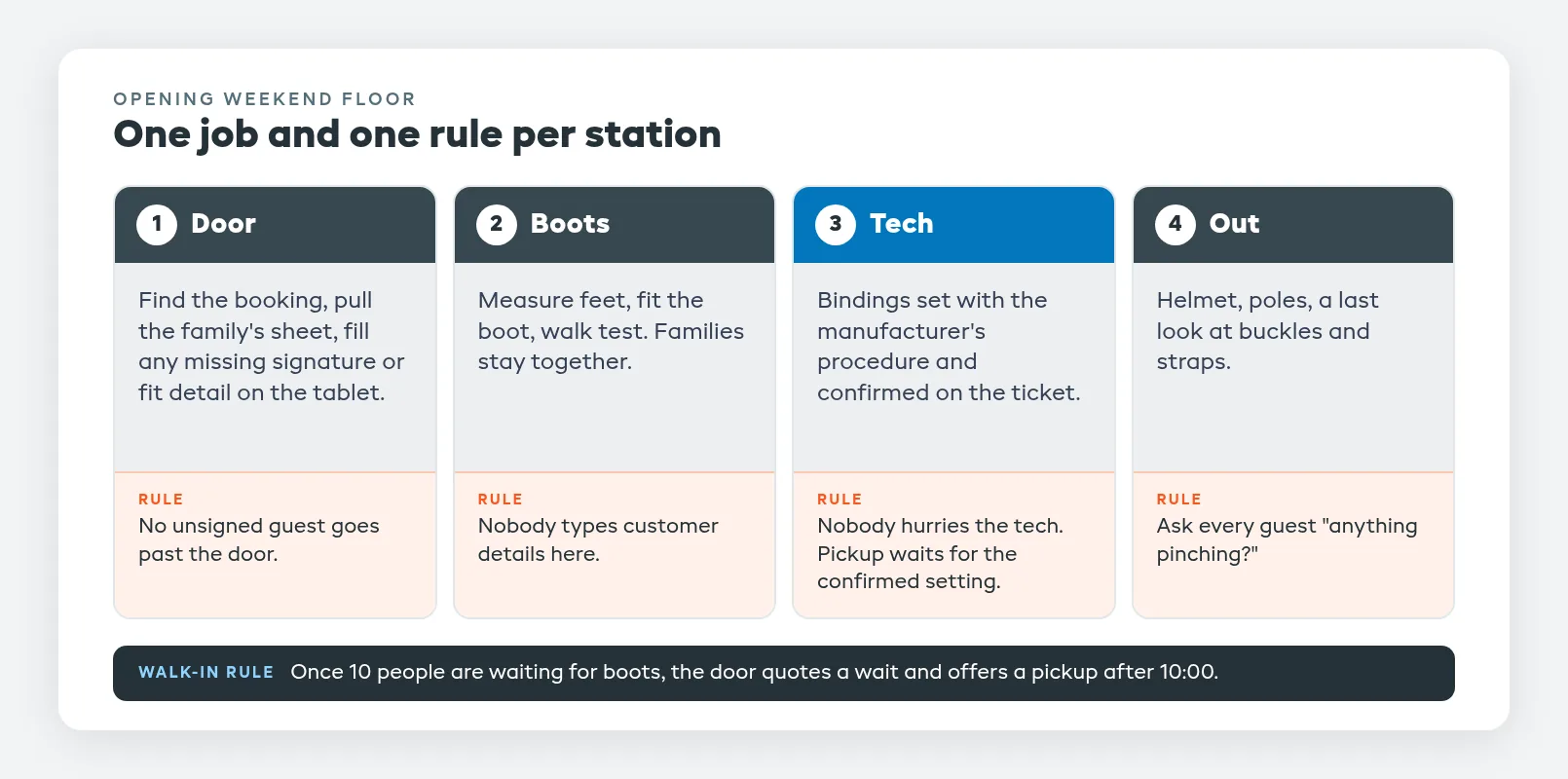
- Door. The person at the door owns paperwork only: find the booking, pull the sheet, get any missing signature or fit detail on the tablet. Rule: no unsigned guest goes past the door.
- Boot bench. Measure, fit and walk test. Rule: the bench doesn't type customer details. If something's missing, the guest goes back to the door.
- Tech bench. Bindings set and confirmed on the ticket. Rule: nobody hurries the tech, and pickup waits for the confirmed setting.
- Out. Helmet, poles, a last look at buckles and straps. Rule: one question to every guest before they leave, "anything pinching?"
Decide your walk-in rule before Saturday, not at 8:20 with a queue out the door. Something like this works: once the boot bench has 10 people waiting, the door quotes a wait and offers a pickup after 10:00. Write the number down and give everyone at the door the same one.
Keep each family together through the stations. Splitting a family across two benches usually means one parent waiting at the door for the other, and a sheet that's in the wrong place.
Reset every evening of the weekend
Opening weekend is two openings back to back. Saturday's returns land between 3:30 and 5:00, right when you should be getting ready for Sunday, so give the reset an order and stick to it.
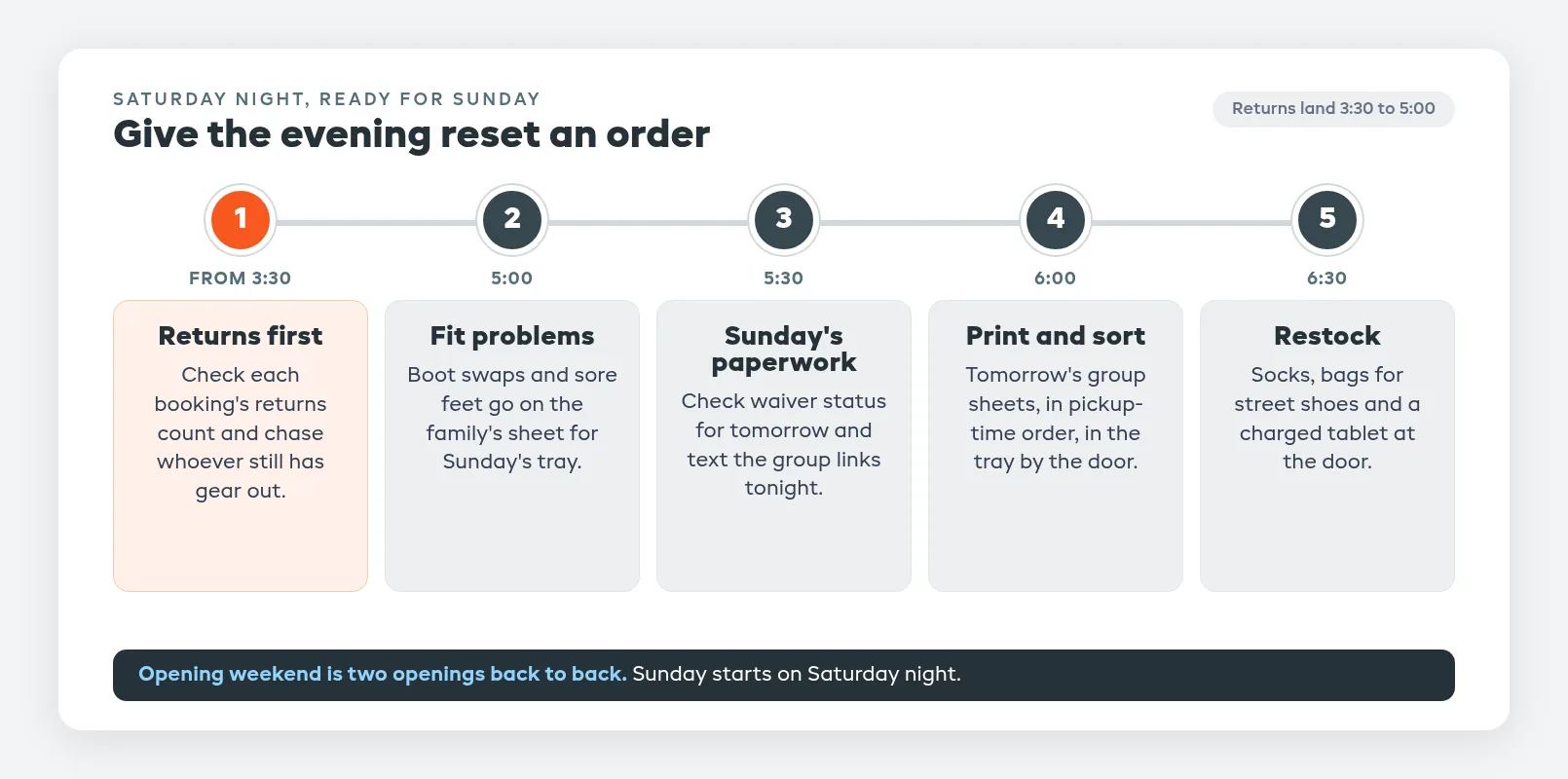
- Returns first. Each booking shows how many of its items are back ("3 of 4 returned"), so you can see who still has your skis before you lock up.
- Write down the fit problems. Every boot swap or sore-foot complaint from Saturday goes on that family's sheet, and the sheet goes in Sunday's tray. If they're back, the bench starts from the right boot.
- Chase Sunday's paperwork. Check waiver status for tomorrow's bookings and send the group links tonight.
- Print and sort. Tomorrow's sheets, sorted by pickup time, in the tray by the door.
- Restock the bench. Socks, bags for street shoes, a charged tablet at the door.
After the weekend, look at where the time actually went. If the door was the bottleneck, the fix is probably more pre-arrival paperwork next year. If the boot bench was, look at more pickups on the evening before. Either way, the pre-season prep plan is where next season's fixes go.
Where EquipDash fits
EquipDash runs the paperwork side of a ski shop in one place. Fit tickets take height, weight, age and ability at checkout, keep foot size, boot sole length and the binding setting at the bench, and print as one group sheet per booking. Returning customers can start from their last fit, and the binding setting is always set fresh.
On the Growth and Pro plans, digital waivers can be signed inside checkout or from one group link, with signed status on every booking and on the manifest. Walk-ins go through the POS from the same stock as your website, so the last pair of 27.5 boots can't be sold twice. See how it all comes together for ski and snowboard rental shops.
FAQ
When should a ski shop print fit tickets for opening weekend?
Print them the evening before each opening day, once the day's online bookings are in. Use Print all (group) on each booking so a family's tickets arrive as one printout, and sort the sheets by pickup time so the person at the door can pull the next one without asking.
What fit details should ski renters give online?
Height, weight, age and ability level, plus stance for snowboarders. Foot size, boot sole length, helmet size and the binding setting are taken in the shop. The tech sets the binding with the manufacturer's procedure and confirms it on the ticket before pickup.
Can returning customers skip the fitting?
No, but they can skip the typing. EquipDash can copy a returning customer's last fit onto the new ticket, which saves time at the door. It doesn't copy the binding setting, and the bench should still measure feet, because they change between seasons, especially kids' feet.
How do you get waivers signed before opening day?
On EquipDash's Growth and Pro plans, have customers sign inside checkout, let reminders chase whoever hasn't signed, and check signed status the night before. Text one group signing link to any family that's still missing signatures, and keep a tablet at the door for walk-ins and last-minute stragglers.
How many walk-ins can a ski shop handle on opening Saturday?
Work it out from your bench. Multiply your boot stations by the minutes in your arrival window, then divide by how long one fit takes. Four stations over 90 minutes at 12 minutes each is 30 people. Subtract your pre-booked arrivals, and whatever's left is your walk-in room.
What should a ski shop do at the end of opening day?
Check returns first, so you know who still has gear out. Then write any fit problems on that family's sheet for the next day, chase the next day's unsigned waivers, print and sort the next morning's sheets, and restock the bench and the door.
in one place