Self-Service Kiosks and Keyless Pickup for Bike Rentals
Self-Service Kiosks and Keyless Pickup for Bike Rentals
Walk past any beach-town bike shop at 9 a.m. in July and you will see the same scene: a line of customers out the door, one staffer juggling waivers and helmet sizing, and thirty perfectly good bikes locked in a rack while the people who already paid for them wait to sign a form. The bottleneck is not the bikes. It is the counter.
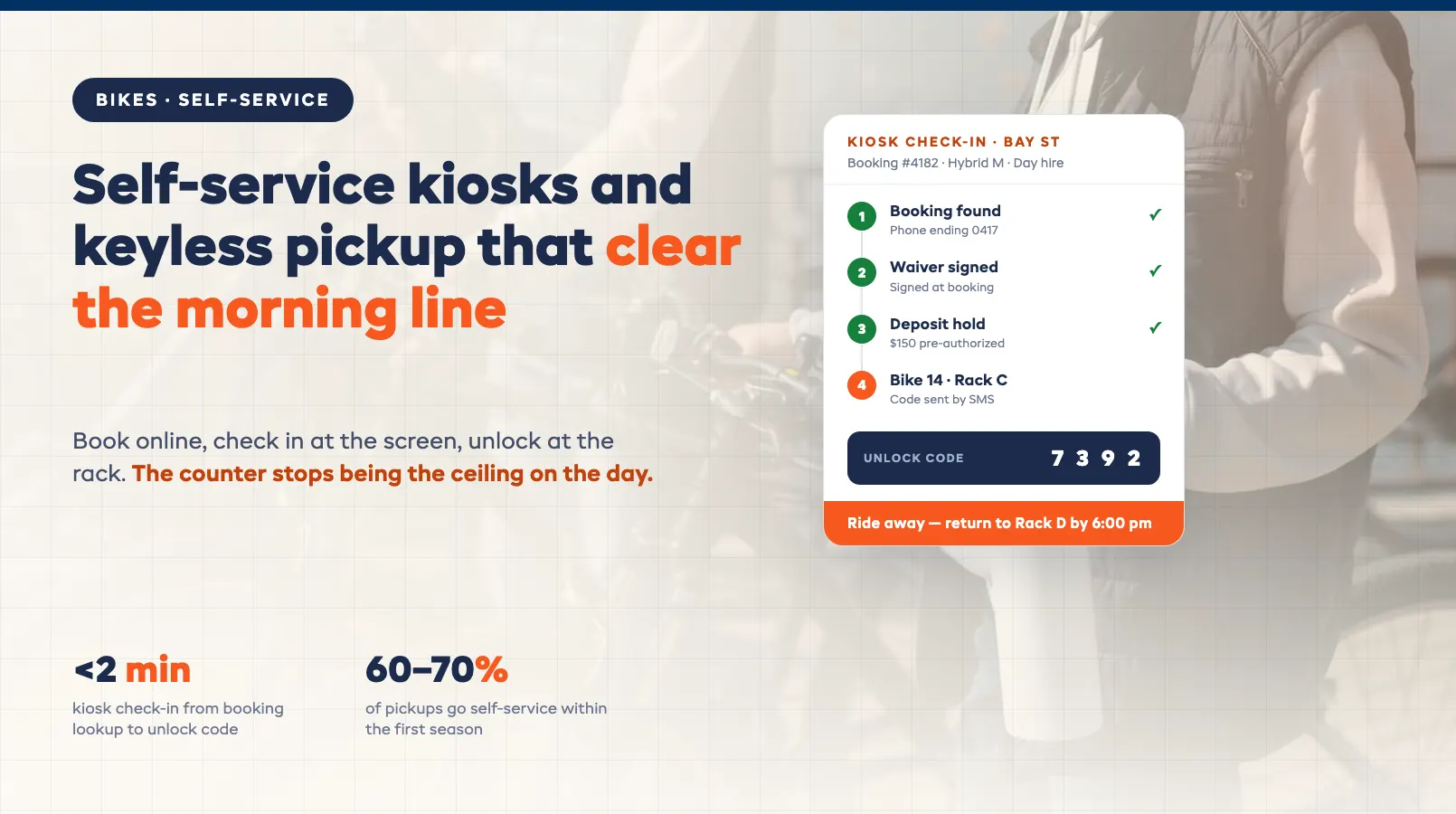
Self-service kiosks and keyless pickup remove the counter from the transaction. The customer books online, arrives, checks in at a screen or on their own phone, gets an unlock code, and rides away — no queue, no clipboard, no staffer required for the routine cases. Operators who make the switch report the same three effects: mornings stop being a scramble, after-hours revenue appears where there was none, and the one staffer on shift spends their time on fittings and problems instead of paperwork. This guide covers how to actually run it — the check-in flow, the lock hardware, the station layout, and the controls that keep unattended bikes from becoming missing bikes. It sits alongside our full guide to running a bike rental business, which covers the fundamentals this model builds on.
Why the Counter Is the Bottleneck
A staffed handover takes eight to twelve minutes per customer: find the booking, print or sign the waiver, take payment or a deposit, size the bike, explain the rules, hand over the lock key. At peak, that means a shop with one staffer serves five to seven customers an hour — while demand runs at three times that. The overflow does not wait patiently. Some of it walks to the competitor two blocks over; the rest of it starts the ride annoyed, which shows up later in reviews.
The insight behind self-service is that most of that eight minutes is administration, not service. The booking already exists. The payment already cleared. The waiver could have been signed on a phone the night before. The only parts that genuinely need a human are bike fitting for first-timers and judgment calls — and those are exactly the parts your staffer has no time for while they are retyping a booking reference.
Splitting the flow fixes both sides. Routine pickups go through the kiosk; your staffer handles the exceptions. Shops running this model typically move 60-70% of pickups to self-service within a season, which is the difference between needing four weekend staff and needing two.
The Kiosk Check-In Flow
"Kiosk" covers two setups that share the same software flow: a mounted tablet or touchscreen at the shop entrance, or the customer's own phone via a QR code on the door. The mounted screen looks more official and works for customers with dead batteries; the QR-to-phone version costs almost nothing and scales to any number of simultaneous arrivals. Most operators run both — the screen as the anchor, the QR code as the overflow valve.
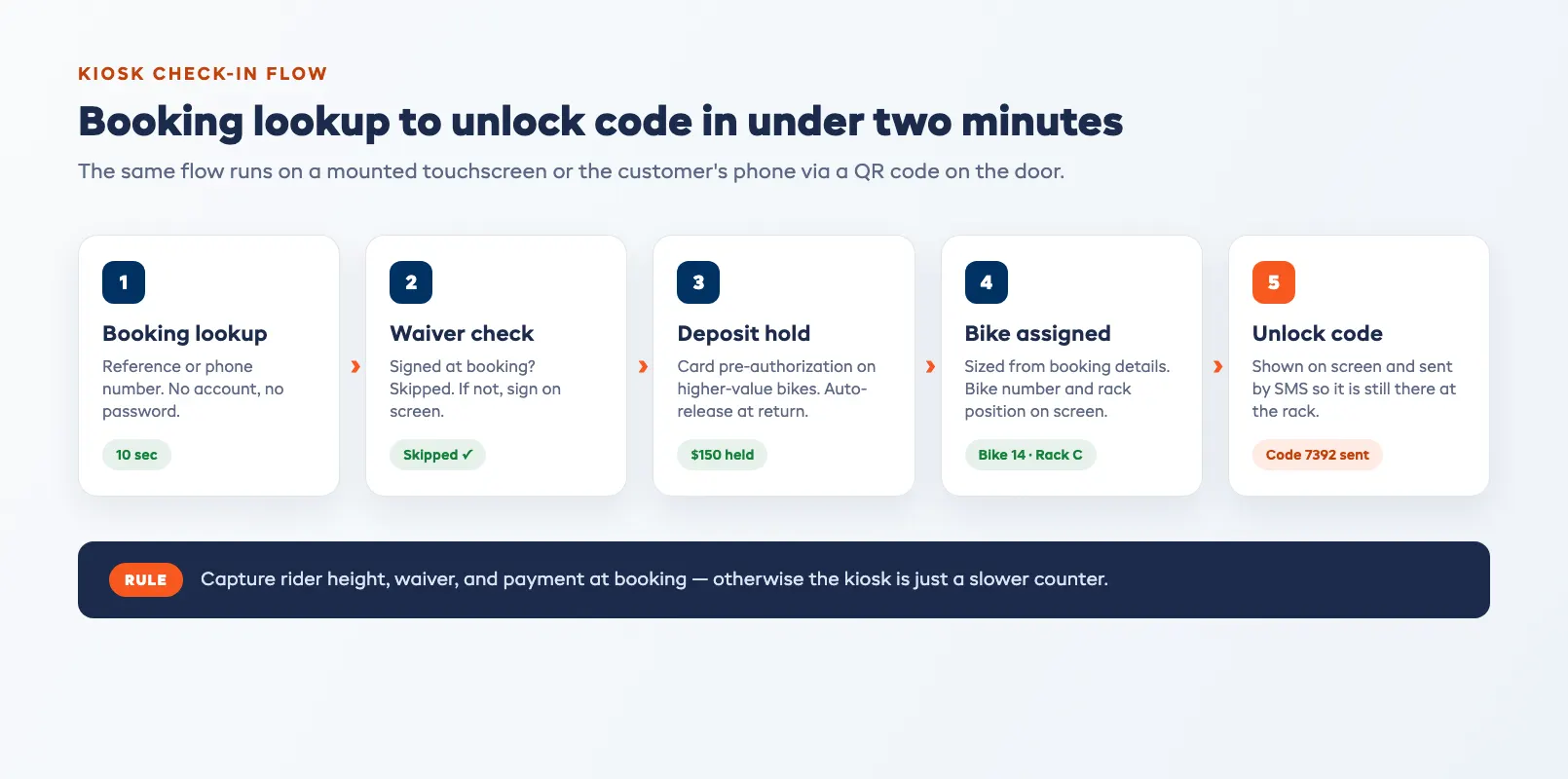
The flow itself should take under two minutes:
- Booking lookup. The customer enters their booking reference or the phone number they booked with. No account creation, no password — friction here kills the whole model.
- Waiver check. If the digital waiver was signed at booking, the kiosk skips this step. If not, it presents the waiver for signature on screen and stores it against the booking.
- ID and payment verification. For higher-value bikes, the kiosk prompts for a card pre-authorization as a security deposit. The hold releases automatically at return.
- Bike assignment. The system assigns a specific bike — by size, from the customer's booking details — and displays the bike number and rack position.
- Unlock code delivery. The code appears on screen and lands in the customer's SMS or email at the same time, so they still have it at the rack.
Everything upstream of this matters more than the kiosk itself. If your booking flow does not capture rider height, waiver signature, and payment before arrival, the kiosk just becomes a slower counter. Get the online booking right first — the kiosk is the last step of a chain, not a standalone gadget.
One flow decision worth getting right early: e-bikes. Battery checks and motor briefings do not belong on a screen, so most operators route e-bike bookings to staffed pickup while standard bikes go self-service. Our guide to e-bike rental operations covers where that line sits as the fleet grows.
Smart Locks and Keyless Release
The hardware layer is simpler than it looks. Three options cover nearly every operation:
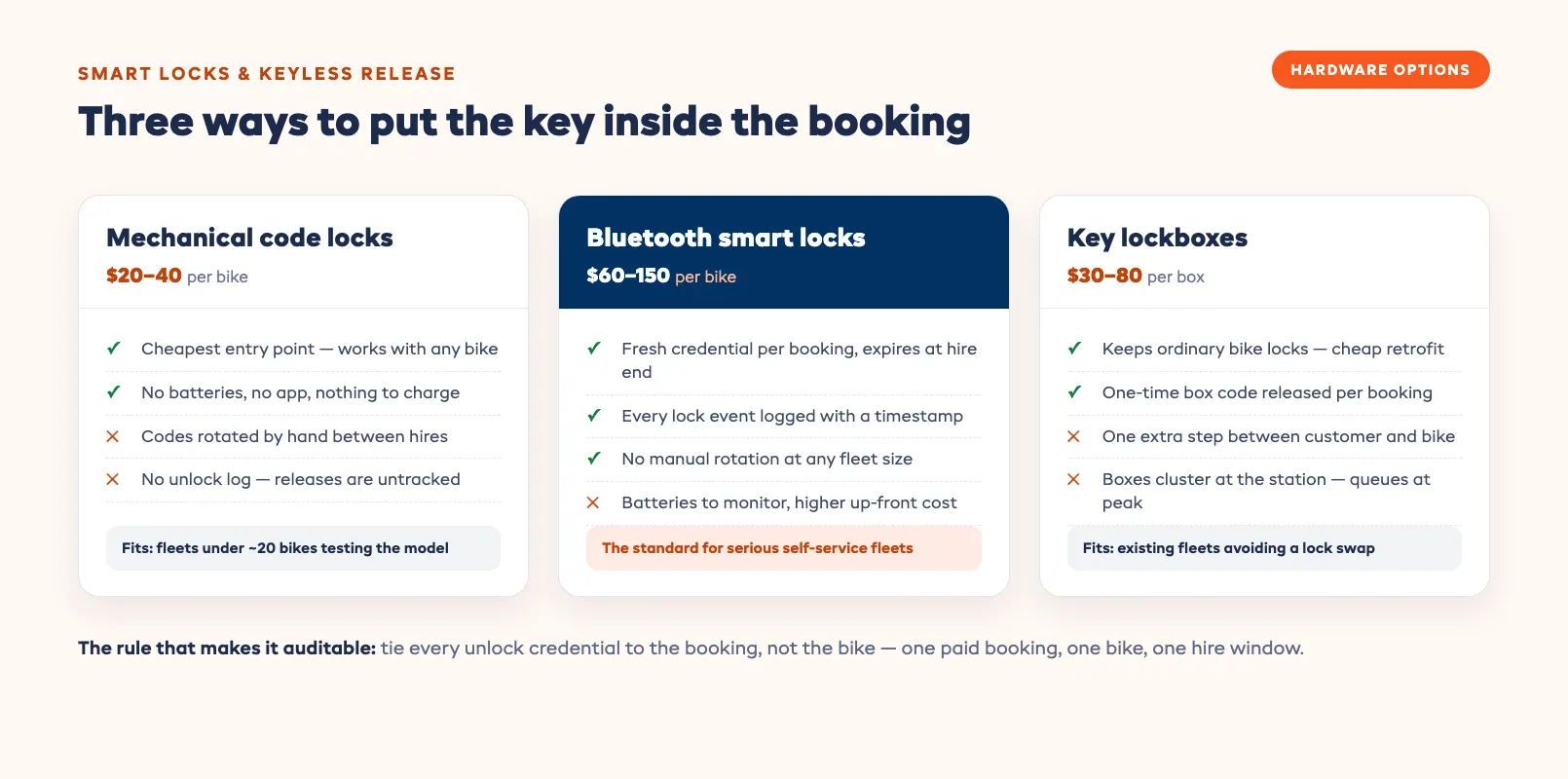
Mechanical code locks ($20-40 per bike) are the entry point. Each bike carries a 4-digit combination lock; the system tells the customer the code for their assigned bike. The catch is code rotation — you must change codes manually between hires, or yesterday's customer can unlock today's bike. Workable for small fleets, painful past twenty bikes.
Bluetooth and app-controlled smart locks ($60-150 per bike) generate a fresh unlock credential per booking. The customer taps unlock in their browser or the code expires when the hire ends. No manual rotation, and every lock event is logged with a timestamp — which turns "when did that bike leave?" from a guess into a lookup. This is the standard for serious self-service fleets.
Key lockboxes ($30-80 per box) suit operators who want to keep ordinary bike locks: the kiosk releases a one-time code to a wall-mounted lockbox holding the bike's key. Cheaper to retrofit across an existing fleet, at the cost of one more step for the customer.
Whichever you choose, tie the unlock credential to the booking, not the bike. The code the customer receives should work only for their assigned bike, only within their hire window. That single rule is what makes unattended operation auditable: every release traces to a paid booking with a signed waiver and a card on file.
Designing the Unattended Pickup Station
Hardware and software fail quietly when the physical station is confusing. Customers standing in front of forty identical bikes with an unlock code and no idea which bike is theirs will call the phone number on the door — and now you are staffing the counter again, remotely, one call at a time.
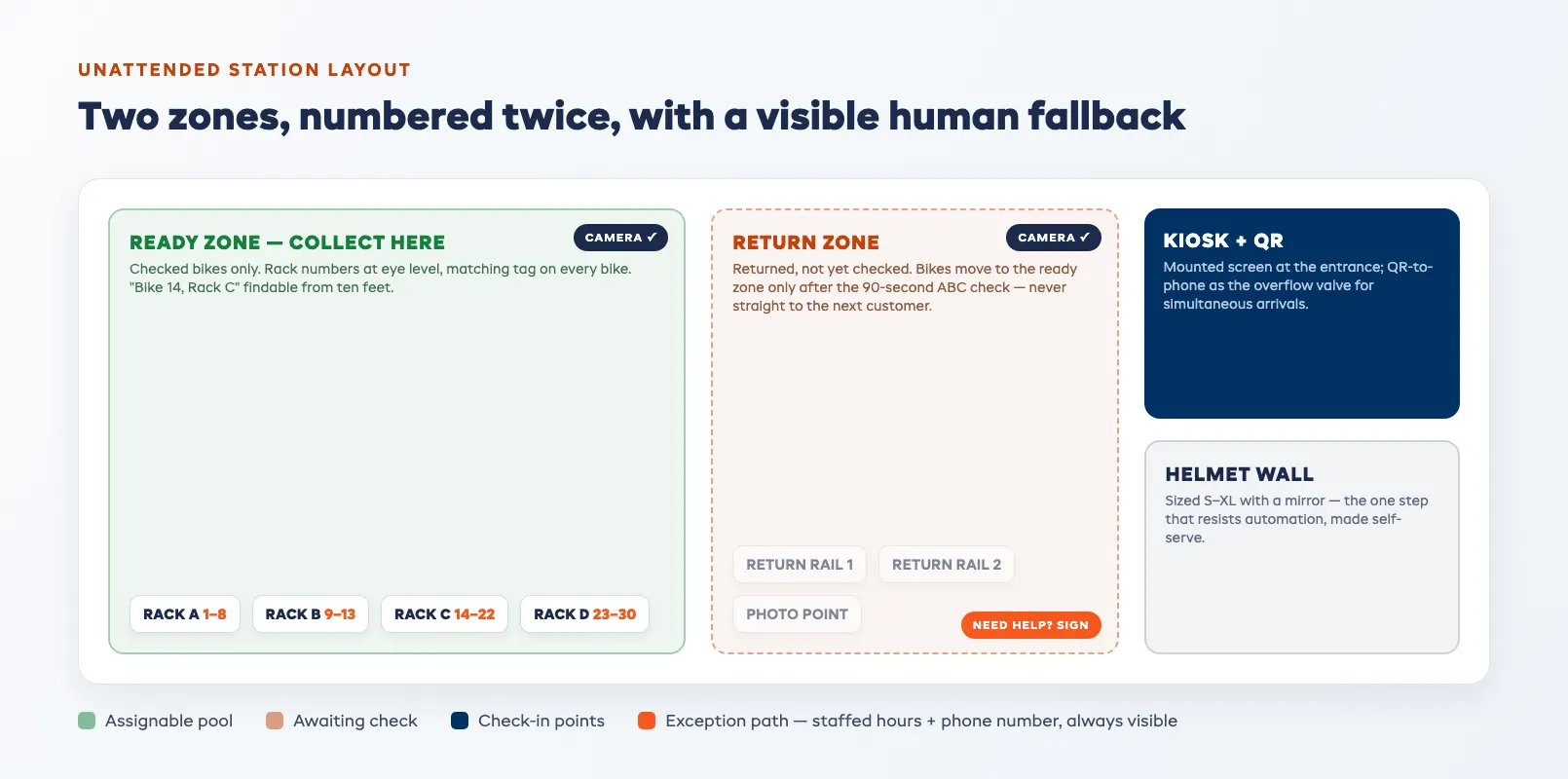
The layout rules that prevent those calls:
- Number everything twice. Large rack-position numbers at eye level and a matching tag on each bike. The kiosk message says "Bike 14, Rack C" — the customer should be able to find both from ten feet away.
- Separate ready bikes from returned bikes. A returned-but-unchecked bike that gets picked up by the next customer is how a snapped brake cable becomes your liability. Two zones, clearly signed: collect here, return there. Bikes only move from the return zone to the ready zone after a check — the pre-rental ABC check takes about ninety seconds per bike and is the minimum bar.
- Put helmets and accessories on an honor wall by size. Helmet fitting is the one step that resists automation; a sized wall with a mirror gets most customers through it unassisted.
- Sign the exception path. A visible "Need help?" sign with a phone number and a note of staffed hours. Customers forgive a self-service station that offers a human fallback; they do not forgive a locked door with no answers.
- Camera coverage on both zones. Not hidden — visible. A camera over the racks deters casual theft and settles damage disputes. Pair it with the return-photo requirement below and disputes mostly resolve themselves.
Station design is also a placement question. A hotel courtyard rack served entirely by keyless pickup is a revenue point that never needs a staffer on site — the model behind the hotel and resort partnership approach, where the front desk hands out nothing but a QR code.
Damage, Theft, and the Controls That Make Unattended Work
Every operator considering self-service asks the same question: what stops someone unlocking a bike and never coming back? The honest answer is that the controls are financial and procedural, not physical — and they work.
Card pre-authorization is the backbone. A $100-300 hold per bike, taken at booking or check-in and released at return, changes the economics of walking off with a bike. Combined with full identity capture on the booking — name, phone, card, signed waiver — theft on pre-booked self-service hires is rare. Operators consistently find that anonymous walk-ups, not booked customers, account for nearly all losses; self-service actually closes that gap because there is no anonymous path to a bike.
Return photos close the damage loop. At return, the flow asks the customer to photograph the bike in the return rack before the deposit releases. Timestamped photos against the booking mean a bent wheel discovered later has a before-and-after record. Your damage-charge process should already follow the framework in our bike rental damage policy guide — self-service just makes the evidence automatic.
Overdue automation replaces the phone call. When a hire runs past its window, the system messages the customer, then applies the late rate from your terms, then flags the booking for follow-up. Most "thefts" are actually customers who lost track of time; a firm automated sequence recovers them without a staffer chasing anyone.
GPS on the expensive end of the fleet. Trackers at $10-15/month per unit make sense for e-bikes and premium models, not for the whole fleet. Fit them where replacement cost justifies the subscription.
Supervising It All From the Dashboard
Unattended does not mean unwatched. The operating model is one staffer — on site during peak, at home after hours — supervising the whole operation from a screen.
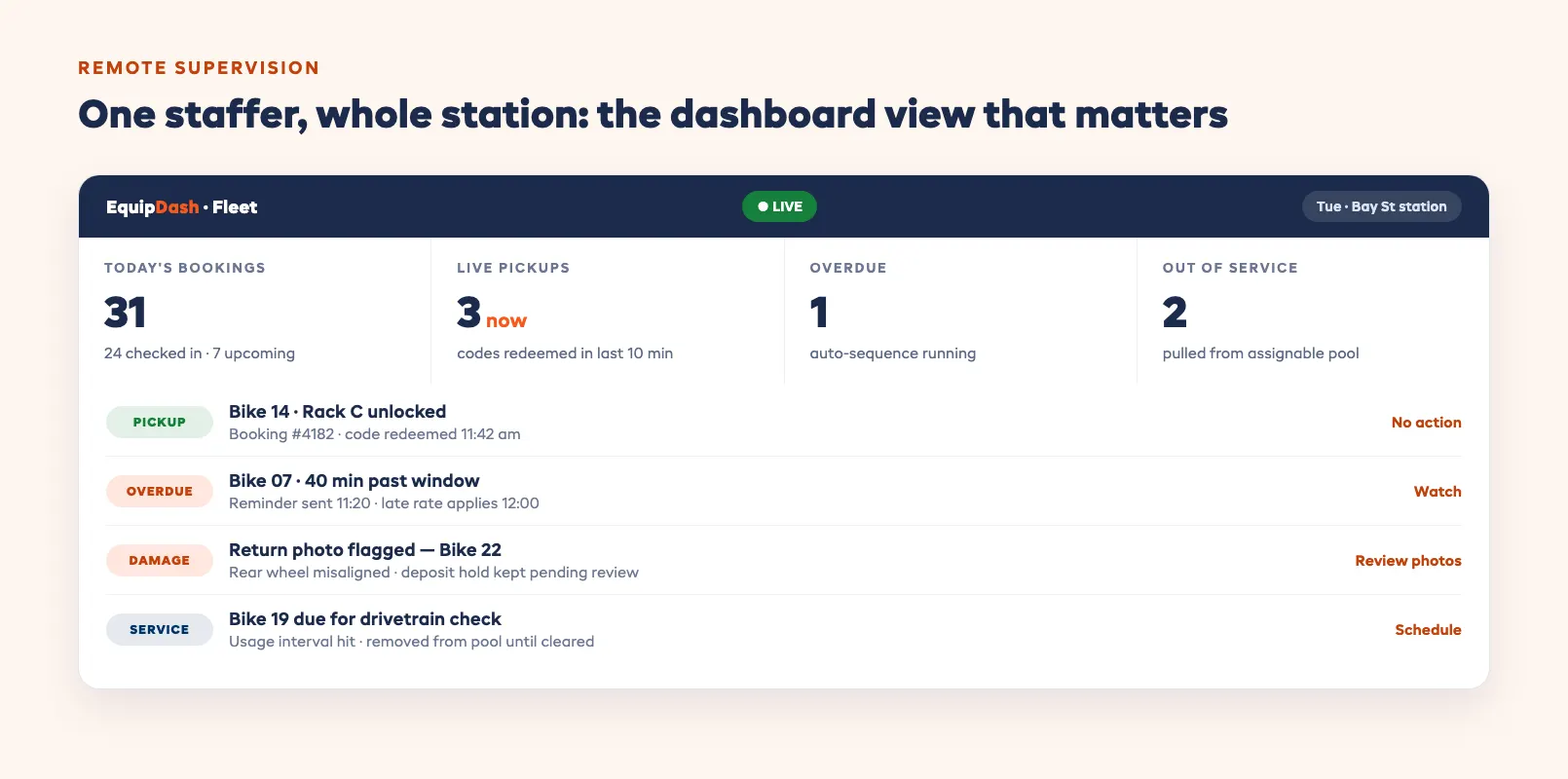
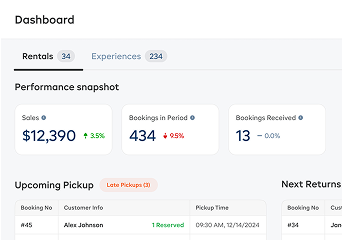
The dashboard view that matters shows: today's bookings with check-in status, live pickups as codes are redeemed, overdue hires with the automation state, and bikes flagged out of service. The staffer intervenes only on exceptions — a customer stuck at the kiosk, a return photo showing damage, a bike overdue past the grace window. Everything else runs itself. Dash AI adds a useful layer here: it answers customer questions at the kiosk stage — "can I extend?", "where do I return after hours?" — before they become phone calls.
Maintenance is the discipline that keeps the model honest. With no staffer touching every bike at every handover, scheduled checks replace incidental ones: usage-based service intervals, a maintenance flag that pulls a bike out of the assignable pool the moment it is reported, and a weekly fleet audit. The cadence and templates are covered in our bike fleet maintenance schedule guide — and a maintenance due alert agent watches the intervals so nobody has to remember them.
City shops and tourist-town shops will weight this differently. High-churn hourly hires in an urban core lean harder on the kiosk throughput; day-hire tourist operations lean on the after-hours and satellite-station side. The urban versus tourist rental breakdown covers how the two models diverge — but both get the same core win: the counter stops being the ceiling on the day's revenue.
For the vocabulary behind the hardware and booking terms in this guide, the bike rental glossary has the full set, and the bikes hub collects every guide, checklist, and template we publish for bike operators.
FAQ
How much does it cost to set up self-service pickup for a bike fleet?
For a 30-bike fleet: Bluetooth smart locks run $60-150 per bike ($1,800-4,500), a mounted tablet kiosk $200-500, signage and rack numbering $200-400, and camera coverage $300-600. Total hardware sits around $2,500-6,000, plus rental software with self-service check-in. Mechanical code locks or key lockboxes cut the lock cost by more than half if you accept manual code rotation.
Do customers actually use kiosks, or do they still want a person?
Pre-booked customers overwhelmingly prefer the fast path — most operators see 60-70% of pickups go self-service within the first season. The customers who want a person are first-timers needing a bike fit and e-bike hirers needing a briefing, which is exactly where your staffed capacity should go. Keep a visible human fallback (staffed hours plus a help number) and satisfaction stays high on both paths.
What stops someone from unlocking a bike and stealing it?
Identity and money. Every unlock code ties to a booking with a name, phone number, signed waiver, and a card carrying a $100-300 pre-authorization hold. That is a far stronger position than a walk-up cash hire, where you often hold nothing but a photocopied ID. Add visible cameras at the station and GPS trackers on premium bikes, and losses on self-service hires run lower than on anonymous counter hires.
Can I run keyless pickup after hours or overnight?
Yes — after-hours hires are one of the strongest revenue arguments for the model. Early-morning trail riders and evening commuter returns happen outside any shop's staffed window. Set an after-hours pickup window in your booking rules, make sure the station is lit and covered by cameras, and route after-hours bookings through the same code-release flow. Many operators add a modest after-hours convenience fee that customers happily pay.
Do I still need staff at all if pickups are self-service?
Yes — the model changes what staff do, not whether you need them. Someone still checks returned bikes before they re-enter the ready pool, handles fittings and exceptions during peak, runs maintenance, and supervises the dashboard. The practical shift is staffing ratio: shops that needed four people on a summer Saturday typically run the same volume with two, and after-hours revenue needs nobody on site.
Which bikes should stay on staffed handover instead of self-service?
E-bikes (battery and motor briefing), premium road and full-suspension mountain bikes (higher deposit conversations and fit sensitivity), child seats and trailers (installation checks), and any first-time customer who flags they need help choosing a size. A simple rule in your booking flow — these categories route to staffed pickup slots, everything else goes keyless — keeps the exceptions from clogging the self-service lane.
in one place