Boat Rental Online Booking: Reducing No-Shows and Empty Slips
Boat Rental Online Booking: Reducing No-Shows and Empty Slips
A slip is perishable inventory. If the pontoon tied up in A3 doesn't go out on Saturday, that revenue is gone forever — you can't sell Saturday twice. Hotels figured this out decades ago; plenty of boat rental operators are still learning it one empty berth at a time. Most empty slips trace back to two failures: bookings that cost the customer nothing to abandon, and weather calls that turn into refunds instead of rebookings.
This guide covers the online booking setup that fixes both. It sits alongside the complete guide to running a boat rental business — that covers the whole operation; this one goes deep on the booking flow itself.
The Real Cost of a No-Show
Do the arithmetic once and no-shows stop feeling like bad luck. A bowrider at $450 a day with a 16-week season has roughly 112 sellable days. Every no-show is close to 1% of that boat's annual revenue — and it usually lands on a Saturday, the day you'd have sold three times over.
The knock-on costs are worse than the lost fee. The boat was fueled and staged, a dock hand held the slot, and two walk-ups were turned away at 9 AM for a customer who never appeared. Phone-and-notebook operations wear this because they have no tooling to prevent it. Online booking gives you three levers: money at stake, reminders that land, and a way to resell the slot fast.
Deposits: Make Every Booking Cost Something
A booking that costs nothing to make costs nothing to abandon. The single biggest no-show fix is taking money at the moment of booking — either a paid deposit or a card pre-authorization. Operators who move from "pay at the dock" to a booking-time deposit routinely see no-show rates drop from double digits to under 3%.
Size the amount to the boat, not to a flat number. A $50 hold is meaningful on a kayak and irrelevant on a 27-foot cruiser.

A working tier structure: around 20–25% of the day rate on pontoons and runabouts, 30% on bowriders and ski boats, and 50% or a fixed $500+ on cruisers and anything captained. The deposit does double duty — it commits the customer to showing up, and it becomes the security hold at handover. How that hold interacts with damage claims is its own topic, covered in the damage deposits and customer policy guide.
State the forfeit rule in one sentence at checkout: cancel more than 48 hours out, full refund; inside 48 hours, the deposit converts to a rebooking credit; no-show, it's forfeit. Customers don't resent clear rules — they resent surprises.
Reminders That Get Read
Most no-shows aren't defiance, they're forgetfulness — a trip booked three weeks ago on a phone during a lunch break. A short automated sequence catches nearly all of them.

The cadence that works:
- Instant confirmation with date, time, dock address, and what to bring. This is the anchor the customer searches for later.
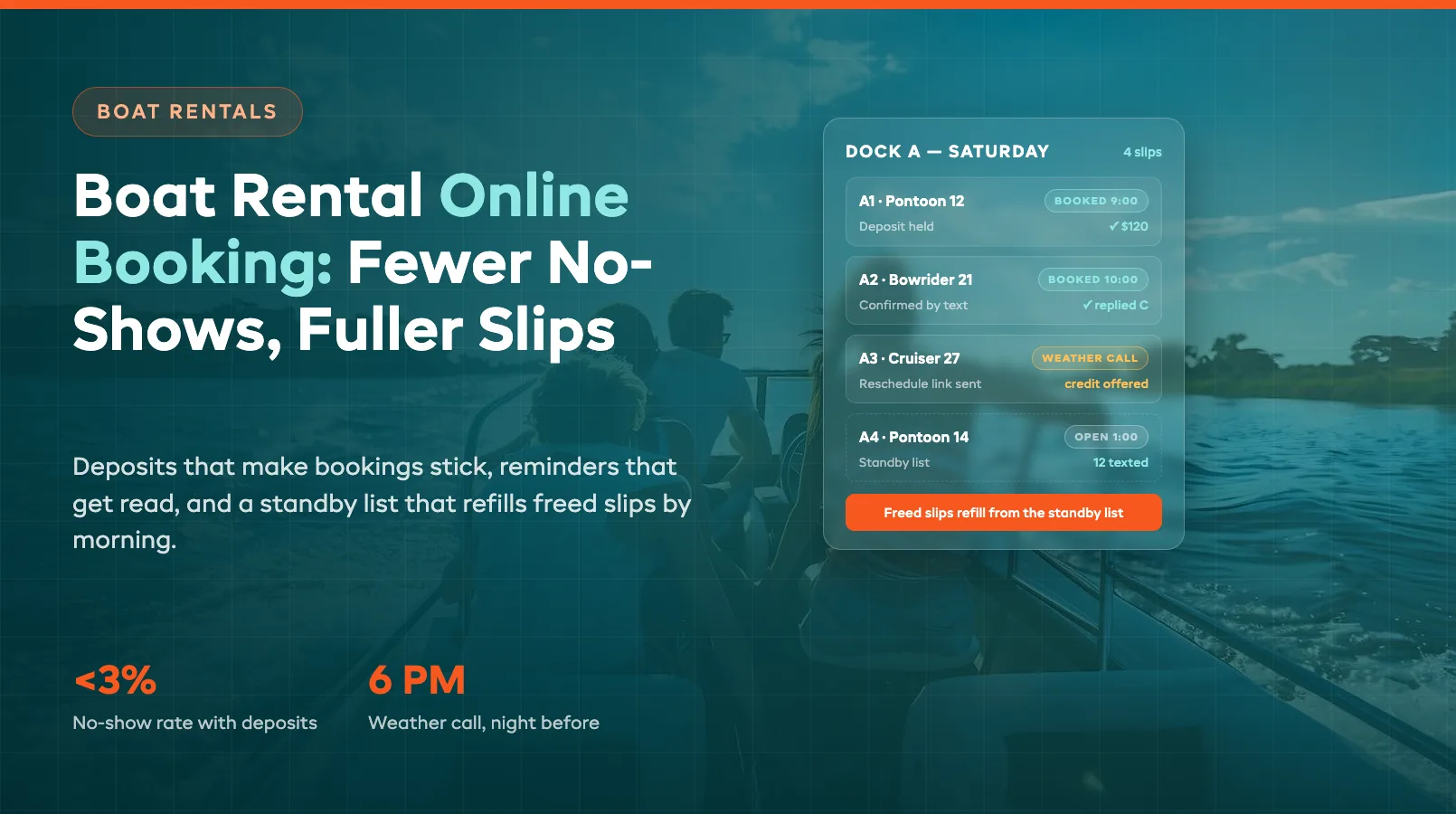
- 48 hours out: a text, not an email. "You're booked Saturday 9 AM, Dock A. Reply C to confirm or R to reschedule." A reply-to-confirm text surfaces the silent cancellations two days early — while you can still resell the slot.
- Morning of: parking directions, skipper's license reminder, and the dock hand's first name. People show up on time for a person more reliably than for a company.
The customers who never reply to the 48-hour text are your risk pool. Chasing them manually is tedious phone work, which is why it's worth automating end to end — the boat rental no-show follow-up agent template shows what that sequence looks like running on its own.
Weather Calls Without the Refund Bleed
Weather is the boat rental no-show excuse that's often legitimate — and the way you handle it decides whether a blown-out Saturday becomes lost revenue or deferred revenue. The mistake is treating every marginal forecast as a refund event. Lead with rebooking instead.

Publish the policy before anyone asks: you make the call, not the customer, based on wind and sea state at the dock — not a rain icon on a phone app. When you cancel, offer in this order: first a same-week reschedule, then a full-value credit valid twelve months, and a cash refund only when the customer insists. Operators who sequence it this way keep 70–80% of weather-canceled revenue on the books instead of returning it.
Make the call by 6 PM the night before for morning departures. An early call with an instant reschedule link converts far better than a 7 AM scramble — and it frees the slip in time to matter. Automating the messaging side is exactly what the boat weather cancellation agent template is for.
Filling the Slip Anyway
Prevention fails sometimes. The difference between a good operator and a great one is what happens to the freed slip in the next two hours.
Run a standby list. Every "sorry, we're full" phone call and every sold-out date on your booking page should feed a waitlist with a mobile number attached. When a slot frees at 7 PM Friday, a text to the list — first to book takes it — refills most prime-day cancellations before the dock opens. That only works with online booking, because a standby customer needs to be able to pay and sign the waiver from their couch, not at your counter at 8:55 AM.
Then price the quiet days instead of ignoring them. Weekends sell themselves; Tuesday mornings don't. A 20–30% midweek discount, a half-day option on shoulder days, and repeat-customer codes sent in the off-season all pull demand into slots that would otherwise sit empty. If your dock is at capacity on Saturdays and dead on Wednesdays, the fix is pricing, not more boats — a point the pontoon scaling guide makes in detail before recommending any fleet purchase.

Track it weekly. A simple grid — each berth across the seven days, marked booked, open, or turnaround — tells you in ten seconds where the money is leaking. Utilization below 50% on a summer week is a pricing problem; a berth that's always on turnaround is a dock-flow problem, which belongs to the marina operations playbook.
Booking Software That Does This Without You
None of the above is hard. All of it is tedious, which is why it doesn't happen on paper. When you evaluate online booking for a boat rental operation, check for the specific machinery this guide relies on:
- Deposit and pre-authorization rules per boat class — not one flat setting for the whole fleet.
- Automated confirmation, reminder, and reschedule messages by text, with reply handling.
- Credit issuance built in, so a weather cancellation becomes a stored credit in one click, not a spreadsheet entry.
- Real-time availability with turnaround buffers, so back-to-back bookings never collide at the dock.
- Waivers and license checks at booking, not at the counter — essential for same-morning standby fills.
- A waitlist that notifies and lets customers self-book the freed slot.
The economics differ if you run captained trips alongside self-drive hires — deposits, staffing, and cancellation exposure all shift, and the captained vs bareboat economics guide walks through both models. EquipDash covers the list above for either setup, with the deposit tiers, message sequences, and credits managed from one calendar.
Putting It Together
Start with deposits — it's one settings change and it removes most of the problem this week. Add the 48-hour reply-to-confirm text next, then publish the weather policy with the credit-first ladder. Build the standby list as sold-out dates accumulate, and put the utilization grid on the wall every Monday.
None of these steps needs new boats, new staff, or a bigger dock. They need a booking system doing quiet work overnight, so the only slips sitting empty are the ones you priced wrong — and the grid will show you those. For the wider operation around the booking flow, the boat rental hub collects every guide in this series, and the boat rental glossary covers the terms.
FAQ
How big should a boat rental deposit be?
Size it to the boat class, not a flat number. A useful ladder: 20–25% of the day rate for pontoons and runabouts, 30% for bowriders and ski boats, and 50% — or a fixed $500 and up — for cruisers and captained trips. The amount should be large enough that abandoning the booking stings, and it can convert into the security hold at handover.
Do deposits actually reduce no-shows?
Yes, more than any other single change. Operators moving from pay-at-the-dock to a booking-time deposit typically see no-show rates fall from 10% or more to under 3%. A booking with money attached gets canceled in advance instead of silently abandoned — which is what you want, because an early cancellation is a slot you can resell.
What's the best reminder schedule for boat bookings?
Three touches: an instant confirmation with dock address and what to bring, a text 48 hours out asking the customer to reply and confirm, and a morning-of text with parking and the dock hand's name. The 48-hour reply-to-confirm text is the workhorse — anyone who doesn't reply is flagged early enough for you to resell the slot.
Should customers be able to cancel for bad weather?
You make the weather call, not the customer — based on wind and sea state at your dock, announced by 6 PM the night before. When you cancel, offer a same-week reschedule first, a twelve-month credit second, and a cash refund only on request. Sequenced that way, most weather-canceled revenue stays on your books as a future booking.
How do I fill a slip after a last-minute cancellation?
Keep a standby list. Every turned-away caller and sold-out-date visitor should land on a waitlist with a mobile number. When a slot frees, text the list and let the first responder book, pay, and sign the waiver online. Prime-day cancellations refill within hours this way — but only if payment and paperwork can happen on the customer's phone.
What slip utilization rate should a boat rental aim for?
In peak season, healthy operations run 70%+ across the week — near-full weekends and respectable midweek days. Below 50% in summer usually means midweek pricing is wrong, not that demand is missing: a 20–30% midweek discount and half-day options pull bookings into the gaps. Track it on a simple weekly berth-by-day grid so leaks show up while you can still fix them.
in one place