Scuba Rental Gear Management: Servicing, Tank Tracking, Turnaround
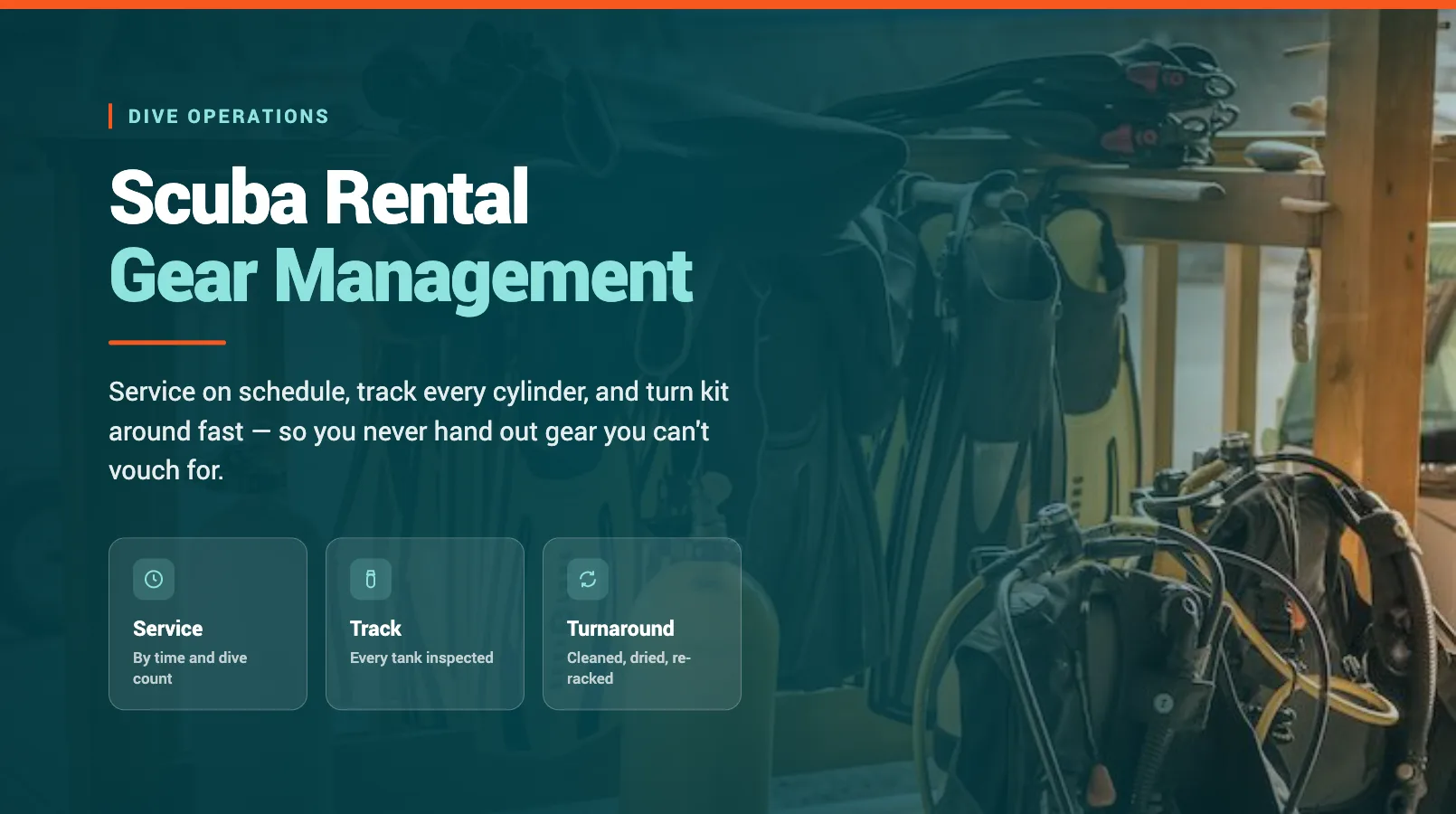
A dive shop's rental fleet is both its biggest recurring cost and the thing customers put their lives on underwater. Every regulator, BCD, cylinder, and wetsuit has to be serviced on time, tracked through its inspections, and turned around fast enough to be on the next diver without ever going out unsafe. Get the systems right and the fleet earns quietly in the background. Get them wrong and you are either handing out gear you cannot vouch for or watching a full boat wait while someone hunts for a tank that is actually in date.
Rental gear takes far more punishment than a private diver's kit — more dives, more hands, more saltwater, more sizes to keep in stock. This guide covers the three jobs that keep a rental fleet safe and earning: building a servicing schedule that holds up under that use, tracking cylinder inspections and fills, and turning gear around between divers without cutting corners. It sits alongside the complete guide to running a scuba diving business, which covers the wider operation around the gear room.
Why gear management makes or breaks a rental fleet
Rental gear fails differently to owned gear. A private diver services one regulator a year and knows its whole history. You are running dozens of items through hundreds of dives a season, handled by staff who rotate and divers who do not care whether the reg they were handed is the one due for service. Nobody remembers what is where in their head, so the shop that runs on memory eventually hands out something it should not have.
The cost of getting it wrong runs in two directions. On the safety side, gear that goes out overdue or damaged is the exact thing an incident review looks at first — and "we meant to service it" is not a defense. On the money side, gear that is not tracked either gets over-serviced out of caution, or sits broken and unrentable, or is quietly lost. A fleet you can see is a fleet you can keep safe, keep working, and keep sized to demand.
Building a servicing schedule that keeps gear in the water
Manufacturers set service intervals by time or by dive count, whichever comes first — commonly an annual regulator service, with BCDs and inflators on their own cycles. For a private diver, time is the binding limit. For a rental fleet, dive count usually gets there first, because a popular reg can log a season's worth of dives in a couple of busy months. That is why servicing has to be tracked per unit, not across the fleet as a whole.
The practical version is a schedule that lists every serviceable item, its last service date, its dive count since, and the date or count it is next due. When a unit approaches either limit, it comes off the rack and into the workshop before it goes out again — not after a diver flags a free-flow on the boat. Staggering services across the off-season, rather than sending the whole fleet out at once, keeps enough gear available to trade through the shoulder months while the workshop works through the queue.
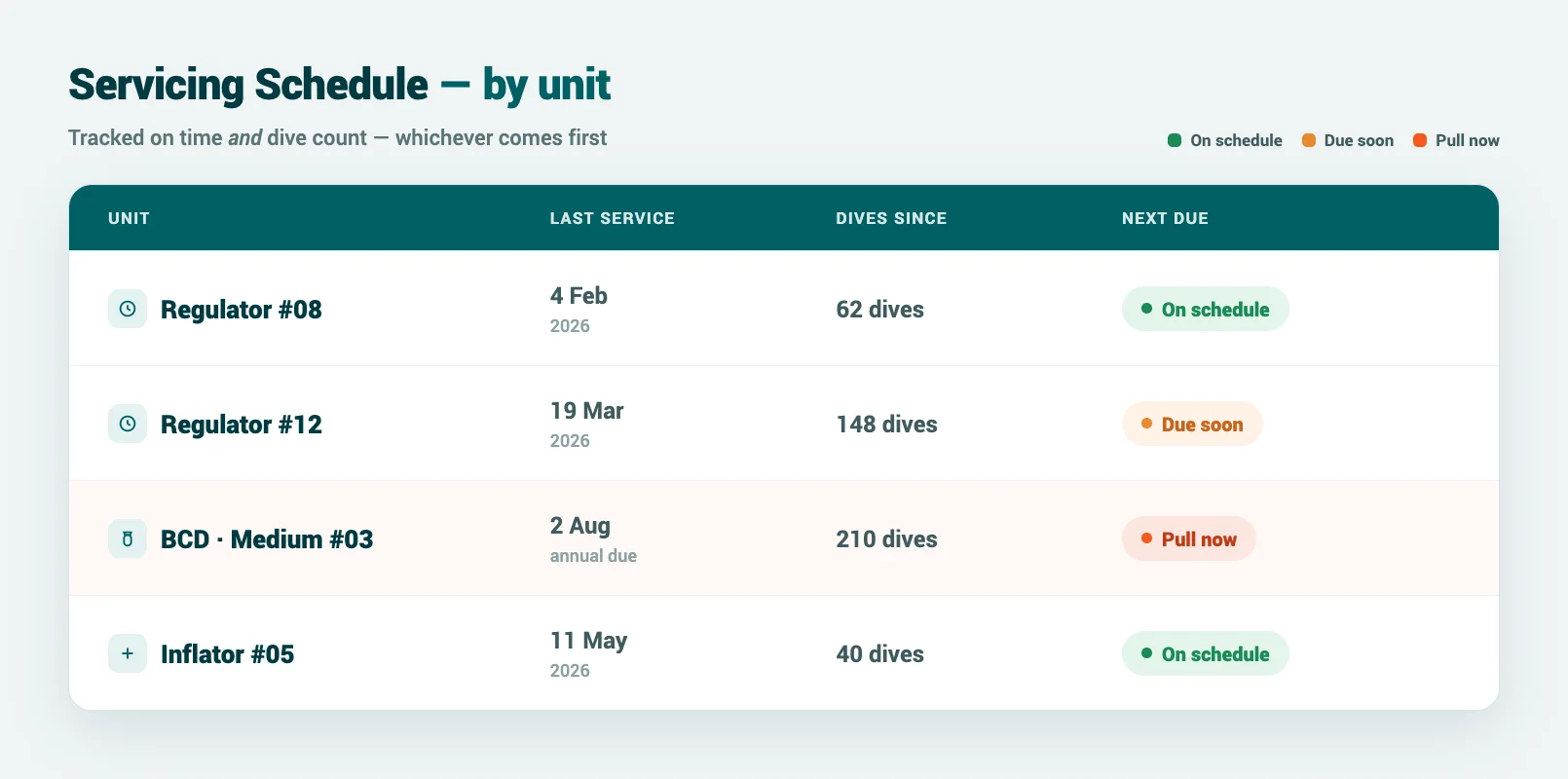
The same schedule feeds your buying. If three regulators are all due in the same fortnight and you have no spares, that is a gap you can see coming weeks out instead of discovering on a Saturday morning. Servicing, spares, and replacement planning are the same picture viewed from different angles.
Tank tracking: visual inspections, hydro tests, and fills
Cylinders carry their own rules, separate from the regulators that hang off them. Most regions require a periodic visual inspection — typically annual — and a hydrostatic test on a longer cycle of several years. A tank that is out of visual or out of hydro cannot legally or safely be filled, and a good fill station will refuse it. The sticker on the cylinder shows the last visual, but a sticker is easy to miss on a rack of forty tanks on a busy morning.
The fix is a log per cylinder, keyed to its serial number, holding its visual date, its hydro date, and its current fill status. That way you know at a glance which tanks are in date, which are coming due, and which are empty and waiting on a fill. Tracking it against the serial rather than a rack position means a tank keeps its history even when it moves around the shop or comes back from test.
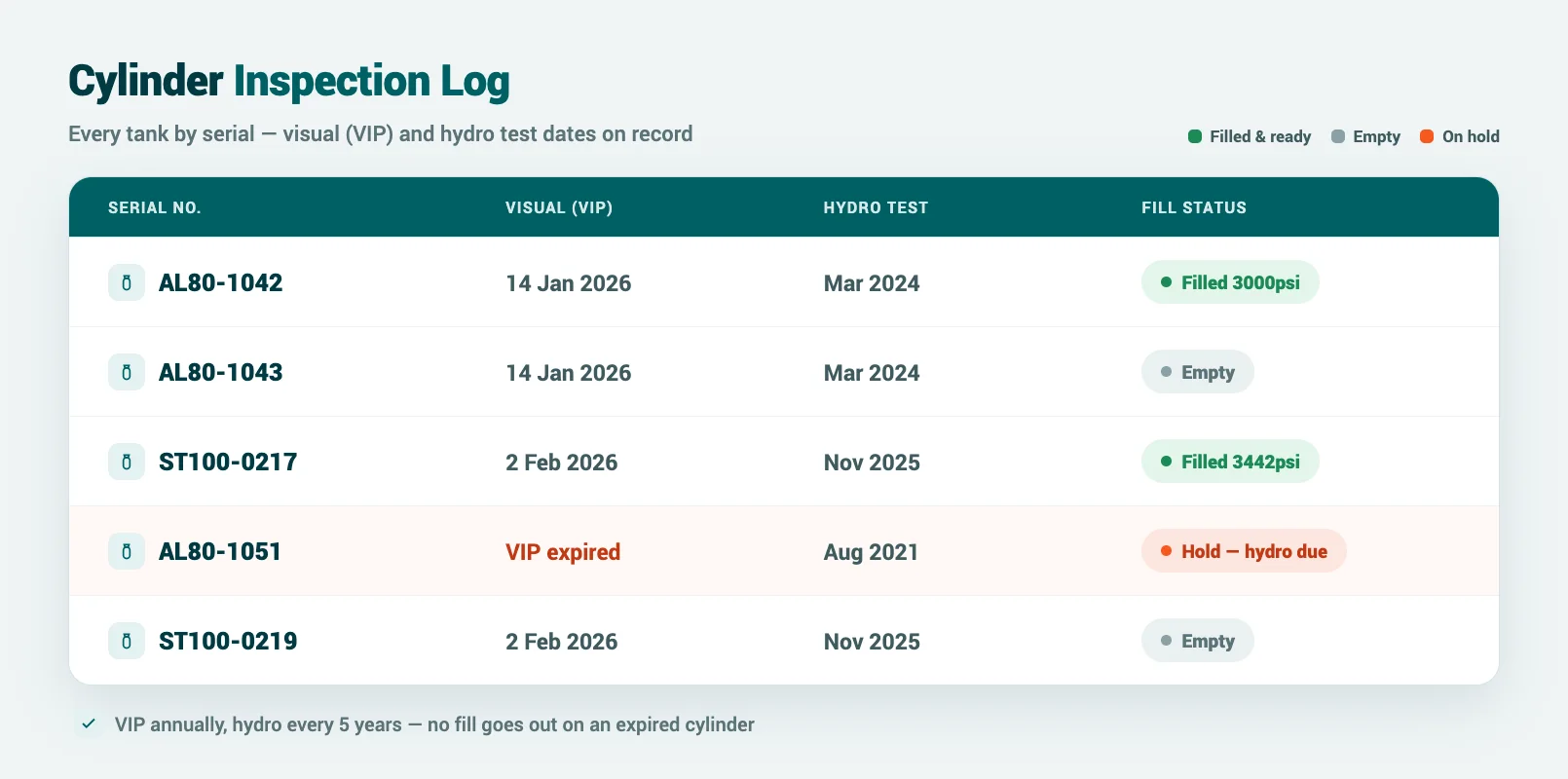
Fills add a daily rhythm on top of the inspection cycle. On trip mornings you need to know how many tanks are filled and ready against how many divers are booked, and whether you have the right mix of sizes and air versus nitrox. When your tank status sits next to your boat and course bookings, the morning question — do we have enough filled, in-date tanks for today — answers itself instead of turning into a scramble at the compressor.
Turnaround between rentals: rinse, inspect, dry, rack
Turnaround is where a rental fleet either flows or jams. The loop is the same every time: gear comes back, gets checked in against the booking, gets rinsed and disinfected, gets inspected for damage, dries fully, and goes back on the rack marked ready. Skip a step and you either hand a diver wet or damaged kit, or you lose track of what actually came back.
The limiter on a busy day is almost always drying. Wetsuits, BCDs, and regs take real time to dry, and rushing wet gear back onto the next diver is both unpleasant and hard on the equipment. Operators who run tight turnarounds solve this with spare capacity rather than speed — enough kit to cover a second wave of divers while the first wave's gear dries properly. That means the size of your fleet is really a turnaround decision, not just a demand one.
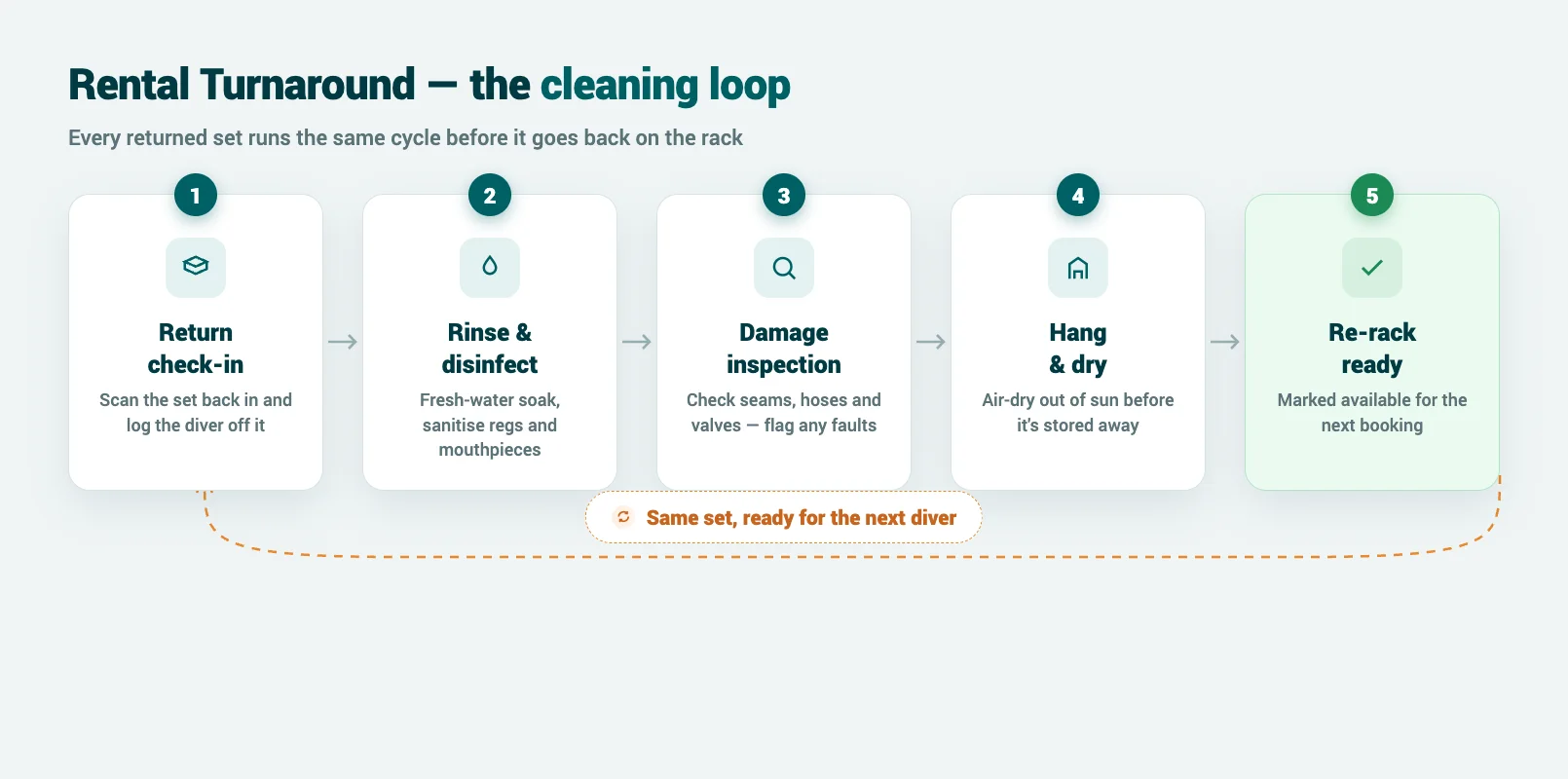
Check-in at the front of that loop matters more than it looks. Logging exactly what came back, against the booking, is how you catch the mask that did not return, the reg that came back with a damaged hose, and the wetsuit that needs to come out of stock for a repair. It is also the moment to reconcile deposits and note damage while the diver is still standing there, rather than chasing it later.
Tracking each item's history over its life
Every item in the fleet has a life, and the shops that manage gear well treat each unit as its own record rather than a number in a pile. Against a single regulator you want its purchase date, its service history, its dive count, and any repairs — so when it is time to decide whether to keep servicing it or retire it, the history makes the call for you. A reg that has failed a service twice or costs more to maintain than to replace has told you what to do.
That per-item history is what turns replacement from a guess into a plan. Instead of buying reactively when something fails on a diver, you can see which units are aging out, budget for them in the off-season, and keep the fleet's average condition where you want it. Utilization data — which sizes and items sell out first — tells you what to buy more of, so the fleet grows toward demand rather than toward whatever was on sale. The scuba diving glossary is a useful reference for the servicing and inspection terms that show up on those records.
Keeping the fleet moving on busy days
All of this is manageable on paper for a small fleet, and most shops start there. The strain shows up at scale and at pace — the busy Saturday when three regs are due, four tanks are out of visual, and a wave of divers is at the counter. That is when a folder of service dates stops being enough, because nobody has time to cross-reference it against forty tanks and a rack of regs while a boat is loading.
The upgrade is to hold the tracking in one place and let it flag what needs attention. When service dates, inspection dates, and stock levels live against each item, the system can warn you a regulator is coming due or a tank is out of test before it becomes a problem at the fill station — the kind of quiet, always-on check a Dash agent can run in the background so staff are not the ones remembering. Pair that with the same certification checks you run at the counter and the front desk is handling divers, not paperwork, on the day it matters most.
Putting it together
Rental gear management is not one big job — it is a handful of small systems that each catch a specific failure. Service per unit on time and dive count, log every cylinder's inspection and fill status against its serial, run a consistent rinse-inspect-dry-rack turnaround, and keep a per-item history that tells you when to buy and when to retire. Do that and the fleet stays safe, stays available, and stays sized to what your divers actually book.
The through-line is visibility. A fleet you can see — every service date, every inspection, every item's history — is one you can keep working without holding it all in your head. Build the tracking once and the busy days stop being the days something slips through.
FAQ
How often should scuba rental regulators be serviced?
Follow the manufacturer's schedule, which is usually an annual service or after a set number of dives, whichever comes first. Rental regulators rack up dives far faster than a private diver's, so a fleet regulator often hits its dive count well before the year is out. Track service dates per unit rather than across the whole fleet, because a heavily used reg needs attention long before one that sat on the rack.
How do I track scuba cylinder inspections?
Keep a record per tank of its visual inspection date and its hydrostatic test date, and tie both to the tank's serial number. A visual inspection is typically done annually and a hydrostatic test every few years, depending on your region's rules. The sticker on the cylinder shows the last visual, but a written or digital log is what tells you which tanks are coming due before they fail a fill-station check.
What is a fast turnaround for rental dive gear?
A full turnaround is a rinse, an inspection, a proper dry, and a dry-check that the reg breathes and the BCD holds air before the gear goes back into stock. On a busy day the limiter is usually drying, so operators with tight turnarounds hold enough spare kit to cover a second wave while the first is still drying, rather than rushing wet gear back onto a diver.
How much spare scuba gear should a rental fleet hold?
Enough to cover your busiest realistic day plus a buffer for gear that is out for service or drying. The exact number depends on your boat capacity and how many back-to-back trips you run, but the common mistake is sizing the fleet for an average day and then coming up short on every peak weekend. Track utilization by size and item so you can see which sizes sell out first and buy to that, not to a round number.
When should rental scuba gear be retired?
Retire an item when repairs stop being economic, when it can no longer pass a service, or when a wetsuit, BCD, or mask is worn enough to affect fit or safety. Tracking each item's service history and repair costs makes the call obvious — a unit that fails inspection twice in a season or costs more to keep than to replace has told you it is done. Planning replacements against that history beats waiting for gear to fail on a diver.
How can dive operators keep gear management from slowing down busy days?
Move the tracking off paper and let the system flag what is due. When service dates, inspection dates, and stock levels live against each item, staff get a heads-up before a regulator is overdue or a tank is out of test, instead of discovering it at the fill station. That leaves the counter handling divers rather than hunting through a folder to work out which gear is safe to hand out.
in one place