Managing Snowmobile Damage Deposits and Repair Charges
Managing Snowmobile Damage Deposits and Repair Charges
A rented snowmobile is a $12,000–$18,000 machine handed to a stranger, ridden hard on ice, rocks hiding under six inches of fresh snow, and tree lines that punish a missed corner. Damage is not a risk in this business — it is a line item. What separates operators who absorb it calmly from operators who eat a tunnel repair every second week is the deposit system: how the hold is sized, how it is taken, what evidence sits behind it, and how charges get settled when something comes back bent.
This guide covers the whole loop — deposit tiers by sled class, card pre-auths versus cash, the two-photo inspection habit, a published repair charge menu, and dispute handling that keeps a damaged sled from turning into a one-star review. It pairs with your waivers and rider briefings, which set the legal ground the charges stand on, and the complete guide to running a snowmobile business for the wider operation.
Size the deposit by sled class, not one flat number
A single flat deposit is the most common mistake in the snowbelt. It is always wrong in one direction: too high for the fan-cooled trail sled and far too low for the mountain machine. Guests on a $99 trail ride balk at a $1,500 hold, while the rider taking your newest deep-snow sled into the trees is under-secured at $300.
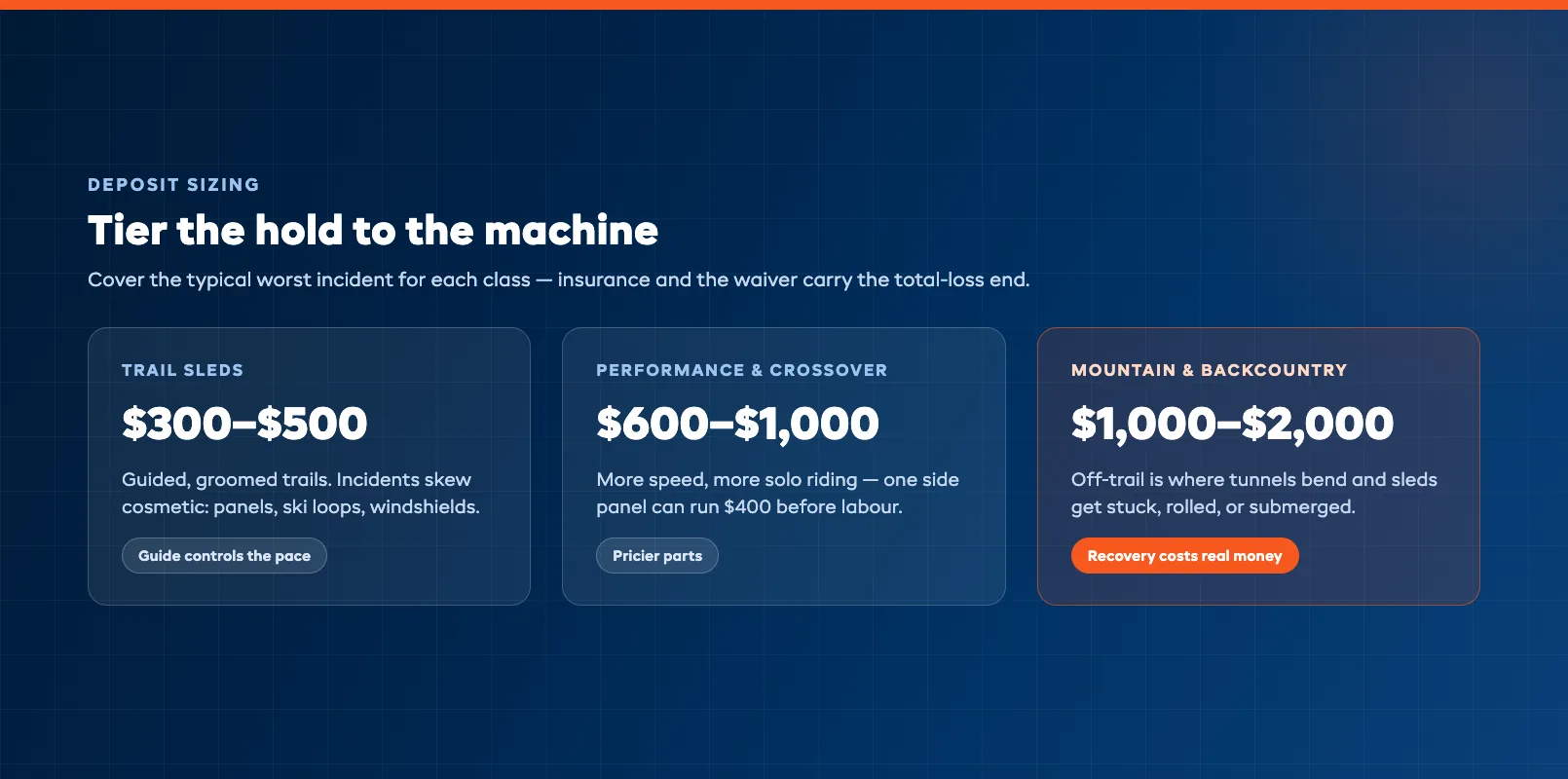
Tier it to what actually breaks and what it costs to fix:
- Trail sleds (guided, groomed trails) — $300–$500. On a guided tour the guide controls pace and line, so incidents skew cosmetic: scratched panels, a bent ski loop, a cracked windshield.
- Performance and crossover sleds — $600–$1,000. More speed, more solo riding, and parts that cost more — a single side panel on a current-year sled can run $400 before labor.
- Mountain and backcountry sleds — $1,000–$2,000. Off-trail riding is where tunnels bend, running boards fold, and sleds get stuck, rolled, or submerged. Recovery alone can cost hundreds before a wrench touches the machine.
Two rules keep the tiers honest. First, the deposit should cover your typical worst incident for that class, not the total-loss scenario — insurance and the waiver carry the catastrophic end. Second, publish the tier on the booking page next to the price. A surprise hold at the counter kills more bookings than a visible one online ever will.
Take pre-auth holds, not cash or full charges
How you take the deposit matters as much as the amount. Cash in an envelope and full card charges refunded later both create friction, and both create end-of-day accounting nobody has time for in a 14-week season.
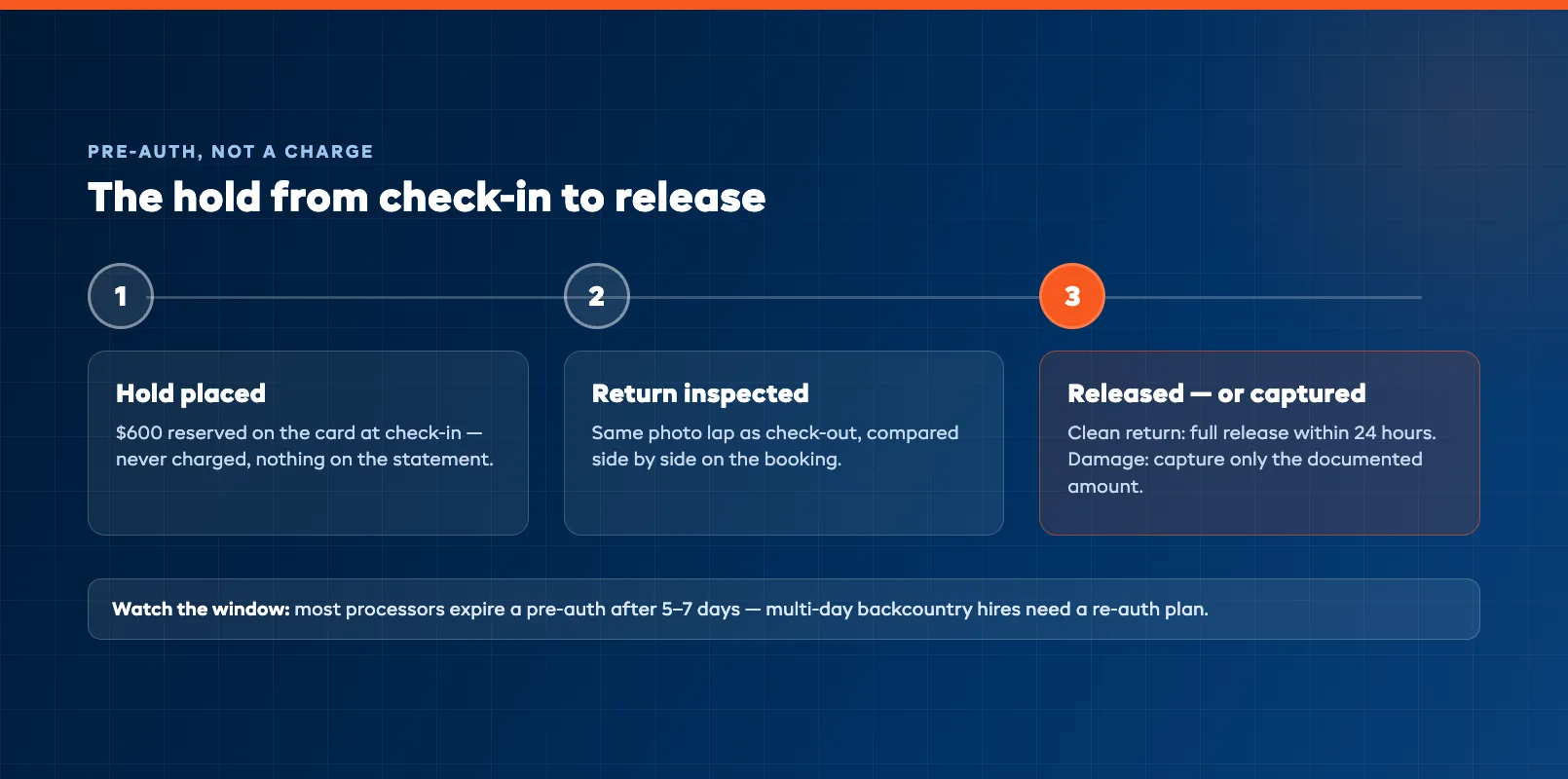
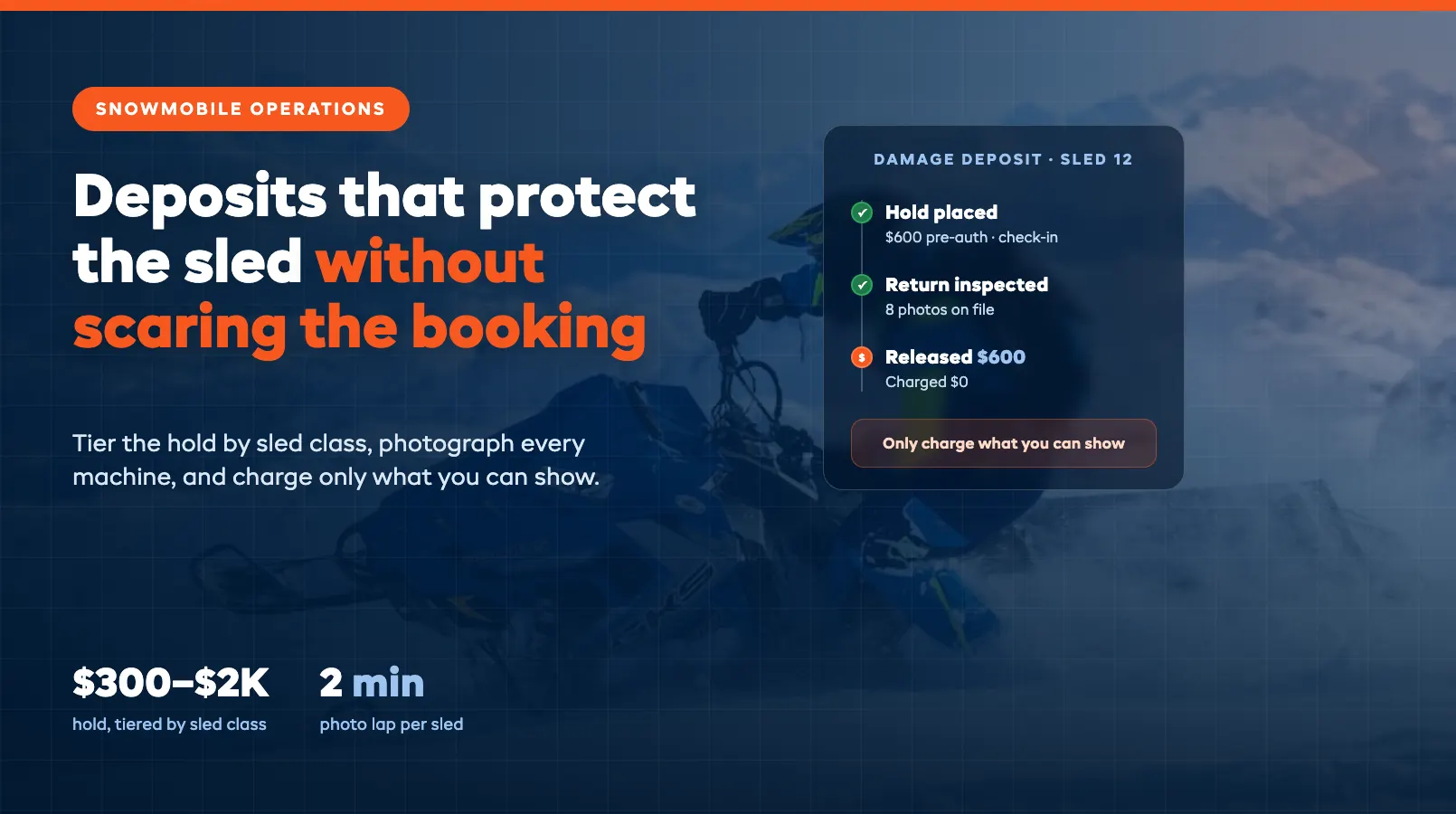
The card pre-authorization is the industry answer: the amount is reserved on the guest's card but never charged. If the sled comes back clean, the hold releases and nothing ever appears on their statement. If there is damage, you capture only the documented repair amount and release the rest. The lifecycle is simple — hold placed at check-in, return inspection, release or partial capture within 24 hours.
Run it through your booking flow rather than a separate card terminal. Snowmobile booking software that takes the pre-auth at check-in against the reservation keeps the hold, the waiver, and the inspection record attached to one booking — which is exactly what you want in front of you when a charge gets questioned. Watch the hold window, too: most processors expire a pre-auth after 5–7 days, which is fine for day rentals but needs a re-auth plan for multi-day backcountry hires.
Photograph every sled at staging — before and after
Every deposit dispute comes down to one question: can you prove the damage happened on this rental? Memory cannot. Photos can. The habit that settles arguments before they start is a fixed photo lap at staging — the same angles, every sled, every departure.
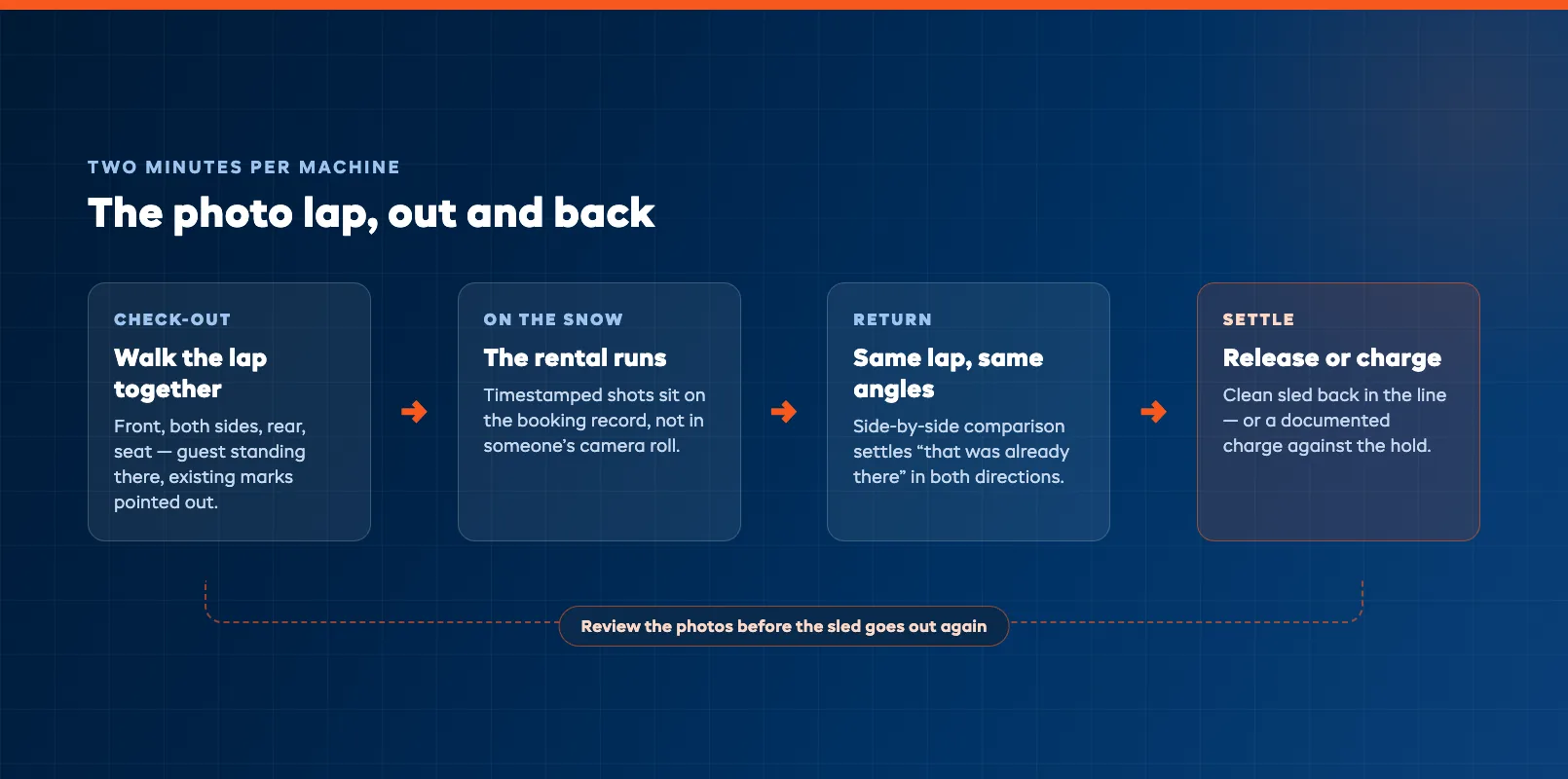
The loop takes under two minutes per machine: front (skis, spindles, bumper), both sides (panels, running boards, tunnel), rear (snow flap, bumper, track), plus the seat and handlebars. Do it with the guest standing there at check-out — walking the sled together and pointing out existing scratches builds trust and removes the "that was already there" argument in both directions. Repeat the same lap at return, before the sled goes back in the line.
Timestamped photos attached to the booking are the standard to aim for. Phone camera rolls work until a February Saturday when three staff are shooting forty sleds and nobody can later say which photo belongs to which booking. If a sled goes out again before the photos are reviewed, you have lost the chain of evidence — build the lap into the turnaround, the same way pre-ride checks live in your fleet maintenance routine.
Publish a repair charge menu
When damage does happen, the difference between a defensible charge and an ugly argument is whether the price existed before the incident. A published charge menu — visible at booking, referenced in the waiver, posted at the counter — turns "how much is this going to cost me?" from a negotiation into a lookup.
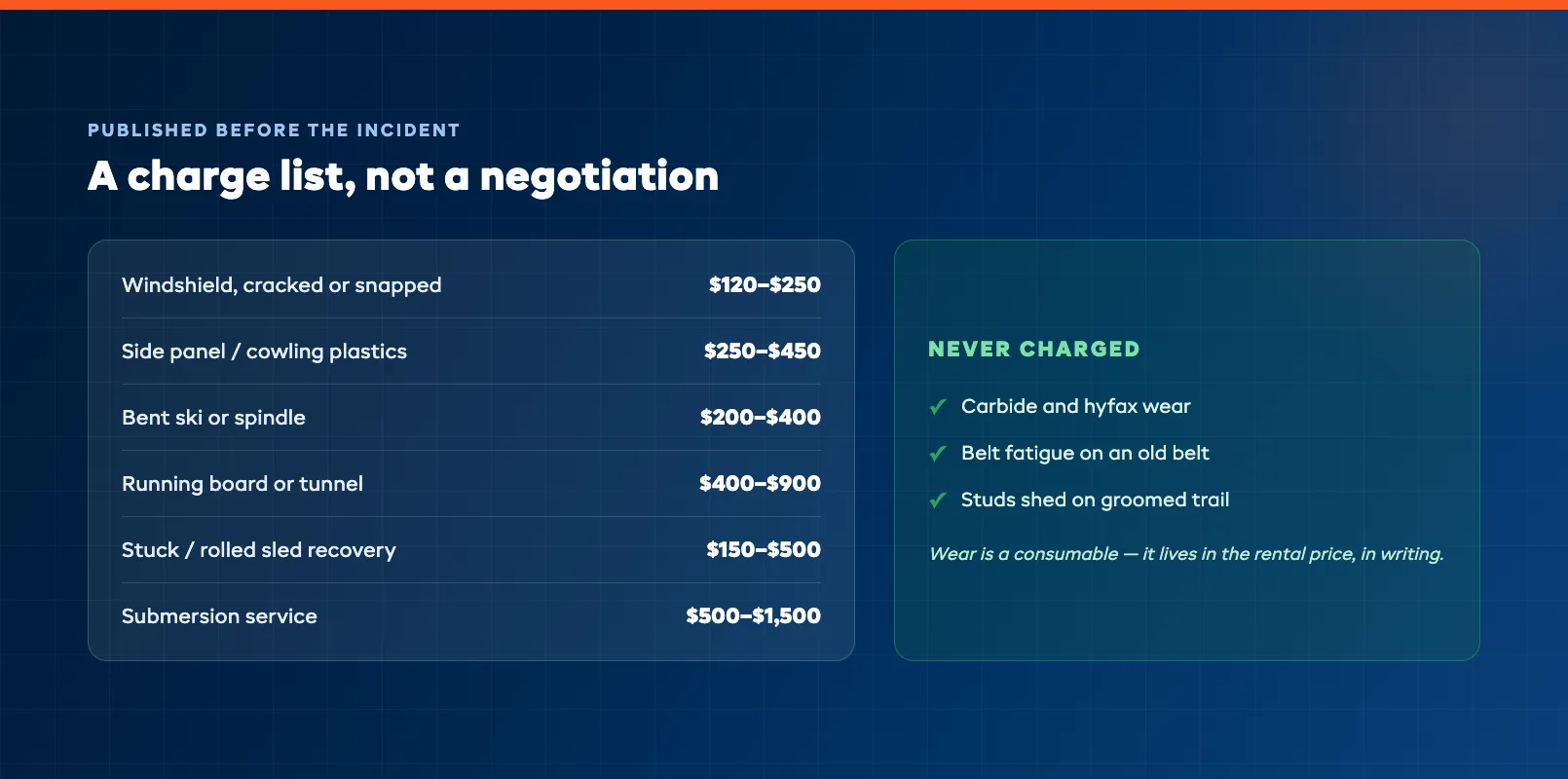
Build it from the incidents your shop actually sees:
| Damage | Typical charge |
|---|---|
| Windshield, cracked or snapped | $120–$250 |
| Side panel / cowling plastics | $250–$450 per panel |
| Bent ski or spindle | $200–$400 |
| Drive belt destroyed (rider abuse) | $150–$220 |
| Bent running board or tunnel damage | $400–$900 |
| Stuck / rolled sled recovery | $150–$500 by distance |
| Submersion (water ingestion service) | $500–$1,500 |
Price each line at parts plus real shop labor — the same numbers your maintenance log already gives you. Then draw the other line clearly: what you will never charge for. Carbides and hyfax wear, belt fatigue on an old belt, studs shed on a groomed trail — that is consumable wear, it is in the rental price, and saying so in writing is one of the cheapest trust builders in the business. Charging renters for wear items is the fastest route to disputes you deserve to lose.
Settle disputes with evidence, not volume
Even with tiers, photos, and a menu, someone will dispute a charge every season. The process that wins — at the counter and at the card issuer — is the same: show, don't argue.
Walk the guest through the check-out photo and the return photo side by side, point to the menu line, and state the number. Offer the middle path where it is genuinely gray: split the difference on a borderline panel scratch and keep the customer; hold firm on a folded running board with clear photos. If it escalates to a chargeback, the packet that wins is the signed waiver naming the damage policy, the two timestamped photos, the published menu, and the repair invoice — which is why all four need to live on the booking record, not in four different drawers.
One communication rule carries most of the weight: tell the guest before you capture anything. A short message — here is the damage, here are the photos, here is the menu line, here is what we are charging against your hold — lands completely differently from an unexplained charge appearing on a statement. Operators who send that message first report disputes in the low single digits per season.
Putting it together
The deposit system is five habits, not a policy document. Tier the hold by sled class and publish it with the price. Take it as a card pre-auth through the booking, never as cash. Photograph every sled at staging, out and back, attached to the booking. Price repairs on a public menu built from real parts and labor — and never charge for wear. When something breaks, show the evidence, charge the documented amount, and release the rest fast.
Run that loop and the deposit stops being the awkward part of check-in and becomes what it should be: quiet proof that you run a professional operation. Guests notice — the snowmobile glossary is full of terms that scare first-timers, but "your hold was released, thanks for riding" is the message that brings them back. For everything upstream of the deposit — fleet, tours, staffing, weather calls — start with the snowmobile business hub.
FAQ
How much should a snowmobile damage deposit be?
Tier it by sled class: $300–$500 for guided trail sleds, $600–$1,000 for performance and crossover machines, and $1,000–$2,000 for mountain and backcountry sleds. The deposit should cover your typical worst incident for that class — panels, skis, running boards — while insurance and your waiver cover the total-loss end.
Should I take the deposit as a card hold or an actual charge?
A card pre-authorization is better for both sides. The amount is reserved but never charged, so a clean return means nothing touches the guest's statement. If there is damage, you capture only the documented repair cost and release the remainder. Full charges refunded later create refund delays, extra fees, and unnecessary friction.
What can I legally charge a renter for?
Damage beyond normal wear that occurred during their rental, at the repair cost you can document — which is why timestamped before-and-after photos, a signed waiver referencing the damage policy, and a published charge list matter. You cannot credibly charge for wear items like carbides, hyfax, or belt fatigue, and trying to usually costs more in disputes than it recovers.
What happens if a renter rolls or submerges a sled?
Recovery and repair come out of the deposit against your published rates — typically $150–$500 for recovery depending on distance, and $500–$1,500 for a water ingestion service. For backcountry rentals, spell out recovery charges explicitly at booking; it is the single most disputed line when it is not disclosed in advance.
How do I win a chargeback on a damage charge?
Card issuers side with documentation. Submit the signed waiver naming the damage policy, the check-out and return photos with timestamps, the published charge menu the amount came from, and the repair invoice. Operators lose chargebacks when evidence is scattered or missing — which is the practical argument for keeping everything attached to the booking record.
Do damage deposits scare customers away?
Hidden ones do. A deposit that first appears at the counter feels like a trap; the same amount shown on the booking page next to the price reads as professionalism. Publishing the tier, taking it as a hold rather than a charge, and releasing it fast after a clean return turns the deposit into a trust signal instead of a booking blocker.
in one place