Dynamic Ticket Pricing for Attractions: Peak, Off-Peak, and Last-Minute
Dynamic Ticket Pricing for Attractions: Peak, Off-Peak, and Last-Minute
Most attractions still sell every ticket at one price. Saturday afternoon in July — the slot that sells out three days early — costs the same as a drizzly Tuesday morning that runs at 20% capacity. That single number is wrong twice: it leaves money on the table when demand is guaranteed, and it does nothing to pull visitors into the hours you are already paying to staff.
Dynamic ticket pricing fixes both, and it does not require an airline-grade revenue team. It requires three price bands, a calendar, and a couple of automated rules. This guide walks through how to set the bands, when to charge peak, how to fill off-peak, and how to run a last-minute window that rescues unsold capacity instead of training guests to wait. It sits alongside the complete guide to running a ticketed attraction and builds directly on capacity management, because you cannot price a slot you are not counting.
What dynamic pricing means at the gate (and what it doesn't)
Dynamic pricing at an attraction is not prices that jump while a guest watches the checkout page. That is the airline experience people hate, and a family day out is not a flight — pull that lever and the backlash costs more than the margin.
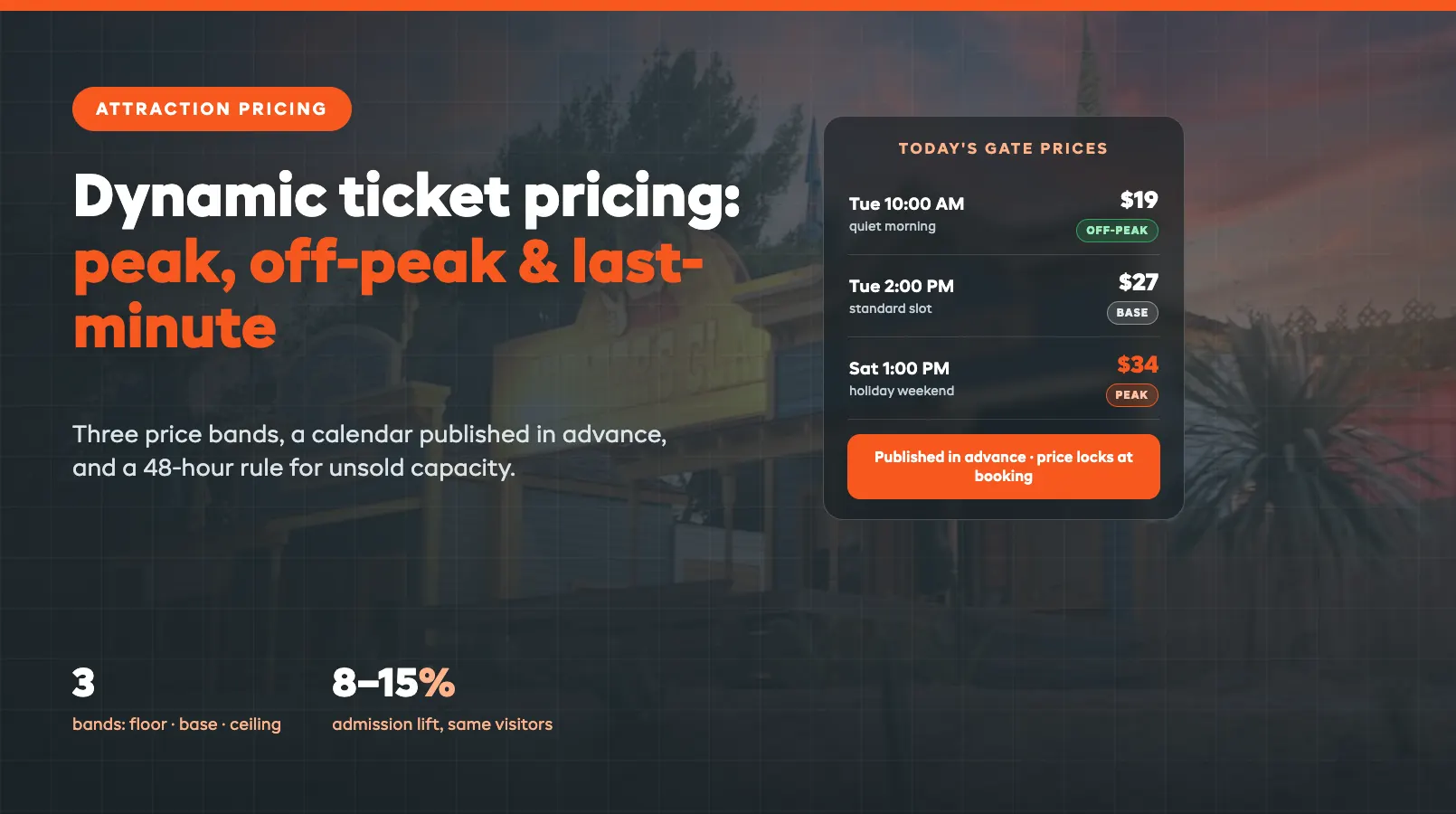
What works at the gate is calendar-based variable pricing: every date and time slot has a price set in advance by predictable demand. School holidays cost more than term time. Saturday costs more than Tuesday. The 10 AM slot costs less than 2 PM. Guests see the full calendar when they book, the price for their chosen slot never moves after they select it, and nobody standing in the same queue paid a mystery number.
The difference matters legally and commercially. Published calendar pricing is just seasonal pricing with finer grain — theme parks, zoos, and museums have run it for years. Guests accept "busy days cost more" the same way they accept peak-season hotel rates. What they do not accept is feeling gamed.
Set your price bands: floor, base, ceiling
Before touching the calendar, fix three numbers per ticket type.
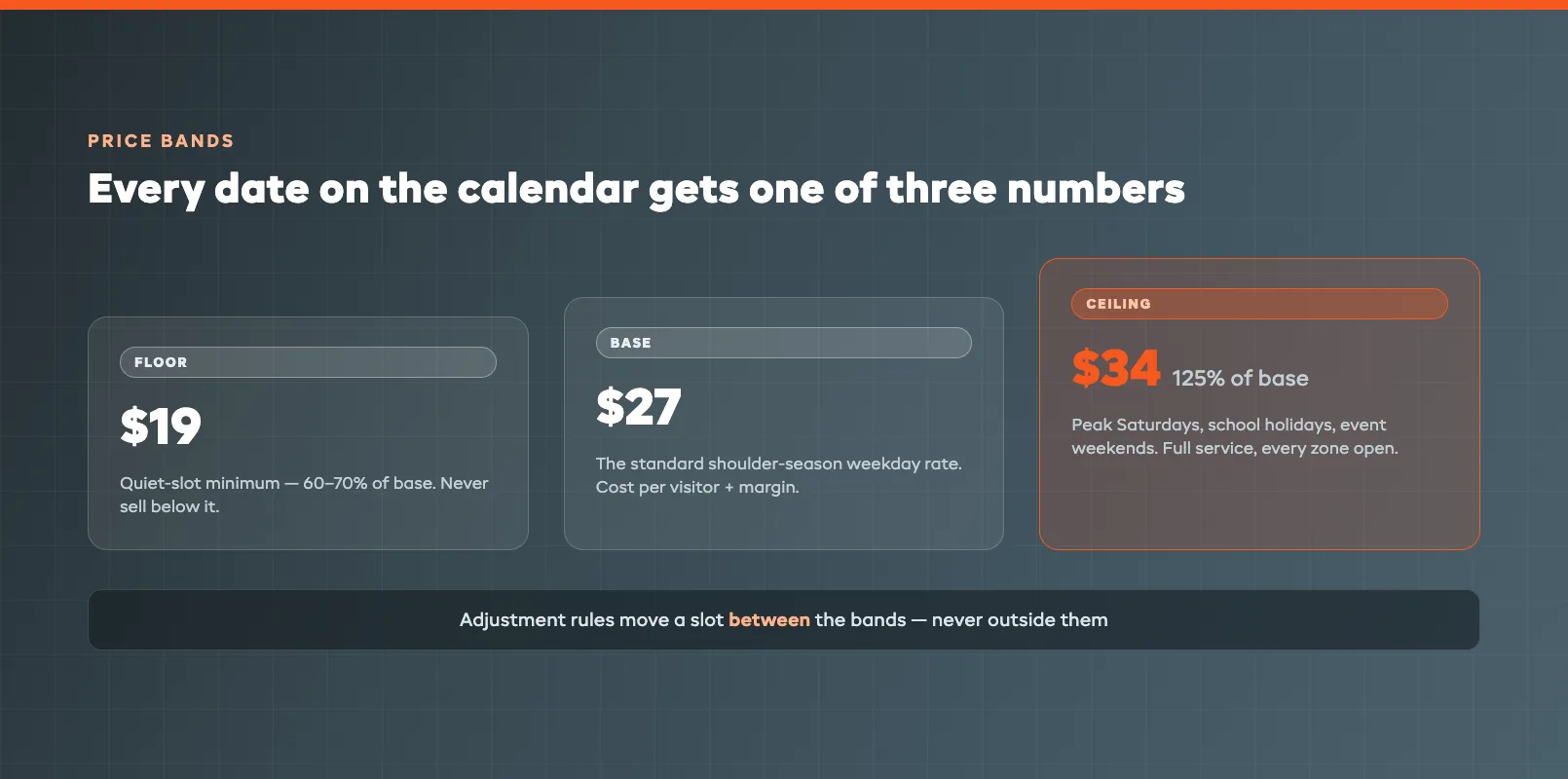
- Floor — the lowest you will ever sell a ticket, even in a quiet-Tuesday promotion. It must cover your variable cost per visitor (staffing share, consumables, payment fees) plus a real contribution. A common floor is 60–70% of base. Below that you are buying foot traffic, not selling admission.
- Base — your standard number, the one on a normal shoulder-season weekday. Set it from your pillar pricing work: cost per operating hour divided by realistic attendance, plus margin, sanity-checked against comparable attractions in your region.
- Ceiling — the peak-day maximum. For most attractions, 120–140% of base is the comfortable range. Push past 150% and reviews start mentioning the number instead of the experience.
Three bands are enough. Operators who build seven-tier matrices spend their winter maintaining a spreadsheet nobody trusts. Floor, base, ceiling — every date on the calendar gets one of them, and every adjustment rule below moves a slot between them, never outside them.
Peak pricing: charge for the days that sell themselves
Peak pricing is the easy half, because the demand data is already in your booking history. Pull last season's numbers and mark every date and slot that hit 85%+ capacity — those are the candidates for ceiling pricing.
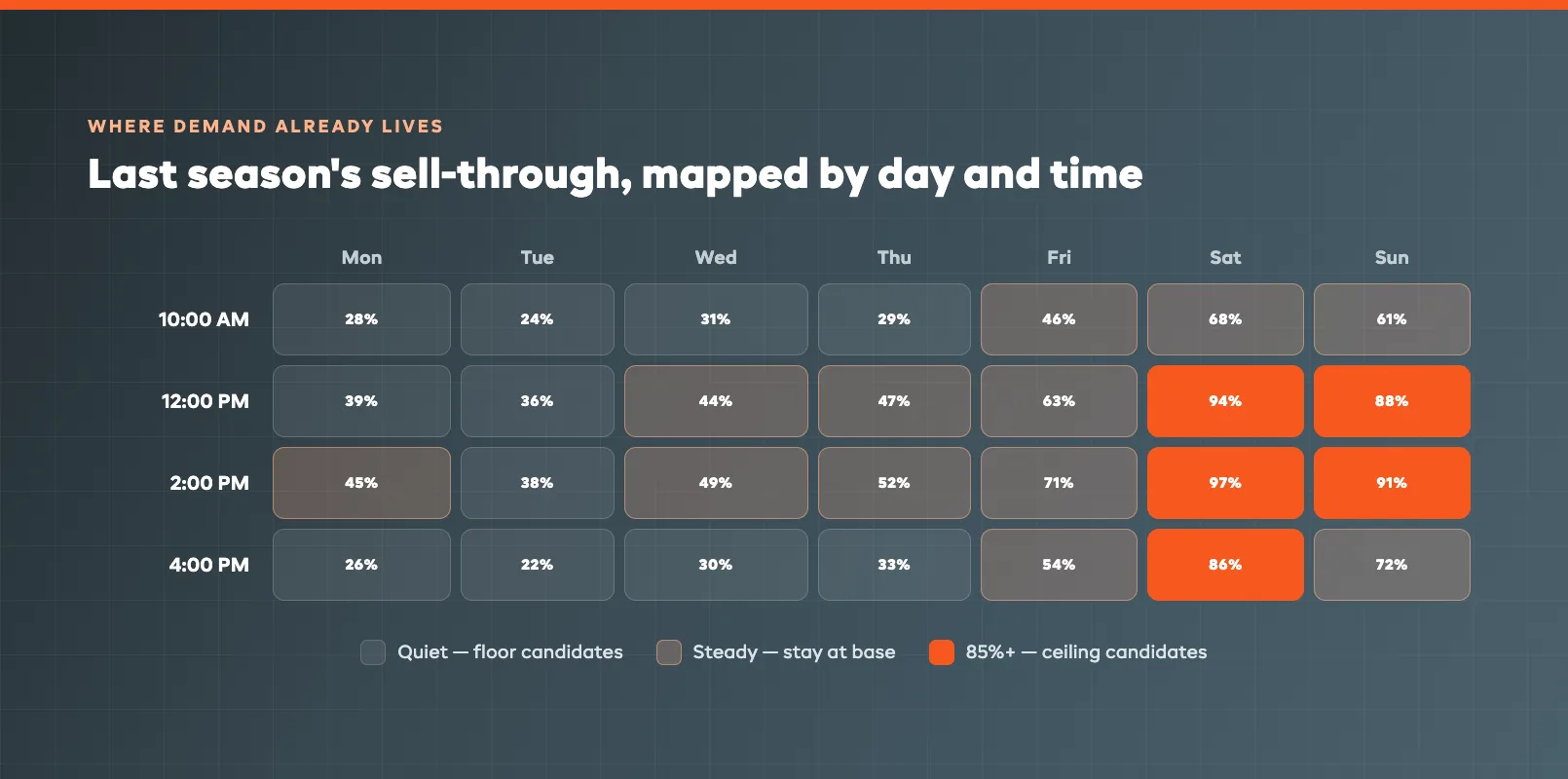
For a typical regional attraction the map is boringly consistent: Saturday 12–4 PM runs hot all season, Sunday close behind, school-holiday weekdays behave like weekends, and one or two event weekends spike everything. Put ceiling prices on exactly those cells and leave the rest at base. A first pass usually prices 15–25% of the calendar at ceiling.
Two rules keep peak pricing clean:
- Publish early. The peak calendar goes live when booking opens for the season, not week by week. Guests planning a holiday Saturday see the higher number from day one — that is a fact about the date, not a squeeze.
- Peak means full service. A ceiling-price day is the day you run every show, open every zone, and roster your best gate team. Charging 130% for a day with two attractions closed is how you convert your best revenue day into your worst review day. Weather-exposed sites should pair peak dates with a clear weather refund policy so a rained-out premium day has a script.
Season pass holders skip this entire mechanism — their deal is unlimited entry regardless of the daily rate, which is exactly what makes a season pass program more attractive once day tickets vary.
Off-peak pricing: fill the quiet slots
Off-peak is where variable pricing actually earns its keep, because a below-base ticket sold into an empty slot is nearly pure margin. Your building is open, your staff are rostered, your shows are running — visitor number 41 in a half-empty morning costs you almost nothing to serve and spends real money at the café and gift shop. Secondary spend per visitor at most attractions runs 30–60% on top of admission, and it arrives whether the ticket was full price or not.
So price the quiet cells at floor or between floor and base, and say so loudly: "Weekday mornings from $19." That line does three jobs — it fills dead capacity, it gives price-sensitive families a real way in, and it makes your advertised from-price stronger everywhere your attraction is listed. If you distribute through resellers, feed the same calendar to every channel so your OTA listings show identical slot prices to your own site; nothing burns trust faster than a marketplace undercutting your gate.
Give the off-peak discount a reason a guest can repeat: quieter rooms, shorter queues, easier parking, better photos. "Cheaper because it's worse" is not the story — "calmer and cheaper" is.
Last-minute pricing: the final-days window
Unsold capacity on the day is worthless by closing time — but a badly-run last-minute discount teaches your whole market to stop booking ahead. The fix is a narrow, rule-driven release, not a panic button.
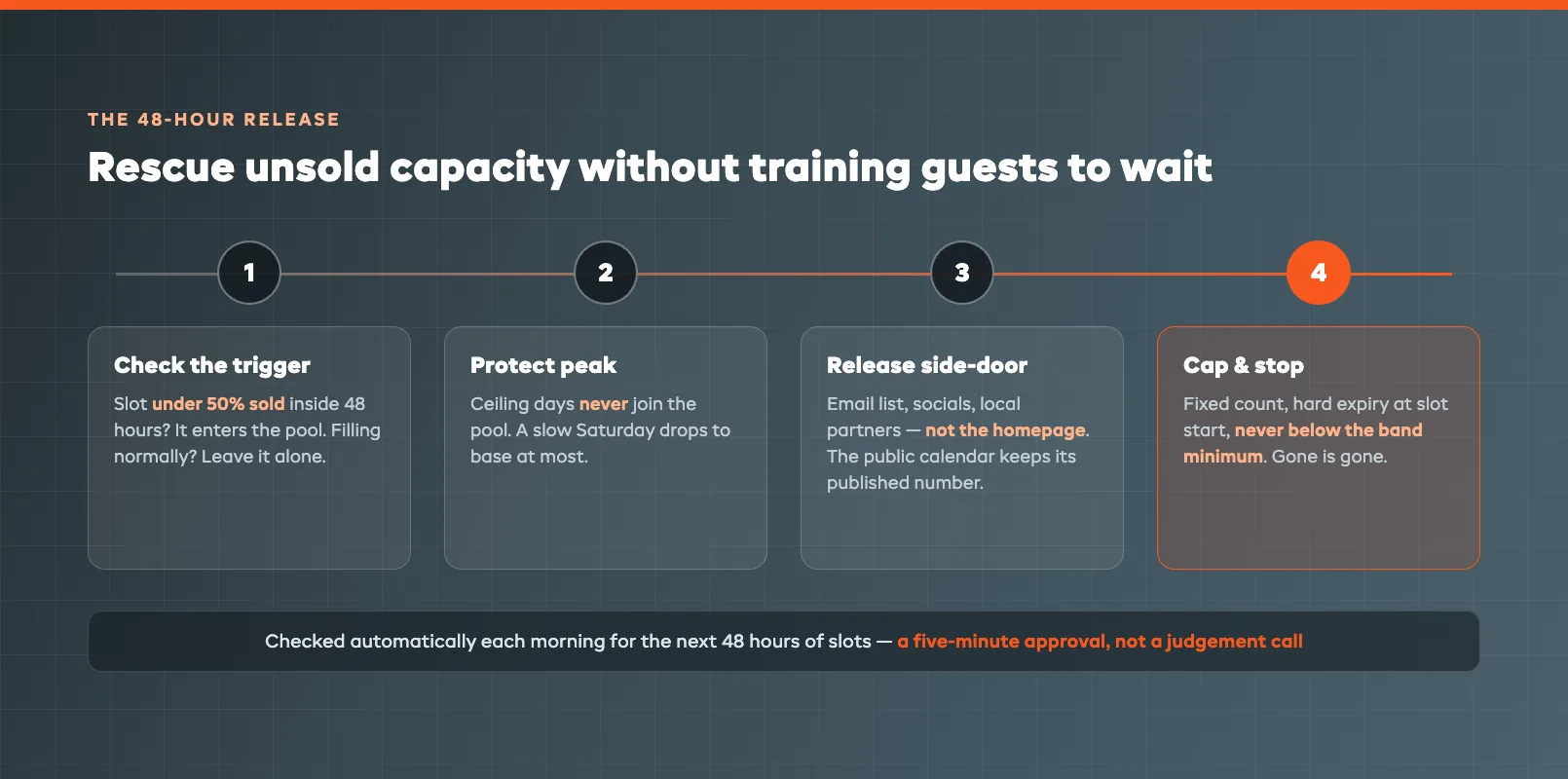
Work the decision as a simple gate, checked automatically each morning for the next 48 hours of slots:
- Is the slot under 50% sold inside 48 hours? If yes, it enters the release pool. If it is tracking normally, prices stay put — never discount a slot that is filling on its own.
- Is it a peak cell? Peak days never join the pool. A slow Saturday drops from ceiling to base at most; it never goes below. Protecting peak integrity is what keeps advance bookers from feeling like suckers.
- Release through side doors, not the homepage. Push the offer to your email list, your socials, and local partners — "tomorrow 10 AM, 30% off, 40 tickets." Your public calendar keeps its published price; the offer reaches people who were not coming anyway.
- Cap and stop. Fixed ticket count, hard expiry at the slot start, floor price respected. When it's gone, it's gone — scarcity is the point.
The operational trick is making step 1 automatic. A capacity alert that flags every under-filled slot two days out — the job the capacity alert agent template is built for — turns last-minute pricing from a daily judgment call into a five-minute approval.
Keep it fair: explaining variable prices to guests
Every pricing mechanic above survives only if guests read it as fair. The good news: fairness is mostly presentation, and the rules fit on one card.
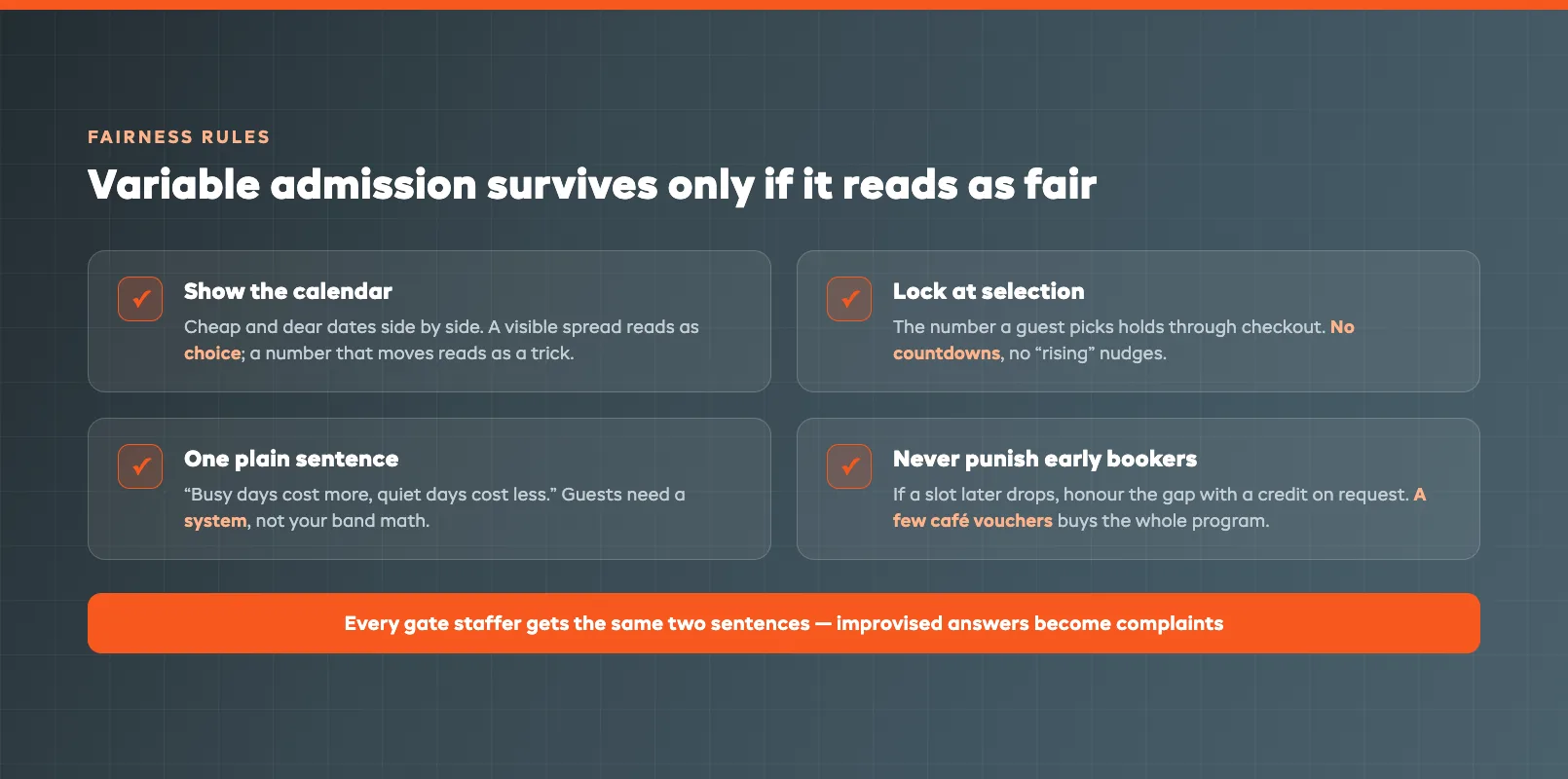
- Show the calendar, not a price. Let guests see cheap and dear dates side by side and choose. A visible spread reads as choice; a single number that moves reads as a trick.
- Lock the price at selection. Once a guest picks a slot, that price holds through checkout. No countdown timers, no "prices rising" nudges.
- Name the logic once, plainly. One line on the booking page: "Prices vary by date — busy days cost more, quiet days cost less." Guests do not need your band math; they need to know there is a system. Keep your public wording consistent with the terms defined in the attractions glossary.
- Never punish the advance booker. If a slot later drops below what an early guest paid, honour the difference with a credit on request. It costs you a handful of café vouchers a season and buys the right to run the whole program.
- Train the gate team. Every front-line staffer gets the same two sentences for "why was my ticket dearer than his?" Improvised answers are how a pricing policy becomes a complaints file.
Putting it together
Start smaller than you think: three bands, one season, weekends and school holidays at ceiling, weekday mornings at floor, everything else at base. Add the 48-hour last-minute rule once the calendar is stable, and review the numbers monthly — slot-level revenue, load factor, and secondary spend — against the admission audit checklist so drift gets caught in the data, not in the reviews. Run it for a full season before adding any more grain. Most attractions find the first pass — peak up 25%, off-peak down 25% — lifts admission revenue 8–15% without a single new visitor, purely by charging the right price to the demand that was already there. Everything else in this cluster, from capacity planning to the wider playbook on the attractions hub, works better once the price of a slot finally reflects what the slot is worth.
FAQ
Is dynamic pricing legal for attractions?
Yes. Calendar-based variable pricing — different published prices for different dates and times — is standard practice for theme parks, zoos, museums, and cinemas worldwide. The practices to avoid are the ones that mislead: changing a price after a guest has selected a slot, fake countdown scarcity, or advertising a from-price that is never actually available. Publish the calendar, honour the displayed price, and you are on well-trodden ground.
How much more can I charge on peak days?
Most attractions land between 120% and 140% of base for peak dates. Below 120% the uplift barely registers; above 150% the price itself becomes what guests talk about. Start at 125% on your provably-full dates, watch sell-through and reviews for a month, and adjust. The constraint is not what the busiest Saturday could bear — it is what keeps the premium invisible in your review feed.
Won't discounting quiet slots devalue my attraction?
Not if the discount is anchored to the slot, not the product. "Weekday mornings from $19" tells guests the experience is calmer and cheaper at that time — it says nothing negative about the attraction itself. The risks to avoid are discounting peak dates (which trains everyone to wait) and selling below your floor price (which buys visitors at a loss). Off-peak visitors also spend on food and retail at near-normal rates, so a filled cheap slot usually out-earns an empty one several times over.
Should last-minute tickets be cheaper or more expensive?
For attractions with unsold capacity, cheaper — but only through a controlled release: slots under 50% sold inside 48 hours, published to your email list and partners rather than your homepage, capped in quantity, never on peak days. If your attraction routinely sells out, run it the other way: hold a small allocation of walk-up tickets at ceiling price. The rule in both directions is that the public calendar price never moves; the exception lives in a side channel.
How do season passes interact with dynamic day pricing?
They get stronger. Once day tickets vary, a season pass becomes the guest's hedge against peak prices — "never think about the calendar again" is a genuinely better pitch than a flat multiple of a flat ticket. Price the pass against your base rate (typically 2.5–4 visits' worth), and expect variable day pricing to lift pass conversion, since your most frequent visitors are exactly the ones who notice peak rates most.
What software do I need to run variable ticket pricing?
A booking system that supports per-date and per-slot pricing on a published calendar, locks the price at selection, syncs the same rates to any reseller channels, and reports revenue by slot. Add an automated capacity alert so under-filled slots surface two days out without anyone checking dashboards. If your current system only supports one price per ticket type, that — not strategy — is the first thing to fix.
in one place