Furniture Rental Software for Event Hire and Long-Term Contracts
Furniture Rental Software for Event Hire and Long-Term Contracts
A velvet lounge set goes out on a six-month staging contract in August. In October a planner asks for it for a Saturday launch, and the spreadsheet says it is free because the contract lives in a different file. Furniture rental runs two businesses on one set of stock, and most systems handle one of them well and bolt the other on.
Event rental is fast and short. Pieces go out Friday, come back Monday, and the margin depends on how many weekends each piece works. Long-term rental is slow and steady: show homes, offices, and corporate apartments that keep a sofa for months and pay every month. Both draw on the same warehouse, and both depend on the piece looking right when it arrives.
This guide covers what furniture rental software has to do for a business that runs both: one stock pool for events and contracts, condition tracked per piece, refurbishment treated as downtime, recurring billing that runs itself, deposits sized to what is going out, and a weekly checklist.
Event and long-term on one stock pool
The most expensive mistake in furniture rental is promising the same piece twice. It almost always happens when events and contracts live in separate places. The event calendar shows the lounge set as free because nobody added the staging contract to it, and the contract file has no idea a planner is holding Saturday.
One stock pool fixes this. Every piece, whether it goes out for two days or six months, is booked against the same availability. A sofa on a long contract is simply not offered for an event until the contract end date, and a dining set held for a wedding is not offered to a show-home client for that week.
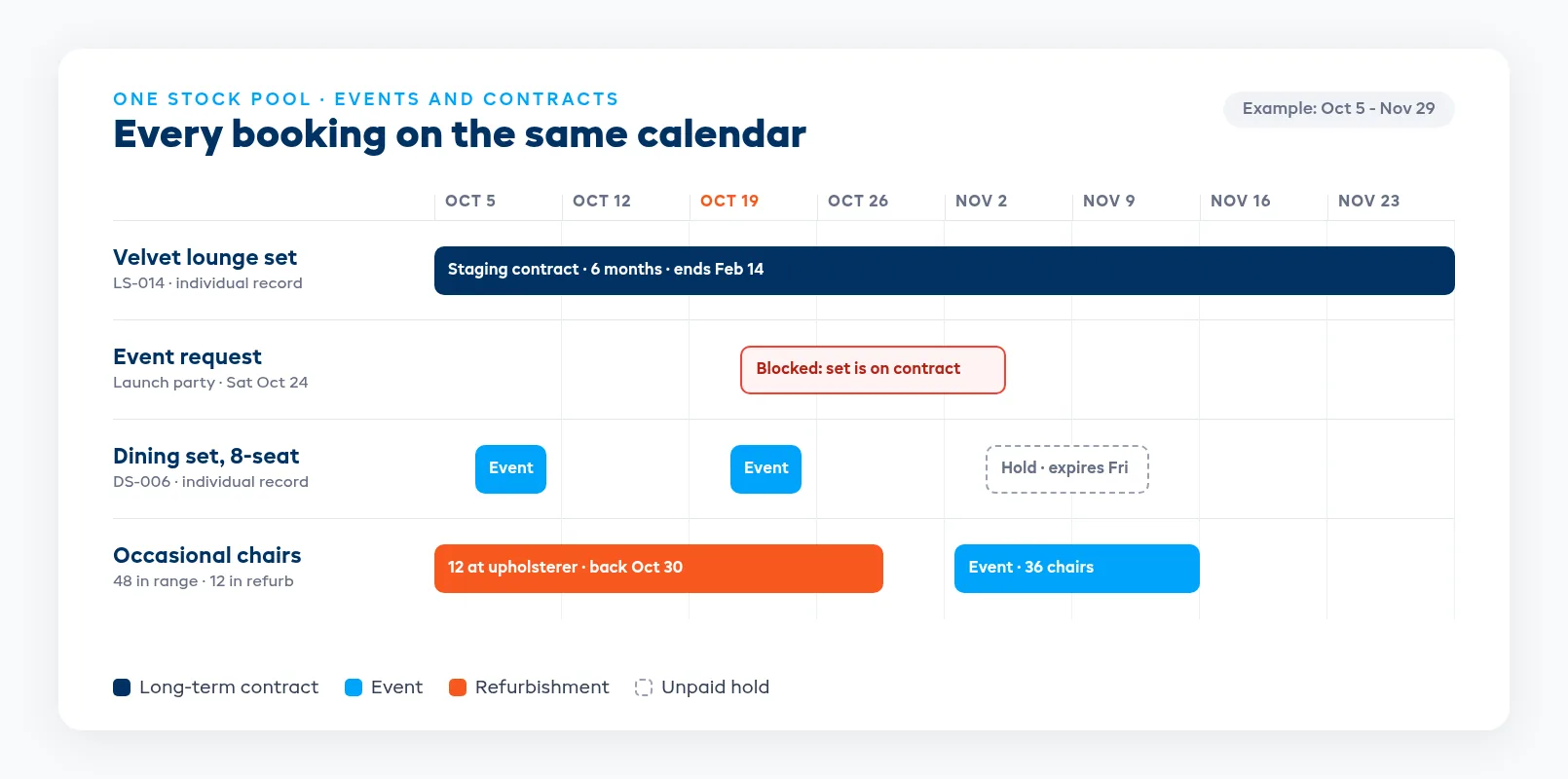
What that looks like in practice:
- Daily, weekend, and monthly rates on the same item. The lounge set has an event price and a monthly price. The order picks the rate, and the stock stays the same.
- Contract end dates that matter. A six-month rental ending February 14 frees the set from February 15, plus whatever turnaround you need to clean and check it.
- Holds with an expiry. A planner's "maybe" on a Saturday should lapse after a few days if no deposit lands, so it doesn't block a contract inquiry.
- Multi-warehouse stock. If you run two warehouses, each one needs its own availability, with transfers booked like any other movement.
The test is simple. Pick your most popular piece and ask: on any date in the next six months, can anyone in the business see whether it is free, on an event, on a contract, or in the workshop? If that answer needs two files and a phone call, you will double-book it during a busy month.
Event furniture businesses that also rent tables, linens, and tents often run party rental software for the high-volume side. Furniture needs the same date-based availability plus per-piece condition and long rentals, which a quantity-only party setup usually doesn't track.
Per-piece condition
In furniture rental, the piece and its condition are the same thing. A dining table with a scratched leg is a different product from an identical one without, and only one of them should go to a photoshoot. Customers are paying for how it looks, so the condition of each piece is part of your stock count.
That means higher-value pieces need their own records. Sofas, lounge sets, dining tables, statement chairs, and anything that gets photographed should carry an ID, a condition history, and photos.
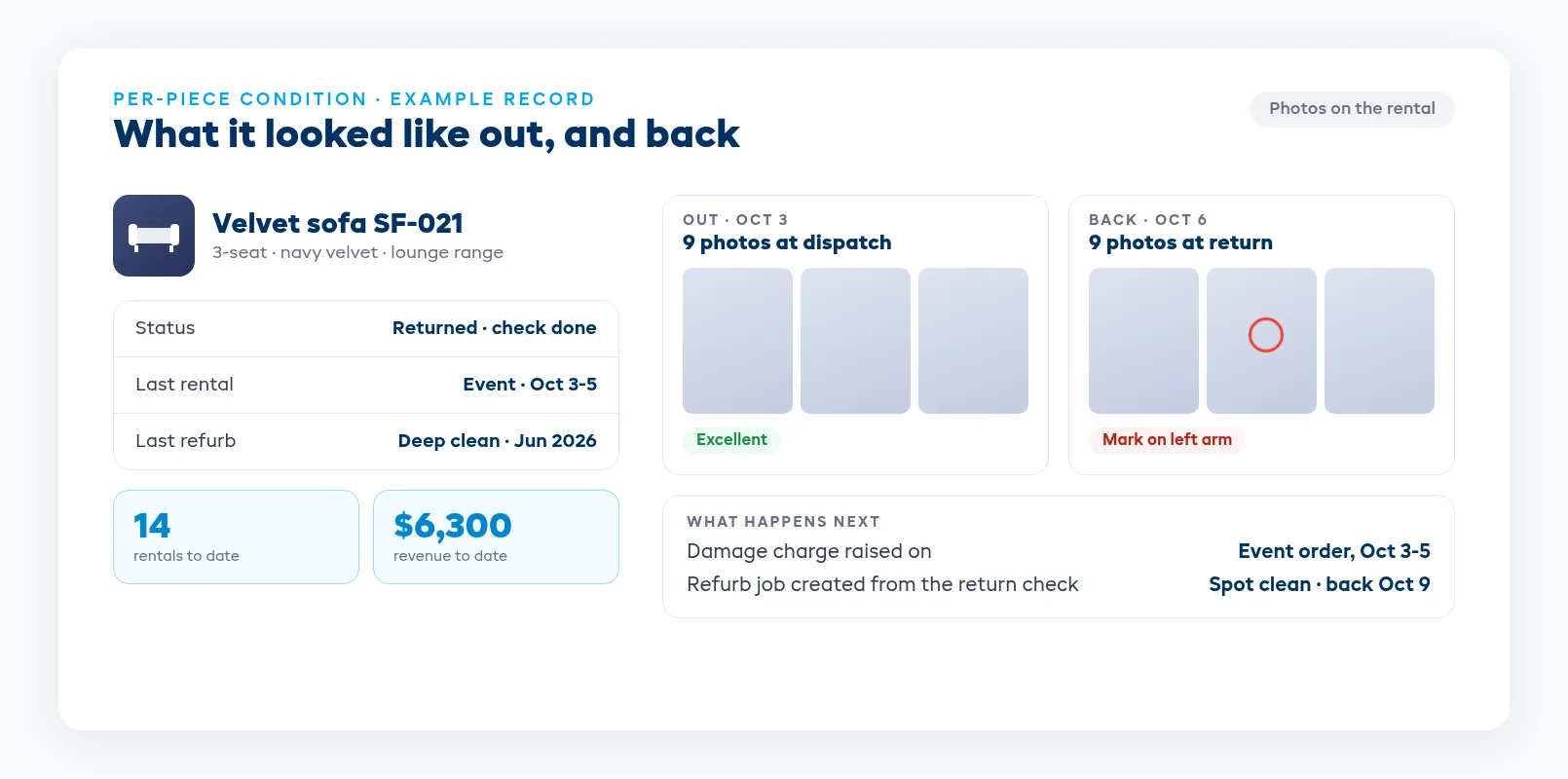
A good piece record answers four questions:
- What did it look like when it left? Photos taken at dispatch, attached to the rental.
- What did it look like when it came back? Photos taken at return, attached to the same rental, so any new mark is clearly tied to one customer.
- What work has it had? Cleaning, reupholstery, polishing, and repairs, with dates.
- How hard is it working? Number of rentals and revenue to date, so you know which pieces earn their warehouse space.
Not everything needs this level of detail. Twenty-four identical bar stools are better tracked as a quantity, with counts out and back and a note on any damaged units. Mixing the two is normal: individual records for pieces that are photographed, quantities for stock that is all the same.
Condition records also settle damage arguments. When a staging client says the arm was already marked, you can open the dispatch photos instead of guessing. The damage charge then goes against the rental it happened on, not as a separate invoice that gets disputed weeks later.
Refurbishment as downtime
Cleaning, reupholstery, and repair are the real limit on furniture stock. A sofa that needs a deep clean is not stock, even though it is sitting in your warehouse. If your availability still counts it, someone will book it, and a client will open the truck to find a stained cushion.
Treat refurbishment as downtime, the same way a vehicle rental business treats a car in the workshop. When a piece comes back and fails its check, it leaves availability until someone marks it fit to send.
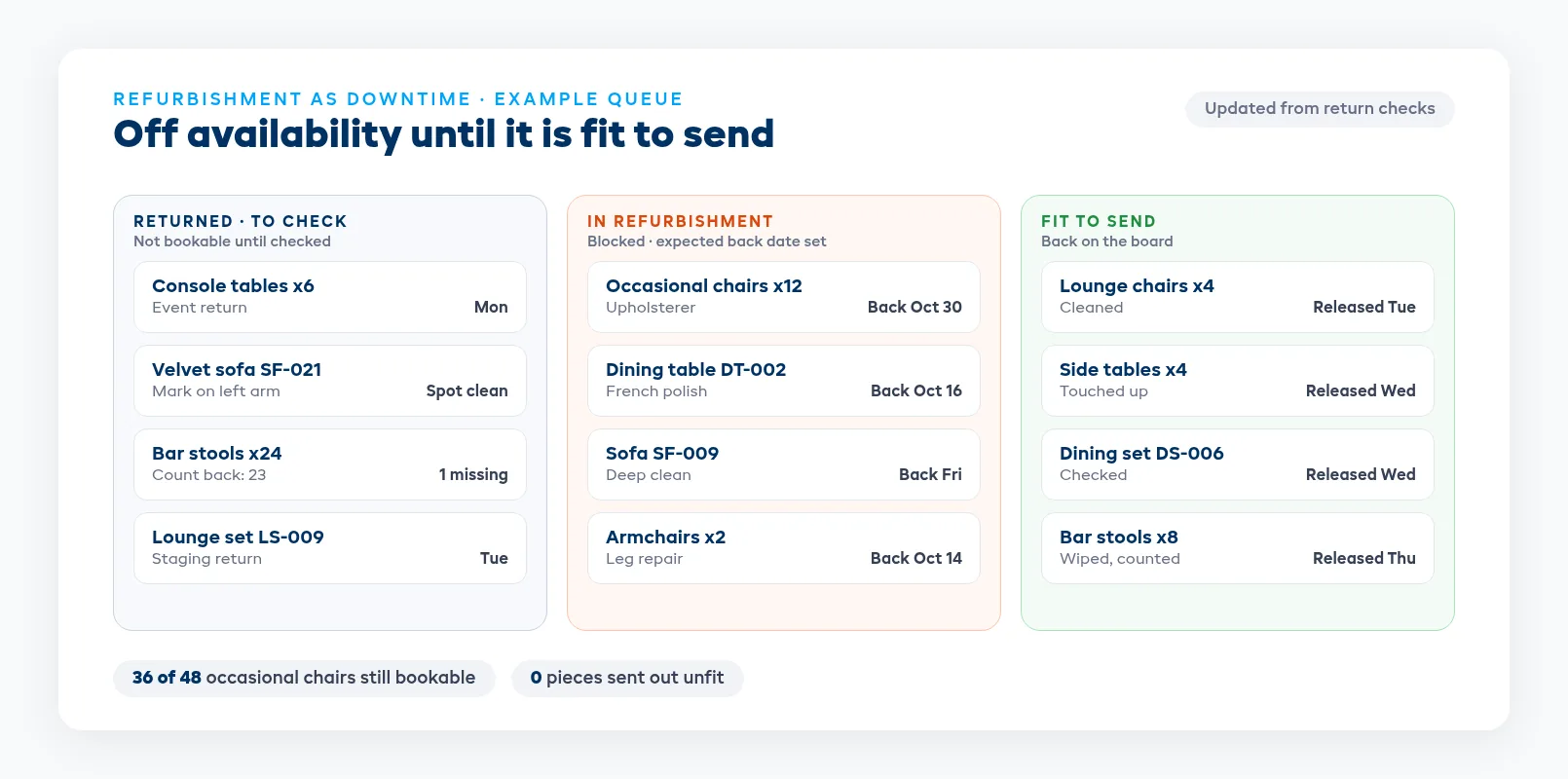
How to set it up:
- Raise the job from the return check. If the person checking a return notes a stain or a loose leg, that note should create the refurbishment job. Nobody should have to retype it into a separate list.
- Block only the affected pieces. Twelve chairs at the upholsterer should come off availability. The other 36 in the same range stay bookable.
- Give every job an expected return date. "Upholsterer, three weeks" lets sales see when the chairs come back, so they can quote a date in a month instead of turning the client away.
- Watch turnaround time. Track how long pieces sit between return and their next rental. If the average is creeping up, either the workshop is the bottleneck or returns aren't being checked fast enough.
The weekend after a big event is when this matters most. Forty pieces come back Monday, and Thursday's event needs half of them. If the return check and refurbishment queue live on paper, sales will promise pieces that are still in the cleaning bay.
Recurring billing
Long-term rental is where the steady money is. A show home that keeps a living room set for six months at $400 a month is worth $2,400, and it doesn't need a truck every weekend. The problem is billing. Many shops rebuild the invoice by hand every month, chase it by email, and lose track of which contracts are due to end.
Recurring billing should run off the contract itself:
- Bill on a schedule. The contract says monthly on the 1st, and the invoice goes out on the 1st without anyone rebuilding the order.
- Take payment automatically where the client agrees to it. A card or account on file turns monthly collection into a background task.
- Know your recurring total. You should be able to see what all active contracts are worth each month, and which ones are ending soon.
- Flag renewals early. A contract ending in six weeks is a renewal conversation now. Leave it until the last week and the client has already called another company.
Payment terms need the same care. Long contracts often take a first month up front, then monthly in advance. Large staging jobs may need staged payments: a deposit at signing, a balance before delivery, then the monthly rate. Write the schedule into the contract and let the system send the reminders, so nobody has to remember who owes what.
Contracts should be signed digitally and stored against the order. When a corporate client asks for the terms 10 months in, you send a copy instead of digging through an inbox.
Deposits by value
A $40 side table and a $4,000 lounge set should not carry the same deposit. Flat deposits either scare off small orders or leave you exposed on the expensive ones. Size the deposit to the value of what is going out.
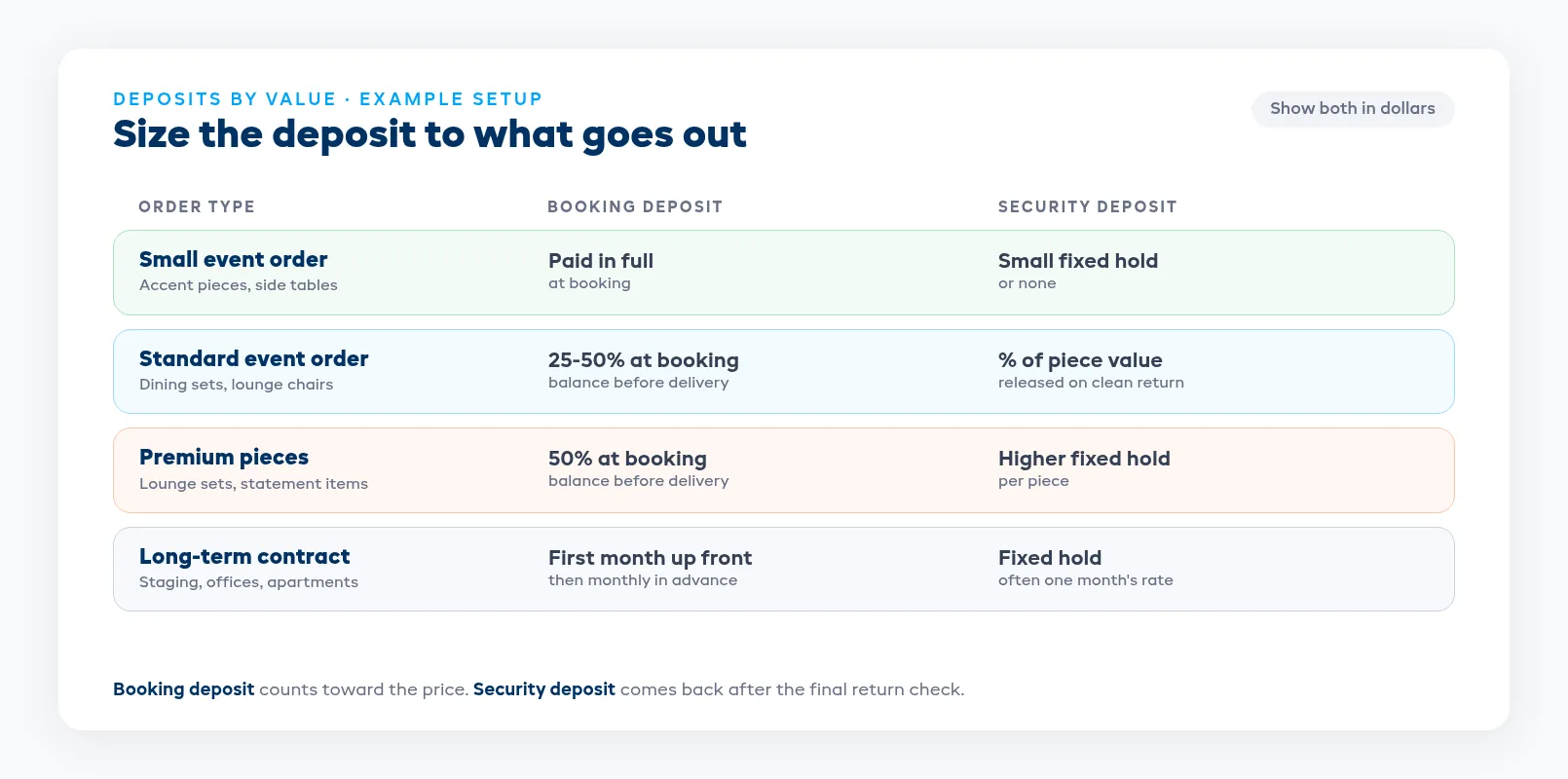
A simple setup most furniture shops can start with:
| Order type | Booking deposit | Security deposit |
|---|---|---|
| Small event order (accent pieces, side tables) | Paid in full at booking | Small fixed hold, or none |
| Standard event order | 25-50% at booking, balance before delivery | Percentage of piece value |
| Premium pieces (lounge sets, statement items) | 50% at booking | Higher fixed hold per piece |
| Long-term contract | First month up front | Fixed hold, often one month's rate |
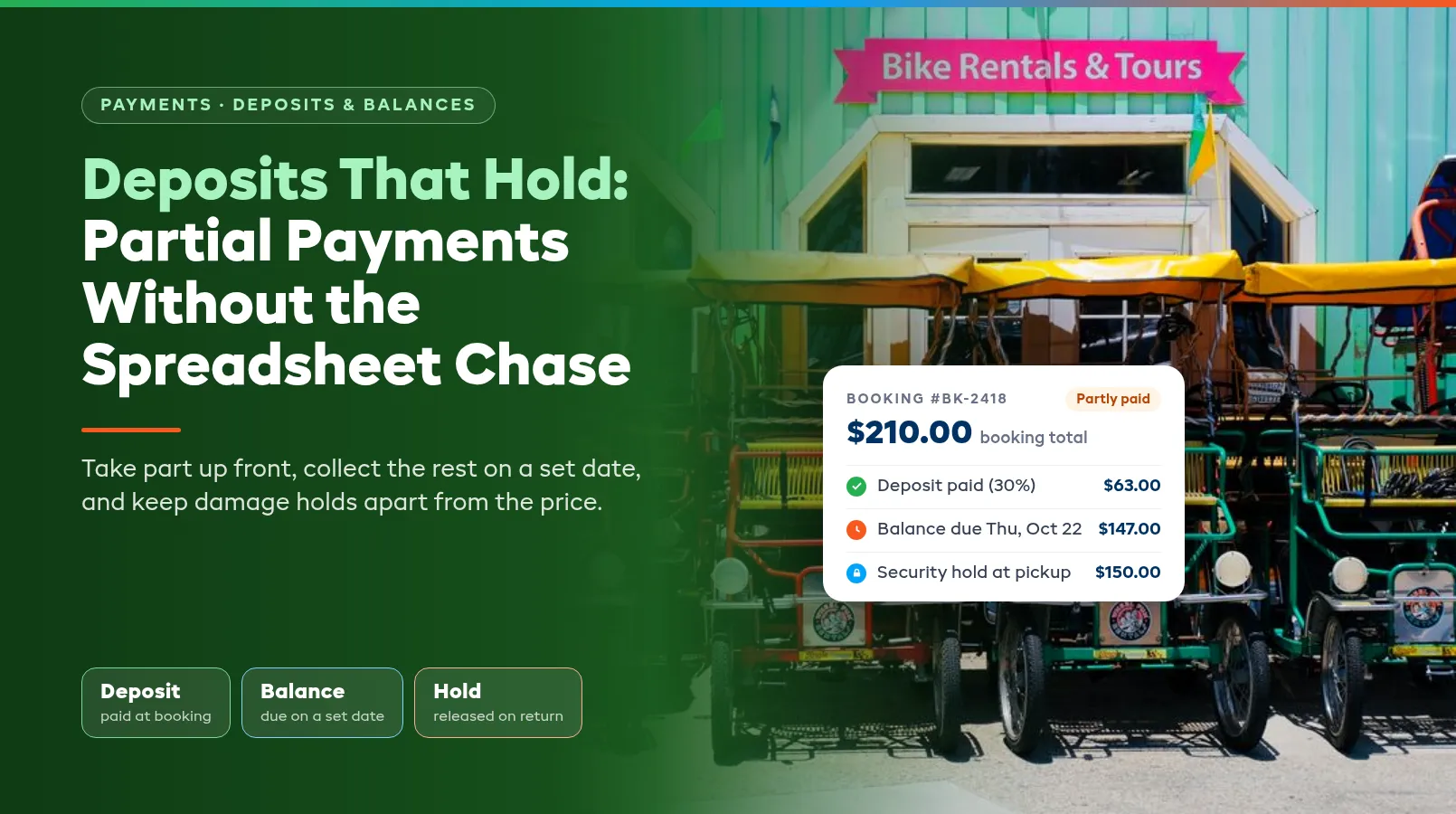
Keep the two kinds of deposit apart. A booking deposit is part of the price paid early. A security deposit covers damage and comes back on a clean return. Your quote and confirmation should show both as dollar amounts, so the client knows which money they will get back.
For event orders, collect the balance before the truck is loaded rather than on site. For long contracts, hold the security deposit for the length of the contract and release it after the final return check, when the condition photos match the dispatch photos.
Checklist
Run this every week, and before every busy weekend:
- Check availability across both businesses. Every contract and every event order should be on the same calendar, including end dates for long rentals and turnaround after each one.
- Clear expired holds. Release any piece held for a client who hasn't paid a deposit by the deadline.
- Walk the refurbishment queue. Every piece has a job, an expected return date, and an owner. Mark anything fit to send as soon as it is.
- Confirm condition photos. Every return this week has return photos on the rental, and every dispatch for the weekend has a slot for them.
- Review contract renewals. List contracts ending in the next 60 days and contact each client.
- Check payments. Monthly invoices sent, event balances collected before delivery, security deposits ready to release on clean returns.
- Send the weekend brief. Deliveries, crews, and pull lists for every event go out on Thursday, not Saturday morning.
If you're comparing systems, run this checklist against a free trial with your own stock. Load a long contract and an event on the same piece and see whether it blocks the double-booking. Then mark a returned sofa for cleaning and check that it drops off availability. You can see plans and what is included on the EquipDash pricing page, and more about running workshop jobs and returns on the operations features page.
FAQ
What is furniture rental software?
It is the system a furniture rental business runs on: what pieces you own, what condition they are in, what is out on an event, what is on a long-term contract, and what is in the workshop. Because customers judge furniture on how it looks, condition and availability are effectively the same question.
Can one system handle event rental and long-term contracts?
Yes, as long as both draw on the same stock. Event rates and monthly rates can sit on the same piece, and a sofa committed to a six-month contract is not offered for a Saturday event. Contracts should bill on a schedule, so nobody rebuilds the order every month.
Should every piece of furniture be tracked individually?
No. Track higher-value pieces individually, such as lounge sets, sofas, dining tables, and anything that gets photographed, with their own condition history. Identical items like bar stools or folding chairs are easier to track as quantities, with counts out and back.
How do I stop furniture in refurbishment from being booked?
Treat refurbishment as downtime. When a return check finds a stain or damage, raise the job from that check and take the piece off availability until someone marks it fit to send. Give each job an expected return date so sales can quote later dates.
How much deposit should a furniture rental business take?
Size it to the value of the order. Small event orders can be paid in full at booking. Standard event orders often take 25-50% up front with the balance before delivery. Premium pieces carry a higher security hold, and long contracts usually take the first month up front plus a fixed hold.
How should recurring billing work for long-term furniture rentals?
The contract should set the billing date and amount, and invoices should go out on that schedule automatically. Keep a card or account on file where the client agrees, track your total monthly recurring revenue, and flag contracts ending in the next 60 days so you can renew them early.
in one place