Managing ATV Damage Deposits and Fair Charges
Managing ATV Damage Deposits and Fair Charges
Every ATV operator has the story: the machine that went out shiny at nine and came back at noon with cracked plastics, a bent rack, and a rider swearing it was like that when they got it. The damage deposit is the tool that turns that story from a shouting match into a process. Sized right, it filters out the riders who never planned to be careful, covers your common repairs, and still feels fair to the ninety-five percent who bring the machine back the way they found it.
Sized wrong, it does damage of its own. Too low and you eat every cracked fender out of margin. Too high and riders book with the outfit down the road that only holds $200. This guide covers how experienced operators set deposit amounts by machine type, lock in proof with photo inspections, publish a charge menu that ends arguments before they start, and choose between card holds and cash. It is one piece of the wider operation covered in the complete guide to running an ATV and off-road tour business.
Size the deposit by machine type, not by gut feel
One flat deposit across the fleet is the most common mistake in the book. A $300 hold might be perfectly matched to a utility quad, laughably low for a $28,000 side-by-side, and high enough to scare a family off the youth machines. The deposit should track what the machine actually costs you when it comes back hurt.
A working rule: set each tier to cover your most common repair bill for that class, not the worst case. For a standard quad that is usually plastics, a tire, or a rack — a few hundred dollars. For a sport quad, add suspension and the higher parts prices. For a side-by-side, doors, glass, and body panels push the number four figures. The rental agreement covers the catastrophic cases; the deposit only needs to cover the likely ones.
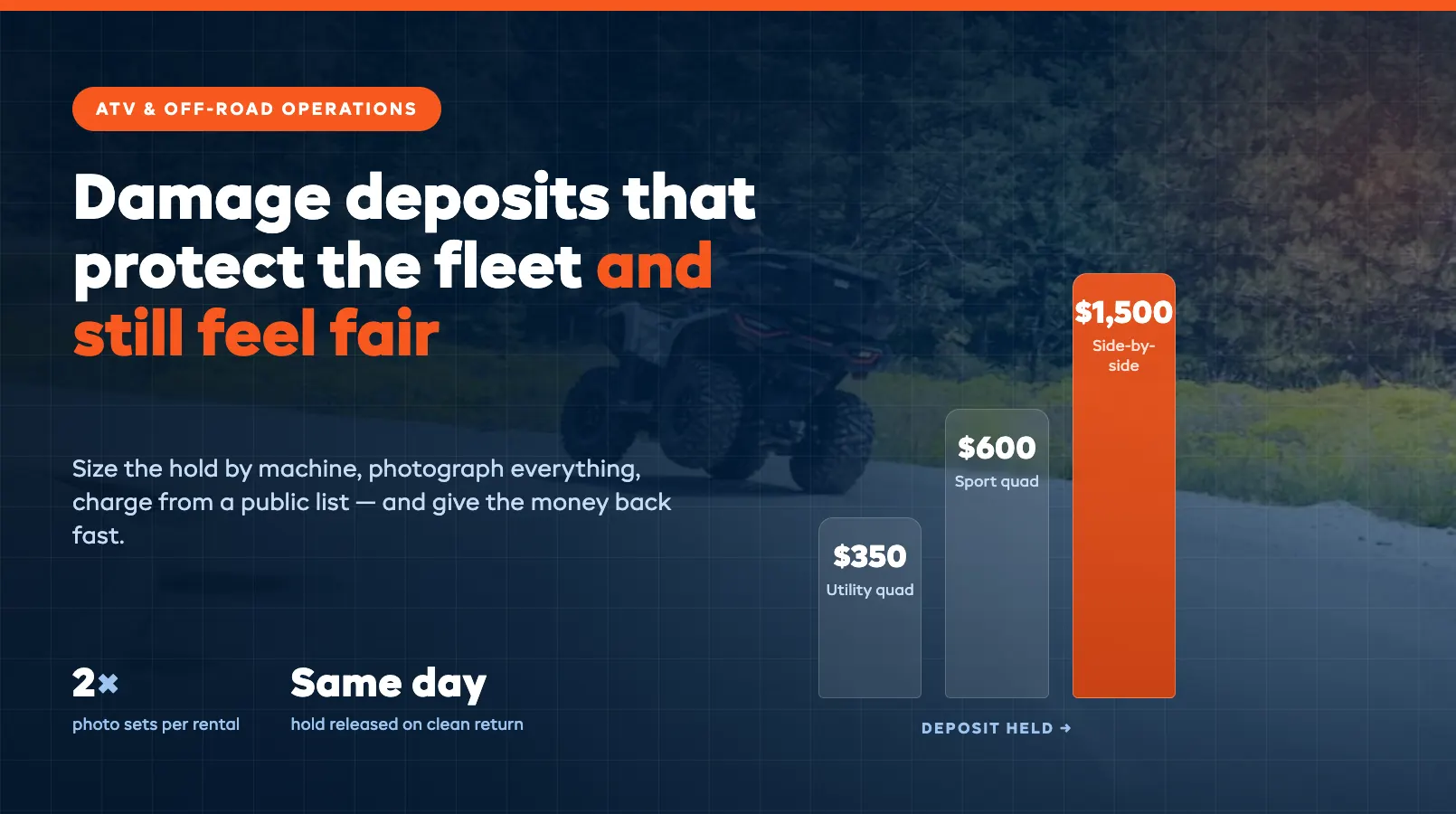
A typical ladder looks like this: $250–$400 on utility quads and youth machines, $500–$750 on sport quads, and $1,000–$2,000 on side-by-sides. Guided tours can run lighter than self-drive rentals — your guide is watching the machine all day — which is one more reason tour pricing and deposits should be designed together rather than copied from the rental side.
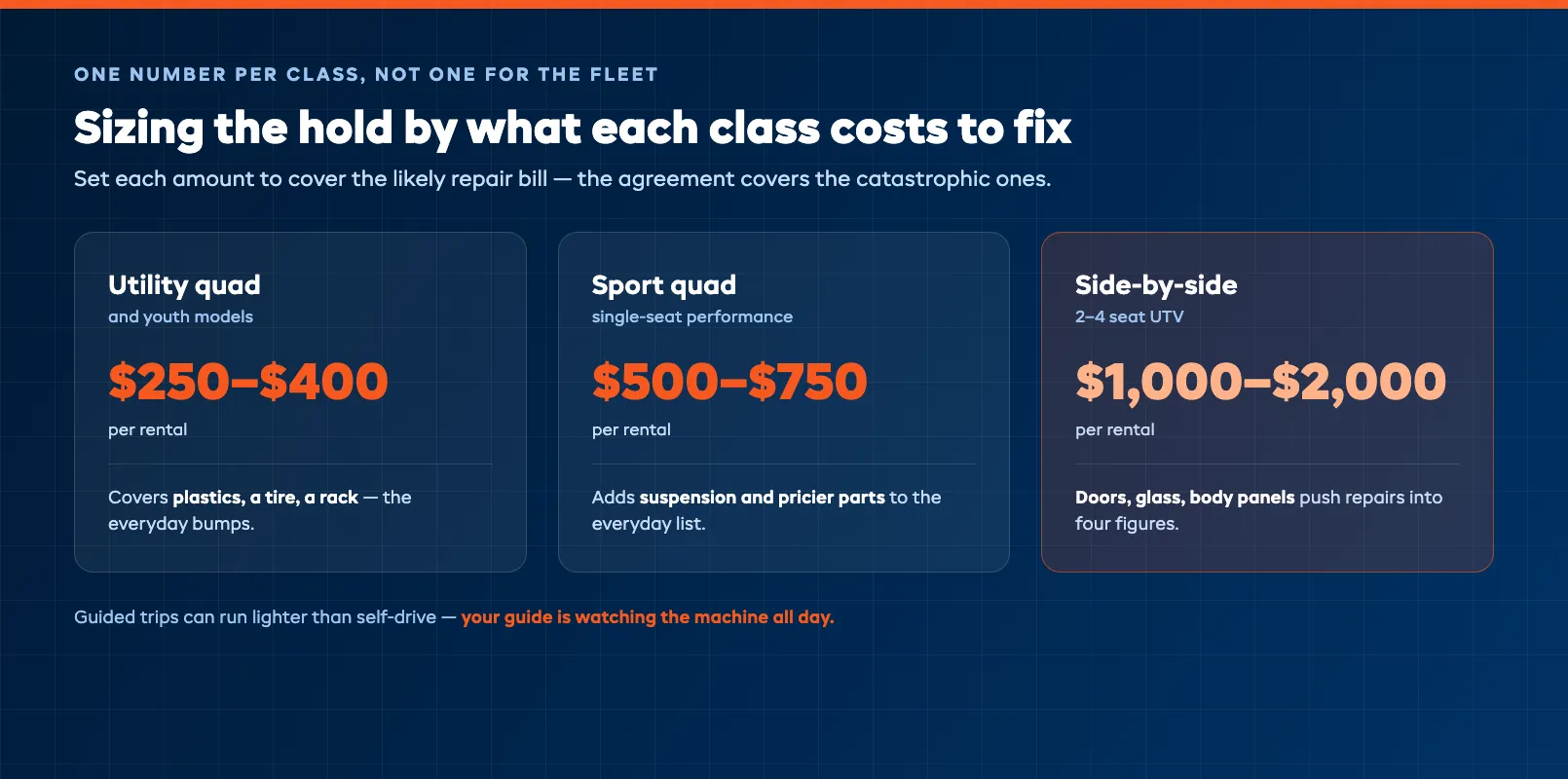
Photo inspections: your evidence, taken twice
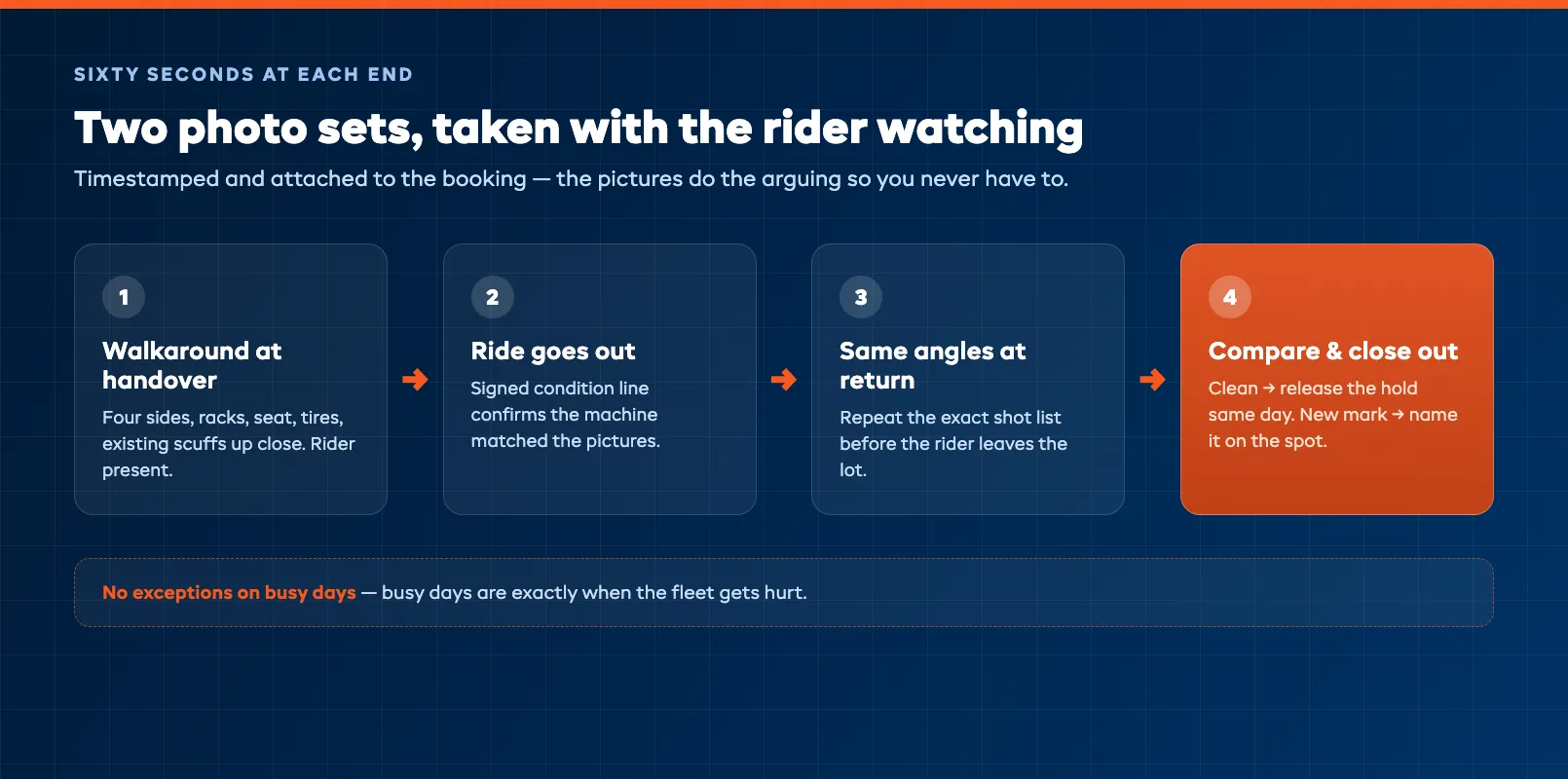
A deposit without photos is a promise you cannot enforce. The whole system rests on being able to show that the scratch was not there at 9:00 and was there at 12:30. That means a photo inspection at both ends of every single rental, no exceptions on busy days — busy days are exactly when damage happens.
The handover set: walk the machine with the rider, shoot all four sides, the racks, the seat, the tires, and any existing scuffs up close. Ten photos, sixty seconds. The return set repeats the same angles. Timestamped photos attached to the booking do the arguing for you; the rider watched you take them, so there is nothing to dispute later. Operators who log inspections against each unit also catch slow-building problems early — the same habit that drives a good fleet maintenance program.
Pair the photos with a signed condition line in your paperwork. The rider confirms the machine matched the photos at handover, the same way they confirm the risks in your waivers and safety briefings. Two signatures, two photo sets, and the dispute rate drops to almost nothing.
Publish a fair charge menu
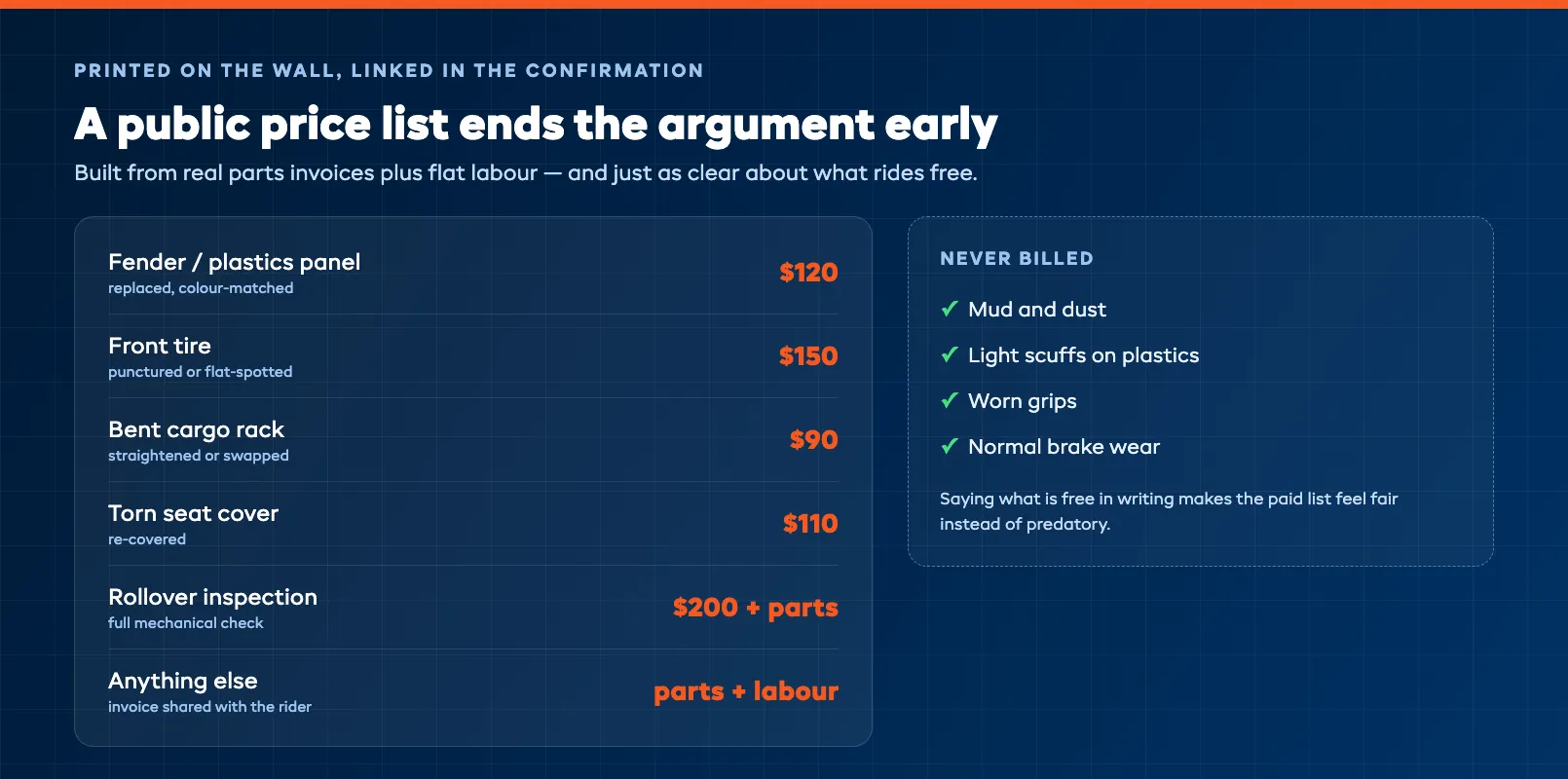
The second-worst moment in a damage conversation is naming the price. If you invent a number at the counter, the rider assumes you are padding it — and sometimes, under pressure, operators do. A published price list kills that suspicion. Fender, $120. Front tire, $150. Bent rack, $90. Rollover inspection fee, $200 plus parts. The rider can read the same list you are quoting from, and half the argument disappears.
Build the list from your actual parts invoices plus a flat labor rate, and round to numbers you can defend. Put the common items on it — plastics, tires, racks, seats, mirrors, levers — and a line that says anything else is charged at parts plus labor with the invoice shared. Print it on the wall, link it from the booking confirmation, and reference it in the agreement.
Just as important: publish what you do not charge for. Mud, dust, light scuffs, worn grips — normal wear rides free. Saying so in writing makes the paid list feel fair instead of predatory, and it is one of the cheapest trust signals in the business. The full set of terms every rider sees lives in your booking software, so the price list should sit one tap away from the checkout screen.
Card holds vs cash: pick the one that scales
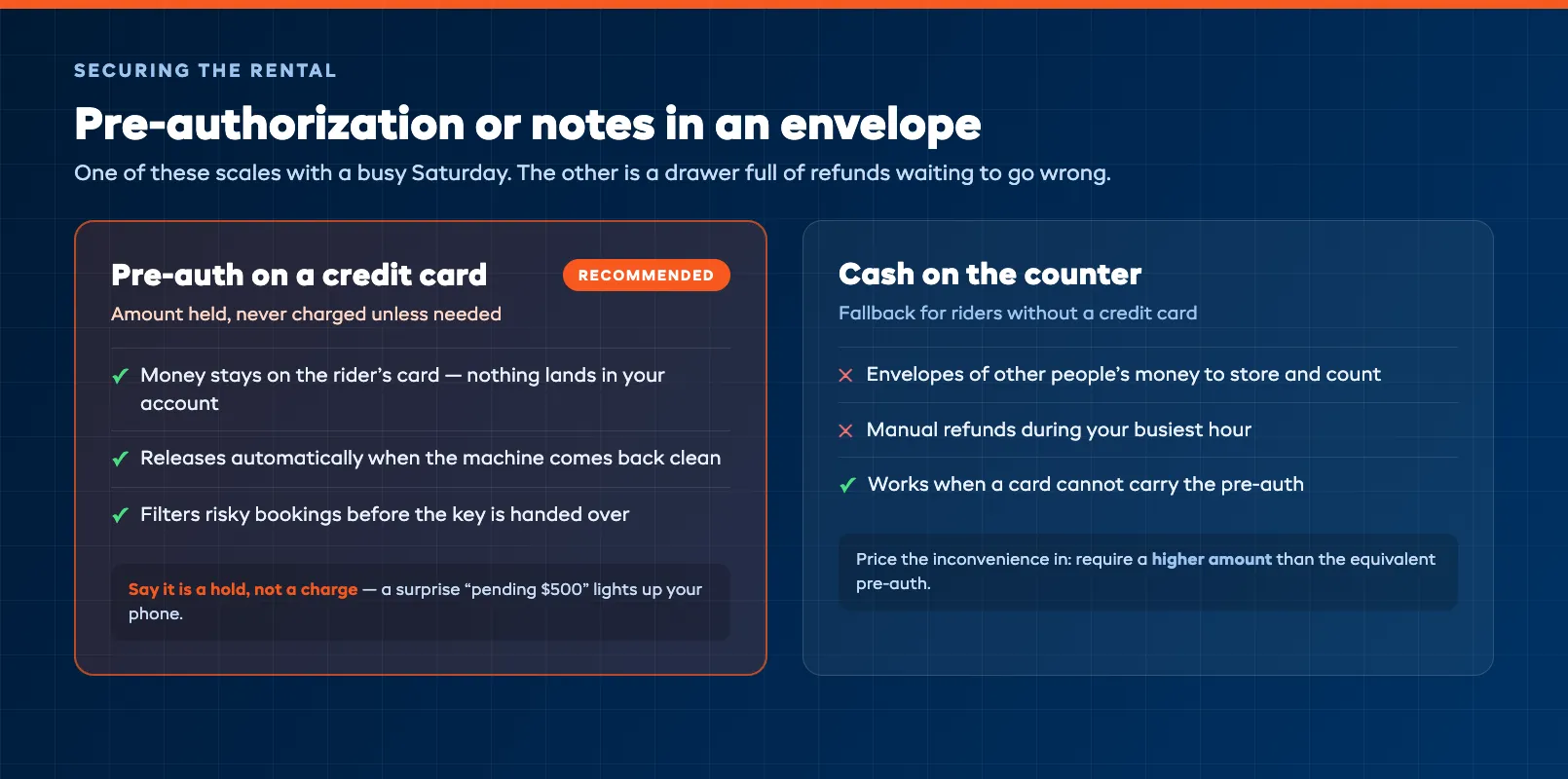
Cash deposits feel simple and they are, right up until they are not. You are holding envelopes of other people's money, counting refunds during your busiest hour, and explaining to a rider why the drawer is short. Card pre-authorizations solve all of it: the amount is held on the rider's card, never lands in your account, and releases automatically when the machine comes back clean.
The hold also filters your customers. A rider whose card cannot carry a $500 pre-auth on a machine worth $15,000 is telling you something useful before the key is handed over. Set the hold at booking or at check-in, and make sure your terms state clearly that it is a hold, not a charge — riders who see a "pending $500" without warning light up your phone.
Keep a cash option for the genuine edge cases, but price the inconvenience in: many operators require a higher cash deposit than the card hold, refunded on clean return. Whichever route the rider takes, the release speed is the thing they remember. Same-day release on a clean return turns the deposit from a friction point into proof you run a straight shop.
Handle disputes like a business, not a battle
Even with photos and a price list, a few riders will push back. The process that wins: stay calm, show the evidence, quote the list. Open the handover photo and the return photo side by side. Point to the charge menu line. Offer the parts invoice if the item is off-menu. Most disputes end there, because there is nothing left to argue about — only facts the rider watched you collect.
For the ones that do not end there, decide in advance what the damage is worth against the relationship. A $90 rack on a rider who books a group trip every summer might be a write-off you make deliberately. A rollover with a denial in front of witnesses is not. Escalate through the card network with your photo sets and signed agreement if you must — documented operators win those — but treat chargebacks as the last step, not the second one.
One rule protects everything: never let a rider leave the lot before the return inspection is done and any damage is named. A charge that appears three days later by email feels like an ambush even when it is legitimate. Named on the spot, with photos, it is just business. Your guides can help here too — on guided trips, a well-run guide roster means someone saw the rollover happen, which ends the "it just fell over" defense before it starts.
Putting it together
A deposit system that works is boring on purpose. Tiered amounts that match each machine class. Photos at both ends of every rental, with the rider watching. A printed charge menu built from real invoices, next to a plain-English wear-and-tear promise. Card holds that release the same day the machine passes inspection, and a dispute script that leans on evidence instead of volume.
Run it that way and the deposit stops being a fight you have with customers and becomes part of the pitch: this outfit photographs everything, charges from a public list, and gives your money back before you reach the highway. If you are setting up the wider operation around it, the ATV and off-road hub collects the tools, and the off-road glossary covers any term in your paperwork a first-timer might question.
FAQ
How much should an ATV damage deposit be?
Most operators hold between $250 and $500 for a standard quad, $500 to $1,000 for a sport quad, and $1,000 to $2,000 for a side-by-side. The deposit should cover your most common repair bill — plastics, a tire, a rack — not the full replacement value of the machine.
Should I take the deposit as a card hold or a cash payment?
A card pre-authorization is better for almost every operator. The rider keeps their money unless something happens, you avoid handling and refunding cash, and the release is automatic when the machine comes back clean. Keep cash as a fallback for riders without a credit card, at a higher amount.
What counts as normal wear and tear on a rental ATV?
Mud, dust, light scratches on plastics, worn grips, and brake wear from normal riding are yours to absorb — they are the cost of running rentals. Cracked plastics, bent racks, torn seats, punctured tires, and anything from a rollover sit on the rider's side of the line. Publish the line so nobody argues it at the counter.
How do I prove damage happened during a specific rental?
Timestamped walkaround photos taken at handover and again at return, with the rider present both times. If the crack shows in the return set and not the handover set, the conversation is short. Without photos, it is your word against theirs — and you will lose more of those than you win.
When should I release the deposit after a rental?
Same day if the return inspection is clean — riders judge you on how fast their money comes back. If you find damage, tell the rider before they leave the lot, show the photos, and quote from your published price list within 24 to 48 hours.
What if the repair costs more than the deposit?
Your rental agreement should state that the rider is liable for damage beyond the deposit amount, with the deposit acting as the first payment rather than a cap. In practice, chase the gap for large, well-documented damage and write off small gaps — the paperwork and goodwill often cost more than the difference.
in one place