Off-Road Fleet Maintenance: Service Intervals, Damage, and Downtime
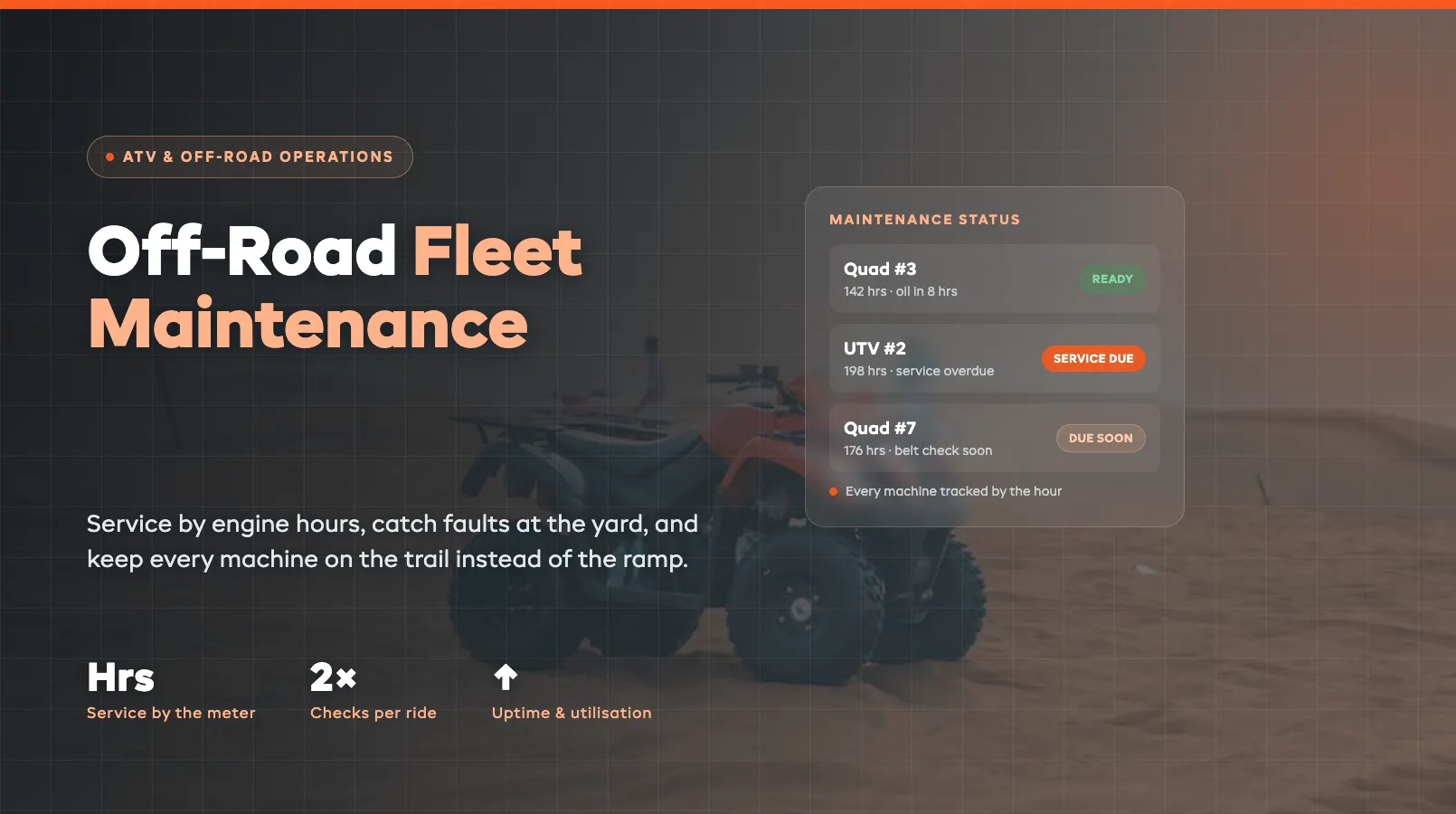
An ATV and off-road business is a fleet business first and everything else second. You can have the best trails, the friendliest guides, and a booking page that converts like a dream, but if half your machines are on the workshop ramp on a sold-out Saturday, none of it matters. The fleet is the product. A quad that is running earns money every hour it is out; a quad that is broken costs money every hour it sits. Fleet maintenance is not the boring part of the job you do when there is time left over — it is the part that decides whether the business makes money.
The trouble is that off-road machines take a beating no private owner would ever inflict. Rentals and tour quads run long days over dust, mud, rock, and water, ridden by people who did not pay for them and will not own them tomorrow. They accumulate wear fast, and they accumulate it unevenly. Getting maintenance right in that environment is not about being a better mechanic — it is about being a better operator: measuring the right things, catching problems early, and keeping machines available when the calendar is full. This guide walks through how to do that. If a term here is unfamiliar, the ATV and off-road glossary covers the vocabulary, and the wider operating playbook lives in the guide on how to run an ATV and off-road tour business.
Service intervals: measure hours, not dates
The single biggest mistake operators bring over from owning a personal machine is servicing by the calendar. Change the oil every spring, book the annual service, done. That works for a quad that runs a few weekends a year. It falls apart the moment the machine is earning its keep, because a rental or tour ATV can rack up more engine hours in one busy month than a private one sees in a year.
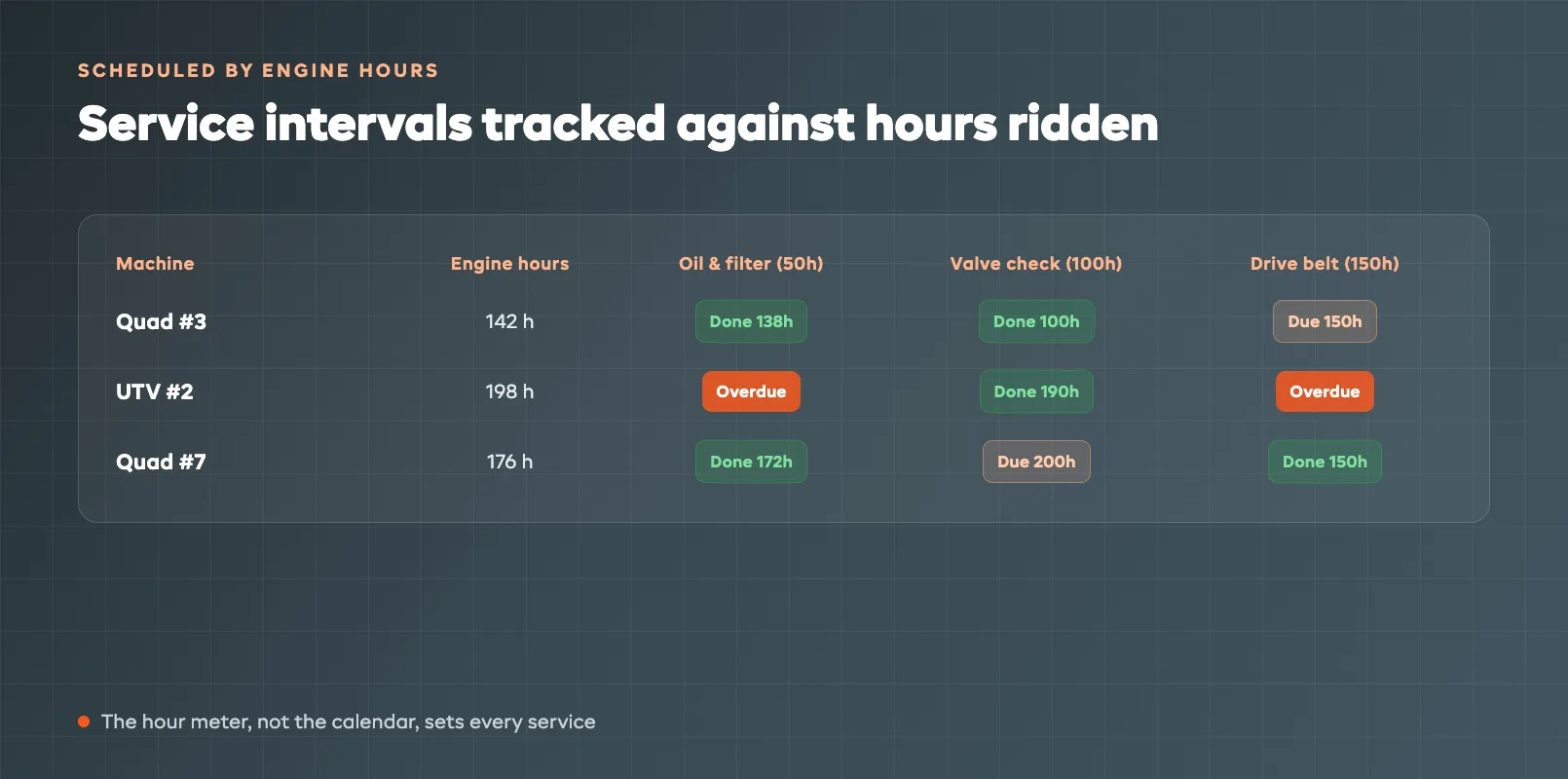
The fix is to schedule everything against engine hours. Every machine has an hour meter; log it, and service against the manufacturer's hour-based intervals for oil and filters, valve checks, drive belts and chains, brakes, and coolant. A quad that runs guided tours all day hits its next oil service weeks before an identical machine that mostly sits waiting for rentals — and the hour meter is the only thing that tells you so. Schedule by hours and each machine gets serviced exactly when it has earned it, which is cheaper than servicing too early and far safer than servicing too late.
This also lets you plan ahead instead of reacting. If you know a popular machine is approaching a service in roughly two weeks of normal use, you can book the workshop time during a quiet midweek slot rather than pulling the quad off a fully booked weekend. The hour meter turns maintenance from a surprise into a schedule.
Pre-ride and post-ride inspections
Services keep a machine healthy over the long run; inspections keep it safe today. A short check before and after every ride is the cheapest insurance an off-road operator can buy, because it moves the moment of discovery from the trail to the yard. A soft tire spotted at the trailer costs two minutes; the same soft tire found two kilometres out, with a guest aboard, can end the trip and put a machine on a recovery trailer.
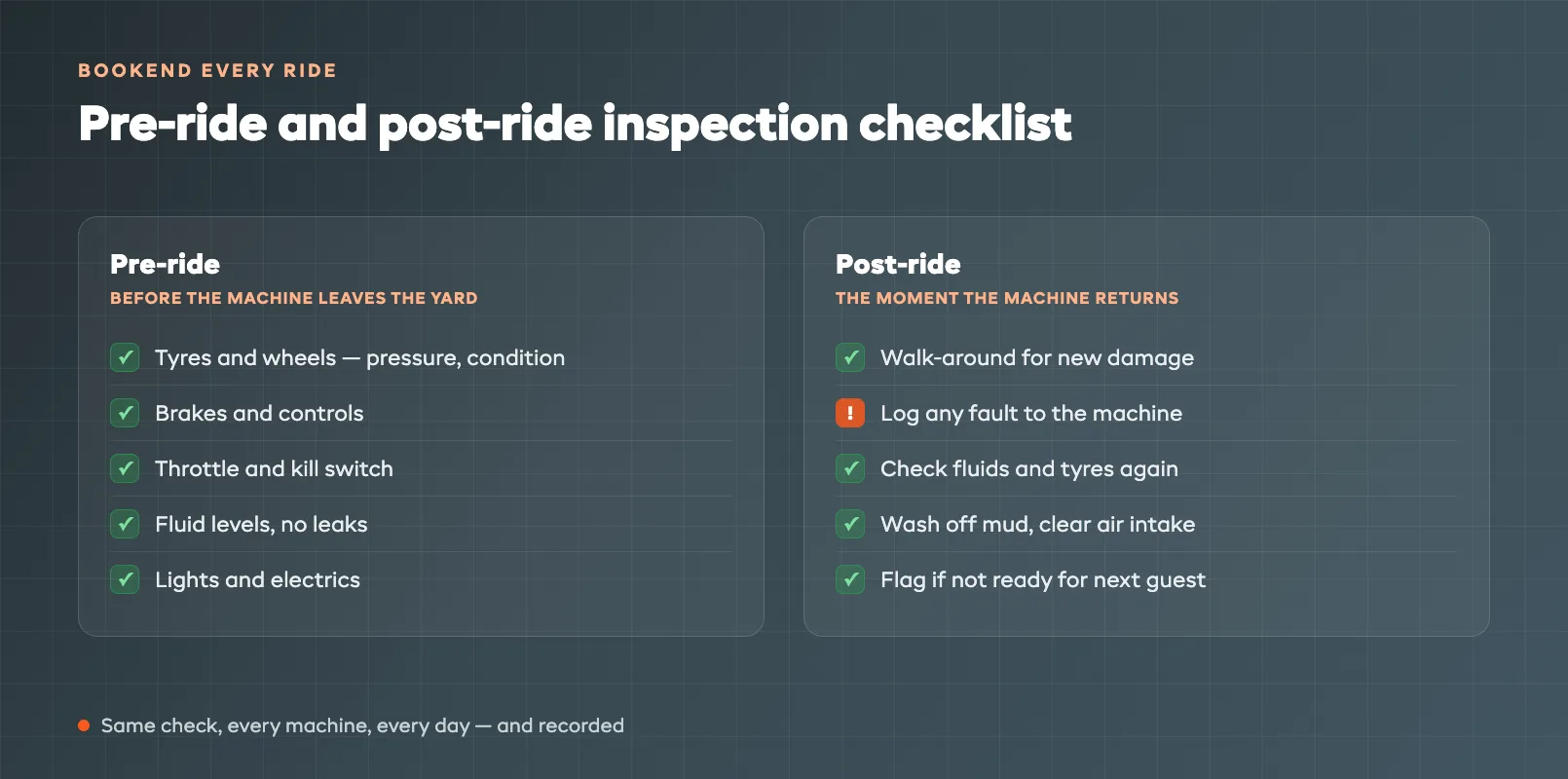
The pre-ride check should be short, consistent, and the same every time — tires and wheels, brakes, throttle and controls, fluid levels, lights, the kill switch, and a quick scan for anything loose or leaking. Many operators lean on the T-CLOC memory aid (tires, controls, lights, oil and fluids, chassis) so nothing gets skipped when the yard is busy. What matters is that the same check happens on every machine, every day, and that it is recorded, so you know it was actually done and not waved through.
The post-ride inspection is just as important and easier to forget. When a machine comes back, a quick look-over catches damage while you still know which rider had it, flags the fault before the next guest inherits it, and feeds your maintenance list for the evening. A problem logged at return is a problem you fix on your terms overnight; the same problem discovered at the next pre-ride is a scramble while a group waits. Bookending every ride with a check is how a busy fleet stays both safe and available.
Tracking damage and repairs
Off-road machines get damaged — that is the business, not a failure of it. What separates a fleet that stays profitable from one that quietly bleeds margin is whether that damage is tracked. Every fault, every repair, and every bit of damage needs to be tied to the specific machine it happened to, not dumped into a general sense that "the quads need work."
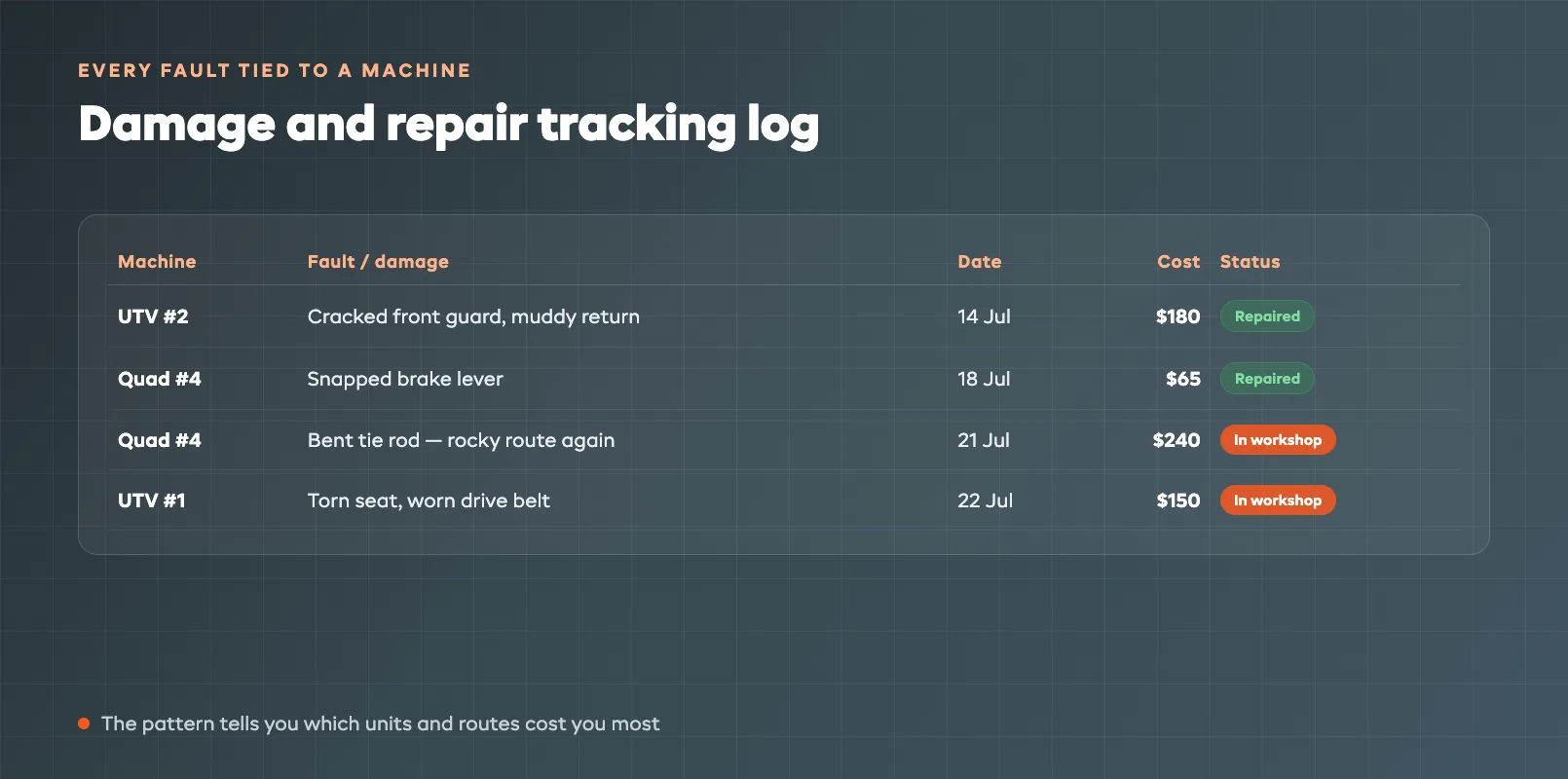
Log what broke, which machine, the date, the cause if you know it, the cost, and the fix. Do that consistently for a season and the data starts talking. You see which units are eating your repair budget and might be due for retirement. You spot that one model has a recurring weak point worth engineering around. You notice a particular route or a particular type of booking that keeps sending machines back damaged, which tells you where to tighten your briefing or your deposit rules. None of that is visible if repairs live only in your head and a box of receipts.
Damage tracking also plugs straight into how you get paid. When a self-drive machine goes out in known condition and comes back cracked, the record of what it looked like before and after is what turns an awkward conversation into a clear, defensible charge. The same log that helps you manage the fleet protects the deposit and damage process covered in the guide on ATV and UTV booking software. Damage you do not record is damage you can neither recover nor prevent.
Parts, service logs, and keeping records
Behind good maintenance sits good record-keeping, and for a fleet that means a proper history for every machine rather than a shared logbook nobody trusts. Each unit should carry its own record: its hour meter over time, every service with the date and the hours it was done at, the parts fitted, the faults and repairs, and the daily inspection trail.
That history earns its keep in four ways. It stops overdue work slipping through the cracks, because you can see at a glance where every machine sits against its next service. It protects any manufacturer warranty, which often depends on being able to prove the scheduled servicing was actually done. It backs you up if there is ever an incident or an insurance claim, where a clean maintenance record is the difference between a defensible position and an expensive one. And it lifts resale value when you rotate machines out of the fleet — a quad with a complete, credible service history sells for noticeably more than an identical one sold on trust alone.
Keeping a parts history matters too. When you know what you fit, how often, and how long each item lasts, you can hold the right consumables and common spares on the shelf instead of losing a machine for days waiting on an order. Whether all of this lives in software or a well-kept binder is less important than that it is consistent, per machine, and actually maintained. The record is part of the asset.
Minimizing downtime and protecting utilization
Every hour a machine spends in the workshop is an hour it is not earning, so the real goal behind all of this is uptime. The operators who do maintenance well are not the ones who never service — they are the ones whose servicing is invisible, scheduled into quiet windows so the fleet is always ready when demand is high.
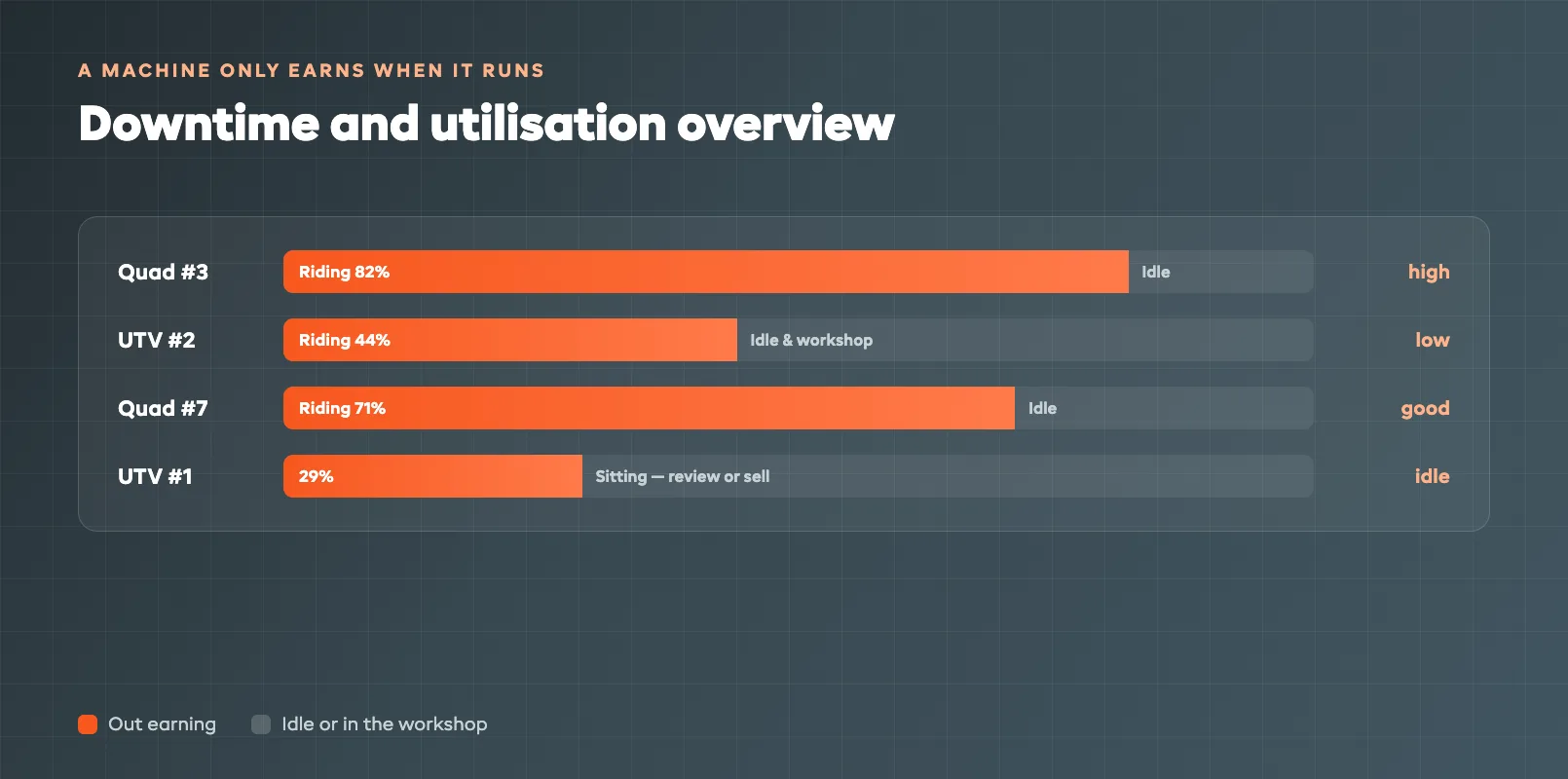
A few habits protect uptime. Stagger services so you never have several machines off the road at once — the hour-meter scheduling above makes this easy to plan. Hold the consumables and common spares that cause the longest waits, so a routine fix is an overnight job rather than a three-day one. Service proactively in the off-season and midweek lulls instead of reacting to a breakdown on your busiest day. And catch small problems early through those daily inspections, before they grow into the kind of failure that takes a machine out for a week.
The other half of the picture is utilization — knowing how hard each machine actually works. Review hours ridden and revenue earned per unit across the season and the fleet tells you what to do next. A machine that is always out and always earning justifies a second like it. One that constantly sits is either priced wrong, positioned wrong, or surplus you can sell to fund something better. Maintenance and utilization are two sides of one number: a machine only earns when it is both available and booked, and your job is to protect both.
Putting it together
Fleet maintenance is not the housekeeping you do around the real business — for an off-road operator it is the real business. The machines are the product, and everything that keeps them running is what keeps the money coming in. Measure service intervals in engine hours, not calendar dates, so each machine is serviced when it has actually earned it. Bookend every ride with a quick inspection so problems surface in the yard, not on the trail. Track every fault and repair against the specific machine so damage becomes data you can act on. Keep a real service and parts history per unit to protect warranty, defend yourself, and lift resale. And run all of it in service of uptime, because a machine only pays when it is available and booked. Do this well and your fleet lasts longer, breaks down less, and earns more — which is the whole point. When you are ready to see how maintenance fits alongside bookings, safety, and the rest of the operation, the ATV and off-road operator hub pulls every piece into one view.
FAQ
How often should ATV fleet machines be serviced?
Service by engine hours, not by the calendar. A rental or tour quad might rack up more hours in a busy month than a private machine does in a year, so a date-based schedule either services too early and wastes money or too late and risks a breakdown. Follow the manufacturer's hour-based intervals for oil, filters, valve checks, and drive components, and log the hour meter on every machine so you know exactly where each one sits. In peak season some operators service popular units every few weeks; in the off-season the same machine might go months. The hour meter, not the date, tells you the truth.
What should a pre-ride ATV inspection cover?
A good pre-ride check takes a few minutes per machine and covers the things that strand a guest or cause an incident: tire condition and pressure, brakes, throttle and controls, fluid levels, lights, the kill switch, and anything loose or leaking. Off-road operators often use the T-CLOC idea — tires and wheels, controls, lights and electrics, oil and fluids, chassis and chain — as a memory aid. The point is consistency: the same check, every machine, every day, recorded so you know it was done. Catching a soft tire or a dragging brake in the yard is cheap; discovering it two kilometres down the trail is not.
How do I track damage across a fleet of ATVs?
Tie every fault and repair to the specific machine, not to a general workshop pile. When something breaks or comes back damaged, log what happened, the machine it happened to, the date, the cost, and the fix. Over a season that record tells you which units are eating your margin, whether a particular model has a recurring weak point, and which rider or route keeps causing damage. It also feeds your deposit and damage-charge process — if a machine goes out clean and comes back cracked, the before-and-after record backs up the charge. Damage you do not track is damage you cannot control.
How do I minimize fleet downtime?
Downtime is the enemy because a machine in the workshop earns nothing. Cut it by staggering services so you never have half the fleet on the ramp at once, holding the consumables and common spares that cause the longest waits, and servicing proactively during quiet periods rather than reacting to breakdowns on a busy Saturday. Catching small problems early through daily inspections stops them becoming multi-day repairs. And knowing your parts lead times means you order before you run out, not after. A little planning turns unplanned, revenue-killing downtime into scheduled, invisible maintenance.
Why measure maintenance by engine hours instead of dates?
Because wear tracks use, not time. Two identical quads bought on the same day can be a full service apart by mid-season if one runs guided tours all day and the other sits for rentals that rarely fill. A calendar schedule treats them the same and gets both wrong. Engine hours measure the actual load on the machine — the running time that wears the oil, the valves, the drive train, and the brakes. Schedule against the hour meter and every machine gets serviced when it has earned the service, which is cheaper, safer, and easier to defend if anything ever goes wrong.
What records should I keep for each machine?
Keep a per-machine history: the hour meter over time, every service with the date and hours it was done at, all parts fitted, every fault and repair with its cost, and the daily inspection record. Together these tell you the true running cost of each unit, protect any warranty, prove the machine was maintained if there is ever an incident or insurance claim, and lift resale value when you rotate the fleet. A machine with a clean, complete service history sells for more and is far easier to stand behind. Whether it lives in software or a well-kept binder, the record is part of the asset.
in one place