Zipline & Aerial Park Operations: Throughput, Safety Checks, Staffing
Zipline & Aerial Park Operations: Throughput, Safety Checks, Staffing
A zipline or aerial park is a factory with trees. Revenue is launches per hour, cost is guides per platform, and the entire business sits on top of gear and course inspections that nobody sees but everybody depends on. The operators who struggle usually aren't short on courage or marketing — they're running a 40-guest-per-hour course at 22 because check-in leaks time, or carrying a payroll built for peak Saturday across a quiet Tuesday, or trusting harness retirement to whoever happens to clip it that morning. This guide works through the operating system: real throughput math, inspections that get logged instead of assumed, PPE lifecycle tracking, staffing ratios that hold, and the check-in and weather decisions that protect both your start times and your reviews.
This is part of our activities and adventure series — if you're earlier in the journey, start with the full guide to running an adventure activity business and come back for the aerial-specific operations.
The Throughput Equation
Every course has a theoretical capacity and a real one, and the gap between them is unbilled revenue. Theoretical capacity is simple: launches per hour per line, times lines, divided by elements per guest. Real capacity is what actually happens once you account for the harness fit that takes eight minutes instead of four, the briefing that restarts because two guests arrived late, and the platform bottleneck where one nervous climber holds a queue of nine.
Work the number honestly for your own course:
- Ground school and gear-up: 15–25 minutes per group, and it only runs on time if guests arrive checked in. This is the stage where most parks bleed capacity.
- Course time: fixed by design — a 10-element canopy tour might be 90 minutes moving well, 130 dragging.
- The choke point: every course has one — usually the longest line or the highest platform. Your real hourly capacity is the choke point's capacity, not the sum of everything else.
- Turnaround: harness de-kit, gear check-back, photo upsell. Ten minutes done well; twenty when it's chaos.
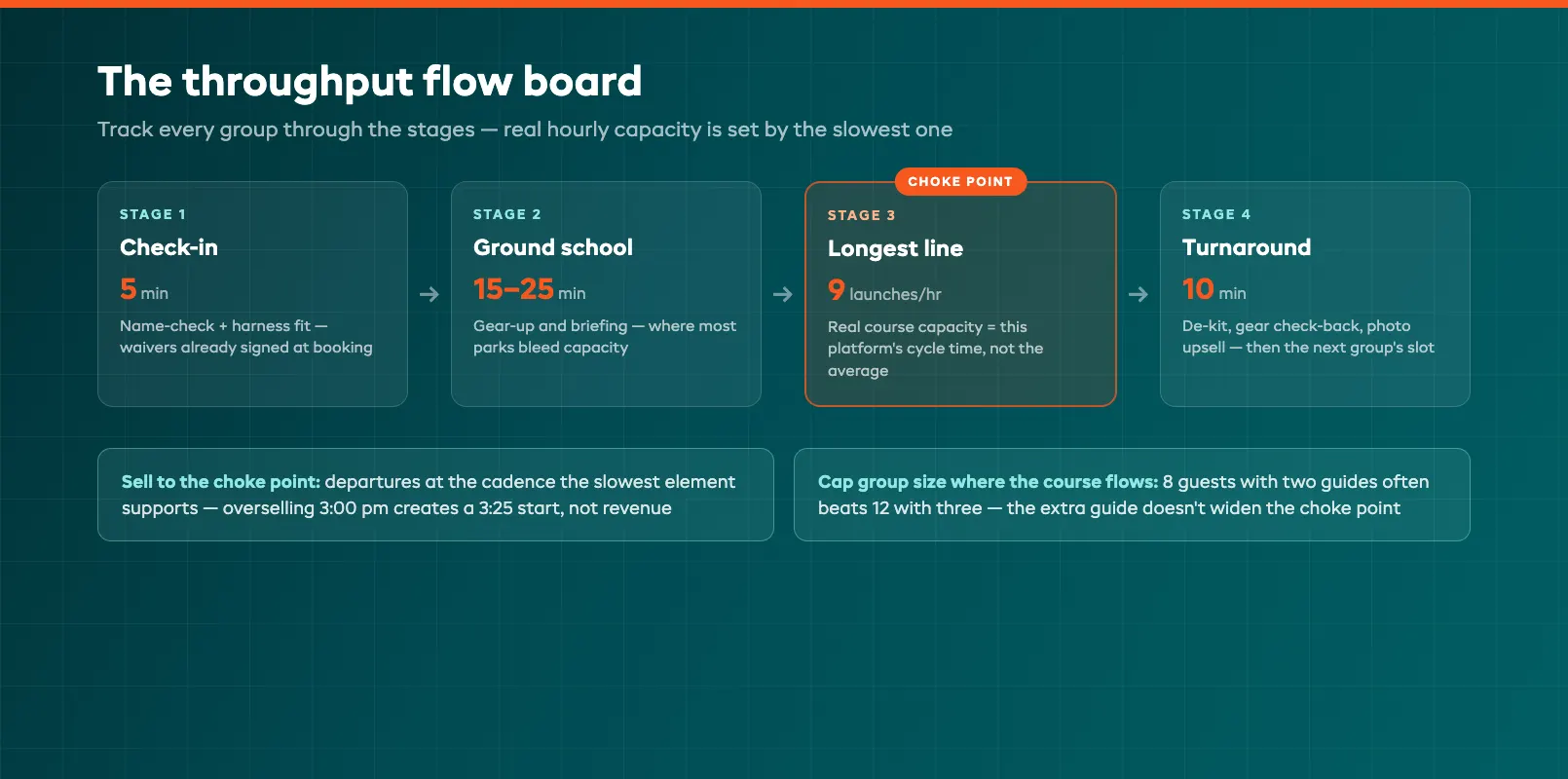
Once you know the real number, two decisions follow. First, tour slots: sell departures at the cadence the choke point supports, not the cadence the calendar looks nice at. Overselling a 3:00 pm slot doesn't create revenue, it creates a 3:25 start and a one-star review. Second, group size: a course that flows at groups of 8 with two guides often jams at 12 with three, because the extra guide doesn't widen the choke point. Booking software built for capacity-managed activities enforces this automatically — each departure has a hard cap, walk-ups fill remaining seats rather than overloading them, and the pricing model you run can charge peak slots at peak rates instead of averaging everything down.
Daily Safety Checks That Actually Get Logged
Aerial operations in most jurisdictions run under ACCT or ASTM-aligned standards, and every one of them assumes a documented daily inspection — not a walk-through, a record. The difference matters twice: once operationally, because a logged inspection gets done properly, and once legally, because after an incident the first document anyone requests is the inspection log for that morning.
A workable daily routine has three layers:
- Course open: a competent inspector walks or rides the full course before the first guest — cable condition and tension, terminations, platform decking and rails, ladder and stair systems, brake systems on every line, trolleys and lanyards in the rotation. Each item gets a pass, a note, or a red flag; a red flag closes the element until it's cleared.
- Gear issue: every harness, helmet, and lanyard issued that day gets a tactile and visual check at issue — webbing, stitching, buckles, carabiner gates and locking action. Seconds per item, but only if it's a defined step rather than a vibe.
- Course close: a short end-of-day pass logging anything that changed — the drop zone that got muddy, the trolley that started running loud. Tomorrow's open inspection starts from today's close notes.
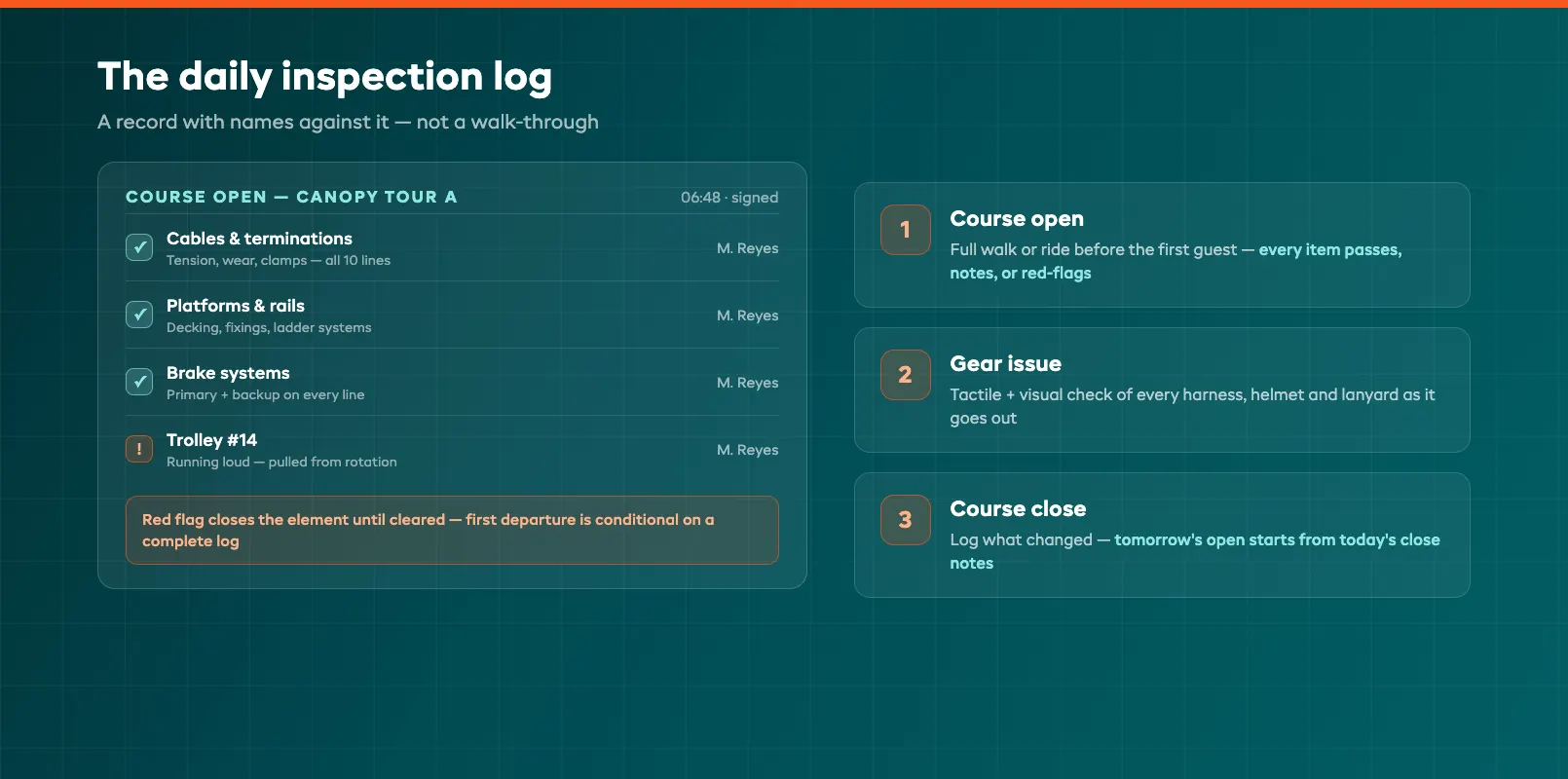
The failure mode is never that operators don't inspect — it's that the record lives on a clipboard that gets rained on, skipped on the day the opener called in sick, or filled in from memory at 4 pm. Put the checklist on a phone, require a name against every section, and make the day's first departure conditional on the log being complete. Our pre-activity briefing checklist covers the guest-facing half of this routine, and if the worst happens anyway, an incident report procedure you've rehearsed is what keeps a bad hour from becoming a bad year — the full incident response playbook is worth reading before you need it.
Harness and PPE Lifecycle Tracking
A harness doesn't fail on a schedule, but it retires on one. Every piece of life-safety equipment in an aerial park — harnesses, lanyards, trolleys, carabiners, helmets — has a manufacturer lifespan (commonly 5–10 years from first use for soft goods), a usage profile, and a retirement trigger list. The operational question is whether you can answer, for any single harness in your kit room, three things: when it entered service, what its inspection history says, and when it leaves service.
That means per-item tracking, not per-batch guessing:
- Serial or ID-tag every item and log first-use date. "The harnesses are about three seasons old" is not an answer an inspector accepts.
- Log periodic detailed inspections — most standards expect a documented thorough inspection at set intervals on top of daily checks, by someone trained to do it.
- Record retirement with a reason — age, damage, fall event, recall — and quarantine retired gear physically. The harness that "was in the retire pile but looked fine" is a lawsuit with a buckle.
- Track usage where it varies — the harness that runs every slot all summer ages differently from the spare that runs Saturdays.
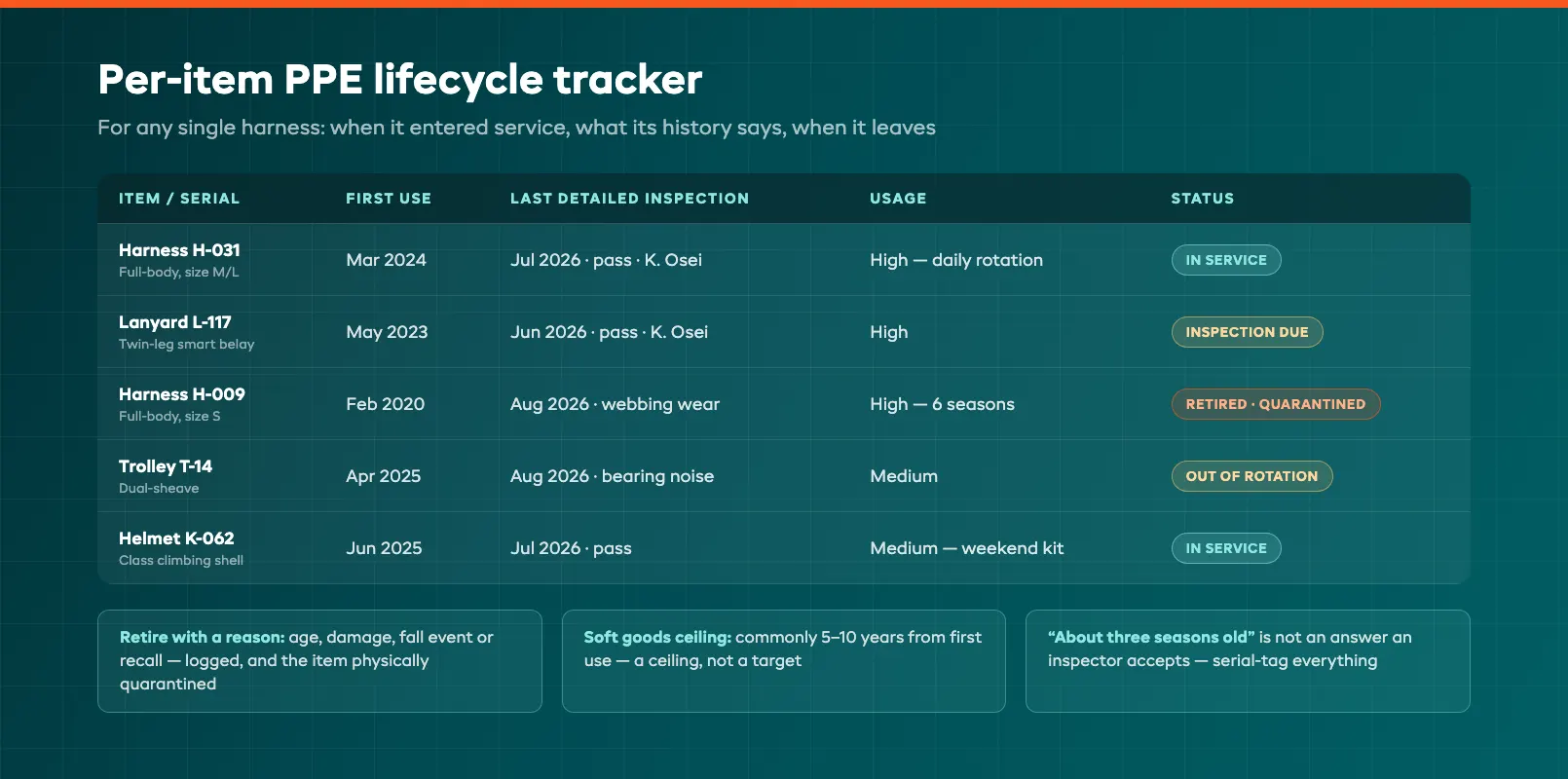
This is the same asset-lifecycle discipline that applies across adventure gear generally, but aerial PPE is the sharpest version of it because the consequence of a missed retirement isn't a refund — and because your insurer's loss adjuster knows exactly which records to ask for. Keep the log digital, keep it per-item, and keep it where the booking and operations records live so nothing depends on one laminated binder.
Staffing: Ratios, Rotation, and the Burnout Mistake
Guide payroll is the biggest controllable cost in an aerial park, and understaffing is the most expensive way to save it. The staffing math starts from ratios: your standards, your insurer, and your course design set a guide-to-guest ratio — commonly one guide per 6–8 guests on a guided canopy tour, plus fixed positions like a dedicated brake or landing monitor on certain lines. Those numbers are floors, not targets to negotiate on a busy day.
The harder problem is rotation. Guiding a zipline course is physical, repetitive, and attention-critical — the 200th clip-check of a guide's day must be as sharp as the first. Parks that run guides on the same course position all day get slow drift: briefings compress, checks go from tactile to visual to assumed. Build the roster so guides rotate through positions — launch, mid-course, landing, ground school — and get real breaks off the course, not standing-by-the-platform breaks.
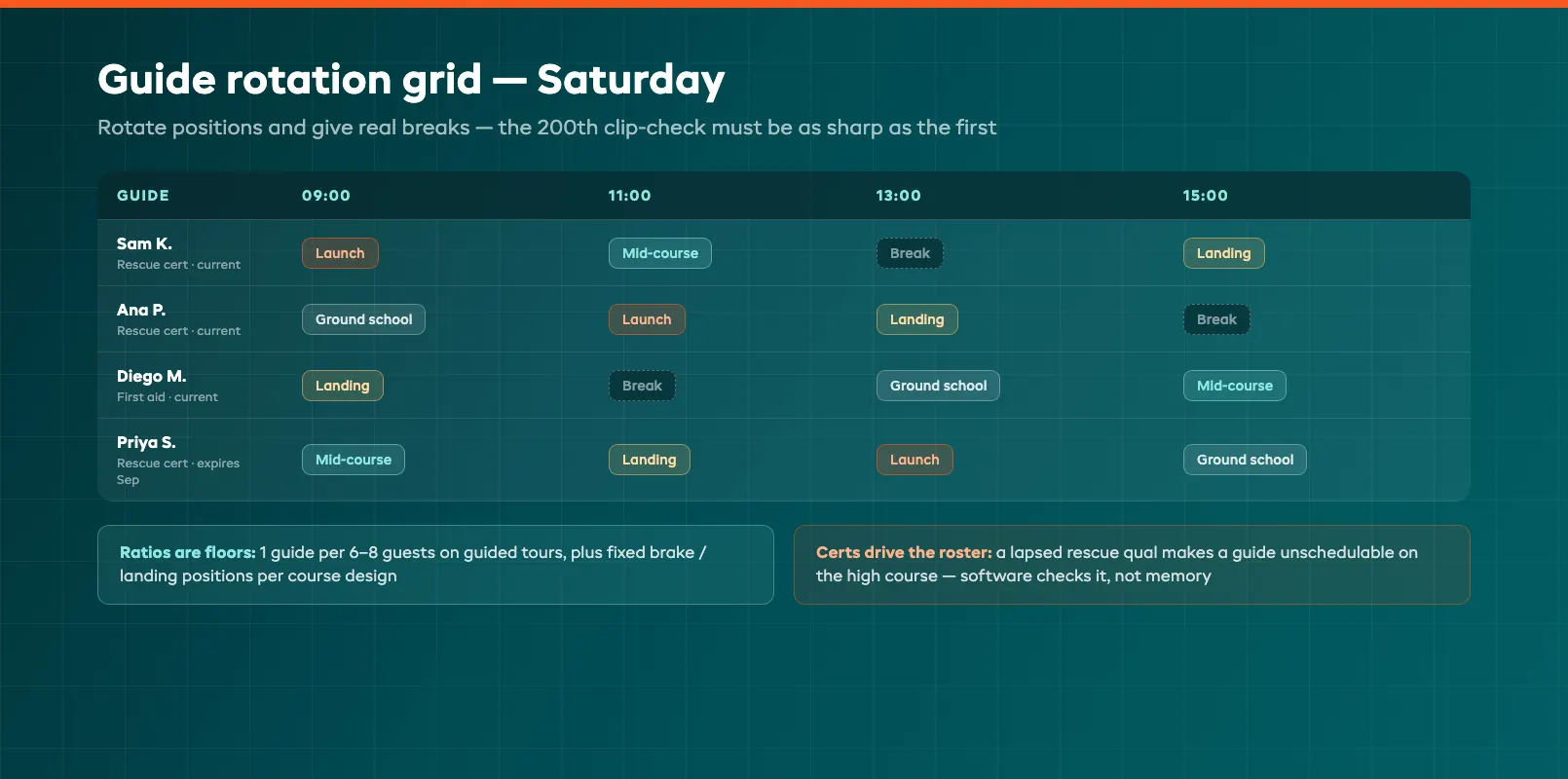
Three practices keep the roster honest:
- Staff to bookings, not to hope. With online bookings visible days out, Thursday's roster should reflect Thursday's actual load. A seasonal staffing approach beats a fixed crew carried across shoulder months.
- Track certifications against the roster. Course-specific sign-offs, first aid, rescue quals — a guide whose rescue cert lapsed shouldn't be schedulable on the high course, and that check belongs in software, not memory. The full picture is in our guide to certifications and insurance requirements.
- Make the rescue drill routine. Every guide on every course should be current on pickoff and lowering procedures for the elements they work. An annual practice is compliance; a monthly one is competence.
Check-In, Waivers, and the Briefing Flow
Start times die at the front desk. A 10:00 departure with twelve guests, four of whom haven't signed waivers and two of whom are surprises on the manifest, launches at 10:20 — and every slot behind it inherits the delay. The fix is moving everything movable to booking time: waivers signed on the guest's phone the day they book, weight and age limits confirmed at checkout instead of argued at the counter, arrival instructions sent automatically the evening before. On the day, check-in becomes a name-check and a harness fit rather than a paperwork session.
Two details punch above their weight. First, make the waiver chase automatic — a reminder at 48 hours and another that morning clears most of the unsigned before they arrive; the reasoning (and what makes a waiver actually defensible) is covered in our waiver defensibility guide. Second, brief in parallel, not in series: while one guide runs ground school for the 10:00 group, the desk is already checking in the 10:30s. The briefing itself deserves a script — hand signals, braking, what happens if you stall out mid-line — delivered the same way every time, because "roughly the same briefing" is how gaps happen. If any of the vocabulary here is new, the activities glossary covers the terms your guides use on course.
Weather Calls Without Torching Reviews
Wind closes ziplines; lightning clears courses; and the operator always makes the call later than they should because the 2:00 pm group is standing there in harnesses. The way out is a written threshold policy: sustained wind and gust limits per course, lightning distance and all-clear timings, and named decision authority — the duty manager calls it, not the guide getting pressured on the platform.
Then make the policy pay for itself commercially. Guests don't review you badly for weather; they review you badly for chaos and dead silence. A cancellation triggered early, communicated by text with a one-tap rebook or refund, converts a rained-out afternoon into a rebooked one — most operators find the majority of weather-hit guests rebook when the offer arrives before they've left the parking lot. An automated weather cancellation agent handles the messaging and rebooking the moment you make the call, which means the call gets made on the threshold instead of on the sunk cost.
The through-line of all six sections is the same: a zipline park runs well when the invisible systems — capacity math, inspection logs, PPE records, rosters, waiver chases, weather thresholds — are written down and running on software rather than living in the owner's head. The courses are the easy part.
FAQ
How many guests per hour can a zipline course handle?
Whatever your choke point handles — usually the longest line or highest platform, not the course average. Work it out per stage: ground school and gear-up (15–25 minutes per group), course time by design, and the slowest element's cycle time. Most guided canopy tours land somewhere between 20 and 50 guests per hour depending on lines and layout. Sell departure slots at the cadence your choke point supports, and cap group sizes where the course actually flows.
What daily inspections does a zipline or aerial park need?
Three layers, all logged with a name against them: a full course-open inspection before the first guest (cables, terminations, platforms, brakes, trolleys), a tactile check of every harness, helmet, and lanyard at issue, and a short course-close pass recording anything that changed. ACCT and ASTM-aligned standards assume a documented record, not just a walk-through — and after any incident, that morning's log is the first document requested.
How often should zipline harnesses be replaced?
Follow the manufacturer's stated lifespan — commonly 5–10 years from first use for soft goods — but treat it as a ceiling, not a target. Track every harness individually by serial or ID tag with its first-use date, inspection history, and usage level, and retire immediately on damage, a significant fall event, or a failed detailed inspection regardless of age. Quarantine retired gear physically so it can't wander back into the rotation.
What guide-to-guest ratio does an aerial park need?
Your operating standards, insurer, and course design set the floor — commonly one guide per 6–8 guests on guided canopy tours, plus fixed positions such as a dedicated landing or brake monitor on certain lines. Treat ratios as hard minimums, rotate guides through positions during the day to keep attention sharp, and track certifications against the roster so a guide with a lapsed rescue qualification can't be scheduled onto a course that requires it.
When should a zipline park close for weather?
At the thresholds written in your policy, decided by the named duty manager — not negotiated on the platform. Typical triggers are sustained winds or gusts above the course's rated limits and any lightning within your stand-down radius, with a fixed all-clear wait before reopening. Make the call early and pair it with instant guest messaging and one-tap rebooking; guests forgive weather, they don't forgive chaos.
How do I speed up zipline check-in without cutting corners?
Move everything movable to booking time: waivers signed on the guest's phone when they book (with automatic reminders for the unsigned), weight and age limits confirmed at checkout, and arrival instructions sent the evening before. On the day, check-in is a name-check and harness fit, and briefings run in parallel — one group in ground school while the next checks in. The corners stay uncut because the checks happened earlier, not because they happened faster.
in one place