
EquipDash hands the busywork — bookings, waivers, deposit holds, tide reschedules — to Dash AI. So you can focus on getting surfers in the water instead of behind a screen.





 Dashboard

 POS
POS
 Calendar
 Scan a barcode
 Bookings
 Rentals
 Experiences
 Customers
 Staff
Staff
 Waivers & Forms
| # | Surfer | Session | Status | Meet | Price |
|---|---|---|---|---|---|
| BK-2389 | Sarah M. | Beginner group ×4 + boards | Confirmed | 24 May 10:00am | $320.00 |
| BK-2388 | Jake R. | Private lesson + board | In water | 24 May 8:30am | $120.00 |
| BK-2387 | Patel family | Group lesson ×5 | Confirmed | 25 May 11:00am | $375.00 |
| BK-2386 | Marco L. | Board rental · 4hr | Returned | 23 May 9:00am | $40.00 |
Dashboard
POS
Calendar
Scan a barcode
Bookings
Rentals
Experiences
Customers
Staff
Waivers & Forms
| Assigned | Ref | Qty | Status | |
|---|---|---|---|---|
🏄 |
7'2 Funboard · 62L | BP-FUN-14 | ×1 | Assigned |
🩱 |
Wetsuit 3/2 · Medium | WS-M-08 | ×1 | Assigned |
Dashboard
POS
Calendar
Scan a barcode
Bookings
Rentals
Experiences
Customers
Staff
Waivers & Forms
| Item | Ref | Qty | Status | |
|---|---|---|---|---|
🏄 |
7'2 Funboard · 62L
Nose ding · open · ~2 in
|
BP-FUN-14 | ×1 | Repair |
🩱 |
Wetsuit 3/2 · Medium | WS-M-08 | ×1 | Returned · OK |
More bookings online. Every board tracked. Every surfer contacted automatically. The stuff your last system promised and never quite delivered.
Most surfers book direct on your website — if the widget feels like your school. Embed a branded widget that looks like your operation, not generic tourism software. Real-time availability, group + private + rental pricing, tide-window slots, deposit holds. Mobile-ready and fast, even on the busiest Saturday of the season.
In the water. Back on the rack. On the repair bench. Overdue. Assign at check-in, mark return — from any device. Auto-text the surfers running late so you stop chasing them.
A signed waiver and a swim-ability declaration captured on every booking before the sand. Surfers sign on their phone. Ding photos save automatically. Exports are insurance-ready, not a PDF mess.
Confirmations. Tide-window reminders. Overdue chasers. Waiver follow-ups. Blown-out reschedule offers. Post-session review requests. All sent automatically — no scripts, no 11pm copy-paste from a spreadsheet. Pulls surfer phone right from the booking.
Ask Dash anything in plain English — get the answer in seconds. Or deploy pre-built bots that run in the background while you're on the sand or in the shop.
Three workflows other rental software doesn't have. Plus all the standard tools you'd expect — done well.
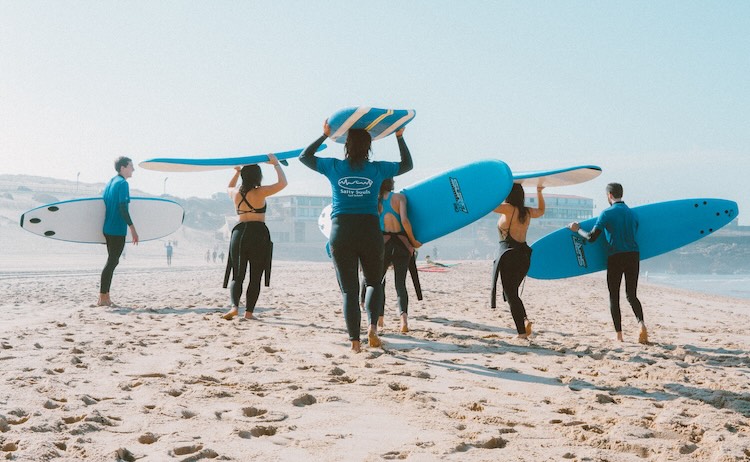
Ten-o’clock group rolls up all at once. EquipDash checks the whole group in on a tablet, matches each surfer to the right board by height and skill, hands them a wetsuit in their size, and keeps the instructor ratio honest — so nobody’s standing on the beach in the wrong gear when the tide’s pushing.
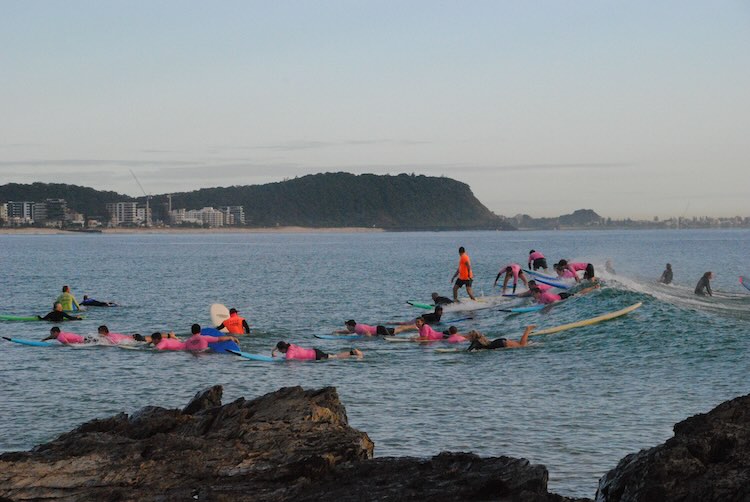
Beginner surf works on a pushing mid-tide with small, clean waves — and that window moves every day. EquipDash ties each lesson slot to a tide state instead of a fixed hour, pulls swell, wind and tide into one day view, and auto-suggests the good windows so you sell sessions that actually work.
A board comes back with a fresh nose ding. Log it at return and EquipDash opens a repair ticket on the spot, pulls the board off the water, applies a rate-card ding charge to the deposit hold, and texts the surfer with the photo. The board’s back on the rack repaired — not renting out with water getting into the foam.
The 3 features above are unique to surf school and board rental ops. Everything below is table stakes — and we don't charge extra for any of it.
Every soft-top, funboard, mini-mal, fish and shortboard tracked by ref number and volume. Live updates as boards go out and come back — no more “sorry, the 7’2 is already out” mid-Saturday.
Every board gets a full repair history across seasons. Dings logged per board, resin work, fin swaps, last check. Free surf pre-rental checklists. Searchable by board, surfer or date.
Build rosters for the Saturdays that matter. Pair with the tide-window alert bot to forecast the good sessions ahead.
Surfers book, pay a deposit, sign the waiver and declare their swim ability before they arrive. Counter time cut in half. Pre-booked surfers check in 3x faster than walk-ups.
Handle a family of five in one group lesson, a hen party of eight across two instructors, or a corporate surf day — all in one flow. One waiver per booker (guardian-signed for minors), one invoice, one consolidated deposit hold.
Ring up walk-up surfers in seconds. Tap-to-pay on iPad or phone, customer lookup for repeats, board hire and add-ons in the same flow — no separate till to reconcile.
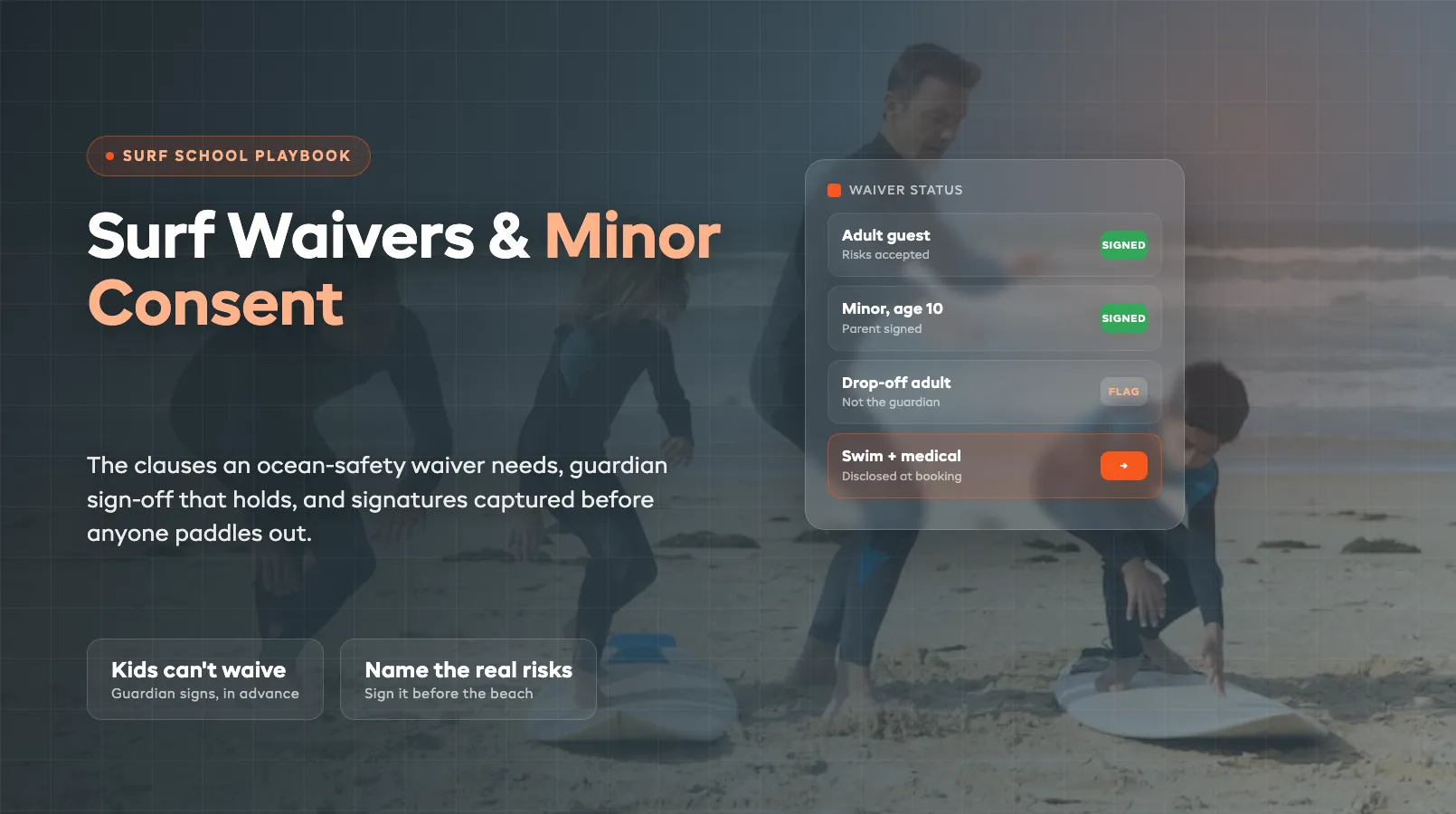
Signed on phone before they arrive. Swim ability declared at booking. Guardian-signed for minors. Every waiver archived and searchable, insurance-ready exports.
Each beach, meeting point or launch spot has its own board fleet, staff and reporting. Owner-level dashboard rolls them up. Instructors can be assigned across sites. Popular pattern: a main beginner beach plus a seasonal point break and a satellite bay.
DESTINATIONS
Browse our directory of surf schools and board rental shops across 12+ coastal destinations. Find schools near your trip or use the directory as a benchmark for your own operation.
AI FRONT DESK
Beginners want reassurance that you teach first-timers, that a wetsuit is included, and that they know where to meet. AI Front Desk answers warmly on the phone and in the chat, recommends the right lesson or board, and books them in, turning nervous browsers into stoked customers.
AI assistant — may make mistakes. Confirm details with Westside Surf Co.
AI AGENT TEMPLATES
Pre-built AI agent templates for surf schools and board rental shops. Waiver chasing, tide-window lesson reminders, no-show recovery, board repair alerts, review requests and off-season student reactivation. Build any of them in Dash Bots in seconds with a plain-English prompt.
BLOG
 Guides
 Guides
 Guides
 Guides
 Guides
 Guides
SURF GLOSSARY
Quick reference answers to the terms that come up when researching surf school software, board fleet management, tide-aware scheduling, waivers and beach logistics. Want the full lexicon? Open the surf glossary below.
Surf school software is a platform that manages every part of a surf lesson and board rental operation — online bookings, board and wetsuit fleet, deposit holds, waivers with swim-ability, instructor assignment, tide-aware scheduling, payments, ding logging and customer comms — in one place. Modern systems like EquipDash replace the whiteboard-and-clipboard setup most surf schools grew up on and add AI bots that handle the repetitive admin (tide reminders, no-show follow-ups, review requests, board repair alerts) automatically.
A group lesson puts several students with one instructor at an agreed student-to-instructor ratio (commonly 4:1 or lower for beginners), priced per head. A private lesson is one-on-one or two-to-one coaching at a higher rate and a faster progression. Most surf schools run both, plus straight board rentals for surfers who don’t need coaching. EquipDash handles all three in one booking flow, with the ratio set per lesson type so a group session can’t oversell its instructor.
Beginner surf works best on a pushing or mid-tide with small, clean waves, so the good teaching window moves every day with the tide rather than sitting at a fixed clock time. Tide-aware scheduling ties each lesson slot to a tide state instead of a rigid hour, then confirms the exact meet time the evening before once the forecast firms up. EquipDash lets you build slots around the tide window and auto-suggests the workable ones; the Tide-Window bot texts booked surfers their meet time so nobody turns up to a blown-out low tide.
A damage deposit is a pre-authorization hold placed on the surfer’s card at booking — typically $50 for a soft-top up to $400 for a performance shortboard. The hold sits on the card without being charged; if the board comes back clean, it’s released automatically (Stripe voids the auth and the hold drops off in 2–7 days). If there’s a ding, a rate-card-priced repair charge is applied against the hold and the balance released. This is the standard approach across surf and water sports rental shops — far cleaner than billing a card on file after the fact.
A pre-rental board check is the quick inspection staff run on every board before it leaves the rack: dings and delamination, existing ding-repair integrity, fin system and fins, leash attachment and length, and wax condition. It takes about six minutes and catches damage before water gets into the foam. In EquipDash this lives as a per-board checklist on a tablet, and anything failing routes the board to the repair bench instead of the next surfer.
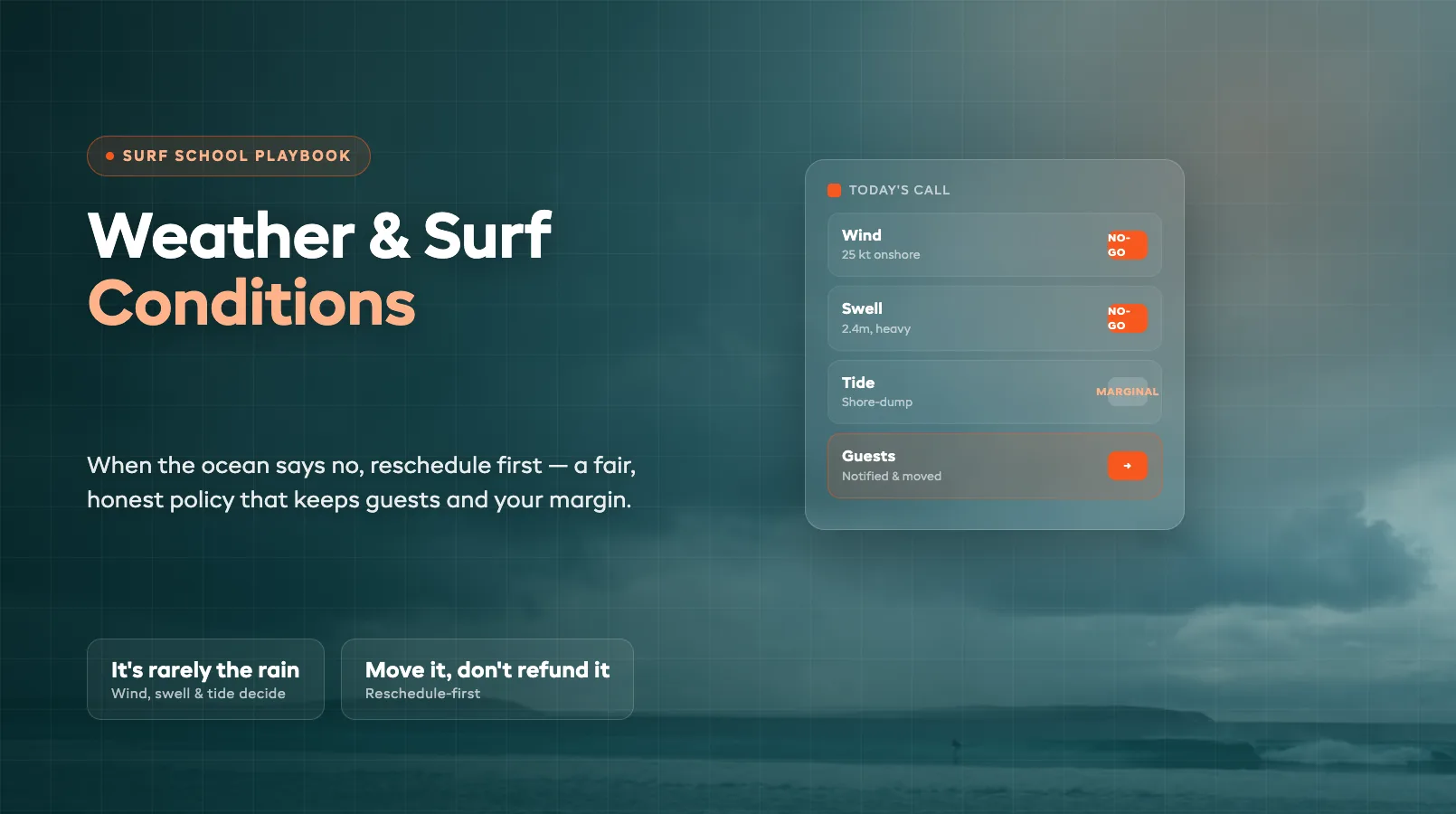
Best practice is to set explicit thresholds (wind over a set speed, swell too big for beginners, a flat or messy forecast), watch the marine forecast the evening before, and proactively text every booked surfer the night before — not the morning of — with a one-tap reschedule to the next good tide window. EquipDash automates this with the Tide-Window bot: the forecast hits your threshold, every booked surfer gets a personalized text, deposit holds roll forward, and refunds inside policy are self-serve. Decide evening-before, not morning-of: surfers are often already driving to the coast by sunrise.
A single-beach operation works from one break or meeting point — one board fleet, one instructor schedule, one set of lesson slots. A multi-beach operation runs lessons and rentals from multiple spots (a main beach plus a satellite bay, or a beginner beach plus a point break) with separate fleets and staff at each. Multi-beach schools need software that tracks boards and bookings per site — a blown-out forecast at one beach shouldn’t black out the others. EquipDash handles both single and multi-beach with no extra add-on.
At check-in, each surfer is matched to a board by length and volume (heavier or newer surfers get more volume) and a wetsuit by size, both recorded against the booking. This keeps the fit right, keeps the fleet accountable, and means a board that comes back with a ding is tied to the session it came off. EquipDash assigns boards and wetsuits on the booking detail, tracks every board by length, volume and condition, and flags a torn wetsuit or a ding for repair at return.
A ding is a break in a surfboard’s outer skin — a crack, a gouge, or an open nose or rail — that lets water into the foam core if it isn’t sealed. A minor ding is a five-to-ten-minute UV-resin fix; deeper cracks need traditional resin work with a longer cure. In a rental fleet, any board flagged with a ding at return comes off the water until it’s repaired. In EquipDash, logging a ding at return auto-creates a repair ticket so the board is fixed before its next session, not after a bad rental.
Volume in liters, not length, is the metric that matters for a rental or lesson board. A rough guide: beginners want roughly their body weight in kilograms multiplied by 1.3–1.5, intermediates around 1.0–1.2, and advanced surfers 0.7–0.9. So a 90kg beginner needs a 120L-plus board, while a 70kg intermediate is happy on 75–80L. Matching surfer weight and ability to the right volume at booking is the single biggest driver of a good first session — EquipDash records volume on every board so staff assign the right one.
Most surf schools send four touchpoints by SMS: a tide-window reminder with the meet time and beach (the evening before), a waiver and swim-ability chase (a few hours before, if unsigned), a no-show follow-up with a rebook link (shortly after a missed session), and a review request (an hour after the surfer comes in). Each is a small touch but stacked together they cut no-shows, recover day-of bookings, and lift your Google rating. EquipDash ships these as pre-built Dash Bots — no scripts to write, no SMS provider to wire up.
Yes. Rental boards take constant knocks — rock contact in the shore break, drops in the car park, sun damage in storage — and the retirement driver is usually accumulated water damage from un-repaired dings, not shape wear. EquipDash tracks every board by length, volume and condition, logs each ding and repair against the board, and the Board Repair Alert bot flags anything with a fresh ding so it goes to the bench before its next session. Wax and leash checks fold into the same pre-rental routine.
GLOSSARY
60+ surf and lesson terms every school owner, beach lead and instructor should know — from pre-rental board checks and Stripe deposit holds to tide states, swell and wind, board volume, and the rental-ops terminology that makes busy summer Saturdays predictable.
FREQUENTLY ASKED QUESTIONS
Real questions from surf school owners and board rental shops evaluating EquipDash. If yours isn't here, get in touch.
Contact UsPlans start at $29/month. 21-day free trial, no card. There is a 1–2% platform fee you can pass to the surfer at checkout — so unlike FareHarbor or Peek Pro pulling 1–6% off your top line, your margin stays yours.
Start your free 21-day trial and explore every feature, including Dash AI and Dash Bots. No credit card, no commitment.
